



HF Modifier: Meaning, Description, Behavioral Health Use, and Medicaid Billing Guide
The HF modifier identifies a substance abuse program in medical billing. Its description is brief, but applying it correctly requires more than recognizing a substance use disorder diagnosis. The service, payer, program, and billing instructions determine whether HF belongs on a claim.
For behavioral health providers, the practical question is whether the payer requires HF for the particular service being reported. Automatically attaching it to every addiction treatment claim can create errors just as easily as leaving it off a claim that requires it.
What does the HF modifier mean?
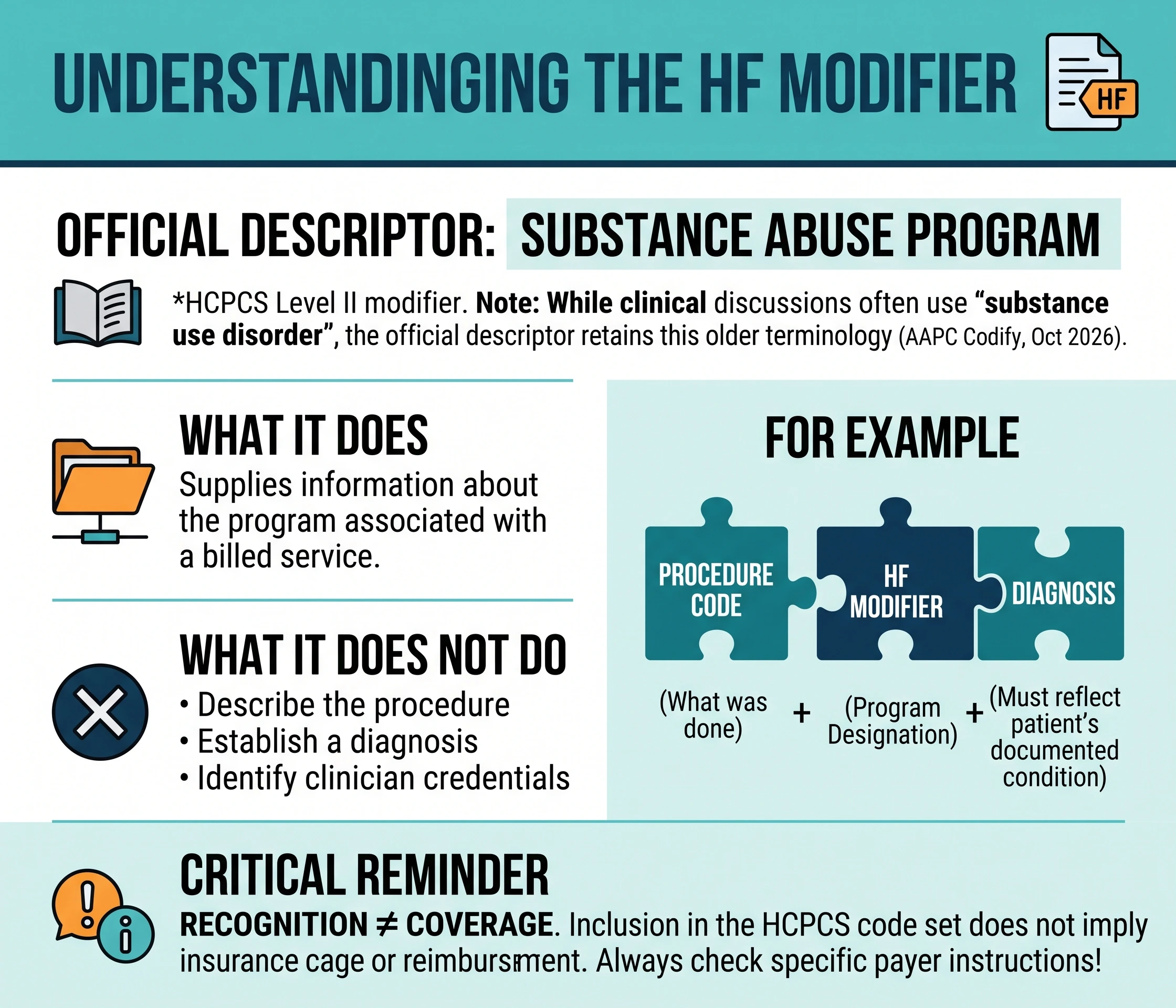
HF is a HCPCS Level II modifier with the official descriptor “Substance abuse program.” AAPC’s Codify listing, accessed October 12, 2026, confirms that wording. Although clinical discussions commonly use “substance use disorder,” the modifier’s published descriptor retains the older terminology.
HF supplies information about the program associated with a billed service. It does not independently describe the procedure, establish a diagnosis, or identify the clinician’s credentials.
For example, a procedure code identifies the service being reported, while HF adds the program designation when the payer’s instructions call for it. The diagnosis must still accurately reflect the patient’s documented condition.
A recognized code also does not establish coverage.CMS clarifies in its HCPCS Release & Code Sets guidance that a code’s inclusion in the code set does not guarantee insurance coverage or reimbursement. Consequently, finding HF in a coding reference is only the beginning of claim review.
How the HF modifier is used in behavioral health
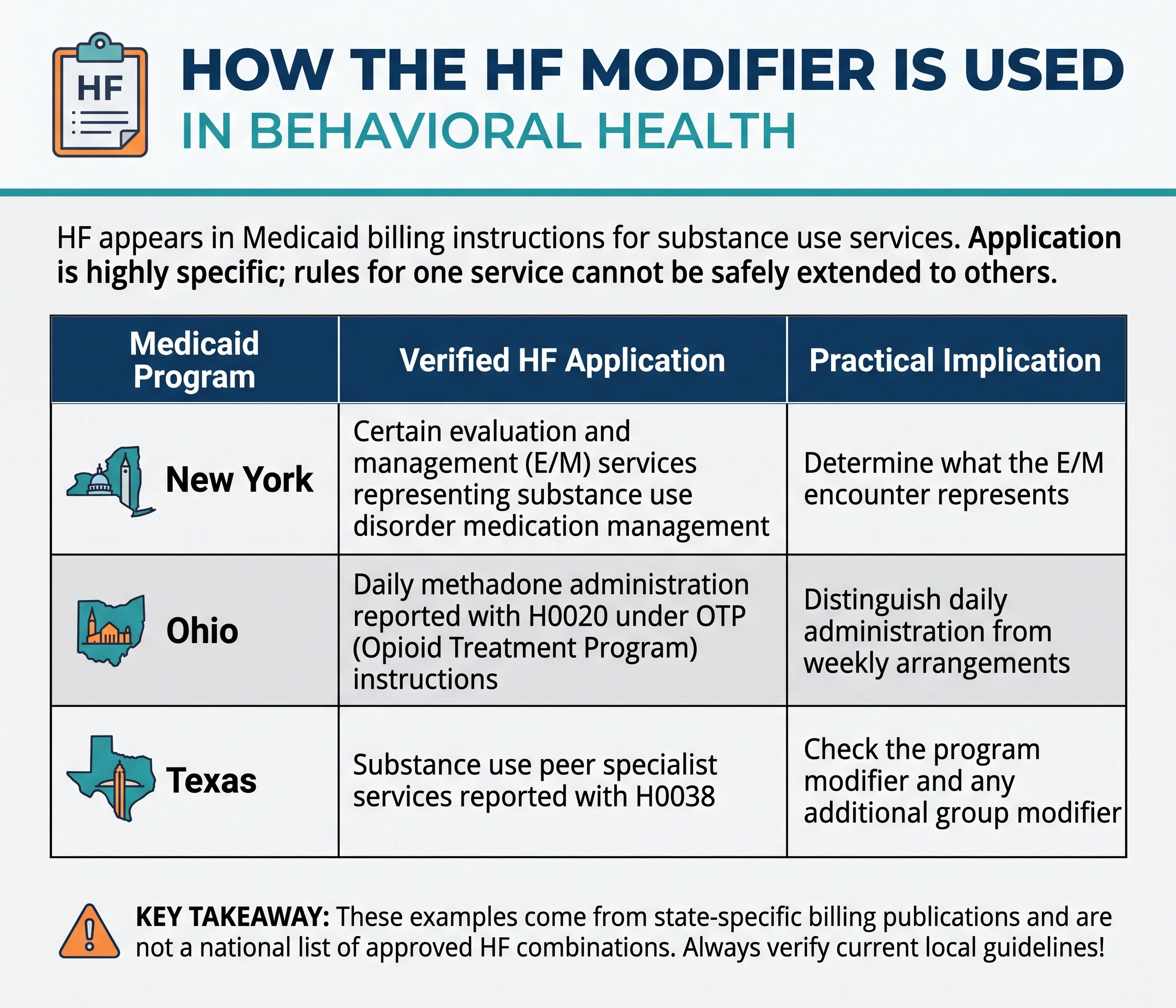
HF appears in Medicaid billing instructions for different types of substance use services. Its application is specific enough that a rule for one service cannot safely be extended to every service offered by the same organization.
Three state examples illustrate the differences:
Medicaid program | Verified HF application | Practical implication |
New York | Certain evaluation and management services representing substance use disorder medication management | Determine what the E/M encounter represents |
Ohio | Daily methadone administration reported with H0020 under its OTP instructions | Distinguish daily administration from weekly arrangements |
Texas | Substance use peer specialist services reported with H0038 | Check the program modifier and any additional group modifier |
These examples come from the respective state billing publications discussed below. They are not a national list of approved HF combinations.
New York: Medication-management visits
The New York State Office of Addiction Services and Supports’ Ambulatory Patient Group Clinical and Medicaid Billing Guidance, dated July 1, 2026, directs providers to append HF to E/M services representing substance use disorder medication management.
The guidance distinguishes these visits from psychiatric evaluations and mental health medication management, which use HE under the stated policy.
This distinction gives an integrated clinic a concrete reason to review the purpose of each encounter. The clinic’s identity alone does not determine the modifier for every E/M service. These instructions apply within the OASAS billing framework described in the manual.
Ohio: Daily methadone administration
The Ohio Department of Medicaid’s Medicaid Behavioral Health State Plan Services Provider Requirements and Reimbursement Manual, version 1.28.1, published March 24, 2026, specifies H0020 with HF for daily methadone administration, including qualifying single take-home doses.
For a daily take-home dose, the manual identifies the service date as the date the patient will take that dose. It separately describes weekly administration modifiers and prohibits overlapping administration billing within the period covered by a weekly modifier.
A billing template therefore needs to distinguish the administration arrangement before selecting modifiers.
Texas: Peer specialist services
The Texas Medicaid & Healthcare Partnership’s online Texas Medicaid Provider Procedures Manual, Behavioral Health section, accessed October 12, 2026, requires H0038 to carry HE for mental health or HF for substance use peer specialist services.
For group services, the instructions also require HQ. This demonstrates why HF does not always provide all the modifier information a claim needs. The program designation and group setting describe separate features of the service.
HF versus HE and HQ
These modifiers answer different billing questions.
Modifier | Description | Information conveyed |
HF | Substance abuse program | Substance use program designation |
HE | Mental health program | Mental health program designation |
HQ | Group setting | Group delivery of the service |
The Texas manual lists these descriptions and explicitly combines a program modifier with HQ for qualifying group peer services. That instruction should not be generalized to unrelated procedures or other payers.
For a patient receiving both mental health and substance use treatment, avoid choosing between HE and HF solely from the diagnosis list. Review the service being billed and the applicable program instructions.
A practical Medicaid billing review
Build an HF review around the actual claim line. A practice can use the following sequence as an internal control rather than treating a modifier lookup as the entire coding decision.
1. Identify the applicable policy
Record the state program, health plan, benefit, and date of service. Locate the relevant service-specific billing instructions.
Save the policy title, effective date, and section beside the practice’s coding rule. This makes later review easier than relying on an undated spreadsheet entry saying “HF required.”
2. Verify the base procedure
Compare the documented service with the proposed procedure code before reviewing HF.
Determine whether the encounter included counseling, medication administration, medication management, assessment, or peer support. A correct program modifier cannot repair a procedure code that describes a different service.
3. Check the complete combination
Review every modifier required for that service. Include the payer’s instructions about modifier placement, provider qualifications, group delivery, and remote delivery where applicable.
For internal quality checks, compare the submitted claim with the source documentation and policy together. Looking at the code and modifier without those references leaves the reasoning untested.
4. Reconcile units and authorization
Check the service dates, units, authorization conditions, and any overlapping claims. Keep these checks separate from the HF decision so staff do not treat a correct modifier as evidence that the entire claim is ready.
A useful review record answers four questions: What was provided? Why is this code appropriate? Why is HF required? What supports the quantity billed?
Documentation that supports an HF claim
There is no single documentation checklist created by HF’s short descriptor. The documentation must substantiate the service provided and meet the applicable program requirements.
For instance, New York’s July 2026 OASAS guidance specifies that service records must include the recipient’s identity, service date and duration, a description of the service, its relationship to the treatment plan, and the signature of the staff member who provided it.
As an internal review practice, organize the supporting information around:
- The service actually delivered and its clinical purpose.
- The applicable treatment plan or service authorization.
- The rendering professional and required credentials.
- Time or other measurements supporting billed units.
- The program and delivery setting relevant to modifier selection.
Avoid adding generic language merely to make a note appear compatible with HF. Resolve an unclear service description with the clinician before finalizing the claim.
Does HF increase reimbursement?
HF has no universal payment amount or percentage increase. Its effect must be established from the applicable payer’s reimbursement instructions, rather than inferred from the descriptor.
Wisconsin provides a specific example of its relationship to pricing. ForwardHealth’s Managed Care Organization Pricing Administration Guide, dated May 5, 2026, lists HF as a contract criterion for alcohol and other drug addiction day treatment.
That association does not create a nationwide HF rate. It shows why billing staff must review the relevant pricing arrangement alongside coding instructions.
When evaluating an apparent underpayment, compare the paid claim with the contracted or published methodology. Avoid assuming that adding HF will produce an adjustment.
HF and Medicare billing
A Medicaid HF example should not be copied into Medicare billing without checking Medicare’s rules.
CMS’s OTP Billing & Payment guidance, accessed October 12, 2026, describes bundled payment codes and separate conditions for eligible additional services. Medicare OTP billing therefore requires review of that payment structure, including services already represented by the bundle.
For a patient with Medicare and Medicaid, identify the applicable primary billing requirements before constructing the claim. An accepted Medicaid code-and-modifier combination does not establish the correct Medicare submission.
How to investigate an HF-related claim problem
Treat the rejection or denial explanation as the starting point. Do not add or remove HF simply to test whether a different submission pays.
Use a short investigation checklist:
- Compare the transmitted claim with the intended claim. Confirm whether HF and other modifiers reached the payer.
- Locate the applicable rule. Check the service, program, provider category, and effective date.
- Review the complete claim line. Examine the procedure, units, dates, and other modifiers together.
- Choose the appropriate resolution. Adhere to the payer’s procedures for claim corrections or appeals.
- Address the source of the error. Update a template only after confirming which claims the rule affects.
Keep a record of the policy supporting the correction. A paid resubmission, by itself, is a weak reference for training staff on future claims.
Applying HF accurately
The HF modifier means “Substance abuse program,” but state instructions determine its practical use. Verified examples include New York medication-management E/M services, Ohio daily methadone administration, and Texas substance use peer services.
Before submitting HF, verify the applicable service requirements, effective date, and supporting documentation. These elements establish a well-supported basis for the claim.