



What Is the 96131 CPT Code? Billing, Time & Documentation Explained
A psychologist wraps up a five-hour neuropsychological battery, writes the report, and sits down with the family to walk through what the results mean. Then comes the part nobody trained for in graduate school: turning that work into a claim. CPT code 96131 is the add-on code Medicare and most commercial payers use to reimburse each additional hour of psychological or neuropsychological testing evaluation, once the first hour is already billed under 96130. In practice, coders and clinicians tend to get stuck on the same few questions: how the time threshold works, what the note needs to survive an audit, and how the code differs from the test administration codes it constantly gets confused with. This guide works through each of those, using the current CPT descriptors and the CY 2026 Medicare Physician Fee Schedule.
Where CPT code 96131 came from
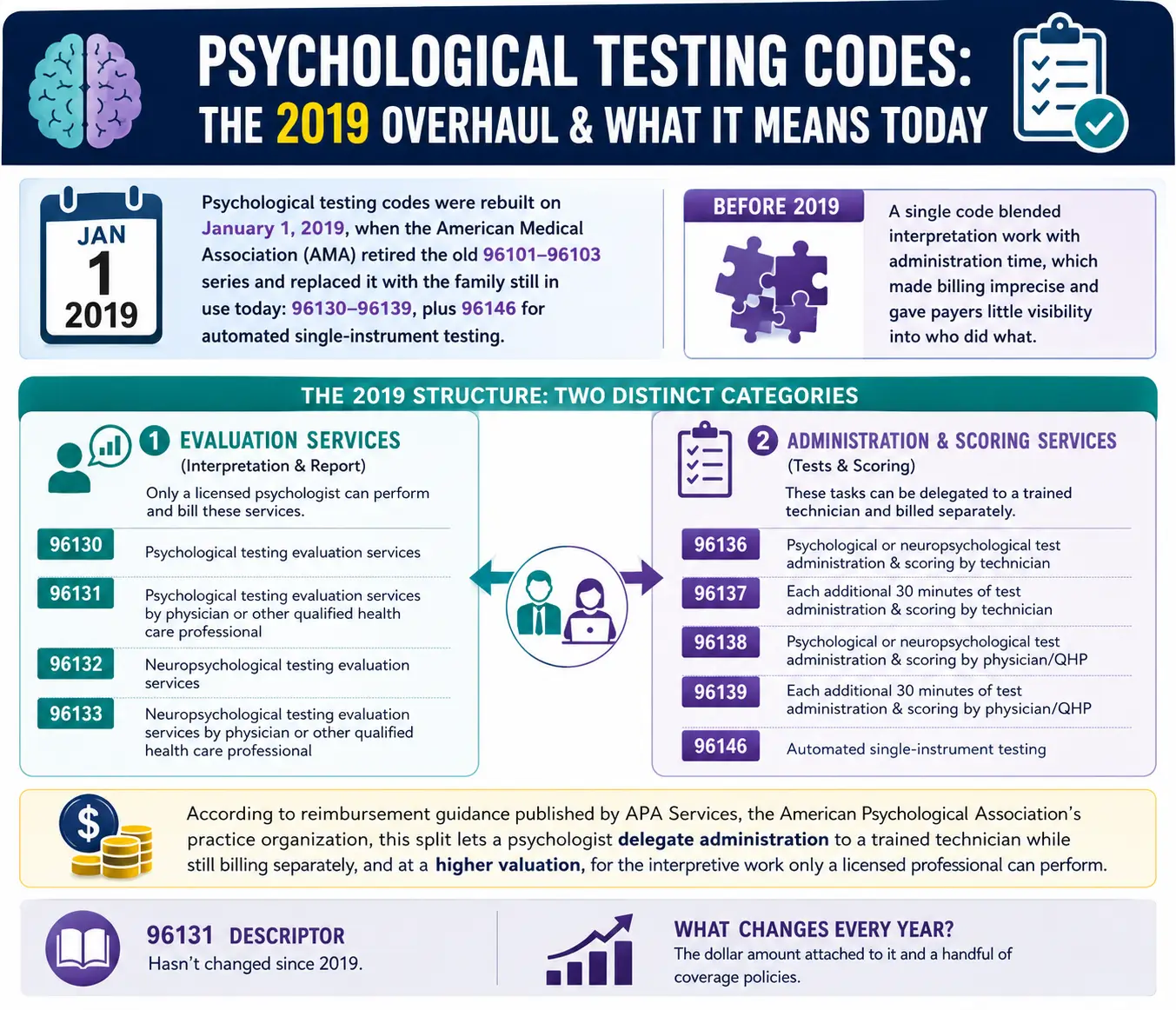
Psychological testing codes were rebuilt on January 1, 2019, when the American Medical Association retired the old 96101 through 96103 series and replaced it with the family still in use today: 96130 through 96139, plus 96146 for automated single-instrument testing. Before 2019, a single code blended interpretation work with administration time, which made billing imprecise and gave payers little visibility into who did what.
The 2019 structure split the work into two categories: evaluation services (96130 and 96131 for psychological testing, 96132 and 96133 for neuropsychological testing) and administration and scoring services (96136 through 96139, plus 96146). According to reimbursement guidance published by APA Services, the American Psychological Association’s practice organization, this split lets a psychologist delegate administration to a trained technician while still billing separately, and at a higher valuation, for the interpretive work only a licensed professional can perform. The 96131 descriptor hasn’t changed since 2019. What changes almost every year is the dollar amount attached to it and a handful of coverage policies covered further down.
What CPT code 96131 actually covers
The full descriptor matters more than the shorthand most billers use. CPT defines 96131 as psychological testing evaluation services performed by a physician or other qualified health care professional, each additional hour, and it lists exactly what that hour has to include: integration of patient data, interpretation of standardized test results and clinical data, clinical decision making, treatment planning and report writing, and interactive feedback to the patient, family member, or caregiver, when performed. CPT marks the code with a plus sign, +96131, in the code book, the standard notation for an add-on code that can never appear on a claim by itself.
Every element in that descriptor is interpretive, professional work, not the act of handing someone a test booklet or sitting with a patient while they complete a computerized measure. That distinction causes more billing errors than any other part of the code. 96131, like its base code 96130, is reserved for evaluation and interpretation; the moment a clinician or technician is administering or scoring a test, that time belongs to a different code family.
Evaluation time versus administration time
A side-by-side view of the full family makes the boundaries clearer:
|
Code |
What it covers |
Typically billed by |
Time unit |
|
96130 |
Evaluation, interpretation, report, feedback (first hour) |
Physician or QHP |
First hour |
|
96131 |
Same evaluation work, each additional hour |
Physician or QHP |
Add-on, per hour |
|
96132 |
Neuropsychological evaluation and report (first hour) |
Physician or QHP |
First hour |
|
96133 |
Same neuropsychological work, each additional hour |
Physician or QHP |
Add-on, per hour |
|
96136 |
Test administration and scoring, two or more tests (first 30 min) |
Physician or QHP |
First 30 minutes |
|
96137 |
Same administration work, each additional 30 minutes |
Physician or QHP |
Add-on, per 30 min |
|
96138 |
Test administration and scoring, two or more tests (first 30 min) |
Technician |
First 30 minutes |
|
96139 |
Same administration work, each additional 30 minutes |
Technician |
Add-on, per 30 min |
|
96146 |
Single automated test via electronic platform, automated result only |
Qualified staff |
Per instrument |
96131 sits in the evaluation family, not the administration one. A full battery for a complex differential (ruling out early dementia versus depression, for instance) often touches four or five of these codes in a single case: an hour or two of evaluation under 96130/96131, several hours of administration split between 96136/96137 and 96138/96139 if a technician is involved, and possibly 96146 if part of the battery runs on an automated platform. Keeping each activity in its own bucket on the time log is what makes the claim defensible later.
The time rules for billing 96131
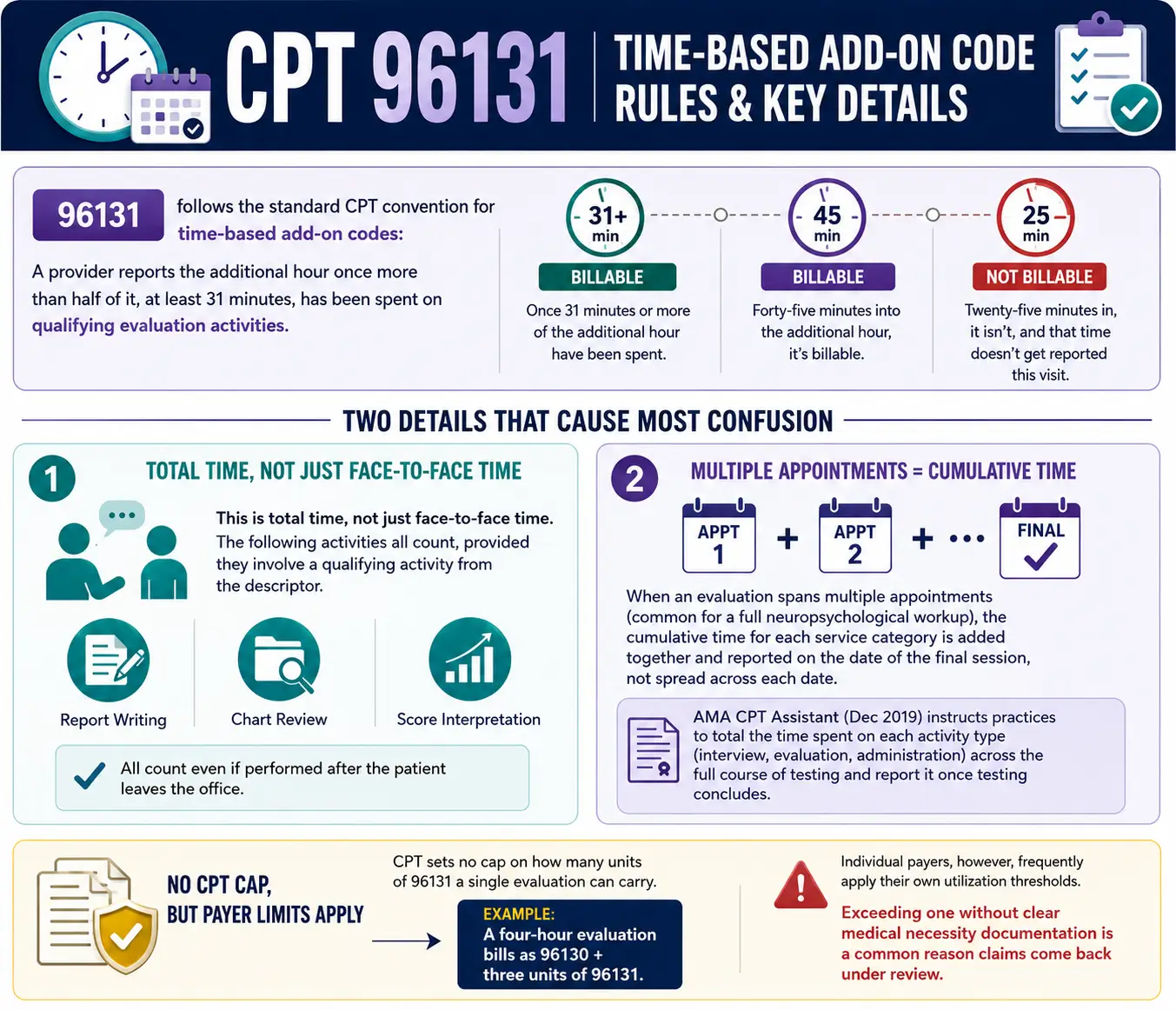
96131 follows the standard CPT convention for time-based add-on codes: a provider reports the additional hour once more than half of it, at least 31 minutes, has been spent on qualifying evaluation activities. Forty-five minutes into the additional hour, it’s billable. Twenty-five minutes in, it isn’t, and that time doesn’t get reported this visit.
Two details cause most confusion. First, this is total time, not just face-to-face time. Report writing, chart review, and score interpretation done after the patient leaves all count, provided they involve a qualifying activity from the descriptor. Second, when an evaluation spans multiple appointments, common for a full neuropsychological workup, the cumulative time for each service category is added together and reported on the date of the final session, not spread across each date. Coding guidance published in the AMA’s CPT Assistant newsletter in December 2019 addresses this directly, instructing practices to total the time spent on each activity type (interview, evaluation, administration) across the full course of testing and report it once testing concludes.
CPT sets no cap on how many units of 96131 a single evaluation can carry; a four-hour evaluation bills as 96130 plus three units of 96131. Individual payers, however, frequently apply their own utilization thresholds, and exceeding one without clear medical necessity documentation is a common reason claims come back under review.
Documentation that holds up to an audit
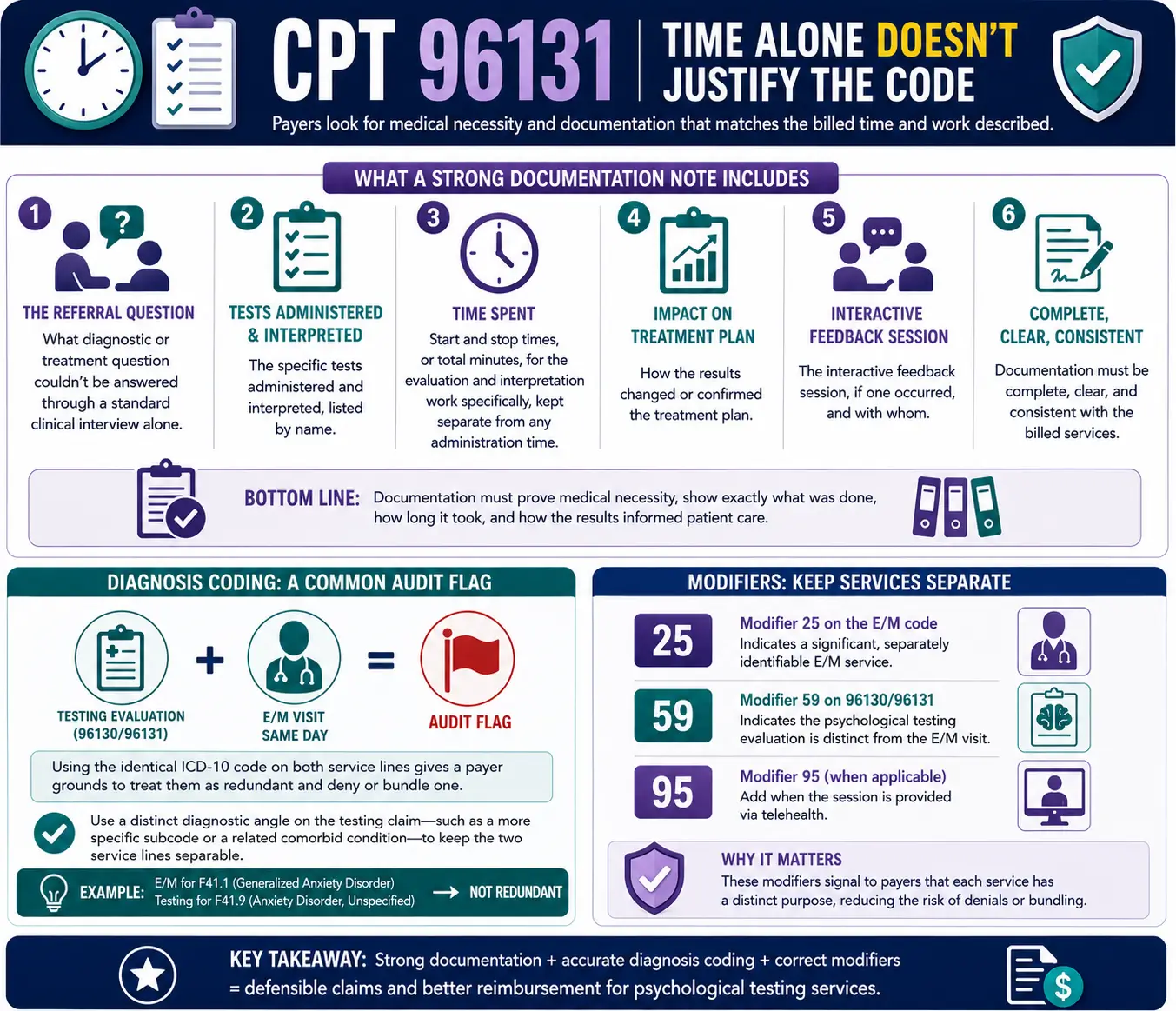
Time alone doesn’t justify the code. Payer audit contractors look for evidence that testing was medically necessary and that the billed time matches the work described. A note that holds up typically includes:
- The referral question: what diagnostic or treatment question couldn’t be answered through a standard clinical interview alone
- The specific tests administered and interpreted, listed by name
- Start and stop times, or total minutes, for the evaluation and interpretation work specifically, kept separate from any administration time
- How the results changed or confirmed the treatment plan
- The interactive feedback session, if one occurred, and with whom
One recurring audit flag involves diagnosis coding. When a testing evaluation and an E/M visit happen the same day, using the identical ICD-10 code on both service lines gives a payer grounds to treat them as redundant and deny or bundle one. A distinct diagnostic angle, even a more specific subcode or related comorbid condition, on the testing claim keeps the two service lines separable. Standard practice pairs two modifiers here: modifier 25 goes on the E/M code to flag it as a significant, separately identifiable service, and modifier 59 goes on 96130 or 96131 to mark the testing evaluation as distinct from that E/M visit. Modifier 95 gets added when the session runs through telehealth.
Who is allowed to bill it
CPT’s language (“physician or other qualified health care professional”) is intentionally broad, but coverage policy narrows it in practice. Medicare’s national coverage rules recognize physicians and licensed clinical psychologists, along with, depending on state scope-of-practice law and the specific payer, nurse practitioners, clinical nurse specialists, and physician assistants. Technicians can administer and score tests (that’s what 96138 and 96139 exist for), but can’t bill the evaluation codes themselves. Master’s-level clinicians, such as licensed professional counselors or clinical social workers, are generally not recognized as qualified health care professionals for this code family under Medicare, even when credentialed to bill other behavioral health codes. Commercial payer policy varies enough here that confirming eligibility in writing, before the first claim goes out, saves a denial later.
What CPT code 96131 pays under the 2026 fee schedule
Medicare prices 96131 using the relative value unit system rather than a flat fee. According to reimbursement documentation from APA Services, CPT 96131 carries 2.51 total RVUs (work, practice expense, and malpractice combined), against 3.30 total RVUs for the first hour under 96130. That gap reflects a pattern across CMS’s testing codes: the first hour of a multi-hour service is consistently valued higher, per hour, than every hour after it, regardless of whether the clinical complexity actually declines.
To turn RVUs into dollars, Medicare multiplies the total RVU by that year’s conversion factor, then adjusts for local practice costs. CMS finalized two separate conversion factors for CY 2026, the first year it has split the rate this way: $33.5675 for clinicians in qualifying alternative payment models, and $33.4009 for everyone else, both up from the CY 2025 factor of $32.3465. At the non-qualifying rate, 2.51 RVUs works out to roughly $84 nationally before geographic adjustment; the same math on 96130’s 3.30 RVUs comes to roughly $110 for the first hour. Actual payment in a given ZIP code runs higher or lower once the locality’s practice cost index applies; CMS’s Physician Fee Schedule Look-up Tool is the most reliable way to check a specific area.
One detail specific to 2026: CMS applied a new 2.5 percent efficiency adjustment to most non-time-based codes this year but explicitly excluded time-based services, including these testing codes, from that cut.
Telehealth rules changed for 2026
Telehealth coverage for these codes has shifted more than once since the pandemic, and the most recent change is worth flagging, since a lot of billing guidance still in circulation reflects the older rule. From 2021 through 2025, CMS carried the psychological and neuropsychological testing codes (96130 through 96139) on its telehealth list under provisional status: approved for telehealth delivery but subject to periodic re-review rather than being a permanent fixture.
In the CY 2026 Medicare Physician Fee Schedule final rule, released October 31, 2025, CMS moved all previously provisional telehealth services, including this entire testing code family, onto the permanent Medicare Telehealth Services list, a change APA Services confirmed in its coverage of the rule. In practical terms, a provider billing 96131 over live video no longer needs to track a yearly renewal; the telehealth allowance is now a settled part of the code’s status. Modifier 95 still gets appended to flag the service as telehealth.
Billing mistakes that trigger denials
A handful of errors show up often enough in claims data and biller forums to be worth naming directly:
- Billing 96131 without 96130 on the same claim. It’s an add-on code and cannot stand alone.
- Counting test administration or scoring time toward the 96131 hour. That time belongs under 96136 through 96139 instead.
- Rounding up. A session with 22 additional minutes doesn’t clear the 31-minute threshold for a unit of 96131.
- Reusing the same ICD-10 code across an E/M visit and a same-day testing evaluation, which invites bundling.
- Billing multiple units of 96131 without documentation specific enough to justify each hour, rather than one undifferentiated block of time.
Practices that see repeat denials on this code often benefit from a periodic internal audit, whether that’s run in-house or by a billing partner such as Mental Health Billing. The code family has enough of these quirks (a technician’s scoring time creeping into an evaluation note is a common one) that a second look tends to catch what a first pass misses.
Is 96131 undervalued? What the research shows
Not everyone agrees the RVU math above reflects the clinical effort involved. A 2024 study by Sarah Steel, Summer Rolin, and Jeremy Davis, published in The Clinical Neuropsychologist, compared work RVUs across E/M visits, neuropsychological evaluation, psychological evaluation, and psychotherapy codes. The authors reported that neuropsychological evaluation services generated an average hourly reimbursement of approximately $72, compared with up to $132 per hour for psychotherapy services billed with a complexity modifier. Based on this comparison, they concluded that the neuropsychological testing evaluation codes, including CPT 96130–96133, are undervalued despite requiring a similar level of clinical expertise, cognitive effort, and professional training as complex behavioral health services.
A May 2026 newsletter piece from the American Board of Professional Psychology raised a related point: the RVU structure values the first hour of an evaluation more highly than every hour after it (3.30 RVUs against 2.51), even though nothing about hour three of a complex case is inherently simpler than hour one. Neither source disputes that 96131 is billable and reimbursable exactly as described throughout this guide. Both make the case that the code’s valuation, not its definition, is where the disagreement with CMS’s methodology sits.
Getting the two codes right
CPT code 96131, paired with 96130, exists to pay clinicians for work that used to disappear into a single blended code: reading test results, integrating them with the rest of a patient’s clinical picture, and explaining what it means to the people who have to act on it. The mechanics, the 31-minute threshold, the separation from administration time, the documentation tying hours to medical necessity, aren’t complicated once laid out individually. Where practices actually lose money usually isn’t a misunderstanding of what 96131 means. The issues are often small but significant: an undocumented six minutes beyond the initial 30-minute period, a duplicate ICD-10-CM diagnosis code, or a claim submitted with CPT 96131 without the required 96130. Correcting these common errors allows the code set to function as intended since its 2019 implementation, ensuring that neuropsychological evaluation services are reimbursed separately from test administration and at a rate that reflects the clinician’s expertise and professional training.