


CPT code 96132 reports the first hour of neuropsychological testing evaluation services performed by a physician or other qualified healthcare professional. It represents the clinician’s evaluative work: integrating patient information, interpreting standardized test results alongside clinical data, making clinical decisions, planning treatment, preparing the report, and giving feedback when that occurs. It does not represent giving or scoring the tests themselves, which have separate codes.
That line between evaluation and administration is where most 96132 claims go wrong. This guide explains how procedure code 96132 works, how its time rules apply, what Medicare and commercial payers look for, and how billing teams can keep claims defensible. Coverage and payment always depend on the payer.
What Is CPT Code 96132?
Quick answer
CPT 96132 is the primary code for neuropsychological testing evaluation, reported for the first hour of qualifying professional evaluation time. Additional qualifying time is reported with CPT 96133, an add-on code.
The code is part of the family of psychological and neuropsychological assessments reorganized in 2019. Neuropsychological evaluation addresses how medical or neurological conditions, such as traumatic brain injury, epilepsy, or suspected dementia, affect cognition and behavior. No 2026 descriptor change turned up in the official and payer sources reviewed, but confirm against your current CPT codebook.
CPT 96132 Code Description: What the Service Includes
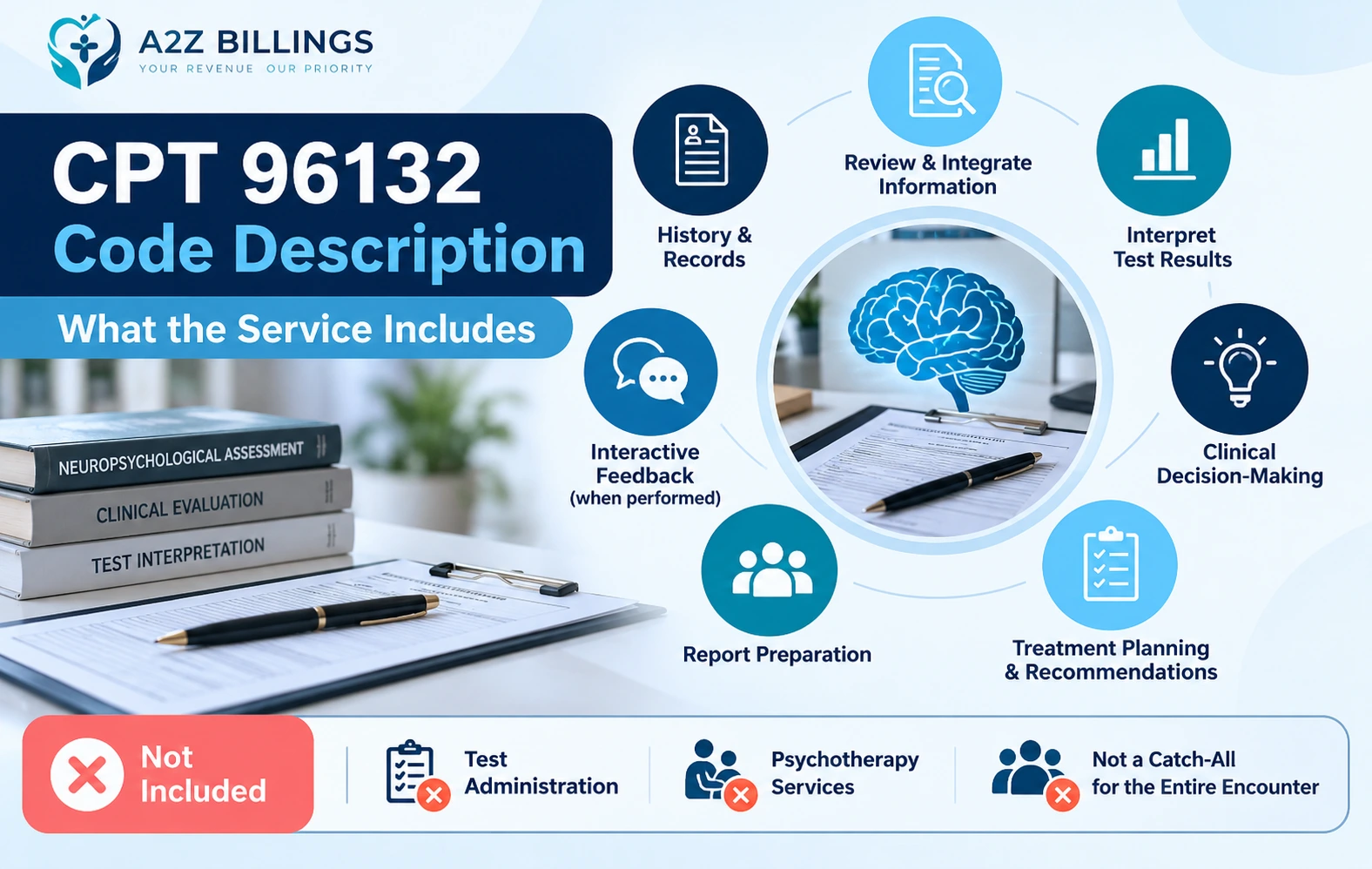
The AMA’s wording is copyrighted, so use the codebook for the official descriptor. In plain language, the 96132 CPT code description covers the clinician’s own professional work after data are gathered:
- Integrating history, records, interviews, and observations
- Interpreting standardized test scores and clinical data
- Clinical decision-making
- Treatment planning and recommendations
- Preparing the report
- Interactive feedback to the patient, family, or caregivers, when performed
It is not a test administration code, not a psychotherapy code, and not a catch-all for the whole encounter.
CPT 96132 Billing Guidelines
Before a claim leaves the office, confirm each of these:
- Service performed: the note shows evaluation work, not only test administration.
- Clinician qualifications: the rendering clinician is licensed, credentialed, and enrolled with the payer for this service.
- Payer rules: check the applicable LCD or plan policy, authorization, frequency limits, and code-family restrictions.
- Medical necessity: the reason for testing and diagnosis codes tie to the record.
- Time: evaluation minutes are documented, exclude administration and scoring, and meet the reporting threshold.
- Code selection: 96132 versus 96130 fits the clinical purpose, and 96133 appears only with 96132.
- Claim review: dates, units, NPIs, place of service, authorization number, and diagnoses match the record.
CPT 96132 Coding Guidelines
- Code the work performed, not the name of the test battery.
- Report 96132 once per evaluation episode. Additional qualifying time goes to 96133.
- Never count the same minutes twice. Time reported under 96136–96139 cannot also support 96132 or 96133, and a same-day diagnostic interview must be a distinct service. NCCI Policy Manual Chapter XI addresses same-day pairings.
- Don’t report 96130 and 96132 for the same episode of work. Some payers explicitly prohibit it.
- Don’t use 96132 for screening instruments or brief cognitive screens. A neurobehavioral status exam (96116) is a different service.
- Modifier 59 or X-modifiers cannot fix an unsupported claim. Use them only when the record shows truly distinct services.
Certified coders reviewing notes against these rules catch most problems before submission.
CPT 96132 Documentation Requirements
Medicare and commercial policies differ, so the last column shows how firmly each element is usually expected.
CPT 96132 Time Requirements
The descriptor says “first hour,” but reporting follows CPT’s time convention: a unit counts once its midpoint has passed. For CPT 96132, that means 31 or more minutes of qualifying evaluation time. Medicare contractor guidance and several commercial policies say the same: at least 31 minutes must be provided to report any per-hour code. Don’t assume a full 60 minutes is required, and don’t assume your payer follows the convention without reading its policy.
The CPT 96133 add-on code uses the same logic. Its first unit starts at 91 total evaluation minutes (60 plus 31), its second at 151, and so on.
Qualifying evaluation time
| Qualifying evaluation time | Codes supported |
|---|---|
| Under 31 minutes | Neither 96132 nor 96133 |
| 31–90 minutes | 96132 ×1 |
| 91–150 minutes | 96132 + 96133 ×1 |
| 151–210 minutes | 96132 + 96133 ×2 |
What counts: professional time spent integrating data, interpreting results, clinical decision-making, treatment planning, report preparation, and feedback, face-to-face or not. Minutes spent administering and scoring tests belong to 96136–96139. Payers differ on activities such as record review and administrative tasks, so confirm before including them.
Multi-day evaluations: CMS’s psychological testing FAQs say total time should be reported at the completion of the entire episode of evaluation. Some commercial plans set their own date-of-service rules.
Time-check example (hypothetical): The note lists 70 minutes of integration and interpretation, 60 minutes of report writing, and 25 minutes of feedback, for 155 minutes. That supports 96132 plus 96133 ×2. A note saying only “3 hours” gives the biller nothing to verify, so query the clinician before billing.
CPT 96132 Medical Necessity
Neuropsychological evaluation is diagnostic. It should answer a clinical question that affects care. Medicare contractor guidance describes testing as a tool for specific diagnoses or prognoses and treatment planning, and says diagnostic procedures with no effect on the plan of care are not medically necessary. The record must document why testing was performed.
A diagnosis alone does not establish necessity. Document the symptoms and functional change, what earlier evaluations could not answer, and how results will inform treatment. Then read the policy that actually governs the claim: the LCD or billing article for your Medicare Administrative Contractor, or the commercial plan’s medical policy. No single LCD applies nationwide.
Who Can Bill CPT 96132?
The code is for a physician or other qualified healthcare professional, and “qualified” depends on licensure, scope of practice, training, and payer enrollment rather than job title. Technicians cannot report it. Their time goes under 96138 and 96139.
For Medicare, contractor guidance lists physicians, clinical psychologists, independently practicing psychologists (generally on a physician’s order), and NPs, CNSs, and PAs within state scope. When a psychologist is on staff at an institution, agency, or clinic, that entity bills. Medicare does not pay for services performed by students or trainees. For the wider provider picture, see this guide on who can bill Medicare for mental health services. Commercial plans add credentialing, panel, and provider-type restrictions.
Keep two questions separate: who may perform an activity, and who may bill for it under this payer’s rules. Supervised associates may contribute work that only the enrolled clinician can bill, or that some payers don’t recognize at all.
When to Bill CPT Code 96132
Report 96132 when a qualified clinician completes and documents professional evaluation work for a neuropsychological question, supported by standardized testing, interpretation, and a report.
Don’t use it for:
- Test administration and scoring (96136–96139)
- A single automated instrument (96146)
- A neurobehavioral status exam alone (96116)
- Evaluations aimed at psychiatric, emotional, or personality questions (96130)
- Screening, psychotherapy, or services the payer treats as non-medical
CPT 96132 vs 96130, 96133, and 96136
| Code | What it reports | Key distinction |
|---|---|---|
| 96132 | Neuropsychological testing evaluation by physician/QHP: integration, interpretation, decisions, planning, report, feedback | First hour; primary code; 31+ minutes |
| 96130 | The same evaluation work for psychological testing questions | First hour; add-on is 96131; not interchangeable with 96132 |
| +96133 | Each additional hour of neuropsychological evaluation | Add-on only; requires 96132; first unit at 91+ total minutes |
| 96136 | Test administration and scoring by physician/QHP, two or more tests | First 30 minutes (add-on 96137); technician versions are 96138/96139 |
Choosing between 96132 and 96130 follows the clinical purpose of the evaluation; the 96130 fee schedule and payment rates show how the psychological side is paid. Choosing between 96132 and 96136 follows the work performed, and counting administration minutes is easier once the 96136 versus 96137 increments are clear. A clinician who both administers tests and interprets them may report both families, but only with separate documented time for each.
CPT 96132 Reimbursement and Medicare Reimbursement Rate for 2026
Medicare pays for CPT 96132 under the Physician Fee Schedule. Relative value units (work, practice expense, malpractice) are adjusted by locality-based GPCIs and multiplied by a conversion factor. Practice expense differs between facility and non-facility settings, so place of service changes the amount.
For 2026, CMS finalized a conversion factor of $33.4009 for clinicians outside a qualifying alternative payment model (shown as $33.40 in CMS materials) and $33.57 for qualifying participants. Published summaries of CMS’s 2026 relative value file list 96132 at 3.66 total non-facility RVUs and 2.95 facility RVUs. At the nonqualifying factor and before geographic adjustment, that is roughly $122 non-facility and $98.50 facility. The 96133 add-on is roughly $98 non-facility.
Treat these as national reference points, not your payment. Confirm your locality, setting, and date of service in the CMS Physician Fee Schedule Look-Up Tool or your MAC’s fee schedule. CMS has also issued a CY 2027 proposed rule, so don’t carry 2026 figures forward.
Three numbers get confused:
- Billed charge: what the practice lists.
- Allowed amount: the fee schedule or contract maximum.
- Payment: the allowed amount minus deductible, coinsurance, and adjustments.
Commercial payers pay by contract, which may reference Medicare or use a separate schedule.
CPT 96132 Insurance Coverage
Coverage is never automatic. It turns on the member’s benefit, provider eligibility, network status, medical necessity, documentation, and authorization rules.
| Topic | Original Medicare | Commercial, Medicaid, Medicare Advantage |
|---|---|---|
| Coverage source | Benefit Policy Manual Ch. 15 §80.2 plus the MAC’s LCD or billing article, which varies by contractor | Plan medical policy |
| Prior authorization | No national requirement identified; check your MAC | Often required; Nevada Medicaid’s 2026 guidelines, for example, require it for 96132/96133 |
| Limits | MAC-specific | Plan-specific; one regional Blue plan limits testing to once per calendar year and bars billing both evaluation families for one episode |
| Payment basis | Fee schedule | Contract |
Verify benefits before testing begins. Insurance eligibility verification should confirm coverage, network status, authorization requirements, and unit limits. Authorization does not guarantee payment, because a claim can still be denied if the record doesn’t support what was billed.
Common CPT 96132 Billing Errors and Denials
| Billing error | Why it causes a problem | Recommended correction |
|---|---|---|
| Administration or scoring minutes counted toward 96132/96133 | Duplicates time reported under 96136–96139 | Separate the minutes and recalculate units |
| 96133 billed without 96132, or units exceed documented time | Add-on needs a primary code and supported time | Correct the claim to what the record supports |
| Time missing, vague, or below threshold | Reviewer cannot verify units | Query the clinician; bill only supported units |
| 96130 vs 96132 mismatch | Code family doesn’t fit the clinical purpose | Coder query to the clinician; correct the code |
| Ineligible or unenrolled rendering provider | Payer rejects the provider, or a technician or trainee did the work | Verify enrollment; bill only for work an eligible clinician performed |
| Unclear medical necessity or missing authorization | Fails LCD or plan criteria | Review policy; appeal with records only if the record supports it |
| Claim doesn’t match the record | Dates, units, or diagnoses conflict with the chart | Reconcile before resubmitting |
When a denial arrives, pull the remittance codes, compare each claim line with the record, and route coding questions to the clinician through a documented query. Correct only what the record supports. Late addenda must be dated and honest, never reconstructed time. A structured denial management process also feeds root causes back to clinicians so the same error doesn’t repeat.
Practical CPT 96132 Coding Examples
These are hypothetical examples, not real cases or payer outcomes.
Example 1: Evaluation versus administration.
A neuropsychologist personally gives and scores tests for 120 minutes, then spends 155 minutes on interpretation, report, and feedback. Charge entry shows 96132 plus 96133 ×4 for “275 minutes.” The administration minutes belong under 96136 ×1 and 96137 ×3, while the 155 evaluation minutes support 96132 plus 96133 ×2. Verify each time block, authorization units, and payer edits. Lesson: one total hides two services.
Example 2: Add-on without a primary code.
A claim goes out with 96133 ×2 after the 96132 line was dropped for a missing authorization number. The payer denies the add-on. The team confirms authorization status and that the time supports both lines, then submits a corrected claim. The psychological-side add-on follows the same rule, and the common 96131 billing mistakes look much alike. Lesson: fix the root cause, not just the denied line.
Example 3: Overlapping time found in an audit.
A plan requests records for 96132 plus 96133 ×2. The note says “3 hours” with no breakdown, and the schedule shows 70 of those minutes overlapped with psychotherapy sessions. The documented evaluation time is 110 minutes, which supports 96132 plus 96133 ×1. The practice adjusts the claim under its compliance policy and handles any overpayment per payer rules. Lesson: time must hold up against other records.
A Practical CPT 96132 Billing Workflow
- Before testing: verify eligibility, benefits, network status, and authorization.
- During the evaluation: the clinician logs evaluation time separately from administration and scoring.
- Coding review: a coder checks the note against code families and add-on rules, and queries gaps.
- Submission: match units, NPIs, place of service, and authorization before claim submission.
- Payment posting: compare payments with the expected allowed amount and flag underpayments.
- Follow-up: work denials by root cause, with disciplined accounts receivable follow-up on aging claims.
CPT 96132 Compliance Checklist
- Rendering clinician is eligible, licensed, and enrolled with this payer
- Reason for testing and medical necessity are documented
- LCD or plan policy reviewed; authorization obtained if required
- Evaluation time documented by activity and date
- Administration and scoring time excluded and billed separately
- Time meets the 31-minute threshold for each unit billed
- 96132 vs 96130 matches clinical purpose
- 96133 appears only with 96132, with supported units
- Claim data matches the record
How Professional Mental Health Billing Support Can Help
Testing claims have many moving parts: authorization units, evaluation versus administration time, add-on logic, and payer-specific limits. Outside billing support can help with documentation-to-code review, eligibility and authorization checks, claim scrubbing, denial follow-up, and payment tracking.
Mental Health Billing’s psychology billing services page describes support for psychological testing claims, including unit tracking, authorization and medical necessity review, and provider qualification checks. Practices with neuropsychology-specific needs should confirm scope with the team directly. Its medical coding service is a related option. No billing partner can guarantee payment or eliminate denials, but consistent front-end checks and root-cause tracking reduce avoidable rework.
Key Takeaways
- CPT 96132 reports professional neuropsychological evaluation work, not test administration or scoring.
- 31 or more qualifying minutes support 96132, and 96133 begins at 91 total minutes.
- 96133 is an add-on and never stands alone.
- 96130, 96132, and 96136 are not interchangeable.
- Eligibility, coverage, authorization, and rates vary by payer and MAC, so verify each one.
Frequently Asked Questions About CPT 96132
What is CPT code 96132, and what does its description include?
It reports the first hour of neuropsychological testing evaluation by a physician or other qualified healthcare professional. That covers data integration, interpretation, clinical decision-making, treatment planning, the report, and feedback when performed. Test administration and scoring are separate.
Who can bill CPT 96132?
Qualified, enrolled clinicians practicing within licensure and scope, such as eligible psychologists and physicians, under payer rules. Technicians cannot. Medicare and commercial eligibility rules differ, so verify enrollment.
When should CPT 96132 be reported?
When a qualified clinician documents at least 31 minutes of professional neuropsychological evaluation work, separate from administration and scoring, and the service is medically necessary.
What are the CPT 96132 billing guidelines and documentation requirements?
Confirm the service, clinician eligibility, payer rules, medical necessity, time, and add-on logic. The record should show the reason for testing, data, interpretation, report, and activity-level time.
What are the CPT 96132 time requirements?
31 or more minutes of qualifying evaluation time supports 96132, and 96133 begins at 91 total minutes. Confirm any payer-specific variation.
What is the difference between CPT 96132 and 96130?
Both report evaluation work. 96132 addresses neuropsychological questions about brain-behavior effects of medical or neurological conditions, while 96130 addresses psychological questions. Some plans bar billing both for one episode.
What is the difference between CPT 96132 and 96133, and how does the add-on work?
96132 is the first hour. 96133 is reported for each additional hour, only alongside 96132 and only with documented time.
What is the difference between CPT 96132 and 96136?
96136 reports test administration and scoring by a physician or QHP (first 30 minutes, with 96137 for more). 96132 reports the evaluation work. Each needs its own documented time.
What is the CPT 96132 Medicare reimbursement rate for 2026?
Nationally, roughly $122 non-facility and $98.50 facility before geographic adjustment, based on CMS’s 2026 RVUs and a $33.4009 conversion factor. Your locality will differ, so confirm in the CMS Look-Up Tool.
Does Medicare cover CPT 96132?
Part B covers medically necessary diagnostic neuropsychological testing from eligible practitioners. Criteria and documentation expectations vary by MAC, and coverage is never guaranteed.
Does CPT 96132 require prior authorization?
No national Original Medicare requirement was identified. Medicare Advantage, Medicaid, and commercial plans often require it. Authorization does not guarantee payment.
What can cause a CPT 96132 claim denial?
Unsupported or duplicated time, confusing evaluation with administration, 96133 without 96132, enrollment gaps, missing authorization, unclear medical necessity, and claim data that doesn’t match the record.
Conclusion
Accurate CPT 96132 billing comes down to the right code for the work performed, a qualified and enrolled clinician, documented medical necessity, defensible time, and attention to payer-specific rules. Build those checks in before submission and denials become easier to prevent and to appeal. If your practice wants a second set of eyes on testing claims, you can contact Mental Health Billing to discuss your workflow.