



A therapy session can be clinically appropriate and still generate an unpaid claim. The patient’s coverage may have changed, an authorization may cover different dates, or the claim may identify the wrong rendering provider. Other denials concern whether the documentation supports the treatment billed.
Understanding why mental health insurance claims get denied starts with identifying the exact problem. Resubmitting an unchanged claim rarely resolves a coverage dispute. Sending a clinical appeal will not correct an inaccurate member ID.
For providers and billing students, the practical task is to connect each denial reason with the right evidence, correction, and submission route.
Start by separating rejections from denials
A rejection generally occurs before a claim completes adjudication. Missing information, invalid identifiers, or electronic formatting errors can prevent processing. CMS explains in its Electronic Health Care Claims guidance, accessed October 2026, that electronic submissions pass through edits that may reject individual claims or entire batches for correction.
A denial generally follows processing: the payer determines that it will not pay some or all of the claim. Payer terminology varies, so confirm the actual claim status before choosing the next step.
Read the complete remittance message. In its Medicare Claims Processing Manual, Chapter 1, CMS distinguishes claim adjustment reason codes (CARCs), which explain payment adjustments, from remittance advice remark codes (RARCs), which provide additional detail. The adjustment group code also helps identify financial responsibility.
Record the claim number, affected service lines, denial explanation, and response deadline. A claim with several services may need different corrections for different lines.
Why mental health insurance claims get denied
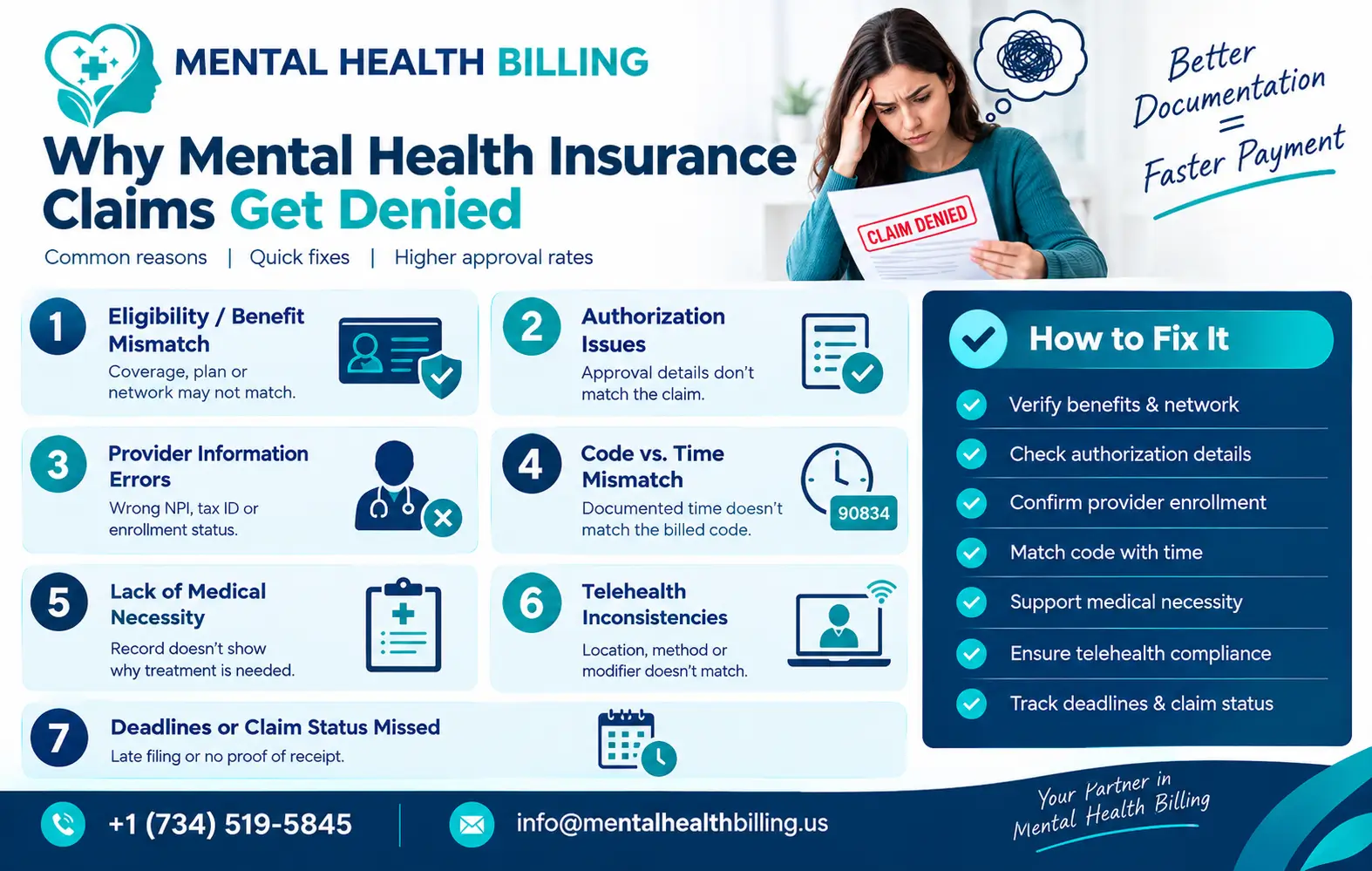
1. Eligibility or benefit information does not match the visit
An insurance card does not establish coverage for every date or service. A patient may have changed employers, moved to another plan, or received treatment from a provider outside the applicable network.
HealthCare.gov’s Internal appeals guidance, accessed October 2026, identifies eligibility, excluded benefits, and network status among reasons a health plan may refuse payment.
How to fix it: Verify coverage for the actual date of service. Compare the submitted member ID, patient information, and plan details against the payer’s records.
Ask specifically about the behavioral health benefit and which organization processes those claims. If another insurer was responsible, confirm the correct submission destination and deadline before rebilling.
For prevention, recheck benefits after reported insurance changes and before starting a new course of treatment. Save the eligibility response and any call reference number.
2. Authorization details do not support the billed service
Treat authorization review as a matching exercise. Check whether the approval applies to the patient, service, provider, dates, and number of visits or units on the claim.
For example, imagine a testing authorization that approves certain services through September, while the submitted claim includes an October date. The existence of an authorization number alone does not resolve that discrepancy.
How to fix it: Compare the approval notice with the claim line by line. Correct a missing or mistyped authorization number through the payer’s designated process. If the service falls outside the approval, ask whether retrospective review or an exception is available under that plan.
Do not assume retrospective approval is available. Obtain the applicable policy and document the payer’s response.
3. Provider enrollment or identifying information is incorrect
Check the rendering clinician separately from the billing organization. A group’s participation does not establish every clinician’s eligibility for every product or service date.
Optum’s Minnesota Provider Overview and Billing Training, accessed October 2026, warns that claims may be denied when submitted provider information does not match its records. This is payer-specific guidance, but it illustrates a useful verification step.
How to fix it: Compare the rendering NPI, billing NPI, tax identification number, service location, and enrollment effective dates with the payer’s file.
Medicare offers a specific example of why dates matter. CMS’s Marriage and Family Therapists & Mental Health Counselors guidance states that qualifying professionals became eligible to bill Medicare independently beginning January 1, 2024, subject to enrollment requirements.
Do not substitute another clinician’s identity simply to obtain payment. Resolve the enrollment issue and determine whether the service date qualifies for reimbursement.
4. The psychotherapy code does not match documented time
Appointment length and billable psychotherapy time can differ.
In Psychotherapy services, published August 6, 2026, Medicare contractor First Coast Service Options identifies these time ranges and emphasizes documenting the encounter’s duration:
| CPT code | Documented psychotherapy time |
|---|---|
| 90832 | 16–37 minutes |
| 90834 | 38–52 minutes |
| 90837 | 53 minutes or longer |
Consider a hypothetical appointment scheduled for 60 minutes that contains 47 minutes of psychotherapy. The documented time supports 90834, assuming the remaining service requirements are met.
How to fix it: Compare the code with the signed clinical record. Correct an inaccurate claim through the payer’s prescribed route. Never increase documented minutes to justify the originally submitted code.
For clinicians providing psychotherapy with an evaluation and management service, review the applicable psychotherapy add-on codes. First Coast requires the E/M work to be significant and separately identifiable. Avoid counting the same work toward both services.
5. Documentation does not explain medical necessity
A diagnosis identifies the condition being treated. It does not, by itself, explain the treatment delivered, its frequency, or the need for continued care.
Review the clinical record for:
- Symptoms and their effect on functioning.
- Treatment goals and interventions delivered.
- The patient’s response and progress.
- The rationale for continued treatment.
- Required time, signatures, and service details.
CMS-hosted Medicare contractor article A59723, Billing and Coding: Outpatient Psychotherapy, accessed October 2026, describes documentation supporting psychotherapy services. Its requirements should be applied within the relevant contractor’s jurisdiction rather than treated as every insurer’s policy.
How to fix it: Obtain the payer’s stated clinical criteria and identify the specific point in dispute. Build an appeal around the existing record and the applicable criteria.
A useful appeal explains how the patient’s documented condition supports the service. Repeating “treatment was necessary” adds little evidence.
6. Telehealth details are inconsistent
Review the patient’s location, communication method, procedure code, place of service, and required modifiers together.
CMS’s Telehealth FAQ, updated February 26, 2026, distinguishes POS 10 for telehealth received in the patient’s home from POS 02 for telehealth received elsewhere.
How to fix it: Confirm where the patient was during the encounter and whether the service used audio-video or audio-only communication. Compare those facts with the payer’s policy effective on the service date.
Do not apply one insurer’s modifier instructions across every plan. HHS’s Billing for telebehavioral health, updated July 29, 2025, notes that Medicaid policies vary by state and directs providers to private insurers for their billing requirements.
7. Filing deadlines or claim status were overlooked
A claim marked “sent” in practice software still needs confirmation of payer receipt. Review acknowledgments and investigate unresolved rejections promptly.
Medicare generally requires claims within one calendar year of the service date, with limited exceptions. CMS’s Medicare Billing: CMS-1500 & 837P training also explains that a timely-filing denial is not an initial determination subject to the ordinary appeal process. Commercial and Medicaid deadlines must be checked separately.
How to fix it: Gather acknowledgment reports, payer claim numbers, and other accepted proof of receipt. Determine whether the payer allows a filing exception.
Before sending another claim, check whether the original is pending, paid, or denied. Use the required replacement or correction process when changing an adjudicated claim.
Choose between a corrected claim and an appeal
The next submission should address the actual defect.
| Situation | Appropriate starting point |
|---|---|
| Incorrect claim data | Correct the data and follow the payer’s correction instructions |
| Payer appears to have processed accurate information incorrectly | Request reconsideration or reprocessing |
| Disagreement over medical necessity or coverage | Submit an appeal with supporting evidence |
| Missing requested records | Supply the specified documentation through the designated channel |
Terminology and sequencing vary. UnitedHealthcare’s Pre- and post-service appeals and reconsiderations guidance, accessed October 2026, illustrates a process that separates reconsideration from a subsequent appeal. Confirm the route for the patient’s particular plan.
Include the claim identifier, disputed service, denial reason, requested resolution, and supporting records. Keep proof of submission.
HealthCare.gov describes a 180-day internal appeal window for the consumer appeals covered by its guidance. Do not treat that as a universal provider deadline. Provider contractual disputes, Medicare appeals, and other processes may follow different rules.
Protect sensitive records during denial follow-up
Progress notes and separately maintained psychotherapy notes have different privacy treatment.
HHS’s September 12, 2017 guidance on mental health information explains that HIPAA psychotherapy notes exclude routine information such as session times, diagnoses, treatment plans, and progress summaries. Separately maintained psychotherapy notes generally require patient authorization for disclosure, subject to limited exceptions.
Review record requests before sending attachments. Provide the appropriate clinical documentation through a secure channel, and clarify requests that appear to seek separately maintained psychotherapy notes.
Prevent repeat denials by correcting the underlying process
Track mental health insurance claims by denial reason, payer, responsible staff member, deadline, and final outcome. Separate front-end rejections from adjudicated denials so the numbers identify the actual source of failure.
A recurring authorization problem calls for scheduling controls. Repeated provider mismatches call for enrollment review. Time-based coding errors require documentation and coding checks.
Resolving mental health insurance claims depends on matching the payer’s objection with accurate claim information and supporting evidence. Each completed correction should also produce a specific workflow change that helps prevent the same error on the next claim.