



Medicaid behavioral health billing involves more than selecting the correct procedure code. Providers must also report details about the professional delivering treatment, the type of service performed, and any additional circumstances required by the state Medicaid program. The U4 modifier for behavioral health is one of the billing modifiers used to communicate such information.
Unlike modifiers with broadly consistent applications, U4 is defined differently across state Medicaid programs. Depending on the applicable policy, it may identify a healthcare professional's credentials, a particular behavioral health service, a method of service delivery, or circumstances that qualify for a specific payment adjustment.
These differences create challenges for mental health clinics, substance use disorder treatment programs, social workers, and medical billing specialists handling Medicaid claims.
Understanding the U4 modifier requires examining the state's billing regulations, identifying eligible services, and maintaining documentation that supports its use.
This guide explains the U4 modifier meaning, Medicaid billing requirements, state-specific applications, reimbursement considerations, and common documentation errors.
What is the U4 modifier in behavioral health billing?
The U4 modifier is a two-character HCPCS Level II modifier with the general description "Medicaid level of care 4, as defined by each state."
Although the national description refers to a level of care, the modifier does not universally indicate that a patient receives a fourth level of behavioral health treatment. Individual Medicaid programs establish their own operational meanings and determine which services or providers qualify.
For example, one state may use U4 to identify services delivered by a particular category of licensed professional. Another may assign the same modifier to a service provided through a designated Medicaid program.
The Centers for Medicare & Medicaid Services (CMS) maintains the HCPCS Level II coding system, while individual states establish Medicaid coverage, reimbursement, and service-specific billing requirements.
In behavioral health billing, U4 generally appears alongside an eligible CPT or HCPCS procedure code. The modifier supplies additional information needed to interpret or process that claim.
It does not replace the underlying procedure code, establish medical necessity, or independently authorize payment.
How is the U4 modifier used in Medicaid behavioral health programs?
The meaning of U4 becomes clearer when examining how individual states apply the modifier.
Ohio Medicaid: Identifying licensed social workers
Ohio Medicaid uses U4 as a practitioner modifier for licensed social workers (LSWs) within its community behavioral health billing framework.
The Ohio Department of Medicaid's Behavioral Health Provider Manual, Version 1.28.1, published March 24, 2026, identifies several professional categories through designated modifiers.
For example, U2 identifies licensed professional counselors, U4 identifies licensed social workers, and U5 identifies licensed marriage and family therapists.
Ohio's manual also explains that these practitioner modifiers are generally optional for fee-for-service billing, except in specified circumstances involving professionals with multiple licenses. Managed care requirements must be checked separately.
Consequently, a behavioral health organization should not automatically apply U4 to every service performed by a social worker. The provider's licensure, enrollment classification, covered service, and applicable payment policy must be evaluated first.
New York Medicaid: Services provided in another language
New York provides a different example.
Under specific Office of Mental Health outpatient billing rules, the U4 modifier identifies eligible mental health services delivered in a language other than English.
The New York State Office of Mental Health issued billing guidance on October 5, 2023, establishing that, effective October 1, 2023, U4 applies to qualifying Mental Health Outpatient Treatment and Rehabilitative Services (MHOTRS) delivered by staff fluent in the patient's preferred language.
The guidance provides a 10% payment enhancement for qualifying services.
When an eligible service uses a contracted translation professional or vendor instead, the policy identifies a separate modifier combination, U1 and U7, rather than U4. Those modifiers carry different reimbursement rules.
This distinction demonstrates why billing specialists must consult the exact program requirements before applying a modifier.
The 10% enhancement is specific to the qualifying New York services. It is not a national U4 reimbursement rate.
North Carolina Medicaid: Identifying authorized 1915(i) services
North Carolina Medicaid uses U4 with several services available through its 1915(i) program.
Examples include community transition, respite, supported employment, and community living and supports.
The North Carolina Medicaid billing guidance identifies combinations such as H0043-U4 for community transition and H2023-U4 for supported employment services.
The state also requires eligible members to complete the applicable assessment process and obtain service authorization when required before providers submit claims.
In this setting, U4 helps identify services within a particular Medicaid benefit structure.
Comparison of U4 modifier applications
| State or program | U4 modifier application | Billing consideration |
|---|---|---|
| Ohio Medicaid community behavioral health | Licensed social worker practitioner designation | Verify licensure and whether the modifier is required |
| New York OMH MHOTRS | Qualifying services delivered by fluent staff in a language other than English | Eligible services may receive a 10% enhancement |
| North Carolina Medicaid 1915(i) | Designated services such as supported employment and community transition | Verify program eligibility, authorization, and code combination |
| Minnesota UCare state public programs | Certain non-face-to-face mental health contacts | Check covered services and the plan's modifier policy |
The Minnesota example comes from UCare's published provider modifier grid. Its application is specific to the applicable products and policies.
These examples illustrate the range of U4 applications rather than a universal list of permitted uses.
Medicaid billing requirements for the U4 modifier
Correct U4 modifier billing starts with identifying the applicable Medicaid program.
Providers must determine whether the patient has fee-for-service Medicaid coverage or receives benefits through a Medicaid managed care organization. Both may follow state requirements, but managed care contracts and provider manuals can impose additional claims-processing conditions.
Verify the eligible procedure code
The first requirement is confirming that the underlying CPT or HCPCS code accurately represents the service performed.
A behavioral health organization might bill psychotherapy, psychiatric assessment, case management, rehabilitative treatment, or community support services. However, the presence of a behavioral health procedure code does not automatically justify appending U4.
The modifier must be permitted for that code under the applicable Medicaid policy.
Some programs publish approved procedure-code and modifier combinations. Others specify practitioner modifiers based on credentials or enrollment classifications.
Confirm provider qualifications and enrollment
When U4 identifies the rendering professional, the billing record must accurately reflect the individual's qualifications.
For example, an Ohio behavioral health claim involving an LSW should be reviewed against the professional's active license, Medicaid enrollment, rendering provider information, and applicable supervision requirements.
A practitioner holding multiple professional licenses may also face specific billing instructions concerning which credential supports the reported service.
Review service authorization requirements
Certain Medicaid behavioral health services require prior authorization, an approved treatment plan, or enrollment in a qualifying program.
Using U4 does not eliminate these requirements.
North Carolina's 1915(i) guidance, for instance, distinguishes eligibility for the program from authorization for an individual service.
Billing teams should confirm both requirements before submitting applicable claims.
Check modifier combinations and placement
Some claims require more than one modifier to identify the service correctly.
Depending on state guidance, additional modifiers may describe group treatment, provider qualifications, service modality, or other circumstances.
The claim must follow the payer's accepted modifier combinations and sequencing instructions.
A technically valid modifier can still produce a payment problem when paired with an incompatible procedure code or another modifier.
Documentation requirements for the U4 modifier
Accurate clinical documentation provides evidence that the service was delivered and that its reported billing characteristics are correct.
Because U4 has different applications, the documentation needed to support it also varies.
Clinical documentation and medical necessity
Behavioral health records should explain the clinical reason for treatment and show how the service relates to the patient's assessed needs.
Depending on the service and applicable payer policy, relevant records may include the patient's assessment, diagnosis, treatment plan, service goals, and progress notes.
For psychotherapy, documentation should support the treatment provided and any time-based coding requirements.
For rehabilitative or community-based services, progress notes should identify the interventions delivered and their relationship to the patient's approved service plan.
Medical necessity and modifier eligibility are separate considerations. A medically necessary service can still be incorrectly billed if U4 does not apply.
Provider credentials and service details
When U4 identifies a licensed professional, organizations should maintain evidence of that professional's credentials and eligibility to provide the service.
Relevant information may include the rendering provider's identity, active licensure, enrollment status, and supervision documentation when required.
The service record should also identify the date, duration or units, location, and treatment activities to the extent required by the applicable program.
Documentation for language-related services
For qualifying New York MHOTRS services, the record must support the circumstances under which the language-related modifier is billed.
Providers should document the patient's language needs, the qualifying service, and the language assistance arrangement according to OMH requirements.
Staff-delivered language services should not be confused with contracted interpreter services because the two arrangements are subject to different modifier instructions.
The organization should also maintain appropriate procedures for assessing the language competency of personnel providing language assistance.
How does the U4 modifier affect reimbursement?
The reimbursement effect of U4 depends on the state, Medicaid program, procedure code, and payer.
In some settings, U4 identifies the type of practitioner or program without establishing a universal payment increase. In other circumstances, it helps determine an applicable rate or enhancement.
New York's qualifying MHOTRS language services demonstrate how the modifier can directly affect reimbursement.
However, providers should not assume that appending U4 increases payment in other states.
The final payment may depend on the applicable Medicaid fee schedule, managed care contract, provider classification, service setting, units, and date of service.
Before estimating reimbursement, billing teams should review the fee schedule and billing guidance effective on the treatment date.
Common U4 modifier billing errors
One frequent mistake is assuming that U4 has the same meaning throughout the country.
A billing rule used successfully in Ohio cannot automatically be transferred to a New York or North Carolina Medicaid claim.
Another problem involves applying U4 to an unsupported procedure code. Even where the modifier has a recognized program meaning, the specific code combination may be restricted.
Incorrect provider classification is also a concern. When the modifier identifies professional credentials, claims should reflect the actual rendering provider rather than a different clinician's qualifications.
Documentation problems create additional risks. Claims may be questioned when the record does not substantiate the service, provider designation, language arrangement, or program eligibility represented by the modifier.
Finally, billing staff may overlook effective dates. Medicaid programs periodically update procedure codes, modifier requirements, reimbursement methodologies, and authorization policies.
An older billing reference may therefore be unsuitable for a current claim.
Practical U4 modifier billing examples
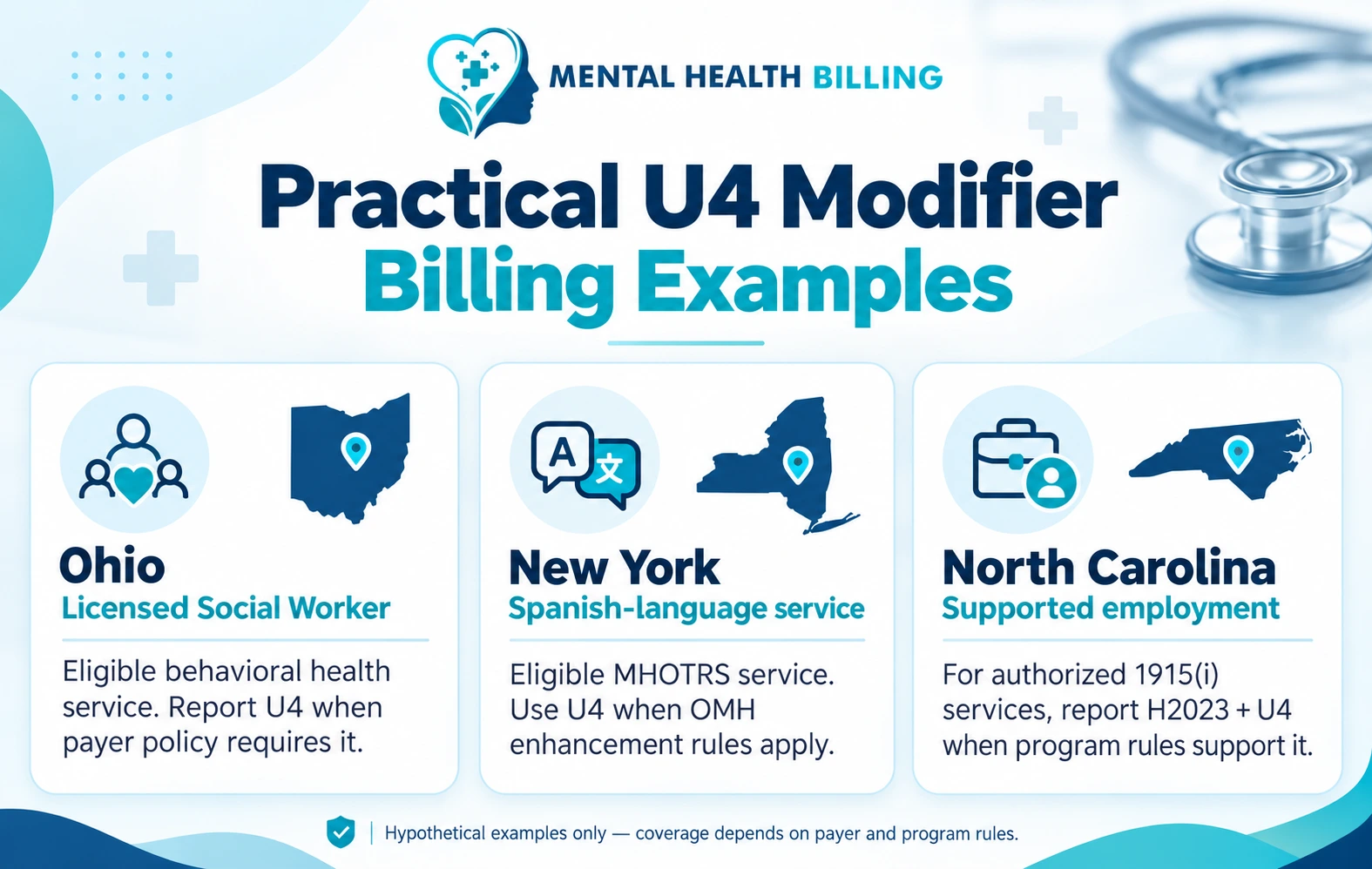
Example 1: Licensed social worker in Ohio
A licensed social worker provides an authorized behavioral health service through an Ohio community behavioral health organization.
Before billing, the coding specialist verifies the LSW's credentials, the procedure code, and the payer's current practitioner modifier requirements.
If the applicable policy requires U4, the billing specialist reports it with the eligible procedure code.
The modifier identifies the professional classification rather than indicating that the patient receives a universal fourth level of mental health care.
Example 2: Behavioral health service provided in Spanish
A patient receives an eligible MHOTRS service in New York from a qualified staff member fluent in Spanish.
The billing department reviews OMH language-service requirements and confirms that the service qualifies for the applicable U4 enhancement.
If the same service instead required assistance from a contracted interpretation vendor, the billing staff would evaluate the separate U1/U7 requirements.
Example 3: Supported employment in North Carolina
A patient eligible for North Carolina's 1915(i) program receives authorized supported employment services.
The provider reviews the service authorization, confirms the appropriate billing arrangement, and reports H2023 with U4 when supported by the applicable program rules.
These examples are hypothetical and illustrate coding decisions, not guaranteed coverage or payment outcomes.
How can providers prevent U4 modifier claim denials?
The most effective approach is to include modifier validation in the pre-submission claims review.
Billing teams should confirm that the procedure code, provider credentials, Medicaid program, and applicable modifier instructions agree with one another.
A review should also confirm required authorizations, treatment documentation, units, and payer-specific claim requirements.
If a claim is rejected or denied, the billing department should examine the remittance information and determine whether the problem concerns modifier validity, provider eligibility, authorization, or another claim detail.
Corrections should be based on the actual service and applicable policy. Removing U4 simply to obtain payment can create an inaccurate claim when the modifier is required.
Regular updates to the billing system's code combinations and payer-specific edits can reduce repeat errors, especially for organizations handling claims across multiple states.
Frequently asked questions about the U4 modifier
Is the U4 modifier used only for behavioral health?
No. U4 is a state-defined Medicaid modifier that can appear in different healthcare service categories. Its behavioral health applications depend on the applicable state or program.
Does U4 always indicate a higher level of care?
No. Although its general HCPCS description refers to Medicaid level of care 4, states may use it to identify a provider classification, eligible program service, or another billing circumstance.
Can U4 be used with psychotherapy codes?
Potentially, where the relevant state Medicaid or managed care policy authorizes that combination. The presence of a psychotherapy CPT code alone does not establish eligibility.
Does the U4 modifier guarantee higher reimbursement?
No. Payment adjustments depend on the applicable state and payer policy. Some qualifying services receive an enhancement, while other applications primarily identify billing characteristics.
Is U4 required for every Medicaid behavioral health claim?
No. The modifier should be reported only under the conditions established by the relevant Medicaid program and payer.
Key takeaways for behavioral health providers
The U4 modifier for behavioral health is a state-defined Medicaid billing modifier whose application varies across healthcare programs.
Ohio uses it to identify licensed social workers in its community behavioral health framework. New York applies it to certain language-related outpatient mental health services, while North Carolina uses it with designated 1915(i) services.
These differences make state-specific policy review essential.
Healthcare providers and medical billing professionals should verify the eligible procedure code, provider qualifications, documentation, authorization requirements, and current reimbursement rules before submitting claims with U4.
The most reliable billing decision is one supported by the actual service record and the Medicaid policy effective on the date of service.