



Top 10 Best Psychotherapy Billing Software for Mental Health Practices in 2026
Mental health claims fail for reasons that rarely trouble a dermatology practice. A session that runs 52 minutes is 90834. At 53 minutes it becomes 90837, worth roughly 15 to 25 percent more, and indefensible on post-payment review if the note omits start and stop times. Add behavioral health carve-outs, where a commercial plan hands its mental health benefit to a separate administrator with its own claim address and eligibility file, and the margin for error narrows again.
The data shows the strain. In Experian Health’s 2025 State of Claims survey of 250 finance, billing, and claims professionals, fielded between June 23 and July 3, 2025, 41 percent of providers reported denial rates of 10 percent or higher, up from 30 percent in 2022. Sixty-eight percent said submitting clean claims had become harder than a year earlier, and half named missing or inaccurate claim data as the leading cause.
This guide compares ten psychotherapy billing software platforms and the 2026 rule changes each has to accommodate. All prices were taken from vendor pricing pages in July 2026.
What changed in 2026 that your billing system has to handle
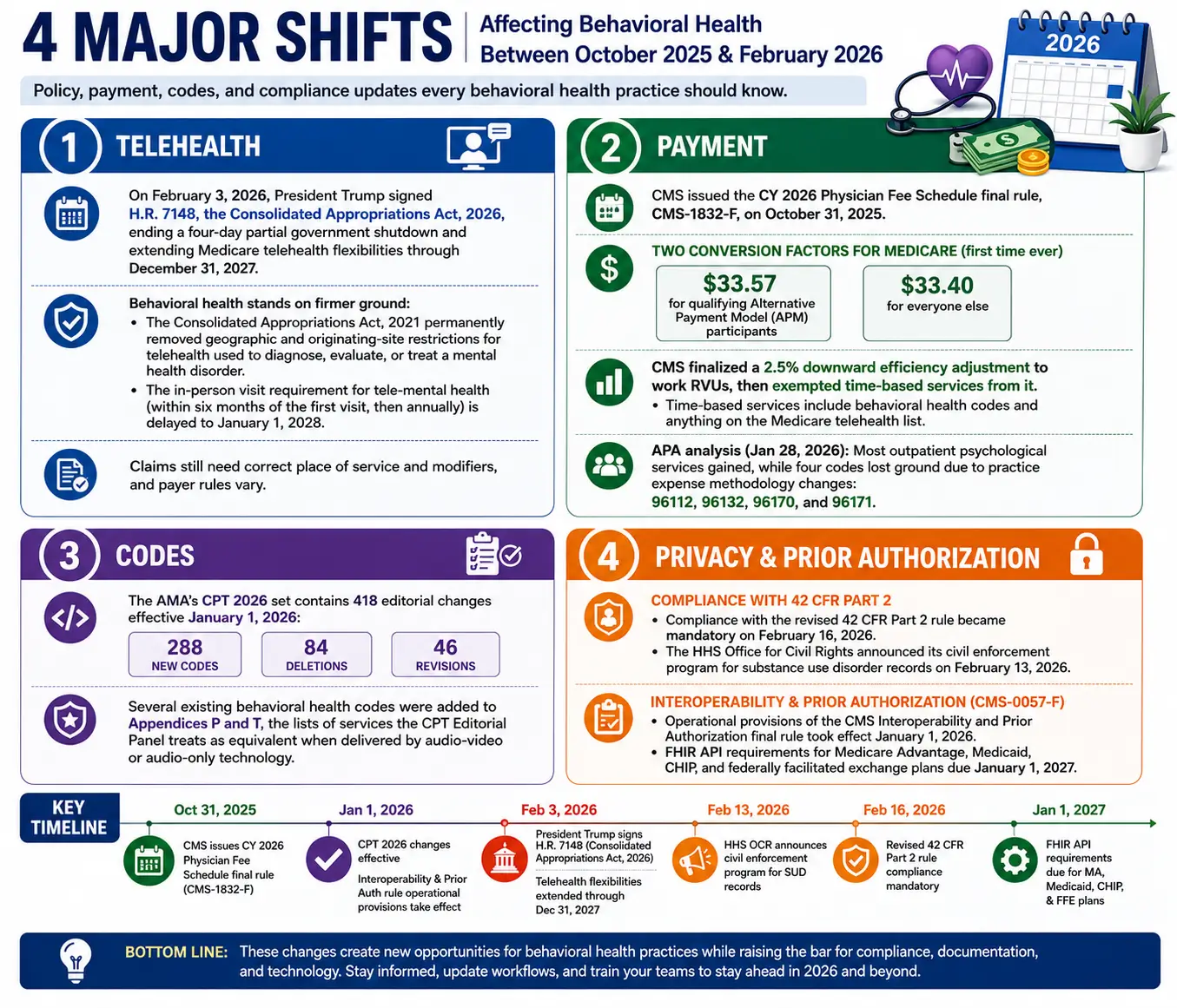
Four shifts landed between October 2025 and February 2026, and they are not evenly distributed across specialties.
Telehealth. On February 3, 2026, President Trump signed H.R. 7148, the Consolidated Appropriations Act, 2026, ending a four-day partial government shutdown and extending Medicare telehealth flexibilities through December 31, 2027. Behavioral health stands on firmer ground than most service lines, because the Consolidated Appropriations Act, 2021 permanently removed geographic and originating-site restrictions for telehealth used to diagnose, evaluate, or treat a mental health disorder. The in-person visit requirement for tele-mental health (within six months of the first visit, then annually) is delayed to January 1, 2028. Claims still need correct place of service and modifiers, and payer rules vary.
Payment. CMS issued the CY 2026 Physician Fee Schedule final rule, CMS-1832-F, on October 31, 2025. For the first time, Medicare uses two conversion factors: $33.57 for qualifying alternative payment model participants and $33.40 for everyone else. CMS also finalized a 2.5 percent downward efficiency adjustment to work RVUs, then exempted time-based services from it, a category that expressly includes behavioral health codes and anything on the Medicare telehealth list. The American Psychological Association’s January 28, 2026 analysis noted that most outpatient psychological services gained, while four codes (96112, 96132, 96170, and 96171) lost ground because of practice expense methodology changes.
Codes. The AMA’s CPT 2026 set contains 418 editorial changes: 288 new codes, 84 deletions, and 46 revisions, effective January 1, 2026. Several existing behavioral health codes were added to Appendices P and T, the lists of services the CPT Editorial Panel treats as equivalent when delivered by audio-video or audio-only technology.
Privacy and prior authorization. Compliance with the revised 42 CFR Part 2 rule became mandatory on February 16, 2026, and the HHS Office for Civil Rights announced its civil enforcement program for substance use disorder records three days earlier. Separately, the operational provisions of the CMS Interoperability and Prior Authorization final rule (CMS-0057-F) took effect January 1, 2026, with FHIR API requirements for Medicare Advantage, Medicaid, CHIP, and federally facilitated exchange plans due January 1, 2027.
The 10 best psychotherapy billing software platforms for 2026
Platforms were assessed on published pricing, claim and eligibility handling, fit for insurance-billing practices, and disclosed limitations. Quote-only vendors are marked as such rather than estimated.
1. TherapyNotes
$69 per month for a solo user. Groups pay $79 for the first clinician and $50 for each additional clinician, with unlimited practice administrators, schedulers, and billers included at no charge. What sets it apart is that transaction costs are published rather than quoted: 14 cents per electronic claim, 14 cents per real-time eligibility request, and 14 cents per claim in an ERA, plus $1 for a mailed paper claim. Card processing is 3.1 percent plus 30 cents. ePrescribe runs $65 per prescriber, and the TherapyFuel AI tools are $40 per clinician.
For billing and coding programs, one detail is easy to miss: TherapyNotes is free for classroom use regardless of class size, although classroom accounts exclude insurance billing.
Limitation: no permanent free tier, and a dedicated account manager requires 30 or more users.
2. SimplePractice
Starter is $49, Essential $79, and Plus $99 per month, with additional group practitioners from $74. SimplePractice reports more than 250,000 practitioners on the platform. The billing caveat is structural. Insurance claim submission and automatic insurance status checks sit on the Plus plan, which includes 35 free insurance claims per month, so a clinician who signed up at $49 expecting to bill insurance will need to move up two tiers.
Add-ons accumulate: Note Taker at $35 per clinician, the Care Aide AI suite at $59 for the account owner and $49 per additional clinician, and ePrescribe at $49 per clinician plus an $89 one-time setup. An annual AMA CPT code access fee applies as well.
3. TheraNest by Ensora Health
$29 Essentials, $59 Advanced, and $89 Premier per therapist per month, with one month free on annual billing. Read the tiers closely. Claims processing does not exist on Essentials. Advanced includes 30 free claims, 30 eligibility checks, and 30 reminders per practice per month, then charges $0.23 per claim, $0.25 per eligibility check, and $0.10 per reminder. Insurance billing automation appears only on Premier.
Billers and schedulers are free on all three plans, which is uncommon. Additional practice administrators cost $19 or $29 per month depending on tier, and Ensora bills an AMA CPT license fee of $19.50 per therapist each December. A managed billing service, Ensora RCM, is sold separately at custom pricing. Therapy Brands, the parent company, rebranded to Ensora Health in April 2025, and product documentation still carries both names in places.
4. Sessions Health
$39 per month for the first practitioner and $29 for each additional one, with unlimited administrative staff included and a free plan capped at three active clients. Electronic claims start at $0.25 and drop to $0.19 per claim above 1,000 claims a month. Real-time eligibility reports are $0.15. Telehealth is a $10 per practitioner add-on, and the AI Assist suite is $35.
Secondary claims, incident-to billing, and out-of-network courtesy billing sit in the base plan rather than behind a higher tier, which matters for group practices billing associate-level clinicians under a supervising provider. Sessions states there are no setup fees, annual fees, or monthly minimums on the clearinghouse side.
Limitation: reporting and workflow automation are lighter than enterprise platforms.
5. ICANotes
Priced by clinician role instead of practice size. Full-time tiers are $55 for Notes Only, $75 Non-Prescribing, and $213 Prescribing, with a $99 activation fee on prescribing plans. Part-time tiers ($35, $45, and $138) cap output at 60 or 100 notes per month. The first non-clinical user is free, then $25 each. Telehealth adds $20 per user and the AI Scribe $49.
The menu-driven content engine assembles narrative notes from pre-written clinical phrases and identifies the highest reimbursable E/M level the documentation supports, which is the reason prescriber-heavy practices choose it. ICANotes is ONC certified and built for CARF and Joint Commission environments.
Limitation: an ICANotes+ subscription requires a three-month commitment, cancellable afterward with 15 days’ notice.
6. Valant
Valant does not publish per-seat pricing. Licensing is structured around the number and type of users, distinguishing therapist, prescriber, and supervisor roles, with separate pricing for patient engagement, reporting, telehealth, and AI documentation. That structure fits practices where a psychiatrist, several therapists, and a clinical supervisor share one caseload and one billing operation.
Valant supports intensive outpatient and partial hospitalization programs, and it ties outcome measurement to documentation, so the rating-scale data a payer requests during utilization review is already attached to the chart.
Limitation: quote-only pricing slows budget comparison, and there is no self-service trial.
7. AdvancedMD
The most transparent enterprise pricing in this group. AdvancedMD publishes a mental health range of $130 to $399 per provider per month and prices managed billing at 4 to 8 percent of collections, with the core software included at no additional charge. Low-volume practices can choose per-encounter pricing instead: $0.87 to $1.74 per claim for practice management, or $1.08 to $2.17 with the EHR bundled, which the company suggests suits practices averaging 250 to 500 claims a month.
One migration detail deserves attention from any buyer, not only AdvancedMD’s. Its data migration tiers cost $800, $1,200, and $2,000, and financial transaction history is excluded from all three. The company advises working down accounts receivable in the old system before cutting over. That advice generalizes to every switch on this list.
8. Tebra
Tebra was formed from Kareo, a billing platform built for independent practices, and PatientPop. Pricing is quote-based. The billing module handles claim scrubbing, eligibility checks, ERA posting, and denial management, and Tebra matches practices with independent billing companies rather than running billing in-house.
Tebra’s own survey work supplies a useful benchmark for anyone comparing outsourced billing quotes: among billing companies using a percentage-of-collections model, 24.5 percent charged 6 to 7 percent in 2022, inside a typical range of 4 to 10 percent.
Limitation: Tebra is a general medical platform. Behavioral health templates exist, but the clinical content is not purpose-built for psychotherapy the way ICANotes and Valant are.
9. Osmind
Osmind is deliberately narrow. It serves psychiatry practices delivering Spravato, TMS, ketamine, and related treatments, where the billing bottleneck is prior authorization and REMS compliance rather than session length. Capterra listed Starter at $199 and Plus at $269 per month as of June 2026. The Osmind 360 tier adds a psychiatry-specific billing team covering prior authorizations, denial work, and credentialing, and the company reports more than 1,000 practices on the platform.
Practices should budget six to eight weeks for implementation when billing and credentialing services are included.
Limitation: there is little reason to buy it for a talk-therapy-only practice.
10. Headway and Alma
These are not software you operate, and they belong on the list for that reason. Both hold the payer contract, manage credentialing, run eligibility, submit claims, and pay the clinician per session. Headway charges no subscription and takes a share of reimbursement. Alma charges a monthly membership fee.
The trade-off is contractual rather than technical. Because the platform owns the payer contract, a clinician cannot negotiate a rate change or appeal one. Consolidation is moving quickly here: Spring Health announced its acquisition of Alma on January 29, 2026 and closed it on May 1, 2026, and Headway was valued at $2.3 billion after a $100 million funding round in 2024.
Worth evaluating when credentialing, rather than software, is the actual bottleneck.
Published pricing at a glance
Platform | Starting price (July 2026) | Claim and eligibility fees | Managed billing |
TherapyNotes | $69 solo; $79 + $50 per added clinician | 14¢ claim, 14¢ eligibility, 14¢ ERA | Through a partner |
SimplePractice | $49 / $79 / $99 per month | 35 claims per month included on Plus | Not offered |
TheraNest (Ensora) | $29 / $59 / $89 per therapist | $0.23 claim, $0.25 eligibility after 30 free | Ensora RCM, custom |
Sessions Health | $39 first, $29 each additional | $0.19–$0.25 claim, $0.15 eligibility | Not offered |
ICANotes | $55–$213 per clinician by role | Quoted | Yes |
Valant | Quote only | Quoted | Not published |
AdvancedMD | $130–$399 per provider | $0.87–$2.17 per claim on encounter pricing | 4–8% of collections |
Tebra | Quote only | Quoted | Partner network |
Osmind | $199–$269 per month (Capterra, June 2026) | Quoted | Osmind 360 |
Headway / Alma | No subscription; membership fee | Included | Included |
Three costs that never show up in a comparison chart
Transaction fees. A practice submitting 400 claims a month pays $56 at TherapyNotes’ 14 cents, $92 at TheraNest’s Advanced rate, and $92 at Sessions Health’s 200-to-499 tier of $0.23. Small numbers individually. Across a ten-clinician group with eligibility checks and reminders layered on, the annual difference reaches four figures.
Annual CPT licensing. Ensora charges $19.50 per therapist each December for AMA CPT code access, and SimplePractice bills a separate annual CPT fee. Neither appears in headline pricing.
Migration. Charted notes usually move. Financial history often does not. Ask specifically whether open accounts receivable, payment history, and adjustment codes transfer, and plan to close out aged claims in the legacy system before the cutover date.
What to test before signing
Ask the vendor to demonstrate, on a live claim, how the system flags a 52-minute session coded as 90837. Confirm how it applies place of service and telehealth modifiers per payer, because the rules differ between Medicare and commercial plans. Verify secondary claim submission and incident-to billing if you employ associate-level clinicians.
For any practice touching substance use treatment, ask how the system handles Part 2 consent and redisclosure now that OCR enforcement is active. Ask about multi-factor authentication and encryption at rest as well: the HHS proposed Security Rule update, published in the Federal Register on January 6, 2025, would make both mandatory, and although no final rule had been issued as of mid-2026, OCR enforcement under the existing rule already cites missing MFA and inadequate risk analysis.
Finally, ask what data export looks like on the way out, in writing, before you go in.
Choosing on evidence rather than interface
The best psychotherapy billing software for a practice is the one whose cost structure matches its claim volume and clinician mix, not the one with the cleanest demo. A solo private-pay clinician and a twelve-provider group billing Medicaid carve-outs are solving different problems, and the pricing pages reflect that: $39 a month at Sessions Health, $399 per provider at AdvancedMD, or 4 to 8 percent of collections if billing is handed off entirely.
The 2025 CAQH Index found that U.S. healthcare avoided an estimated $258 billion in administrative costs in 2024 through electronic transactions, with roughly $21 billion in savings still unclaimed because manual and partially manual workflows persist. Most of that remainder sits in eligibility verification and claim status, which are precisely the two functions that separate the platforms above. Price the transactions, not the subscription.