



Accurate diagnosis coding is essential for healthcare providers who treat patients with dementia and other cognitive disorders. ICD 10 F01.50 identifies vascular dementia when the severity is unspecified and the condition is classified without behavioral disturbance, psychotic disturbance, mood disturbance, or anxiety.
Vascular dementia develops when cerebrovascular disease damages areas of the brain responsible for memory, reasoning, judgment, and other cognitive functions. The condition may appear after a stroke or develop gradually because of repeated vascular injuries affecting brain tissue. Patients may experience difficulties with concentration, decision-making, communication, and everyday activities.
For healthcare providers and medical billing professionals, assigning the correct diagnosis code requires careful evaluation of clinical documentation. The patient's medical record must support the vascular origin of dementia, identify the documented severity, and establish whether associated behavioral or psychiatric disturbances are present.
This guide explains the ICD 10 F01.50 description, coding guidelines, documentation requirements, related diagnosis codes, and medical billing considerations applicable to healthcare claims.
What is ICD 10 F01.50?
ICD-10-CM code F01.50 describes vascular dementia, unspecified severity, without behavioral disturbance, psychotic disturbance, mood disturbance, and anxiety. It belongs to category F01, which covers vascular dementia within the ICD-10-CM classification of mental, behavioral, and neurodevelopmental disorders.
Vascular dementia is a type of major neurocognitive disorder associated with impaired blood circulation or vascular damage in the brain. This damage can affect cognitive abilities such as memory, attention, organization, language, reasoning, and problem-solving. The severity and progression of symptoms depend on the location and extent of the underlying brain injury.
The term unspecified severity indicates that the healthcare provider has not documented whether the dementia is mild, moderate, or severe. The remaining portion of the diagnosis description distinguishes F01.50 from other vascular dementia codes that identify behavioral, psychotic, mood, or anxiety disturbances.
F01.50 is a billable and specific diagnosis code under ICD-10-CM. It is applicable to qualifying healthcare claims when the documented diagnosis supports its complete description. The code remains valid under the fiscal year 2027 ICD-10-CM classification, effective October 1, 2026.
What conditions are associated with ICD 10 F01.50?
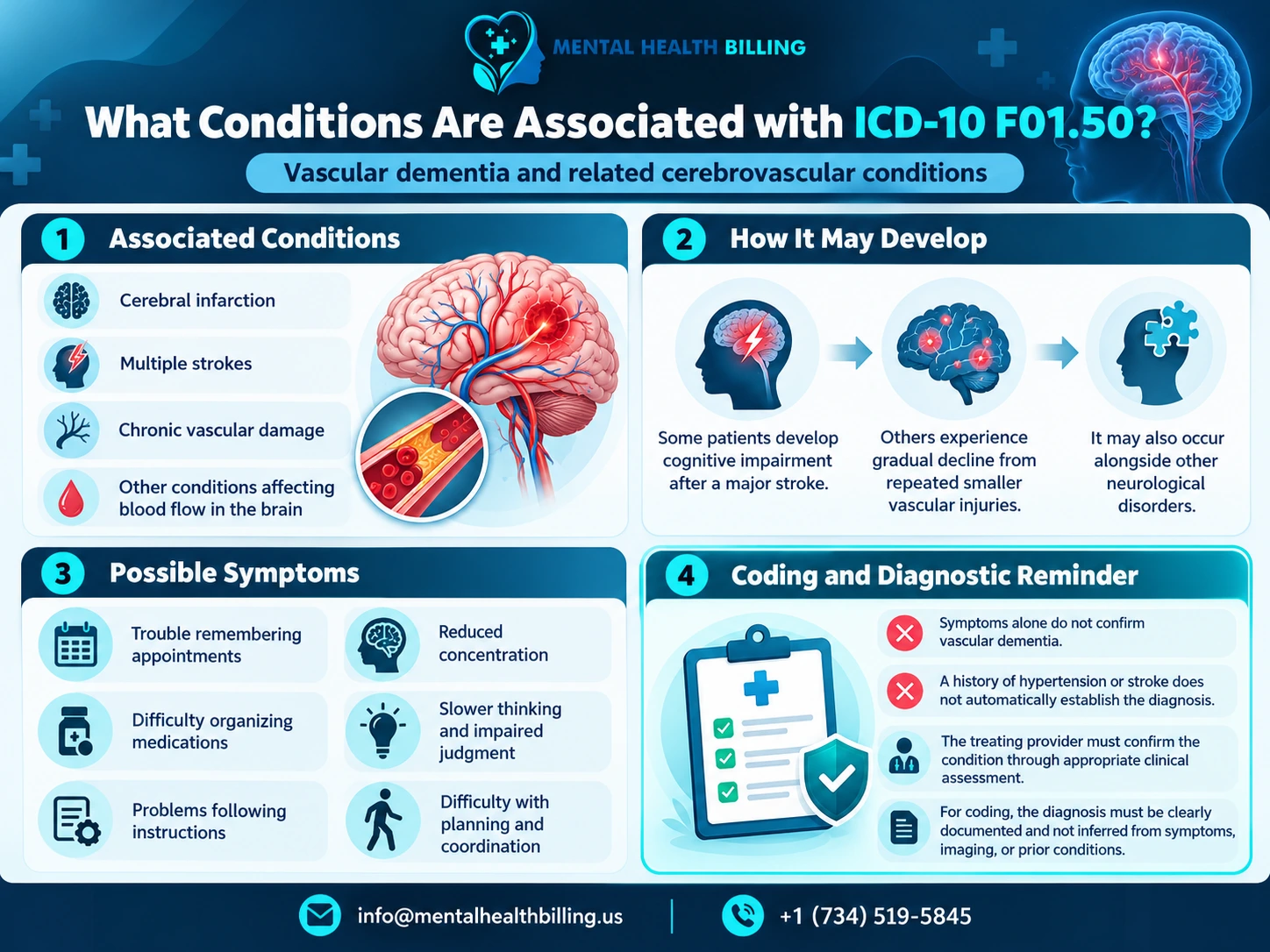
Vascular dementia is associated with cerebrovascular conditions that interfere with normal brain function. These may include cerebral infarction, multiple strokes, chronic vascular damage, and other diseases affecting blood circulation within the brain.
Some patients develop cognitive impairment after a major stroke, while others experience a gradual decline associated with repeated smaller vascular injuries. The condition may also develop alongside other neurological disorders, making accurate diagnosis particularly important.
Patients with vascular dementia may struggle to remember appointments, organize medications, follow instructions, or complete familiar tasks. Others experience reduced concentration, slower thinking, impaired judgment, or difficulty performing activities that require planning and coordination.
However, these symptoms do not automatically establish vascular dementia. A patient with memory loss and a history of hypertension or stroke does not necessarily have a vascular dementia diagnosis. The treating healthcare provider must establish the condition through an appropriate clinical assessment.
For medical coding purposes, the diagnosis must be clearly documented rather than inferred from symptoms, imaging findings, or previously reported medical conditions.
ICD 10 F01.50 coding guidelines
Medical coders must follow the official ICD-10-CM coding conventions when assigning F01.50. The correct diagnosis code depends on the documented type of dementia, its severity, associated disturbances, and any underlying condition requiring additional coding.
Confirm the diagnosis of vascular dementia
Before assigning F01.50, the coding professional must verify that the healthcare provider has documented vascular dementia as an established diagnosis.
The medical record may identify the condition as vascular dementia, multi-infarct dementia, or a major neurocognitive disorder caused by vascular disease. The documentation should provide sufficient information to distinguish the condition from Alzheimer's disease, unspecified dementia, or other cognitive disorders.
For example, a patient may have a history of cerebral infarction and increasing memory difficulties. These findings alone do not permit the coder to assign vascular dementia. The physician must establish the diagnosis and document the relationship between the cognitive disorder and the vascular condition when applicable.
If the documentation is incomplete or contradictory, clarification from the healthcare provider may be necessary before selecting the diagnosis code.
Identify the documented severity of dementia
ICD-10-CM distinguishes vascular dementia according to severity. The classification includes unspecified, mild, moderate, and severe dementia, with different codes available for associated disturbances.
F01.50 is appropriate when the provider documents vascular dementia without establishing a specific severity level and the remaining elements of the code description apply.
If the provider explicitly documents mild vascular dementia without the specified associated disturbances, F01.A0 may be appropriate. Moderate vascular dementia without those disturbances is classified under F01.B0, while severe vascular dementia without those disturbances is classified under F01.C0.
Medical coders should not independently determine dementia severity from cognitive testing scores, the patient's living arrangement, age, or functional limitations. Severity must be established through the healthcare provider's clinical judgment and documentation.
Evaluate behavioral and psychiatric disturbances
Another important consideration when assigning F01.50 is whether the patient has documented behavioral, psychotic, mood, or anxiety disturbances associated with vascular dementia.
The ICD-10-CM classification provides separate codes for vascular dementia with agitation, other behavioral disturbances, psychotic disturbances, mood disturbances, and anxiety. These distinctions help accurately describe the patient's clinical condition.
For example, if a physician documents vascular dementia of unspecified severity with agitation, F01.511 may be appropriate rather than F01.50. Similarly, F01.53 may apply when vascular dementia of unspecified severity is documented with an associated mood disturbance.
Coders should carefully review the medical record to establish whether the disturbance is associated with dementia. Unrelated psychiatric conditions should not automatically be treated as dementia-related disturbances.
Follow code sequencing instructions
Category F01 includes an instruction to code first any applicable underlying causal condition. This means that when the healthcare provider identifies a condition responsible for vascular dementia, the coding professional must evaluate whether that condition should appear before the dementia code.
For instance, if vascular dementia is documented as a consequence of a previous cerebral infarction, the appropriate cerebrovascular sequela code may need to be reported before F01.50.
The exact sequencing depends on the documented diagnosis, applicable ICD-10-CM instructions, and the circumstances of the encounter. Billing professionals should not automatically assign additional cerebrovascular codes without adequate documentation supporting their use.
Difference between ICD 10 F01.50 and related dementia codes
The ICD-10-CM classification contains several vascular dementia codes that distinguish severity and associated behavioral or psychiatric manifestations. Understanding these differences helps coding professionals avoid reporting unspecified codes when the medical record supports a more specific diagnosis.
F01.50 identifies vascular dementia of unspecified severity without the disturbances included in its description. In comparison, F01.511 identifies unspecified-severity vascular dementia with agitation, while F01.518 applies to unspecified-severity vascular dementia with other behavioral disturbances.
F01.52 describes vascular dementia of unspecified severity with psychotic disturbance. F01.53 identifies vascular dementia of unspecified severity with mood disturbance, and F01.54 identifies vascular dementia of unspecified severity with anxiety.
The classification also separates dementia according to documented severity. F01.A0 describes mild vascular dementia without the specified disturbances, F01.B0 describes moderate vascular dementia without those disturbances, and F01.C0 describes severe vascular dementia without those disturbances.
Another important distinction involves F03.90, which identifies unspecified dementia of unspecified severity without behavioral, psychotic, mood, or anxiety disturbance. Unlike F01.50, F03.90 does not establish vascular dementia as the diagnosed type.
Selecting the appropriate diagnosis code requires documentation that supports both the type of dementia and the reported clinical characteristics.
Documentation requirements for ICD 10 F01.50
Proper clinical documentation plays an important role in accurate medical coding and claim submission. Healthcare providers should record enough information to support the diagnosis, explain the patient's clinical condition, and establish the medical necessity of services performed.
Physician diagnosis and clinical assessment
The medical record should clearly identify vascular dementia as the provider's diagnosis. Supporting documentation may describe the patient's cognitive symptoms, neurological findings, relevant medical history, and clinical assessment.
The provider may document memory impairment, reduced concentration, difficulties with executive functioning, or changes in the patient's ability to perform daily activities. Relevant findings from neurological examinations, cognitive assessments, or diagnostic imaging may also contribute to the clinical evaluation.
Although these findings can support the diagnosis, medical coders cannot independently establish vascular dementia by interpreting clinical results. The provider's documented diagnosis remains necessary for code assignment.
Documentation of severity and disturbances
The provider should document the severity of vascular dementia whenever it can be clinically determined. Clear identification of mild, moderate, or severe dementia allows coders to select the corresponding ICD-10-CM code.
If severity is not established, F01.50 may be appropriate when the other coding requirements are satisfied.
Documentation should also address any associated agitation, behavioral changes, psychotic manifestations, mood disturbances, or anxiety that may affect code selection. When the record contains conflicting descriptions of these conditions, the billing or coding team should seek appropriate clarification rather than making unsupported assumptions.
Medical necessity and treatment documentation
The clinical record should also explain the reason for the healthcare encounter and the services furnished.
For example, a neurologist may evaluate changes in cognitive functioning, review the patient's medications, assess safety concerns, and develop a treatment plan. The documentation should describe the relevant clinical findings and management decisions.
Although F01.50 identifies the patient's diagnosis, the code alone does not establish medical necessity for every diagnostic test, procedure, or treatment. Each reported service must satisfy applicable documentation and coverage requirements.
ICD 10 F01.50 billing requirements
ICD-10-CM code F01.50 may be reported on healthcare claims when vascular dementia of unspecified severity is supported by the medical record and the diagnosis meets the remaining requirements of the code description.
Accurate billing requires appropriate diagnosis selection, correct sequencing, and consistency between the clinical documentation and reported healthcare services.
Diagnosis verification before claim submission
Before submitting a claim, medical billing professionals should confirm that the provider has documented vascular dementia and that the diagnosis code accurately reflects the recorded severity and associated disturbances.
If the provider specifies mild, moderate, or severe dementia, the billing department should evaluate the corresponding code rather than automatically reporting F01.50.
The claim should also include any applicable causal condition according to the ICD-10-CM sequencing instructions.
Appropriate CPT and diagnosis code reporting
F01.50 may accompany CPT codes representing medically necessary services furnished to a patient with vascular dementia.
For example, a physician may perform an office evaluation involving cognitive assessment, medication management, and treatment planning. The provider may report an appropriate evaluation and management code when the encounter satisfies the applicable CPT requirements.
However, the exact CPT code depends on the services performed, the documented medical decision-making or qualifying time, and other applicable coding requirements.
Vascular dementia does not automatically justify billing additional cognitive testing, imaging, psychological services, or other procedures. Each service must be supported by the clinical record and the applicable billing rules.
Medicare and commercial payer requirements
Medicare, Medicaid, Medicare Advantage, and commercial insurance plans may have different coverage and payment requirements for services provided to patients with dementia.
A valid diagnosis code does not guarantee reimbursement. Payment depends on the covered procedure, medical necessity, provider eligibility, payer policy, place of service, and applicable reimbursement methodology.
Healthcare organizations should verify the relevant payer requirements for the specific service rather than assuming that every insurance plan applies identical coverage criteria.
Common ICD 10 F01.50 coding and billing errors
One frequent coding error involves reporting F01.50 even though the healthcare provider has documented a specific dementia severity. If the medical record identifies mild, moderate, or severe vascular dementia, the coding professional should use the appropriate classification supported by the documentation.
Another mistake occurs when associated behavioral or psychiatric disturbances are overlooked. For instance, using F01.50 for a patient whose vascular dementia is documented with agitation may result in inaccurate diagnosis reporting.
Incorrect sequencing can also create coding problems. When an applicable causal condition is established, failure to follow the category-level code-first instruction may produce an improperly sequenced claim.
Some medical coders assume that patients with a history of stroke automatically qualify for F01.50. A previous stroke may support the provider's clinical assessment, but it does not independently establish vascular dementia.
Reporting F01.50 for unspecified dementia without a documented vascular origin is another common error. The code should be selected only when the medical record supports vascular dementia rather than an unspecified dementia diagnosis.
Finally, billing departments should avoid treating a valid diagnosis code as automatic evidence of medical necessity. Claims must accurately represent the services performed and satisfy the applicable procedure coding and payer requirements.
Practical ICD 10 F01.50 billing examples
Example 1: Vascular dementia with unspecified severity
A 76-year-old patient visits a neurologist for follow-up management of previously diagnosed vascular dementia. The physician documents ongoing cognitive impairment and vascular dementia but does not classify the condition as mild, moderate, or severe. No associated behavioral, psychotic, mood, or anxiety disturbance is documented.
In this hypothetical situation, F01.50 may be appropriate because the provider has identified vascular dementia without specifying its severity. Any applicable underlying causal condition and sequencing requirements must also be reviewed before claim submission.
Example 2: Vascular dementia with agitation
An elderly patient with established vascular dementia presents for evaluation because of increasing agitation. The physician confirms that agitation is associated with vascular dementia but does not document the dementia severity.
In this example, F01.511 may be more appropriate than F01.50 because the clinical documentation identifies an associated disturbance. Reporting F01.50 would not fully represent the documented condition.
Example 3: Mild vascular dementia
An 81-year-old patient undergoes a follow-up neurological examination for cognitive impairment. The physician documents mild vascular dementia without associated behavioral, psychotic, mood, or anxiety disturbances.
F01.A0 would be more appropriate than F01.50 because the provider has established the severity as mild. Using an unspecified-severity code would fail to capture the additional clinical detail available in the medical record.
These hypothetical examples demonstrate diagnosis-code selection. They do not establish automatic insurance coverage or reimbursement for a particular healthcare service.
Does ICD 10 F01.50 affect reimbursement?
ICD-10-CM code F01.50 can influence diagnosis reporting, medical necessity review, risk adjustment, and certain payment classifications. However, the code does not carry a universal reimbursement amount.
For outpatient professional services, reimbursement generally depends on the CPT or HCPCS procedure code, the payer's payment methodology, the billing provider, the location of service, and the applicable fee schedule.
Diagnosis codes explain the patient's medical condition and help establish the clinical reason for treatment. They do not independently determine the payment amount for a specific office visit, diagnostic procedure, or other service.
Vascular dementia diagnoses may also be relevant to certain risk adjustment methodologies, including Medicare Advantage models. Whether a reported diagnosis affects risk adjustment depends on the applicable model version, documentation, reporting requirements, and eligibility rules.
Billing professionals should verify the payment methodology relevant to the healthcare organization rather than assuming that F01.50 automatically produces a higher reimbursement amount.
Frequently asked questions about ICD 10 F01.50
Is ICD 10 F01.50 a billable diagnosis code?
Yes. F01.50 is a billable and specific ICD-10-CM diagnosis code describing vascular dementia of unspecified severity without behavioral disturbance, psychotic disturbance, mood disturbance, or anxiety. It may be reported when the healthcare provider's documentation supports the diagnosis and applicable coding requirements are satisfied.
What is the difference between F01.50 and F03.90?
F01.50 identifies vascular dementia, whereas F03.90 identifies unspecified dementia of unspecified severity without behavioral, psychotic, mood, or anxiety disturbance. The primary difference is whether the healthcare provider has established the vascular origin of dementia. If dementia is documented without an identified type, F01.50 should not be assigned solely because the patient has vascular risk factors.
Can ICD 10 F01.50 be used for patients with a history of stroke?
F01.50 may be appropriate when a healthcare provider diagnoses vascular dementia and the medical record supports that diagnosis. A history of stroke alone does not establish vascular dementia. When the condition is related to a previous cerebrovascular event, the coding professional should also evaluate applicable causal-condition codes and sequencing instructions.
Can F01.50 be reported when dementia severity is unknown?
Yes. F01.50 specifically represents vascular dementia of unspecified severity. It may be appropriate when the provider documents vascular dementia but does not identify the condition as mild, moderate, or severe, provided the remainder of the code description and applicable coding instructions are satisfied.
Is F01.50 used for Alzheimer's disease?
No. F01.50 identifies vascular dementia rather than Alzheimer's disease. Alzheimer's disease and dementia associated with Alzheimer's disease are classified using other applicable ICD-10-CM codes. When a patient has more than one type of dementia, the coding professional should review the documented diagnoses and relevant classification instructions.
Key considerations for accurate ICD 10 F01.50 coding
ICD 10 F01.50 identifies vascular dementia of unspecified severity without behavioral disturbance, psychotic disturbance, mood disturbance, or anxiety. Accurate coding requires documentation that establishes the vascular dementia diagnosis and supports the characteristics represented by the selected code.
Healthcare providers should document dementia severity, relevant associated disturbances, and applicable underlying conditions whenever clinically established. Medical coders must review these details carefully and follow the ICD-10-CM sequencing instructions before submitting claims.
Although F01.50 is a valid billable diagnosis code, reimbursement depends on the healthcare services provided and the applicable payer requirements. Accurate diagnosis reporting, appropriate CPT code selection, and sufficient clinical documentation help reduce preventable coding errors and support compliant medical billing.