



The HH modifier in mental health billing identifies services associated with an integrated mental health and substance abuse treatment program. It is particularly relevant to certain Medicaid behavioral health programs that treat individuals experiencing both psychiatric conditions and substance use disorders.
Behavioral health providers must understand how this modifier works because its use depends on the specific service, program requirements, and payer billing instructions. Applying HH to an unsupported procedure code or using it without meeting program criteria can result in a rejected or denied claim.
Although HH has a nationally recognized description, individual Medicaid programs determine which services require it and how it should appear on claims. Understanding these differences helps mental health professionals, billing specialists, and coding students report integrated treatment services accurately.
What is the HH modifier in mental health billing?
The HH modifier is a Healthcare Common Procedure Coding System (HCPCS) Level II modifier with the official description "Integrated mental health/substance abuse program."
The Centers for Medicare & Medicaid Services (CMS) maintains the HCPCS Level II coding system. Its October 2026 quarterly update, published September 23, 2026, contains the current national coding files used to identify procedures, services, and modifiers.
Modifier HH communicates that a service belongs to an integrated treatment program addressing both mental health and substance use conditions.
Unlike a procedure code, HH does not independently describe the clinical service performed. Instead, it supplies additional information about the treatment program associated with the service.
For example, an eligible behavioral health facility might use HH with a designated residential treatment code when providing services through a recognized program for individuals with co-occurring mental health and substance use disorders.
The modifier does not automatically establish medical necessity, determine reimbursement, or prove that a patient qualifies for a particular benefit.
Why is the HH modifier important for integrated behavioral health services?
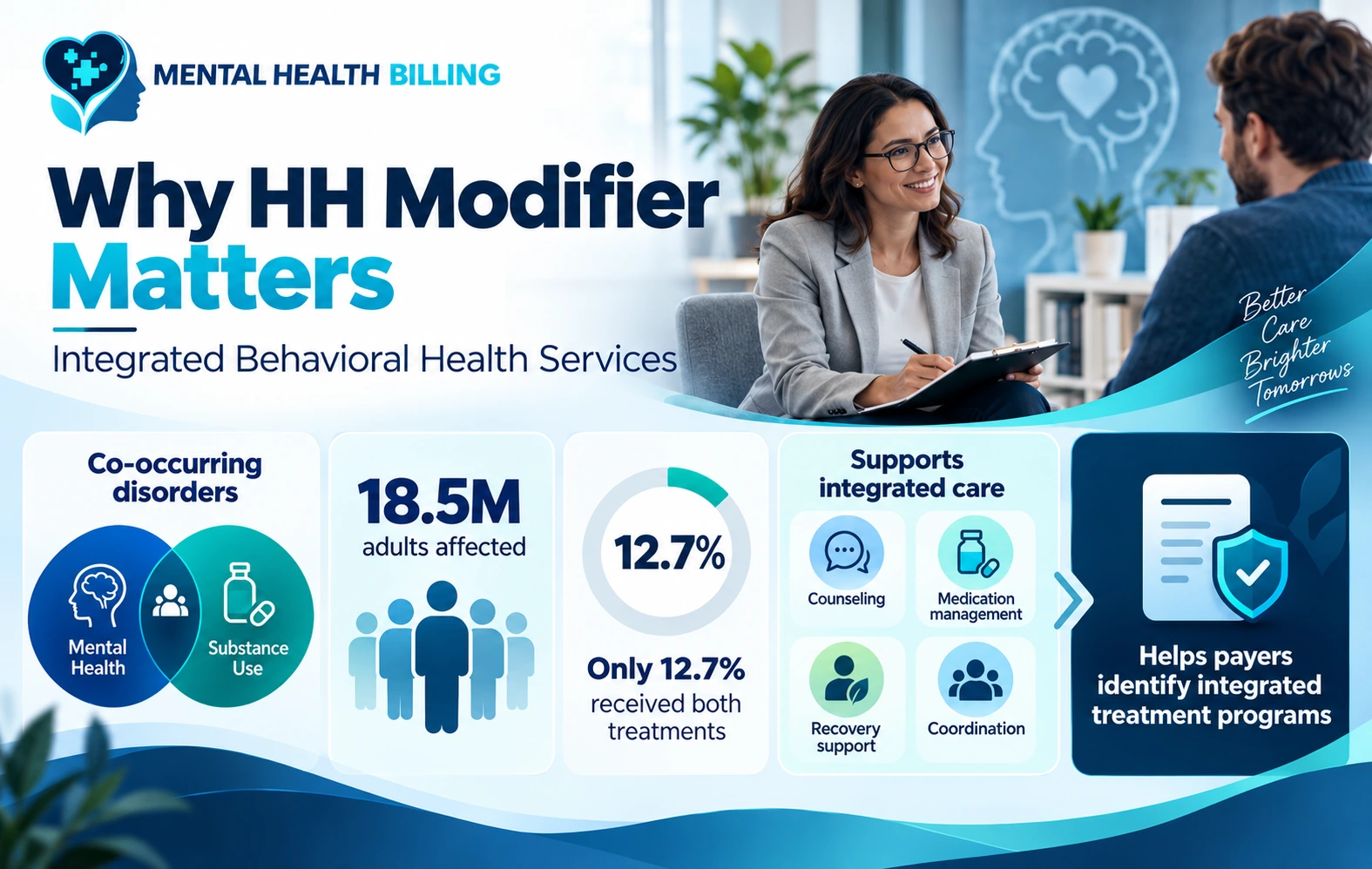
Many patients receiving behavioral health treatment experience more than one condition. Depression may occur alongside alcohol use disorder, while anxiety, post-traumatic stress disorder, or bipolar disorder may coexist with opioid or stimulant use disorders.
These situations are commonly described as co-occurring mental health and substance use disorders.
According to the Substance Abuse and Mental Health Services Administration (SAMHSA), approximately 18.5 million American adults experienced both a substance use disorder and any mental illness during 2025. The findings were published in the agency's 2025 National Survey on Drug Use and Health report, released in July 2026.
The same report found that only 12.7% of adults experiencing both conditions received both substance use treatment and mental health treatment during the year.
These figures help explain the need for treatment programs capable of addressing both conditions.
Integrated behavioral health treatment may combine psychiatric assessment, counseling, addiction treatment, medication management, relapse prevention, and coordinated recovery services.
SAMHSA recommends integrated treatment for people experiencing co-occurring disorders because addressing both conditions can improve continuity of care and reduce gaps between separate treatment systems.
Within qualifying programs, modifier HH helps payers distinguish services delivered through an integrated mental health and substance use treatment model from services provided through other behavioral health programs.
When should providers use the HH modifier?
The HH modifier should be used when the applicable payer requires or permits it for a covered service delivered through an eligible integrated mental health and substance abuse program.
Its use depends on more than the patient's diagnosis.
A person may have both major depressive disorder and alcohol use disorder without receiving treatment through a program recognized by the payer as an integrated service.
For instance, a private therapist who treats depression and discusses a patient's alcohol consumption cannot assume that modifier HH is appropriate for an ordinary psychotherapy claim.
The provider must establish whether the service falls under a qualifying program and whether the payer's billing instructions support the modifier.
Some state Medicaid programs specifically recognize integrated services for individuals with co-occurring disorders. Others associate HH with particular residential programs, rehabilitation services, or specially certified treatment arrangements.
Providers should therefore verify the relevant state Medicaid manual, current procedure code schedule, provider enrollment requirements, and managed care contract before reporting HH.
Having two diagnoses does not automatically justify the HH modifier. The service and program must satisfy the payer's requirements.
How does the HH modifier work in mental health billing?
Modifier HH is reported alongside an eligible CPT or HCPCS procedure code on a claim.
The procedure code identifies the service furnished, while the modifier supplies additional information required by the payer's coding rules.
For claims submitted electronically, the modifier must appear in the appropriate procedure-code modifier field. Billing software and clearinghouses generally support these fields, although the underlying claim format and payer edits determine how the information is processed.
Correct placement alone does not establish compliance.
The billing team must confirm that the procedure is covered, the provider is authorized to furnish it, the patient meets applicable eligibility requirements, and the reported units correspond to the documented service.
Some payers require additional modifiers identifying practitioner qualifications, service settings, or other program characteristics.
Modifier sequencing also requires attention. A combination accepted under one state's Medicaid rules may be rejected under another program's requirements.
Before submission, providers should compare the complete procedure-code and modifier combination against the payer's current billing instructions.
Example of HH modifier billing
Louisiana Medicaid provides a useful example through its Specialized Behavioral Health Services Fee Schedule.
The published schedule identifies HCPCS code H0018 with modifier HH for a co-occurring therapeutic group home per diem service for eligible beneficiaries ages 0 through 20.
In this case, HH distinguishes the co-occurring treatment category from other therapeutic group home service categories reported under H0018.
The modifier identifies a defined program category within the state's reimbursement structure.
This example should not be interpreted as permission to append HH to every H0018 claim. Eligibility, covered services, authorization requirements, and the applicable fee schedule must still be verified.
HH modifier documentation requirements
Accurate documentation is necessary to support behavioral health claims involving modifier HH.
Clinical records should establish the services performed, the patient's treatment needs, and the relationship between the encounter and the qualifying integrated program.
When applicable, documentation should include the patient's mental health and substance use assessments, diagnoses supported by clinical findings, individualized treatment plan, and progress toward established treatment goals.
Progress notes should describe the intervention delivered rather than relying on broad statements such as "integrated counseling provided."
For example, a note might document a counseling intervention addressing depressive symptoms alongside relapse-prevention strategies for alcohol use disorder.
The record should also contain the service date, rendering practitioner, duration or other relevant unit information, and evidence of the patient's participation when required by the billing policy.
Programs subject to special certification or authorization requirements should maintain records demonstrating continued compliance.
The presence of appropriate documentation supports the claim, but it cannot substitute for an underlying coverage or program eligibility requirement.
HH modifier vs. HE, HF, and other behavioral health modifiers
Several HCPCS modifiers are used in behavioral health billing, and their descriptions can appear similar.
Modifier HE identifies a mental health program, while modifier HF identifies a substance abuse program. Modifier HH applies to an integrated mental health and substance abuse program.
Modifier HG identifies an opioid addiction treatment program, and modifier HI describes an integrated mental health and intellectual disability or developmental disabilities program.
Another commonly encountered modifier, HQ, identifies services provided in a group setting.
These distinctions help explain why providers should not substitute one modifier for another simply because the patient receives behavioral health treatment.
For example, individual counseling delivered through a substance use treatment program might require HF under the applicable payer instructions. A service furnished through an approved integrated program may instead require HH or a payer-specified combination of modifiers.
The correct selection depends on the individual procedure code and billing policy.
State-specific instructions can also assign particular operational uses to these modifiers. California's September 2025 Specialty Mental Health Services Billing Manual, for example, identifies HH as the modifier mapping certain caregiver service claims to the psychosocial rehabilitation service category.
This illustrates why national modifier descriptions must be interpreted alongside the payer's detailed billing requirements.
Is the HH modifier covered by Medicare and Medicaid?
The HH modifier is most commonly relevant to selected Medicaid behavioral health billing arrangements, although actual coverage depends on the state program and payer contract.
Medicaid programs differ in their definitions of covered behavioral health services, provider qualifications, authorization procedures, and reimbursement methodologies.
A modifier appearing in a state's billing manual does not mean every enrolled behavioral health provider can use it.
Medicare billing requires a separate distinction.
CMS recognizes HH as an HCPCS modifier, but its existence does not create an independent Medicare payment benefit or increase the reimbursement for a psychiatric service.
Medicare also maintains separate billing provisions for behavioral health integration.
In its January 2026 Behavioral Health Integration Services publication, CMS explains the use of CPT code 99484 for general behavioral health integration and CPT codes 99492, 99493, and 99494 for psychiatric Collaborative Care Model services.
These codes describe specific care management services and have their own billing requirements.
They should not be confused with the HH modifier, which identifies an integrated mental health and substance use program under applicable coding instructions.
Common HH modifier billing mistakes
An incorrect modifier may produce a claim edit, denial, or payment that later requires correction.
One common problem involves applying HH solely because the patient has co-occurring psychiatric and substance use diagnoses. The patient's clinical conditions do not independently establish that the service was delivered through an eligible integrated treatment program.
Another mistake is attaching HH to a procedure code that does not support the modifier under the payer's billing policy.
This can occur when billing staff use a generic modifier list rather than reviewing the relevant state Medicaid fee schedule.
Documentation gaps present another concern. A claim may identify an integrated treatment program, while the associated progress note describes only an unspecified counseling session without sufficient detail to establish the covered service.
Incorrect modifier combinations can also affect claim processing. Some programs require additional modifiers, while others restrict the number or sequence of modifiers accepted for a particular service.
Using outdated Medicaid billing instructions creates further risk because procedure-code combinations, covered services, and reimbursement policies can change.
To reduce these errors, practices should maintain payer-specific coding references and review modifier requirements whenever policies are updated.
How to correct an HH modifier claim denial
When a behavioral health claim involving HH is denied, the billing department should begin by reviewing the payer's explanation of benefits or electronic remittance advice.
The denial reason helps determine whether the problem concerns coverage, eligibility, authorization, modifier compatibility, or documentation.
If the payer rejects the modifier combination, verify the procedure code against the current Medicaid billing schedule and confirm whether HH is permitted for the specific service.
For a denial involving program eligibility, review the patient's enrollment status and the provider's authorization to furnish the integrated treatment service.
Documentation-related denials may require an appeal supported by existing clinical records, treatment plans, or authorization documents.
If the original claim contains a coding error, submit a corrected claim according to the payer's instructions. An appeal is generally more appropriate when the original billing was accurate and the payer's determination is being disputed.
Practices should avoid repeatedly resubmitting unchanged claims because duplicate submissions may create additional processing problems.
Tracking HH-related denials by payer, procedure code, and reason can help identify recurring issues in billing software configuration or staff coding practices.
Frequently asked questions about the HH modifier
Can the HH modifier be used with psychotherapy codes?
Possibly, but only when the applicable payer permits the modifier with the psychotherapy code and the service satisfies relevant program requirements.
A standard psychotherapy service does not automatically qualify for HH because the patient has co-occurring mental health and substance use conditions.
Does modifier HH increase reimbursement?
Not automatically. The modifier identifies a program category, while reimbursement is determined by the payer's published rates, contracts, and payment rules.
Some programs establish separate reimbursement arrangements for designated co-occurring treatment services. Others may use HH primarily to classify the service without changing its payment amount.
Can private mental health practices bill with modifier HH?
A private practice may use HH only when the payer's policy authorizes that modifier for the practice's services and program arrangements.
Simply providing counseling to patients with both mental health and substance use diagnoses is insufficient.
Is prior authorization required when using HH?
Authorization requirements depend on the service and payer. Some residential or structured behavioral health treatment programs require prior authorization, while other covered services may follow different rules.
HH itself does not establish whether authorization is necessary.
What providers should remember about the HH modifier in mental health billing
The HH modifier in mental health billing identifies services associated with an integrated mental health and substance abuse treatment program. It provides additional program information when used with an eligible procedure code.
Correct billing requires verification of the service, program eligibility, payer-specific modifier rules, and supporting clinical documentation.
Healthcare providers should rely on current Medicaid billing manuals and payer instructions rather than applying HH to every encounter involving co-occurring disorders.
Accurate modifier selection allows claims to describe the treatment arrangement correctly while reducing avoidable coding errors and reimbursement disputes.