



Choosing the best medical billing service for multi-location therapy practices requires examining how a vendor handles the details between locations: provider enrollment, authorization tracking, claim routing, payment reconciliation, and accountability.
A company may process claims accurately for one office yet struggle to explain why another office has growing unpaid balances. Practice-wide collection totals cannot answer every operational question.
This guide focuses on outpatient mental health and psychotherapy groups. Practices offering physical, occupational, or speech therapy should also evaluate vendors against those specialties’ separate coding and coverage requirements.
What should the best medical billing service for multi-location therapy practices handle?
Start by defining the work you expect the billing company to own. “Full-service billing” is too imprecise for comparing proposals.
Ask each candidate to identify responsibility for eligibility checks, authorizations, coding review, claim submission, rejections, denials, payment posting, patient balances, and provider enrollment. Record which tasks require action from your staff.
For example, who notices that an authorization is approaching its visit limit? Who requests an extension? Who alerts scheduling if approval remains unresolved?
Document these handoffs before discussing price. Otherwise, two proposals with similar fees may cover substantially different workloads.
Verify enrollment by provider, payer, and location
Ask for an enrollment matrix showing each clinician’s status by payer, applicable group entity, and service location. Include effective dates and outstanding applications.
Medicare illustrates why this detail deserves attention. The Centers for Medicare & Medicaid Services’ December 2025 publication, Medicare Provider Enrollment, clarifies the differences between individual and group enrollment and outlines how benefits can be reassigned. It also requires physicians, nonphysician practitioners, and their organizations to report practice-location changes within 30 days. That deadline should not be assumed to apply to every payer.
Consider a hypothetical therapist who starts seeing patients at a second office. Ask the vendor how it would verify the applicable payer’s requirements before releasing claims from that location.
A useful answer should identify the records checked, supporting confirmation retained, unresolved questions, and the person responsible for follow-up. “The therapist is credentialed” does not establish whether the specific billing arrangement has been verified.
Look for psychotherapy coding oversight
Ask who reviews coding questions, what qualifications they hold, and how they resolve disagreements with clinicians. Request a de-identified example of a coding query and its resolution.
Palmetto GBA’s Billing and Coding: Outpatient Psychotherapy (A59723), effective October 20, 2024, identifies psychotherapy time, therapeutic interventions, treatment goals, and progress among its documentation expectations. This is contractor-specific Medicare guidance, so a vendor should distinguish it from another payer’s requirements.
During evaluation, present a practical question: a scheduled appointment lasts an hour, but the documented psychotherapy time is shorter. Ask what the biller checks before selecting or approving the code.
Also ask how the company handles missing documentation. Require a written query process, a visible hold queue, and escalation to the responsible clinician. Coding questions should remain traceable through resolution.
Examine eligibility and authorization workflows
Ask the vendor to demonstrate how benefits and authorization details are documented and managed across different offices.
The working record should capture the payer’s response, verification date, applicable services, authorized dates, visits or units, and relevant provider or location restrictions. Ask how the team identifies information that needs rechecking.
Use a hypothetical patient attending appointments at two branches. Have the vendor explain how both offices would see authorization usage without maintaining conflicting balances.
Then test the exception process. If the payer’s portal and telephone representative provide different answers, who investigates? What evidence is retained? How is scheduling informed?
These questions reveal whether benefit verification produces usable information or simply a completed checkbox.
Require location-level reporting
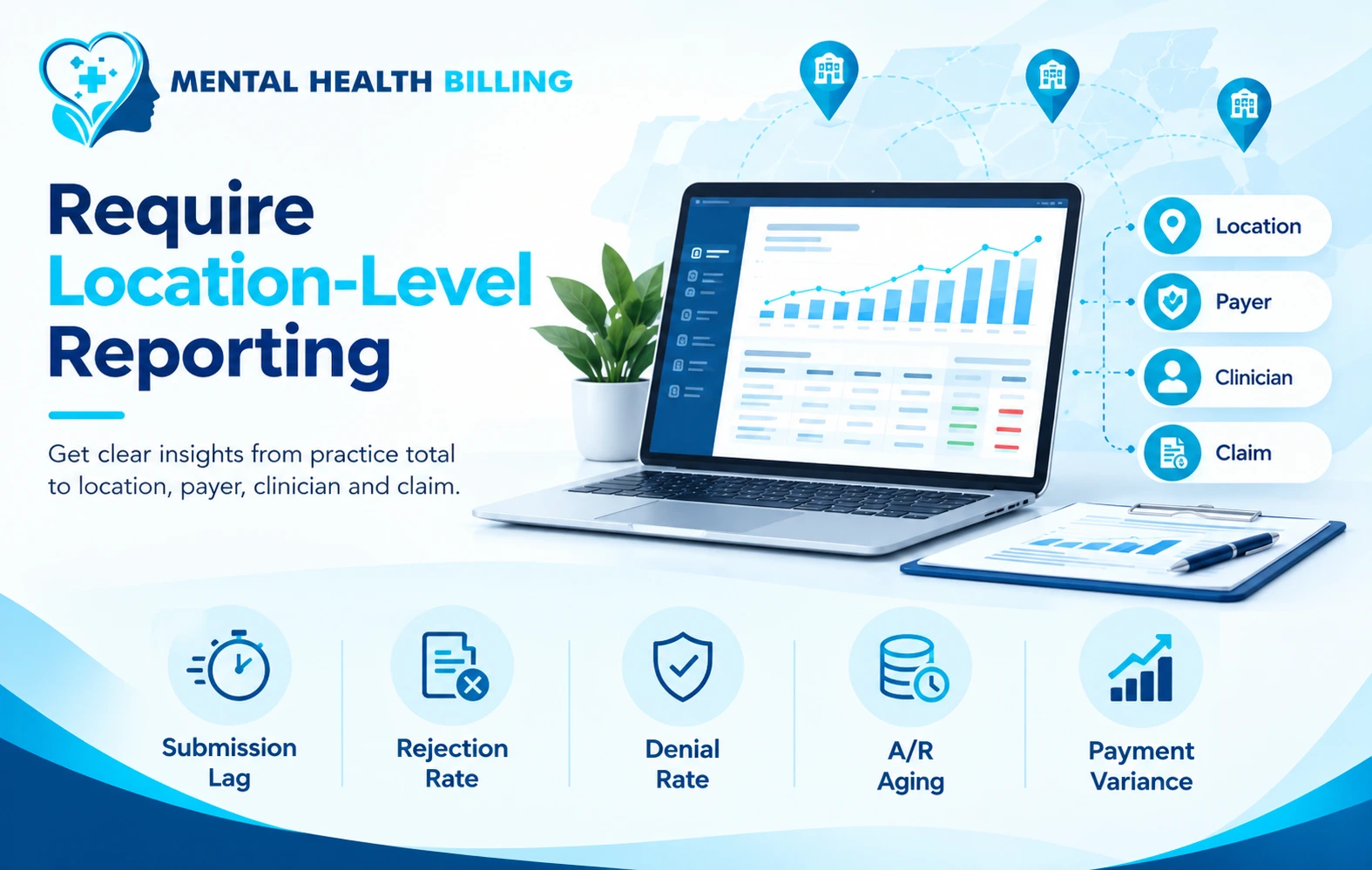
Request a sample report before signing. It should let you move from the practice total to a location, payer, clinician, and individual claim.
The following comparison can guide your review:
| Measure | Definition to request | What to investigate |
|---|---|---|
| Submission lag | Time from completed documentation to initial submission | Claims waiting after notes are ready |
| Rejection rate | Rejected submissions divided by a stated submission population | Errors preventing claims from entering adjudication |
| Denial rate | Denied claims or lines divided by a defined adjudicated population | Coverage, coding, or processing problems |
| A/R aging | Outstanding balances grouped by a consistent aging date | Older unpaid insurance and patient balances |
| Payment variance | Payment compared with the applicable expected allowance | Potential underpayments |
Require written definitions. A denial rate calculated by claim count cannot be directly compared with one calculated by claim-line count.
Review adjustments alongside collections. If a vendor removes balances through write-offs, the aging report may improve without additional cash being collected. Ask who approves adjustments and how reports distinguish contractual adjustments from other write-offs.
Ask to see denial work, not just denial totals
A denial report identifies unresolved claims. Your evaluation should also establish what the billing team does with them.
Request a de-identified work queue showing the denial reason, assigned employee, action taken, next follow-up date, and applicable deadline. Ask how staff decide between a corrected claim, reconsideration, appeal, or request for missing information.
Give the vendor a hypothetical cluster of claims denied from one location. Its investigation should examine shared characteristics, such as provider setup, authorization information, or claim-field mapping, before treating every account as an unrelated problem.
Also separate inherited accounts receivable from newly generated claims. Require distinct reporting so you can assess current billing performance without losing sight of the older backlog.
Test the workflow inside your EHR
A vendor’s statement that it “works with” your electronic health record does not explain how its employees will use it.
Ask for a demonstration using a test environment or de-identified records. Follow one encounter through charge review, submission, acknowledgment, payment posting, and balance resolution.
Inspect where staff record follow-up notes and how your managers can retrieve them. Ask whether information is entered directly, imported, or transferred manually.
For multiple offices, test location selection, rendering-provider mapping, billing-entity selection, and access permissions. If branches use separate databases, ask how the vendor produces consolidated reports while preserving the source account details.
Include payment reconciliation in the demonstration. Have the vendor show how it investigates a remittance that does not match the deposit or posted payments.
Review privacy controls and subcontractors
The U.S. Department of Health and Human Services’ Office for Civil Rights, in its Business Associates guidance accessed October 20, 2026, identifies billing and claims processing involving protected health information as business-associate activities. The guidance describes required business associate agreements and obligations involving subcontractors.
Request the proposed agreement before providing patient information.
Then ask operational questions: Which employees and subcontractors will access records? How are accounts approved and removed? What activity can your practice audit? How will security incidents be reported?
HHS’s Minimum Necessary Requirement guidance, revised April 4, 2003, explains that covered entities generally must limit applicable uses, disclosures, and requests to the information needed for the purpose, with specified exceptions. Use this principle when deciding what billing personnel can access.
Request access settings matched to job responsibilities rather than assuming every billing employee needs unrestricted chart access.
Compare the complete cost
Ask vendors to price the same defined scope using the same practice information.
For percentage-based proposals, establish exactly which receipts generate fees. Clarify treatment of patient payments, old A/R recoveries, refunds, recoupments, and money collected after termination.
For flat or per-claim proposals, ask how additional locations, providers, corrected claims, appeals, and patient statements affect charges.
An illustrative calculation helps expose the difference. At $200,000 in eligible monthly collections, a 3% fee equals $6,000. If a hypothetical proposal also includes $1,500 in monthly mandatory charges, the total is $7,500, equivalent to 3.75% of those collections. These figures illustrate arithmetic, not market pricing.
Price the responsibilities your staff will retain, too. A proposal that excludes authorization follow-up may require additional internal labor.
Put service expectations and transition duties in writing
Specify turnaround expectations for completed encounters, rejected claims, denial follow-up, unresolved questions, and monthly reporting.
Each commitment needs a starting point. “Claims submitted within two business days” is ambiguous unless the agreement explains whether timing begins at the appointment, signed note, or receipt of all required information.
Require reports to identify claims held for practice action, with the missing item and responsible person clearly recorded.
Before transition, request an inventory of open claims, unposted payments, credit balances, outstanding appeals, and enrollment issues. Assign responsibility for work that crosses the changeover date.
The agreement should also explain termination assistance, data exports, access removal, and delivery of claim histories and follow-up notes.
Choose through evidence
A suitable medical billing service for multi-location therapy practices should provide clear evidence of its processes through an enrollment matrix, office-specific reports, documented coding inquiries, and trackable claim follow-ups.
Evaluate a limited sample of accounts or one location before expanding the engagement where practical. Agree on the starting balances and reporting definitions, then inspect what the vendor submits, resolves, collects, and leaves outstanding. This evidence provides your practice with a solid, well-supported basis for choosing a billing partner