



CPT Code 99493 Updates for 2026: What Providers Should Know
Plenty of billing blogs told providers that CPT code 99493 was deleted for 2026 and that any claim carrying it would be denied. That is wrong. The code that covers subsequent months of psychiatric collaborative care is still valid, still payable, and in some settings it now matters more than it did a year ago. What changed is the machinery around it: which providers report it, how much it pays, and how it interacts with a set of new Medicare add-on codes that share its relative values but not its purpose.
This post separates the real 2026 changes from the misinformation, using the CY 2026 Medicare Physician Fee Schedule final rule (CMS-1832-F) and guidance published directly by the Centers for Medicare & Medicaid Services.
What CPT code 99493 covers
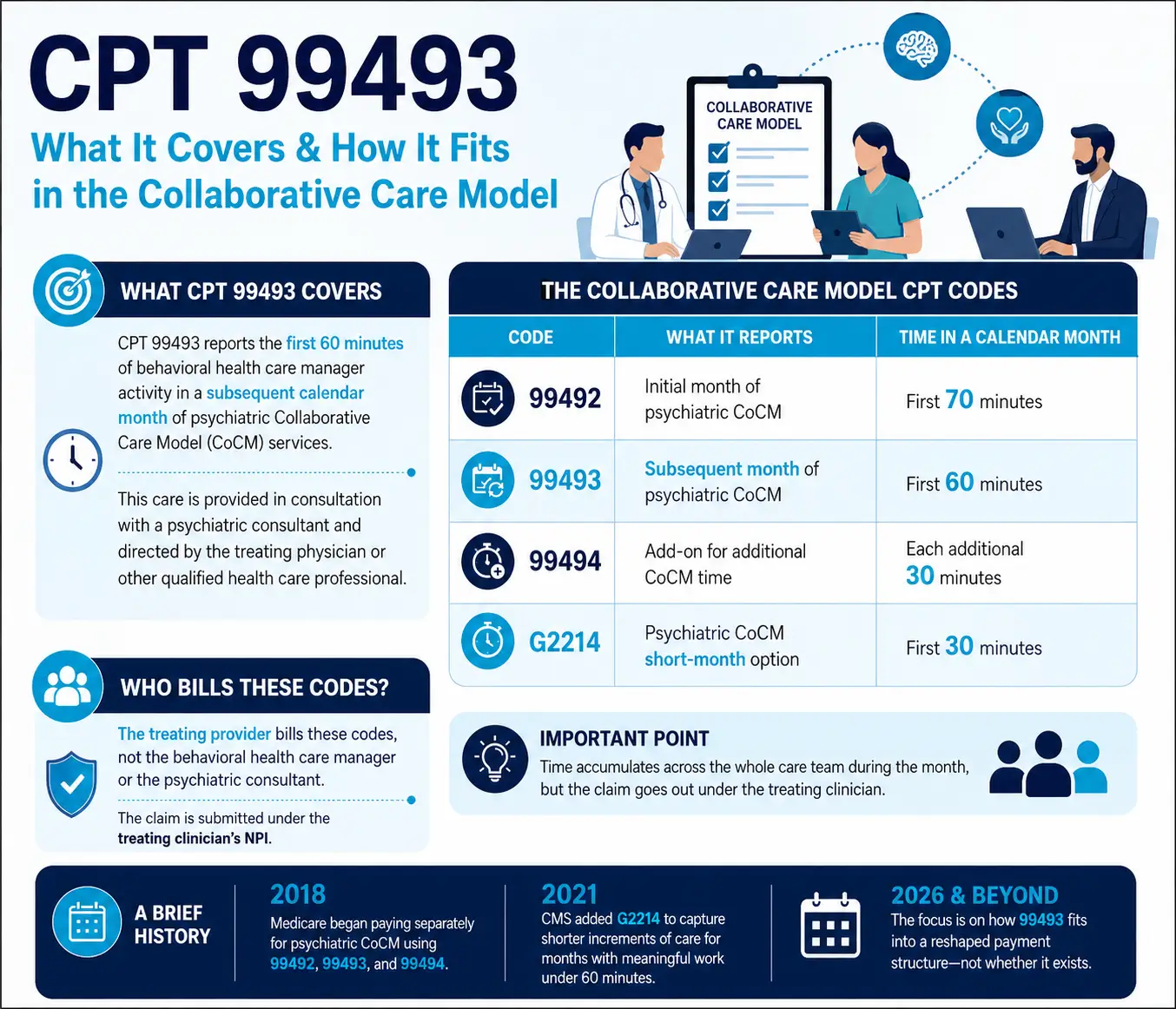
CPT 99493 reports the first 60 minutes of behavioral health care manager activity in a subsequent calendar month of psychiatric Collaborative Care Model (CoCM) services, in consultation with a psychiatric consultant and directed by the treating physician or other qualified health care professional. It sits in the middle of a small family of codes:
Code | What it reports | Time in a calendar month |
99492 | Initial month of psychiatric CoCM | First 70 minutes |
99493 | Subsequent month of psychiatric CoCM | First 60 minutes |
99494 | Add-on for additional CoCM time | Each additional 30 minutes |
G2214 | Psychiatric CoCM short-month option | First 30 minutes |
One point trips up new billers. The behavioral health care manager and the psychiatric consultant do not bill these codes. The treating provider does, under their own National Provider Identifier. That is the physician, nurse practitioner, physician assistant, clinical nurse specialist, or certified nurse midwife who owns the patient relationship and receives the psychiatric consultation. Time accumulates across the whole care team during the month, but the claim goes out under the treating clinician.
The model itself is not new. Medicare began paying separately for psychiatric CoCM in 2018 using 99492, 99493, and 99494. In 2021, CMS added G2214 to capture shorter increments of care for months when the team does meaningful work but does not reach the 60 minute threshold. So 99493 has eight years of billing history behind it. The 2026 questions are not about whether it exists. They are about how it fits into a reshaped payment structure.
The 2026 change that caused the most confusion
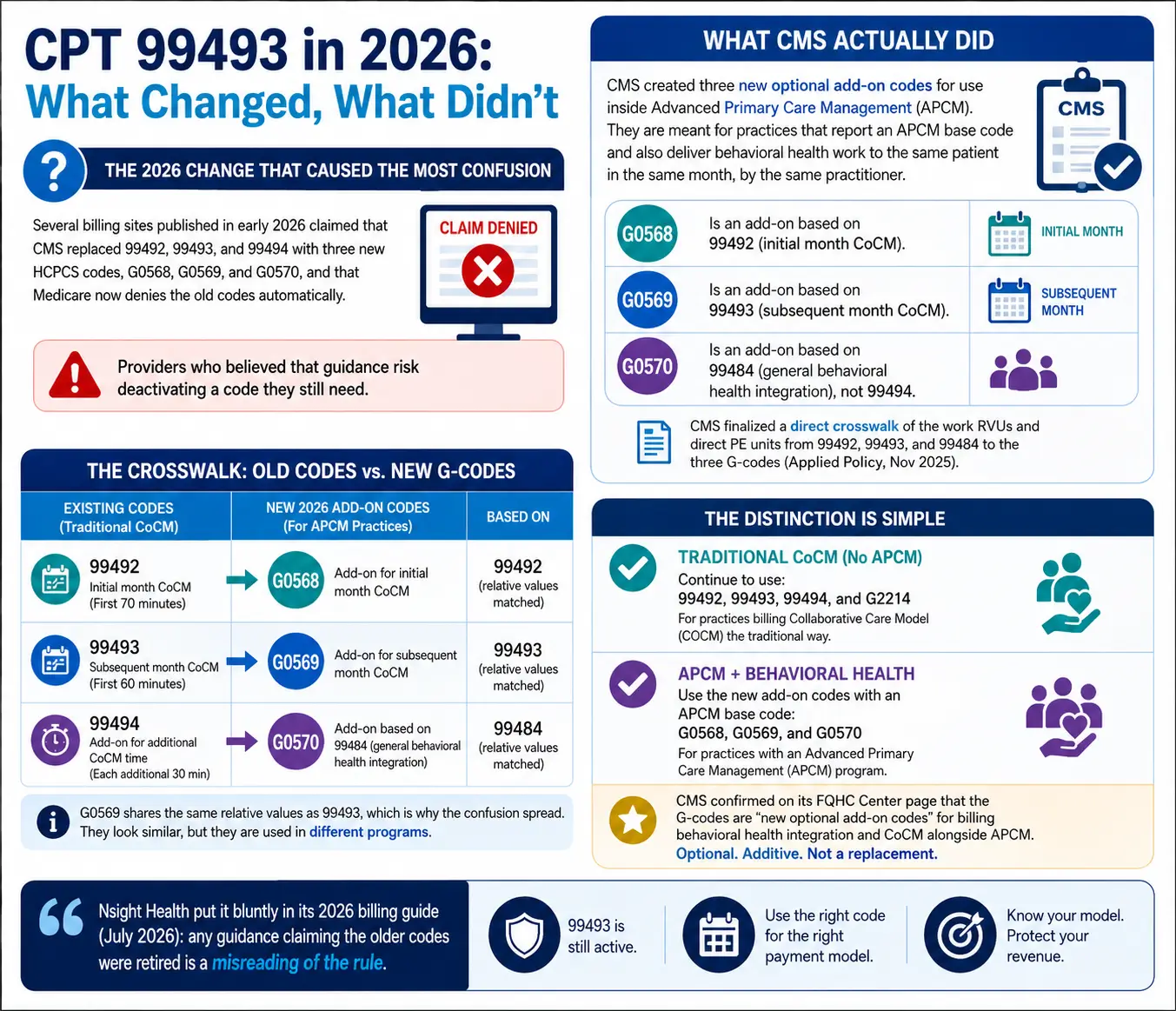
Several billing sites published in early 2026 claimed that CMS replaced 99492, 99493, and 99494 with three new HCPCS codes, G0568, G0569, and G0570, and that Medicare now denies the old codes automatically. Providers who believed that guidance risk deactivating a code they still need.
Here is what the final rule actually did. CMS created three new optional add-on codes for use inside Advanced Primary Care Management (APCM). They are meant for practices that report an APCM base code and also deliver behavioral health work to the same patient in the same month, by the same practitioner. The agency built them by copying the relative values of existing codes:
- G0568 is an add-on based on 99492 (initial month CoCM).
- G0569 is an add-on based on 99493 (subsequent month CoCM).
- G0570 is an add-on based on 99484 (general behavioral health integration), not 99494.
CMS finalized a direct crosswalk of the work relative value units and direct practice expense units from 99492, 99493, and 99484 to the three G-codes, according to the final rule summary published by Applied Policy in November 2025. That crosswalk is exactly why the confusion spread. G0569 shares the same relative values as 99493, so at a glance the two codes look interchangeable. They are not.
The distinction is simple once stated plainly. A practice that bills CoCM the traditional way, without APCM, continues to use 99492, 99493, 99494, and G2214. A practice that has built an APCM program can instead layer collaborative care on top of the APCM base code using G0568, G0569, and G0570. CMS confirmed on its Federally Qualified Health Center Center page that the new G-codes are “new optional add-on codes” for billing behavioral health integration and CoCM alongside APCM. Optional. Additive. Not a replacement.
Nsight Health put it bluntly in its 2026 billing guide, published July 2026: any guidance claiming the older codes were retired is a misreading of the rule.
What actually changed for 99493 in 2026
Three real changes affect how 99493 gets billed and paid this year. None of them delete the code.
FQHCs and rural health clinics now bill 99493 directly
Before 2026, federally qualified health centers and rural health clinics could not report the standard CoCM codes to Medicare. They billed a single bundled code, G0512, for the entire collaborative care service. As of January 1, 2026, CMS discontinued G0512 (along with the older bundled codes G0511 and G0071). FQHCs and RHCs now report the individual component codes, 99492, 99493, 99494, and G2214, at the national non-facility rate. CMS states plainly that G0512 and G0071 are no longer reportable beginning January 1, 2026.
The reason behind the change is worth knowing. The Agency for Healthcare Research and Quality reported that research from the Bowman Family Foundation found the G0512 requirement was linked to low use of behavioral health integration services at FQHCs and RHCs. Forcing safety-net clinics into a single bundled code appears to have suppressed uptake of a service that helps exactly the populations those clinics serve. Unbundling lets these settings apply Medicare’s standard billing rules and, in many cases, collect more for the same work.
For a large share of the safety-net system, then, 99493 went from unavailable to required overnight. Any FQHC or RHC still submitting G0512 in 2026 will see the claim rejected, and the fix is to report the component codes instead. This change applies to Medicare only. Clinics billing Medicaid should follow their state’s policy, and states are transitioning on their own timelines. Texas Medicaid, for example, added FQHC and RHC provider types to 99492, 99493, 99494, and G2214 effective for dates of service on or after January 1, 2026, in an update it published in April 2026.
The conversion factor went up for the first time in five years
Medicare payment for any code equals its geographically adjusted relative value units multiplied by a conversion factor. For 2026, CMS finalized two conversion factors for the first time, as required by MACRA:
- $33.5675 for qualifying Alternative Payment Model participants
- $33.4009 for everyone else
Both are increases over the 2025 conversion factor of $32.3465, a rise of 3.77 percent and 3.26 percent respectively. The American Medical Association noted in its analysis that this is the first payment increase for physicians in five years. The gain comes from a mix of sources: a one-time 2.5 percent increase enacted in the One Big Beautiful Bill Act of 2025, small permanent MACRA updates of 0.75 percent and 0.25 percent, and a budget neutrality adjustment of about 0.49 percent. Because 99493 pays on the same conversion factor as every other code, its reimbursement rises with it.
99493 escaped the efficiency adjustment
The most consequential technical change in the 2026 rule was a new efficiency adjustment. CMS cut work relative value units, and the intraservice portion of physician time, by 2.5 percent for nearly all non-time-based codes. The theory is that clinicians get faster at repeated procedures over the years, and the payment data should reflect it.
CoCM codes avoided that cut. CMS exempted time-based codes, telehealth-list codes, and codes new for 2026 from the efficiency adjustment. Collaborative care codes are billed on accumulated minutes of care manager time, which makes 99493 a time-based code. Its work relative values were not reduced. Combined with the higher conversion factor, that leaves 99493 slightly better paid in 2026 than in 2025, while many procedural codes lost ground.
What 99493 pays in 2026
Exact allowed amounts vary by locality because of geographic practice cost adjustments, and commercial payers set their own rates using Medicare as a benchmark. As a national reference point, the December 2025 rural health clinic webinar hosted by the National Association of Rural Health Clinics listed the G0569 add-on, which carries 99493’s crosswalked values, at $145.96 at the national non-facility rate. Independent revenue-cycle estimates for 99493 itself cluster a little lower, near $130 per month, depending on which conversion factor and locality apply.
Those numbers add up over an episode. A patient enrolled in collaborative care for six months might generate one initial-month claim plus five subsequent-month 99493 claims, before any 99494 add-ons for additional time. Because CoCM is designed to continue until the patient reaches remission or transitions out of the program, 99493 is the code that sustains the revenue month after month. The initial code opens the episode. This one keeps it running.
Billing rules that did not change
The structural rules that governed 99493 before 2026 still apply, and audits still turn on them.
- Report it once per calendar month, per patient. Do not bill 99492 and 99493 in the same month for the same patient.
- General BHI and CoCM do not stack. Code 99484 (general behavioral health integration) and the CoCM codes cannot be reported by the same professional for the same patient in the same month.
- The core program elements are non-negotiable. They include documented patient consent, a validated rating scale such as the PHQ-9 tracked over time, a patient registry, systematic follow-up, weekly psychiatric case review, and treatment adjustment directed by the treating provider.
- Time counts across the team, but only the treating clinician’s directed activity and the care manager’s work toward the CoCM service count. Time spent on separately reported services does not.
Payers interpret the minimum time differently. Horizon Blue Cross Blue Shield of New Jersey, for instance, reimburses 99493 for a total monthly duration of 31 to 75 minutes and denies anything under 31 minutes, applying the CPT midpoint convention to the 60 minute code. Other payers hold to the full 60 minutes. Check each contract rather than assuming a single threshold.
Why Medicare keeps expanding the model
The billing changes for 2026 fit a pattern. CMS has spent years pushing longitudinal, between-visit behavioral health care toward standard fee-for-service payment, and the evidence behind collaborative care is the reason.
The largest test of the model is the IMPACT trial, published by Jürgen Unützer and colleagues in JAMA in 2002. It enrolled 1,801 depressed primary care patients aged 60 and older across eight care organizations. At 12 months, about half of the patients receiving collaborative care reported at least a 50 percent reduction in depressive symptoms, compared with 19 percent under usual care. The cost follow-up, published by Unützer and colleagues in the American Journal of Managed Care in 2008, found that IMPACT patients had roughly $3,365 lower total health care costs per patient over four years than usual-care patients, a return of about $6 saved for every $1 spent on depression care.
Those figures explain why safety-net clinics were unbundled in 2026 rather than left on a code that discouraged the service, and why CMS built new pathways to pair collaborative care with primary care management. The payment structure is being reshaped around a treatment that works.
For providers already billing 99493, the practical takeaways for 2026 are narrow but real. Keep the code active. If you run an FQHC or RHC, switch off G0512 and report the component codes. If you run an APCM program, learn where the new G-codes fit. And expect a modestly higher payment on a code whose relative values, unlike much of the fee schedule, held steady this year.