


F31.9 ICD-10 Code: Clinical Definition, Coding Guidelines and Reimbursement Tips
A behavioral health intake note documents a patient with a known history of dramatic mood swings and a bipolar diagnosis from a prior provider, but the current episode type isn’t clear from what’s in front of you. That’s the exact situation the ICD-10-CM code F31.9, Bipolar disorder, unspecified, exists to document. Coders working intake visits, crisis evaluations, and transferred charts run into it constantly, and getting it wrong in either direction, overusing it or avoiding it when the record genuinely supports nothing more specific, creates billing and audit exposure. This guide covers what F31.9 means clinically, where it sits inside the ICD-10-CM structure, and what a clean, reimbursable claim actually requires.
What F31.9 means clinically
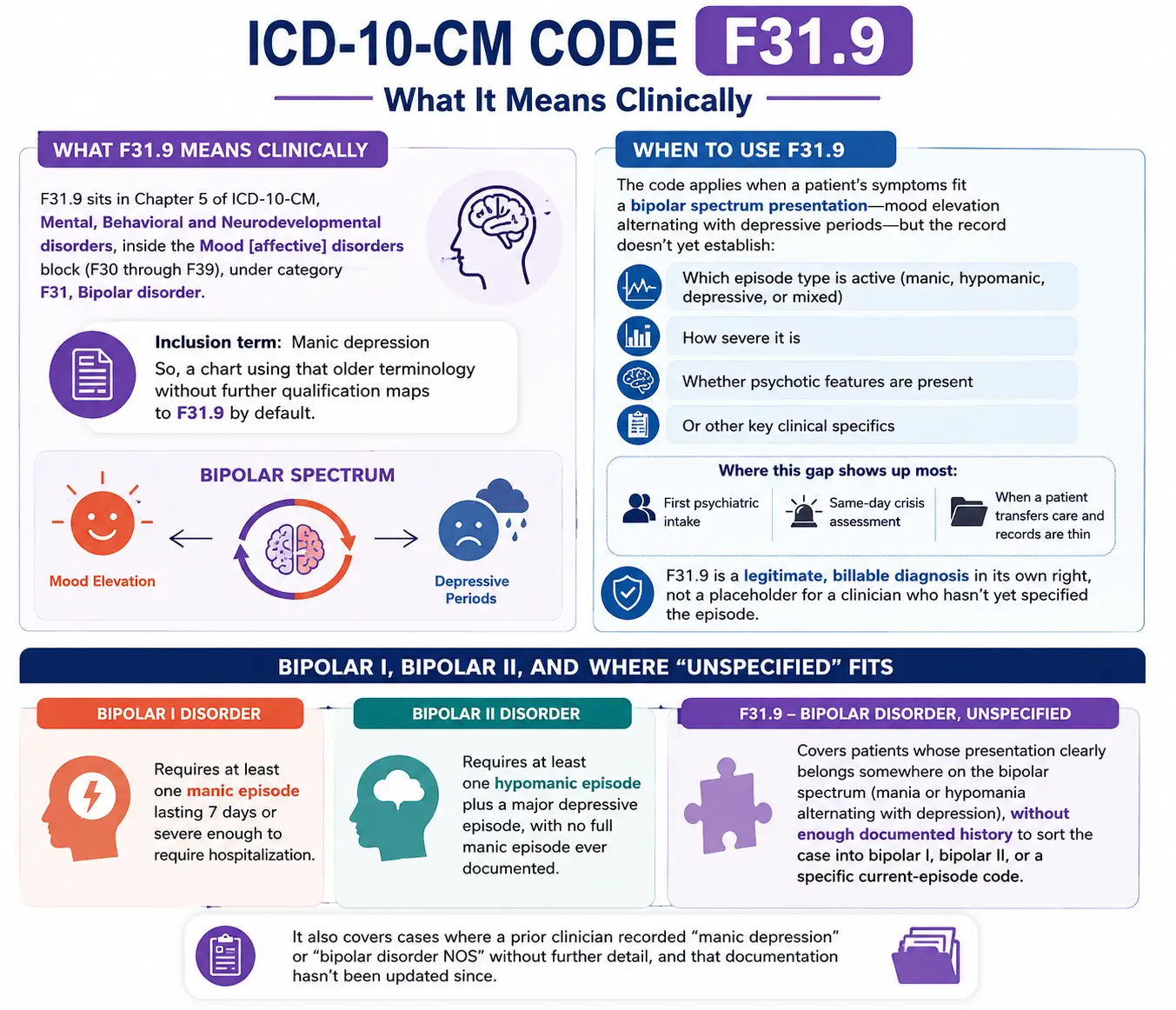
F31.9 sits in Chapter 5 of ICD-10-CM, Mental, Behavioral and Neurodevelopmental disorders, inside the Mood [affective] disorders block (F30 through F39), under category F31, Bipolar disorder. Its only listed inclusion term is manic depression, so a chart using that older terminology without further qualification maps to F31.9 by default.
Clinically, the code applies when a patient’s symptoms fit a bipolar spectrum presentation, mood elevation alternating with depressive periods, but the record doesn’t yet establish which episode type is active, how severe it is, or whether psychotic features are present. That gap shows up most often at a first psychiatric intake, a same-day crisis assessment, or when a patient transfers care and the incoming records are thin. It’s a legitimate, billable diagnosis in its own right, not a placeholder for a clinician who hasn’t gotten around to specifying the episode.
Bipolar I, bipolar II, and where “unspecified” fits
Bipolar I disorder requires at least one manic episode lasting seven days or severe enough to require hospitalization. Bipolar II requires at least one hypomanic episode plus a major depressive episode, with no full manic episode ever documented. F31.9 covers patients whose presentation clearly belongs somewhere on that spectrum, mania or hypomania alternating with depression, without enough documented history to sort the case into bipolar I, bipolar II, or a specific current-episode code. It also covers cases where a prior clinician recorded “manic depression” or “bipolar disorder NOS” without further detail, and that documentation hasn’t been updated since.
A quick note on where the code came from
F31.9 isn’t a new addition. Under ICD-9-CM, the equivalent diagnosis was 296.80, Bipolar disorder NOS, a code retired when the U.S. healthcare system transitioned to ICD-10-CM on October 1, 2015. The General Equivalence Mappings that CMS and the National Center for Health Statistics built to support that transition map 296.80 to F31.9 as an approximate match, not an exact one, because ICD-10-CM’s F31 category carries far more granularity than its ICD-9 predecessor ever did. Practices still pulling historical claims data or running multi-year utilization reports need to account for that approximation; a chart coded 296.80 before 2015 isn’t automatically equivalent to an F31.9 chart coded today.
Bipolar disorder by the numbers
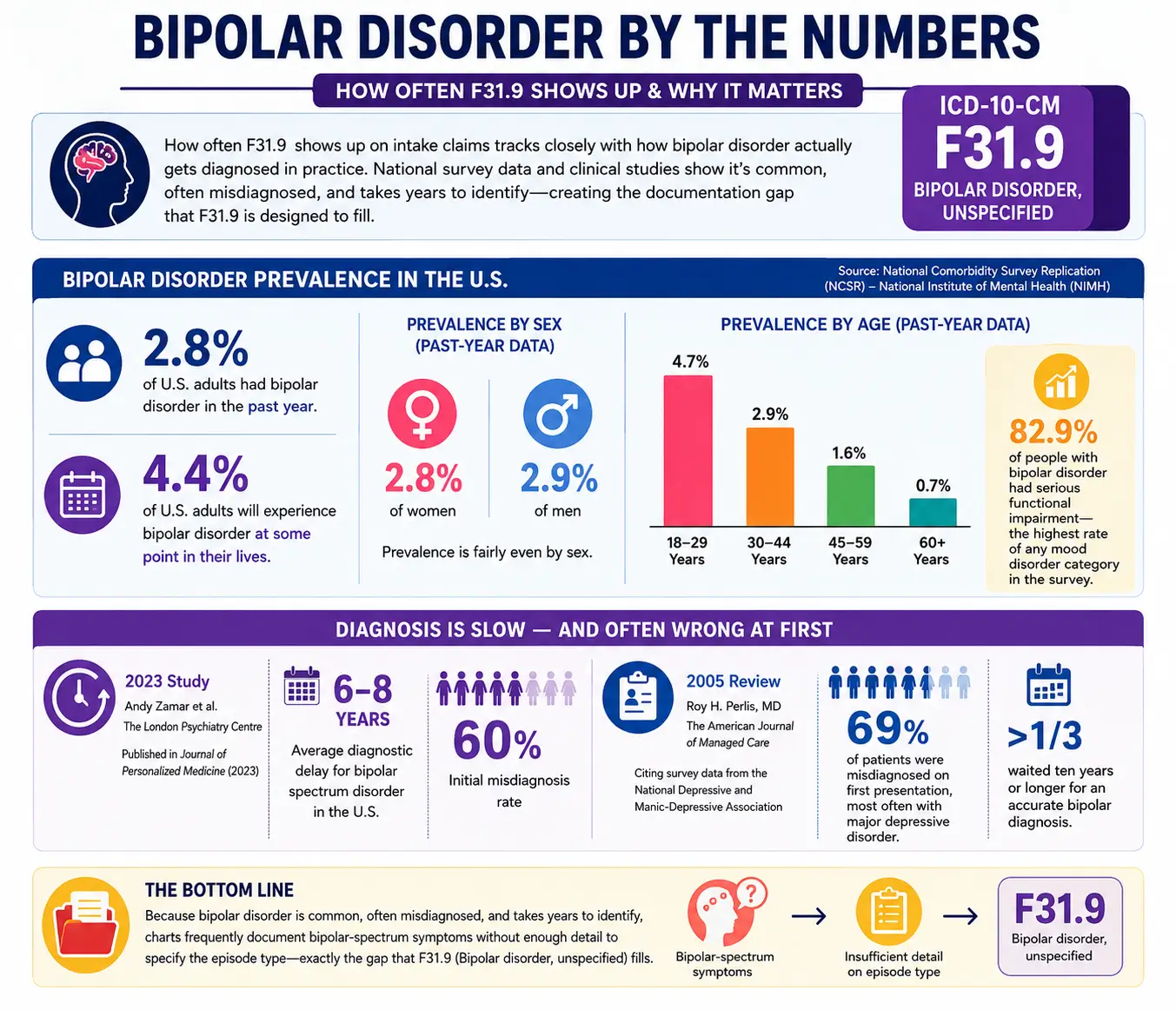
How often F31.9 shows up on intake claims tracks closely with how bipolar disorder actually gets diagnosed in practice. According to national survey data collected through the National Comorbidity Survey Replication and reported by the National Institute of Mental Health, an estimated 2.8% of U.S. adults had bipolar disorder in the past year, and 4.4% experience it at some point in their lives. Prevalence was fairly even by sex, 2.8% of women and 2.9% of men in the past-year data, but it varied sharply by age, from 4.7% among adults 18 to 29 down to 0.7% among adults 60 and older. Among people with the condition, the same NIMH data found 82.9% had serious functional impairment, the highest rate of any mood disorder category the survey tracked.
Diagnosis is also slow to arrive, which matters directly for coding. Andy Zamar and colleagues at The London Psychiatry Centre, publishing in the Journal of Personalized Medicine in 2023, put the average diagnostic delay for bipolar spectrum disorder in the United States at 6 to 8 years, alongside a 60% initial misdiagnosis rate. An earlier review by Roy H. Perlis, MD, published in The American Journal of Managed Care in 2005, cited survey data from the National Depressive and Manic-Depressive Association showing that 69% of patients were misdiagnosed on first presentation, most often with major depressive disorder, and that more than a third waited ten years or longer for an accurate bipolar diagnosis. Every year of that delay tends to produce charts where bipolar-spectrum symptoms are documented but the specific episode type isn’t, which is exactly the gap F31.9 fills.
F31.9 against the more specific F31 codes
F31 has close to thirty child codes covering current episode type, severity, psychotic features, and remission status. F31.9 is the last one listed in the category and the least specific of them all. The table below shows how the main groupings compare.
|
Code range |
What it documents |
|
F31.0 |
Current episode hypomanic |
|
F31.11 to F31.13 |
Current episode manic, without psychotic features, by severity |
|
F31.2 |
Current episode manic, severe, with psychotic features |
|
F31.30 to F31.32 |
Current episode depressed, mild to moderate, without psychotic features |
|
F31.4 to F31.5 |
Current episode depressed, severe, without or with psychotic features |
|
F31.60 to F31.64 |
Current episode mixed, by severity and psychotic features |
|
F31.71 to F31.78 |
In partial or full remission, by most recent episode type |
|
F31.81 |
Bipolar II disorder |
|
F31.89 |
Other bipolar disorder |
|
F31.9 |
Bipolar disorder, unspecified |
Choosing between F31.9 and a row above it comes down to what the documentation actually supports, not what’s fastest to select from a dropdown. If a note establishes a current manic episode with no psychotic features and rates its severity, one of F31.11 through F31.13 outranks F31.9 every time. F31.9 is the right call only when that level of detail genuinely isn’t in the chart yet, not when it’s simply missing because nobody asked.
Coding guidelines for unspecified codes
The ICD-10-CM Official Guidelines for Coding and Reporting, published jointly by CMS and the National Center for Health Statistics and updated for fiscal year 2026 (effective October 1, 2025, through September 30, 2026), treat unspecified codes as legitimate tools rather than shortcuts to avoid. The guidelines direct coders to assign the code that matches the level of detail actually documented, and to use an unspecified code when that’s genuinely all the record supports, instead of guessing at a more specific one that the note doesn’t back up. The same guidelines also instruct coders to report to the highest level of specificity the documentation allows, which is the standard F31.9 needs to be checked against at every single encounter, not just the first one.
No excludes note attaches directly to F31.9 itself in the tabular list. The exclusion notes sit one level up, at the F31 category. Category F31 excludes a single manic episode with no prior depressive history, which is coded to F30 instead, along with a single episode of major depressive disorder (F32) and recurrent major depressive disorder (F33). It also excludes cyclothymia (F34.0), a chronic, milder pattern of mood instability that never rises to full manic or major depressive episode criteria.
Documentation that actually supports F31.9
A claim built on F31.9 holds up under payer review when the note does a handful of specific things:
- States a bipolar disorder diagnosis outright, not “rule out bipolar disorder” or “possible bipolar disorder,” language that supports a symptom code, not F31.9
- References a documented history of manic, hypomanic, or mixed episodes, even secondhand, from a prior provider or the patient’s own account
- Explains, even in a sentence, why episode type or severity can’t be assigned at this particular encounter, whether that’s a new patient, incomplete outside records, or a genuinely first presentation
- Shows a plan to gather the missing detail at a follow-up visit, additional history, collateral information from family, or a longer observation period
Charts that repeat F31.9 across many consecutive visits without ever collecting that missing detail are the pattern that tends to draw attention. A single F31.9 claim rarely gets a second look. A year of F31.9 claims for a patient who’s clearly been in ongoing treatment long enough to characterize the episode, with no movement toward a more specific code, is what invites a records request.
Reimbursement: pairing F31.9 with the right CPT code
F31.9 establishes medical necessity. It doesn’t set a reimbursement rate on its own; that comes from the CPT or HCPCS code billed alongside it. CMS Medicare coverage policy, in Local Coverage Article A57480 (Psychiatry and Psychology Services), lists F31.9 among the ICD-10-CM codes that support medical necessity for the standard behavioral health CPT set, which includes the codes below.
|
CPT code |
Service |
|
90791 |
Psychiatric diagnostic evaluation, no medical services |
|
90792 |
Psychiatric diagnostic evaluation, with medical services |
|
90832 / 90834 / 90837 |
Individual psychotherapy, 30 / 45 / 60 minutes |
|
90833 / 90836 / 90838 |
Psychotherapy add-on, billed with an E/M code |
|
90853 |
Group psychotherapy |
|
99213 / 99214 |
Office visit E/M, typically used for medication management |
A companion Medicare coverage article on psychiatric diagnostic evaluation and psychotherapy services (A57520) reinforces that 90791 and 90792 shouldn’t both be billed on the same date of service, and that a psychotherapy add-on code requires the accompanying E/M service to be a significant, separately identifiable service with its own supporting documentation, not a few lines appended to the therapy note.
A few claim-level habits keep F31.9 encounters from denying:
- Bill 90791 or 90792 to open an episode of care, not both on the same date
- When billing an E/M code plus a psychotherapy add-on, attach modifier 25 to the E/M code and keep separate documentation supporting each service
- Record start and stop times for any timed psychotherapy code; payers can and do request that detail on audit
- Don’t lead a psychotherapy claim with a Z-code, a relationship or life-circumstance code, as the only diagnosis; F31.9 or another F-code needs to carry the claim as primary
Where F31.9 claims tend to fail
Most F31.9 denials trace back to one of three problems. The first is a diagnosis-CPT mismatch, where the billed procedure code doesn’t appear on the payer’s list of diagnoses that support it for that service. The second is a specificity gap, where a payer’s own medical policy expects a more detailed bipolar code than F31.9 for a patient who’s been established in treatment for months. The third is documentation that doesn’t clearly separate a bundled service, such as an E/M visit and a psychotherapy add-on billed together without the modifier and the two distinct notes that combination requires.
None of these three problems are unique to psychiatry; they show up across specialties wherever unspecified codes meet time-based procedure codes. What makes F31.9 worth double-checking on every claim is that it sits at the vague end of a large, granular category, and payers know that. A note that earns the code, because the documentation genuinely doesn’t support anything more precise yet, holds up. A note that defaults to it out of habit is the difference between a clean claim and a records request three months down the line.