


ICD-10 Code F33.0 Explained: Symptoms, Diagnosis & Complete Billing Guide
The medical coding and billing industry requires exact specificity to translate clinical encounters into trackable data and payable insurance claims. The International Classification of Diseases, Tenth Revision, Clinical Modification (ICD-10-CM) provides thousands of alphanumeric codes to represent specific mental health conditions. ICD-10 code F33.0 designates a diagnosis of Major depressive disorder, recurrent, mild.
Medical billers, coding students, and healthcare providers use this specific identifier to communicate a precise clinical picture to insurance payers. Assigning this code informs the payer that the patient has a history of major depression, is currently experiencing a new episode, and exhibits symptoms categorized as mild in severity. Accurate application of this code prevents claim denials, supports medical necessity for treatments, and maintains compliance with federal healthcare regulations.
Clinical definition of ICD-10 code F33.0
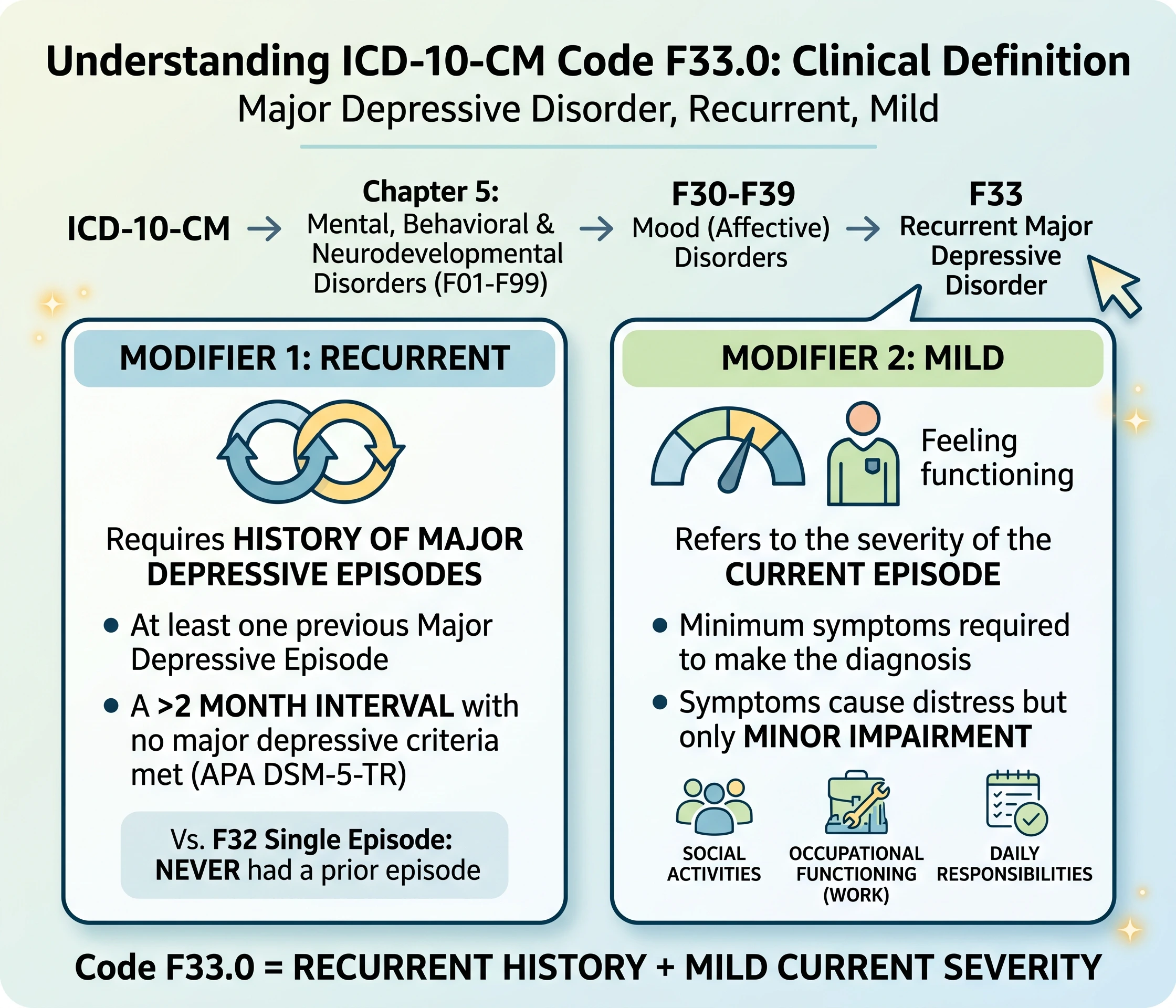
The ICD-10-CM manual organizes mental, behavioral, and neurodevelopmental disorders into Chapter 5, which spans codes F01 through F99. Within this chapter, the F30 to F39 block covers mood (affective) disorders. The specific category for recurrent major depressive disorder is F33.
To use the F33.0 classification, the clinical presentation must meet two distinct modifiers: recurrent and mild.
A recurrent depression diagnosis means the patient has experienced at least one previous major depressive episode. According to the American Psychiatric Association (APA) Diagnostic and Statistical Manual of Mental Disorders, Fifth Edition, Text Revision (DSM-5-TR), an episode is considered recurrent only if there has been an interval of at least two consecutive months during which the patient did not meet the criteria for a major depressive episode. If the patient has never had a prior episode, coders must assign a code from the F32 category (Major depressive disorder, single episode).
The mild severity specifier indicates the current impact of the condition on the patient. In a mild episode, the patient experiences the minimum number of symptoms required to make the diagnosis. While the symptoms cause distress, they result in only minor impairment regarding social activities, occupational functioning, or daily responsibilities.
Diagnostic criteria and symptom presentation
Providers rely on specific diagnostic tools and clinical interviews to determine the appropriate severity level of depression. The Patient Health Questionnaire-9 (PHQ-9) is a standard diagnostic instrument used in primary care and psychiatric settings. A patient scoring between 5 and 9 on the PHQ-9 typically aligns with a mild depressive episode, supporting the use of F33.0.
Patients receiving this diagnosis will exhibit at least five specific symptoms during the same two-week period, and at least one of the symptoms must be either a depressed mood or a loss of interest or pleasure (anhedonia). Standard symptoms documented in the clinical record include:
- Depressed mood for most of the day, nearly every day.
- Markedly diminished interest in all, or almost all, activities.
- Significant weight loss when not dieting, weight gain, or a decrease or increase in appetite.
- Insomnia or hypersomnia nearly every day.
- Psychomotor agitation or retardation observed by others.
- Fatigue or loss of energy.
- Feelings of worthlessness or excessive, inappropriate guilt.
- Diminished ability to think, concentrate, or make decisions.
For the presentation to be coded as mild, the provider must note that the patient continues to manage their daily life. A patient who continues working and maintaining household duties despite experiencing fatigue and depressed mood fits the clinical profile for this specific code.
Provider documentation requirements for medical coders
Medical coders cannot assume a diagnosis based on symptom lists. They rely entirely on the provider’s written documentation. If a provider simply writes “depression” in the assessment section of the chart, the ICD-10-CM guidelines require the coder to default to an unspecified code, such as F32.A (Depression, unspecified). Insurance companies frequently deny claims submitted with unspecified codes, arguing that the provider did not establish medical necessity for the billed services.
To ensure accurate code assignment, clinical documentation must capture the MEAT criteria (Monitor, Evaluate, Assess, Treat). The provider’s note needs to state explicitly that the depression is recurrent and mild.
A compliant documentation entry might read: “The patient presents for follow-up of major depressive disorder. They report a return of depressed mood and fatigue over the last three weeks, following a six-month period of remission. Symptoms are mild, and the patient continues to work full-time. Current PHQ-9 score is 7. We will restart their previous dosage of Sertraline.”
This entry gives the coder everything needed. The mention of a return of symptoms after a six-month remission period satisfies the “recurrent” requirement. The explicit statement of “mild” symptoms and the supporting PHQ-9 score justify the specific severity level.
ICD-10 code F33.0 complete billing guide
When a provider submits a claim for a patient with this diagnosis, the F33.0 code acts as the justification for the procedures performed during the visit. Billers must pair this diagnosis code with the correct Current Procedural Terminology (CPT) codes to generate revenue.
Common CPT codes paired with F33.0
Mental health billing typically involves Evaluation and Management (E/M) codes, psychotherapy codes, or a combination of both.
Psychiatrists, psychiatric nurse practitioners, and primary care physicians frequently perform medication management. They bill E/M codes based on the complexity of medical decision-making or the total time spent on the date of the encounter. Common E/M codes linked to F33.0 include 99213 (low complexity) or 99214 (moderate complexity) for established patients. Since a mild episode of depression typically requires low to moderate medical decision-making regarding prescription adjustments, these codes align well with the diagnosis.
Psychologists, licensed clinical social workers (LCSWs), and licensed professional counselors (LPCs) bill psychotherapy codes. These codes are time-based.
- 90832 represents 30 minutes of psychotherapy (actual time 16 to 37 minutes).
- 90834 represents 45 minutes of psychotherapy (actual time 38 to 52 minutes).
- 90837 represents 60 minutes of psychotherapy (actual time 53 minutes or more).
Navigating combination billing and modifier 25
Some providers (like psychiatrists) provide both medication management and psychotherapy during the same visit. In these cases, the biller must submit an E/M code (e.g., 99213) alongside an add-on psychotherapy code (e.g., 90833 for 30 minutes of therapy combined with E/M).
If a provider evaluates a distinct, separate medical issue and also performs a mental health service, billers use Modifier 25. The Centers for Medicare & Medicaid Services (CMS) strictly audits the use of Modifier 25. The documentation must clearly show that a significant, separately identifiable evaluation occurred apart from the standard psychiatric service.
Contrasting F33.0 with similar diagnosis codes
Assigning the wrong code can trigger claim rejections or audits. Coders must distinguish F33.0 from similar entries in the ICD-10 manual.
ICD-10 Code | Official Description | Clinical Distinction |
F32.0 | Major depressive disorder, single episode, mild | The patient has never experienced a previous depressive episode. |
F33.0 | Major depressive disorder, recurrent, mild | The patient has had past episodes separated by at least 2 months of remission, and current symptoms are mild. |
F33.1 | Major depressive disorder, recurrent, moderate | Current symptoms cause noticeable impairment in social or occupational functioning. |
F33.9 | Major depressive disorder, recurrent, unspecified | The provider documented recurrence but failed to specify current severity. |
Coding social determinants of health (SDOH)
Modern medical coding requires attention to factors outside the immediate clinical diagnosis. The Centers for Disease Control and Prevention (CDC) updated ICD-10-CM guidelines to encourage the reporting of Z codes (Z55-Z65) for Social Determinants of Health. These codes capture socioeconomic and environmental factors influencing a patient’s health status.
When a provider treats a patient for F33.0, the patient’s mild depression might be exacerbated by external stressors. If the provider documents that the patient is experiencing housing instability, the coder should add Z59.0 (Homelessness) or Z59.81 (Housing instability, housed) as a secondary diagnosis on the claim.
While Z codes do not directly increase reimbursement on a standard fee-for-service claim, they justify higher-level E/M codes. Medical decision-making becomes more complex when a provider must tailor a depression treatment plan around a patient’s inability to afford medication or access reliable transportation.
Compliance audits and risk adjustment coding
The Department of Health and Human Services Office of Inspector General (HHS-OIG) monitors Medicare and Medicaid claims to identify patterns of fraudulent billing. Mental health services frequently appear on the OIG Work Plan due to historical issues with upcoding.
Upcoding occurs when a provider or biller submits a claim for a more severe diagnosis or a higher-level procedure than the medical record supports. If a clinical note describes a patient with a PHQ-9 score of 6 who is functioning well at work, but the biller submits F33.2 (Major depressive disorder, recurrent, severe without psychotic features), the practice commits upcoding. Routine internal chart audits help practices ensure that the assigned ICD-10 code perfectly matches the narrative description in the provider’s note.
Furthermore, diagnosis coding impacts risk adjustment models. The Medicare Advantage Hierarchical Condition Category (HCC) model calculates patient risk scores based on diagnosis codes submitted throughout the calendar year. These scores determine the capitated payments insurance plans receive for covering specific patients.
Interestingly, F33.0 does not map to a payment-boosting HCC category in the same way that F33.2 (severe depression) does. In the CMS-HCC model, mild and unspecified depression codes were historically excluded from risk score calculations because they represent lower anticipated resource utilization. Therefore, if a patient actually suffers from severe, recurrent depression (F33.2), but the provider lazily documents a generic or mild presentation (F33.0), the healthcare organization loses out on legitimate risk adjustment funding meant to cover the cost of managing complex psychiatric patients.
Insurance pre-authorization and utilization review
Health Maintenance Organizations (HMOs) and managed care plans often require prior authorization for extended psychiatric treatment. When a clinic requests authorization for a block of psychotherapy sessions (such as twelve visits using CPT 90834), the insurance company’s utilization review department evaluates the request against the submitted ICD-10 code.