



90863 CPT code description: Billing rules, usage, and reimbursement guide
CPT code 90863 represents pharmacologic management, including prescription and review of medication, when performed with psychotherapy services. The American Medical Association classifies this strictly as an add-on code. Healthcare providers and medical billers cannot submit this code on a claim by itself. It must accompany a primary psychotherapy service.
Understanding the specific application of 90863 requires a close look at provider eligibility, companion codes, and the distinction between non-medical prescribing and standard Evaluation and Management (E/M) services. Billing errors related to this code frequently result in claim denials, primarily because administrative staff confuse it with physician-level medication management.
What is CPT code 90863?
The current procedural terminology manual defines 90863 as pharmacologic management, including prescription and review of medication, when performed with psychotherapy services.
Pharmacologic management involves assessing a patient's need for medication, writing new prescriptions, adjusting current dosages, and monitoring for adverse side effects. When a qualified provider performs these tasks during the same encounter as a standard psychotherapy session, they report the medication management portion of the visit using 90863.
Because it is an add-on code, it carries a plus sign (+) in the CPT manual. This designation indicates the service was provided in addition to a primary procedure. Payers systemically deny claims that feature 90863 as a standalone line item without a qualifying primary code on the same date of service.
Eligible providers for pharmacologic management
The primary users of 90863 are prescribing professionals who do not typically report Evaluation and Management codes. The distinction relies heavily on state scope-of-practice laws and individual payer credentialing guidelines.
Medical doctors (MDs) and doctors of osteopathy (DOs) almost never use 90863. They report their medication management using standard E/M codes (99202 through 99215).
The professionals who appropriately bill 90863 typically include:
- Prescribing psychologists
- Advanced Practice Registered Nurses (APRNs)
- Psychiatric Mental Health Nurse Practitioners (PMHNPs)
- Physician Assistants (PAs)
Prescribing psychologists represent the most common user base for this specific code. As of 2024, legislation in New Mexico, Louisiana, Illinois, Iowa, Idaho, and Colorado permits appropriately trained clinical psychologists to prescribe psychotropic medications. The Department of Defense and the Indian Health Service also grant prescribing authority to psychologists working within their federal systems. Since clinical psychologists cannot bill medical E/M codes, the AMA created 90863 specifically to allow them to report medication management when it occurs alongside talk therapy.
Nurse practitioners and physician assistants fall into a gray area. Depending on their state regulations and specific contracts with commercial insurance companies, some PMHNPs bill E/M codes just like psychiatrists. Other commercial payers require nurses and physician assistants to use the 90863 add-on code instead of an E/M code for the prescribing portion of a therapy visit. Billers must verify the credentialing terms for mid-level providers with each insurance network.
Primary psychotherapy codes required for billing
To secure reimbursement, 90863 must appear on a CMS-1500 claim form or electronic 837P file directly beneath a valid primary procedure.
The AMA designates the following CPT codes as acceptable primary procedures for 90863:
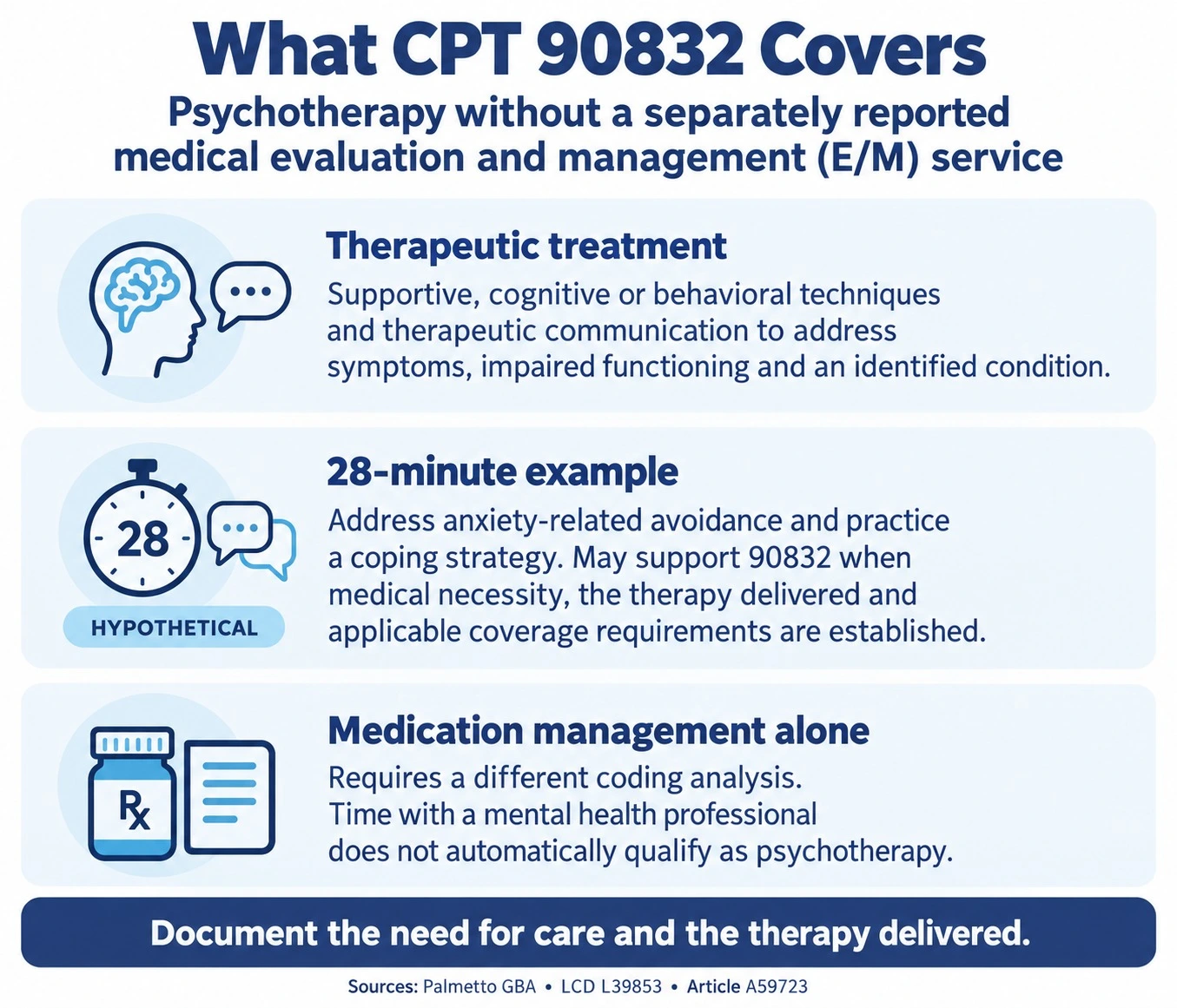
- 90832: Psychotherapy, 30 minutes with patient
- 90834: Psychotherapy, 45 minutes with patient
- 90837: Psychotherapy, 60 minutes with patient
- 90845: Psychoanalysis
- 90846: Family psychotherapy (without the patient present), 50 minutes
- 90847: Family psychotherapy (conjoint psychotherapy) (with patient present), 50 minutes
The time associated with the primary psychotherapy code applies only to the therapy portion of the visit. The time spent managing medications does not count toward the 30, 45, or 60 minutes required for the primary psychotherapeutic service.
For example, a prescribing psychologist meets with a patient for 55 minutes. The provider spends 45 minutes conducting cognitive behavioral therapy and 10 minutes reviewing the patient's response to an SSRI, checking blood pressure, and calling in a prescription refill. The biller will code 90834 for the 45 minutes of therapy and 90863 for the 10 minutes of medication management.
E/M services versus code 90863
Medical coders frequently confuse the sequence for billing psychotherapy combined with medication management. The correct coding path depends entirely on whether the provider is authorized to bill Evaluation and Management codes.
The table below illustrates the inverse relationship between how medical doctors and prescribing psychologists code for the exact same clinical scenario (a 45-minute therapy session plus medication management).
| Provider Type | Medication Management Code | Psychotherapy Code | Billing Sequence |
|---|---|---|---|
| Psychiatrist (MD/DO) | 99213 (Primary E/M) | +90836 (Add-on therapy) | E/M + Psychotherapy Add-on |
| Prescribing Psychologist | +90863 (Add-on medication) | 90834 (Primary therapy) | Psychotherapy Primary + Medication Add-on |
Psychiatrists treat the medical management as the primary service and the therapy as the add-on. Prescribing psychologists treat the therapy as the primary service and the medication management as the add-on. Mixing these hierarchies causes immediate clearinghouse rejections.
Documentation requirements for claims
Insurance auditors scrutinize add-on codes to ensure the provider actually performed a distinct secondary service. Documenting 90863 requires specific medical record entries separate from the psychotherapy notes.
A compliant chart note for pharmacologic management must include:
- A list of current psychotropic medications and dosages.
- The patient's reported compliance with the medication schedule.
- Any reported adverse side effects or physical symptoms.
- Clinical observations regarding the medication's efficacy.
- The specific action taken during the visit (e.g., maintaining the current dose, titrating up, switching classes, or discontinuing the drug).
A vague sentence stating "medications reviewed" does not meet the clinical documentation threshold for reimbursement. The Centers for Medicare & Medicaid Services (CMS) requires the provider to demonstrate active management. If a patient is stable on a drug and the provider simply notes the prescription is still active without assessing its current impact, auditors may determine the criteria for 90863 were not met.
The documentation must also clearly separate the time spent on therapy from the time spent on medication management. Providers should use two distinct paragraphs or sections in their electronic health record (EHR) software to prevent auditors from assuming the medication management time was improperly used to inflate the psychotherapy time code.
Common modifiers and payer specific rules
Add-on codes generally do not require standard pricing modifiers (like modifier 51 for multiple procedures) because their relative value units (RVUs) already account for the reduced overhead of a secondary service. However, specific payers may require informational modifiers on 90863 to identify the discipline of the provider.
When clinical social workers or non-prescribing psychologists operate in jurisdictions where they cannot prescribe, submitting 90863 will trigger a denial based on provider taxonomy. For providers who do possess prescribing authority, some commercial managed care organizations require modifier AH (Clinical Psychologist) or modifier AJ (Clinical Social Worker) attached to the primary code to route the claim through the correct credentialing filters.
Telehealth modifiers also apply to 90863. According to the 2024 CMS guidelines for behavioral health, if the combined therapy and medication management session occurs via synchronous audio-visual technology, the biller should append modifier 95 (Synchronous telemedicine service) to both the primary psychotherapy code and the 90863 add-on code. Place of Service (POS) code 02 or 10 would also be required depending on whether the patient is located in a clinical setting or their home.
Average reimbursement rates and RVUs
Reimbursement for 90863 is relatively low compared to E/M medication management codes. This reflects the AMA's calculation that the primary psychotherapy code covers the majority of the provider's practice expense and clinical time.
Under the 2024 Medicare Physician Fee Schedule (MPFS), CPT code 90863 carries a non-facility total Relative Value Unit (RVU) of 0.47. The total RVU comprises three elements:
- Work RVU: 0.38
- Practice Expense (PE) RVU: 0.07
- Malpractice (MP) RVU: 0.02
Using the final 2024 CMS conversion factor of $33.2875, the unadjusted national average Medicare payment for 90863 is approximately $15.65. This amount adjusts slightly up or down based on the Geographic Practice Cost Index (GPCI) for the provider's specific locality.
Commercial insurance reimbursement varies widely based on network contracts. Private payers typically benchmark their allowable amounts at a percentage of the Medicare rate. Data from regional billing clearinghouses indicates commercial allowable amounts for 90863 generally fall between $18.00 and $25.00 per unit.
Because it is an add-on code, 90863 is not subject to the Multiple Procedure Payment Reduction (MPPR) rule. The payer should remit 100 percent of the contracted fee schedule amount for this code, rather than cutting it by 50 percent as they do with multiple surgical procedures.
Common denial reasons and how to prevent them
Medical billers processing 90863 face several predictable administrative hurdles. Tracking these common denial patterns allows practices to implement front-end scrubbing rules before claims reach the payer.
CO-107: Qualifying service not identified
CO-107: The related or qualifying claim/service was not identified on this claim.
This denial occurs when a biller submits 90863 without 90832, 90834, 90837, 90845, 90846, or 90847. It also happens if the primary procedure is denied for lack of medical necessity, which automatically causes the payer to deny the add-on code. To prevent this, clearinghouse software should be configured to flag 90863 if it appears as a primary line item.
CO-8: Provider type or specialty mismatch
CO-8: The procedure code is inconsistent with the provider type/specialty.
This happens when a provider taxonomy code mapped to the National Provider Identifier (NPI) indicates a specialty that lacks prescribing authority in that specific state. Practice credentialing staff must ensure the provider's file with the payer explicitly includes their prescribing credentials and updated state licenses.
CO-97: Included in another service
CO-97: The benefit for this service is included in the payment/allowance for another service/procedure that has already been adjudicated.
Some localized Medicaid managed care organizations refuse to recognize 90863, adopting internal policies that state medication management is inherently included in the primary psychotherapy service. When dealing with these specific HMOs, billers must accept the contractual write-off, as state Medicaid guidelines supersede AMA CPT definitions in certain jurisdictions.
By verifying provider eligibility, matching the add-on code strictly to approved psychotherapy base codes, and maintaining compartmentalized clinical documentation, billing departments can stabilize their reimbursement cycles for pharmacologic management services.