



90834 CPT Code Explained: 45-Minute Therapy Session Billing Guide
The 90834 CPT code reports individual psychotherapy lasting 38 to 52 minutes of face-to-face time. The American Medical Association, which maintains the Current Procedural Terminology code set, defines it as “Psychotherapy, 45 minutes with patient and/or family member.” In most outpatient behavioral health practices it is the most frequently submitted procedure code, so a single recurring error in time documentation or modifier selection multiplies across dozens of claims each month.
This guide covers the exact time rules, provider eligibility, 2026 Medicare payment amounts, documentation standards, the telehealth requirements that changed again in February 2026, and the denial causes that account for most rejected 90834 claims.
What the 90834 CPT code covers
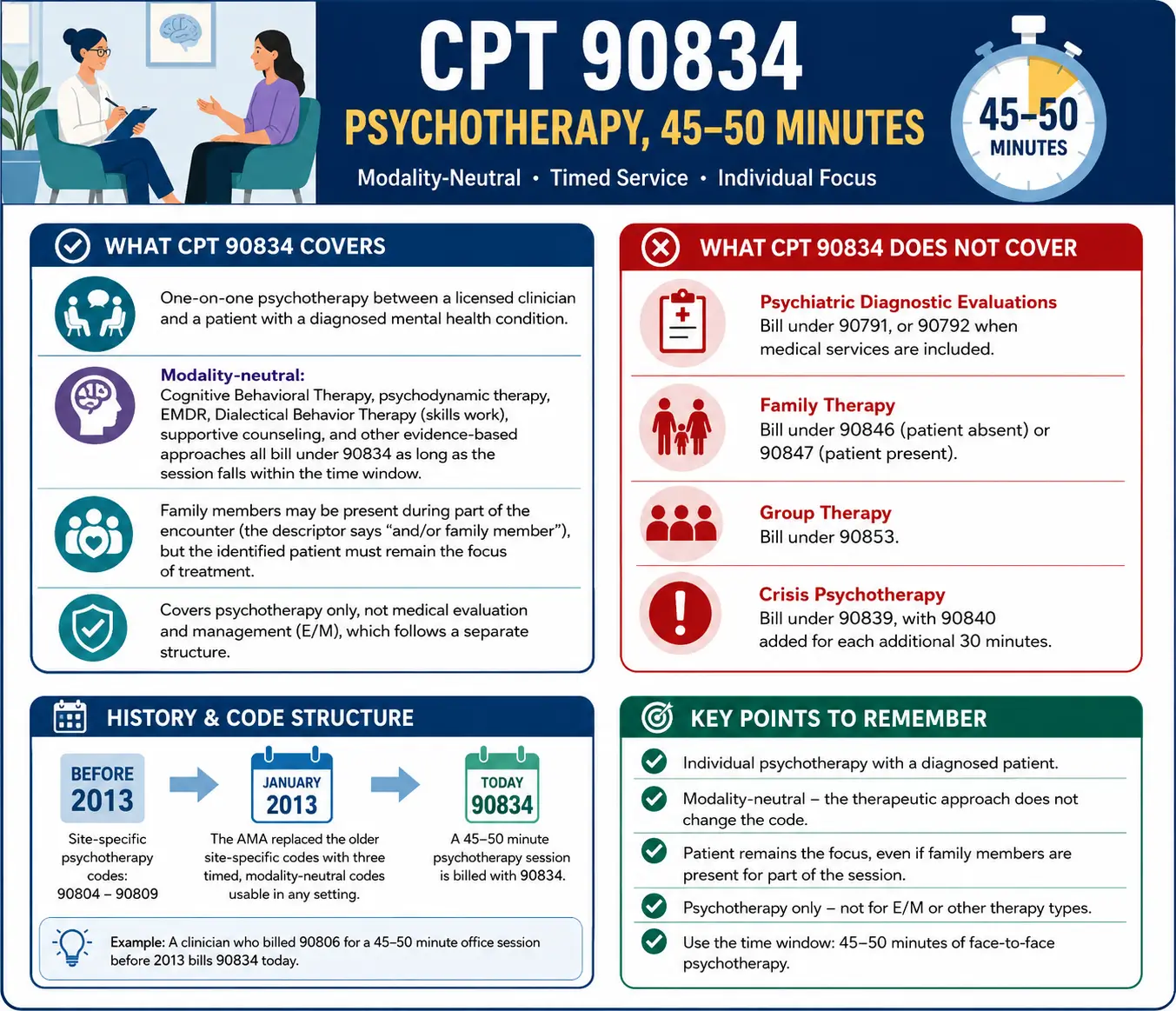
CPT 90834 describes one-on-one psychotherapy between a licensed clinician and a patient with a diagnosed mental health condition. The code is modality-neutral. Cognitive behavioral therapy, psychodynamic work, EMDR, dialectical behavior therapy skills work, and supportive counseling all bill under the same code as long as the session falls inside the time window. Family members may be present during part of the encounter (the descriptor says “and/or family member”), but the identified patient must remain the focus of treatment.
The code covers psychotherapy only, not medical evaluation and management, which follows a separate structure discussed later in this guide. It also excludes several services new billers regularly confuse with it:
- Psychiatric diagnostic evaluations bill under 90791, or 90792 when medical services are included.
- Family therapy bills under 90846 (patient absent) or 90847 (patient present).
- Group therapy bills under 90853.
- Crisis psychotherapy bills under 90839, with 90840 added for each additional 30 minutes.
The current structure dates to January 2013, when the AMA replaced the older site-specific psychotherapy codes (the 90804 through 90809 series) with three timed codes usable in any setting. A clinician who billed 90806 for a 45 to 50 minute office session before 2013 bills 90834 today.
The 38 to 52 minute rule
Code selection among the three individual psychotherapy codes depends entirely on documented time. Clinical complexity, diagnosis severity, and the length of the scheduled appointment play no role. CPT sets the ranges this way: 16 to 37 minutes bills under 90832, 38 to 52 minutes bills under 90834, and 53 minutes or longer bills under 90837. Psychotherapy lasting fewer than 16 minutes is not separately reportable at all.
Only face-to-face therapeutic time counts toward those thresholds. Under CMS guidance, scheduling the next appointment, collecting a copay, casual conversation before the session settles in, and writing the progress note afterward are all excluded. This explains why many appointments booked as “an hour” bill correctly as 90834 rather than 90837. Subtract a few minutes of settling in at the start and calendar comparison at the end, and the therapeutic portion of a 60-minute slot often lands between 45 and 50 minutes.
The boundaries are unforgiving. A 52-minute session is 90834. A 53-minute session qualifies for 90837. Auditors compare documented start and stop times against the code billed, and a mismatch in either direction creates exposure: billing 90837 for a 50-minute session is upcoding subject to recoupment, while routinely billing 90834 for 55-minute sessions understates the service and produces its own documentation inconsistency. Record actual minutes and let the number choose the code.
Who can bill 90834
Eligible provider types include psychiatrists, clinical psychologists, licensed clinical social workers, psychiatric nurse practitioners, physician assistants, licensed professional counselors, and licensed marriage and family therapists. Actual eligibility depends on state scope-of-practice law and each payer’s credentialing rules, so a clinician recognized by one commercial plan may be excluded by another in the same state.
Medicare eligibility expanded recently. Under the Consolidated Appropriations Act of 2023, marriage and family therapists and mental health counselors became able to enroll as Medicare providers on January 1, 2024, closing a gap that had limited Medicare psychotherapy for decades to psychiatrists, psychologists, clinical social workers, and certain nurse practitioners and physician assistants.
Payment differs by credential. Medicare pays clinical social workers, marriage and family therapists, and mental health counselors 75 percent of the fee schedule amount, which works out to roughly $85 for a 90834 session in 2026, while physicians and clinical psychologists receive the full rate. Pre-licensed clinicians and interns generally cannot bill Medicare directly; supervised billing arrangements under commercial and Medicaid plans vary by state and contract.
90834 compared with 90832 and 90837
Code | Descriptor | Time range | 2026 Medicare national non-facility rate |
90832 | Psychotherapy, 30 minutes | 16 to 37 minutes | $85.84 |
90834 | Psychotherapy, 45 minutes | 38 to 52 minutes | $113.90 |
90837 | Psychotherapy, 60 minutes | 53 minutes or more | $167.00 |
Rates are Centers for Medicare and Medicaid Services national averages for 2026 before geographic adjustment.
The roughly $53 gap between 90834 and 90837 is the reason payers watch the longer code closely. Several commercial insurers have sent utilization-review letters to clinicians whose 90837 billing exceeded peer averages, and some plans have required supporting records or prior authorization for it. None of that makes 90837 improper. When sessions genuinely run 53 minutes or more and the note supports the time, the longer code is correct. Compliance risk runs in both directions here, because billing 90837 without the minutes is upcoding, and defensively downcoding real 60-minute sessions to 90834 misstates the service delivered while leaving revenue uncollected.
What Medicare pays for 90834 in 2026
The 2026 Medicare national non-facility rate for 90834 is approximately $113.90, up from $104.16 in 2025. The increase came through the conversion factor, which rose from $32.35 in 2025 to $33.40 for most clinicians in 2026 (and $33.57 for qualifying participants in advanced alternative payment models). It was the first increase after five consecutive annual reductions to the conversion factor.
National figures are a starting point rather than a payment guarantee. CMS adjusts every claim through the Geographic Practice Cost Index, so an identical 45-minute session pays more in San Francisco or Manhattan than in a rural county. Claims from facility settings, such as hospital outpatient departments, pay the lower facility rate because the institution’s overhead is reimbursed separately.
Commercial rates depend on contract. Many plans pay somewhere between Medicare parity and about 30 percent above it for 90834, and negotiated amounts vary widely even within a single insurer across states. Medicaid rates are set state by state and frequently fall below Medicare. Revenue cycle firms that publish payer data, including MedSole RCM and Behave Health in their 2026 rate guides, report that practices which never revisit their contracts tend to sit at the bottom of the commercial range.
Documentation that supports the code
A 90834 claim survives an audit when the note independently proves the service. Each session note should contain:
- Date of service and setting, or the place-of-service code for telehealth
- Start and stop times, or total face-to-face minutes, showing between 38 and 52 minutes
- The ICD-10 diagnosis being treated
- Interventions used, named specifically (cognitive restructuring or graded exposure, for example, rather than “provided support”)
- The patient’s response and current mental status
- Progress toward measurable treatment plan goals
- Clinician signature with credentials
Time is the first element reviewers examine because it determines the correct code. If the documentation does not record the total minutes, or only notes the appointment time (such as “2:00 appointment”), auditors have no way to verify the service, giving payers a valid reason to deny the claim or assign a lower-paying code.
Medical necessity ties the rest together. Reviewers look for what compliance trainers call the golden thread: the diagnosis justifies the treatment plan, the plan justifies this session, and the note shows work on that plan. Diagnoses limited to Z codes, meaning life circumstances such as relationship distress without a covered mental disorder, are a frequent denial trigger because most payers do not accept them on their own as grounds for psychotherapy coverage.
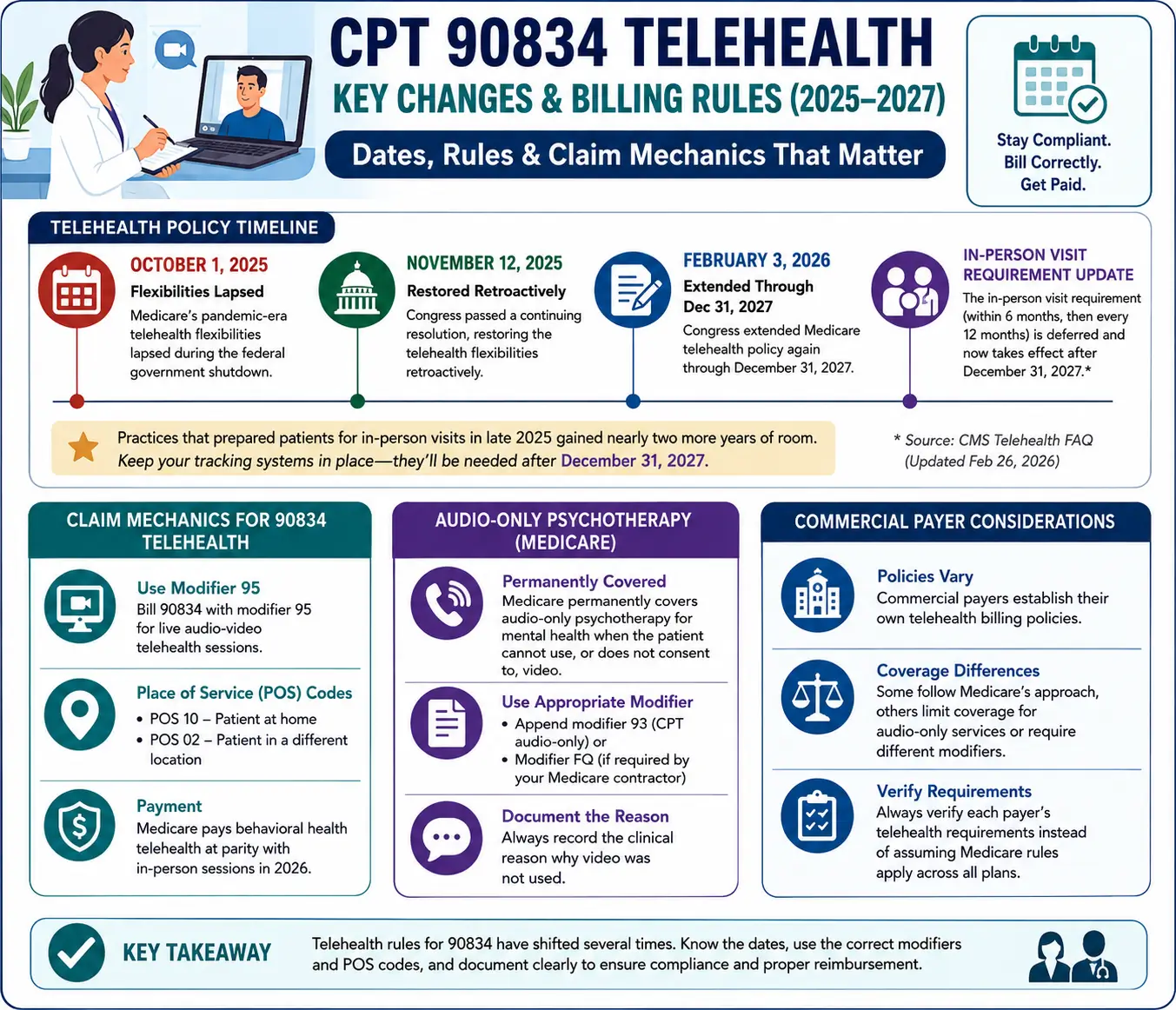
Billing 90834 for telehealth sessions
Add-on codes and same-day restrictions
Two pairing rules account for a disproportionate share of 90834 errors. First, 90834 can never appear on the same claim as an evaluation and management service by the same clinician on the same day. When a psychiatrist or psychiatric nurse practitioner provides medication management plus 45 minutes of therapy, the correct combination is the E/M code (such as 99214) with add-on code 90836, the 45-minute psychotherapy add-on. Reporting 90834 alongside an E/M code triggers an automatic edit under the National Correct Coding Initiative. Second, add-on code 90785 for interactive complexity may accompany 90834 when a specific complicating factor is present, such as maladaptive communication among caregivers involved in treatment, use of an interpreter or translator, or a mandated report of abuse arising during the session. The add-on needs its own documentation of the qualifying factor, and appending it routinely is a recognized audit flag. Sessions that turn into emergencies bill differently. A patient presenting in acute crisis requiring urgent assessment and intervention shifts the encounter to crisis codes 90839 and 90840, replacing the standard psychotherapy codes for that visit.Common denial reasons and how to prevent them
Most rejected 90834 claims trace back to a short list of preventable causes:- Missing time documentation. Without documented minutes, the payer cannot verify that the service met the required 38- to 52-minute time threshold. To prevent denials, configure the EHR template to require both the start and stop times.
- Telehealth modifier and place-of-service mismatches. Claims become internally inconsistent when Modifier 95 is reported with POS 11 (Office) or when POS 10 is submitted without the required telehealth modifier. Reduce denials by incorporating payer-specific telehealth billing rules into your workflow.
- Pairing 90834 with an E/M code. Train prescribers to report 90836 as the add-on instead.
- Diagnosis does not support medical necessity. Claims often fail when only a Z code is reported without a covered mental health diagnosis. Verify that a billable ICD-10-CM mental health diagnosis is documented before submitting the initial claim.
- Credentialing and enrollment gaps. Claims from clinicians not yet effective with a plan deny regardless of documentation quality. Verify enrollment dates before scheduling billable sessions.
- Plan-specific visit limits or authorization rules. Medicare imposes no prior authorization on outpatient psychotherapy, but some commercial and Medicaid plans require authorization after a set number of visits. Track visit counts against each plan’s threshold.