


CPT 90847 Explained: Billing Rules, Time Requirements, and Reimbursement
Mental health clinics submit high volumes of family therapy claims, yet procedure code 90847 frequently generates payment denials. Claim adjudicators require exact documentation of session duration, attendee identities, and clinical justification. Medical billers and clinicians must align their records with stringent coding regulations to maintain consistent clinic revenue and pass post-payment audits.
Defining the clinical parameters of code 90847
The American Medical Association dictates that procedure code 90847 covers 50 minutes of conjoint family psychotherapy. The identified patient, the person holding the primary psychiatric diagnosis must attend the session. At least one additional family member, such as a parent, sibling, or spouse, must also participate.
The therapeutic work must center on treating the primary patient’s diagnosis by addressing family dynamics. Educating relatives about medication side effects does not qualify as therapy. The participating family members do not receive independent treatment during this time; they serve as a component of the primary patient’s clinical care.
Tracking exact minute requirements
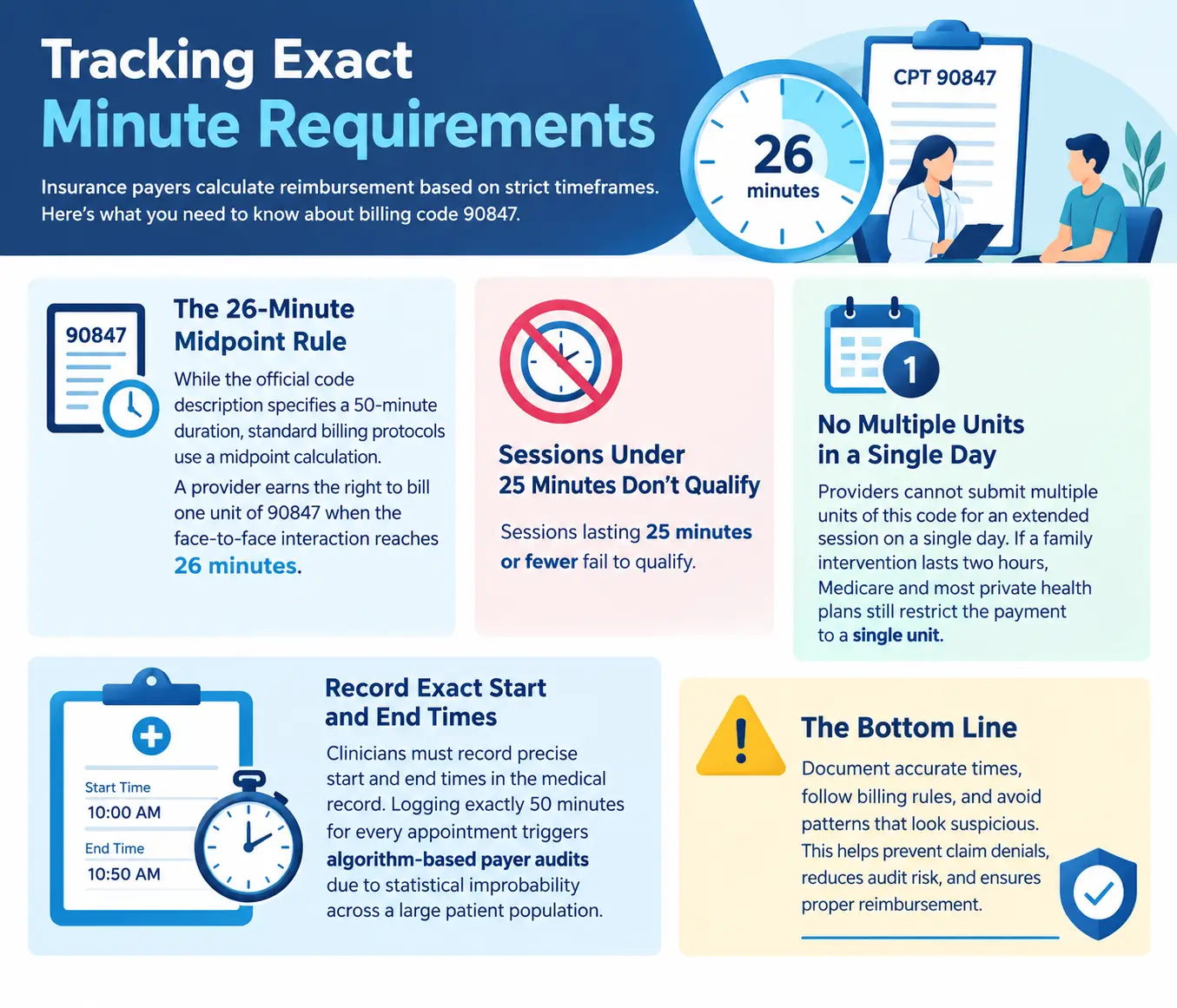
Insurance payers calculate reimbursement based on strict timeframes. While the official code description specifies a 50-minute duration, standard billing protocols utilize a midpoint calculation. A provider earns the right to bill one unit of 90847 when the face-to-face interaction reaches 26 minutes.
Sessions lasting 25 minutes or fewer fail to qualify. Providers cannot submit multiple units of this code for an extended session on a single day. If a family intervention lasts two hours, Medicare and most private health plans still restrict the payment to a single unit.
Clinicians must record precise start and end times in the medical record. Logging exactly 50 minutes for every appointment triggers algorithm-based payer audits due to statistical improbability across a large patient population.
Distinguishing 90847 from alternative therapy codes
Accurate code selection prevents immediate claim rejections. The primary differences involve who is in the room and the focus of the clinical intervention.
Procedure Code | Attendance Requirement | Clinical Application |
90847 | Primary patient and family | Treating the patient’s diagnosis using family interaction. |
90846 | Family only | Consulting with relatives when the patient is absent. |
90837 | Primary patient only | 60 minutes of individual treatment. |
90853 | Multiple unrelated patients | Group therapy for individuals with similar conditions. |
Sometimes a parent steps into an individual session for five minutes to provide a behavioral update. This brief interaction does not convert the visit into family therapy. If the clinician spends 40 minutes working directly with a child and 10 minutes with the parents present, the provider bills an individual psychotherapy code. CPT 90847 requires family involvement for the majority of the clinical hour.
Billing regulations for couples counseling
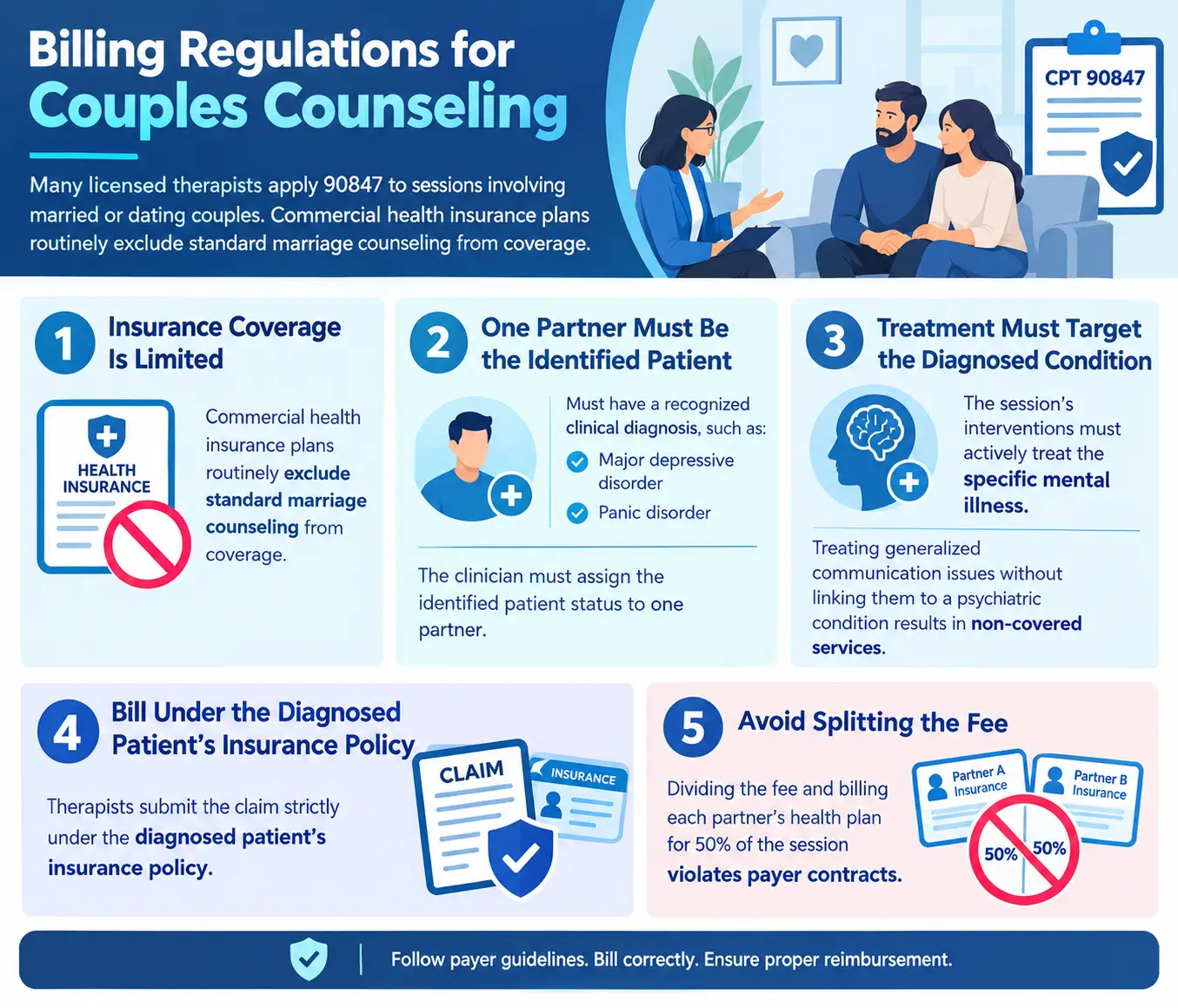
Many licensed therapists apply 90847 to sessions involving married or dating couples. Commercial health insurance plans routinely exclude standard marriage counseling from coverage.
To obtain reimbursement, the clinician must assign the identified patient status to one partner. That individual must carry a recognized clinical diagnosis, such as major depressive disorder or panic disorder. The session’s interventions must actively treat that specific mental illness. Treating generalized communication issues without linking them to a psychiatric condition results in non-covered services.
Therapists submit the claim strictly under the diagnosed patient’s insurance policy. Dividing the fee and billing each partner’s health plan for 50% of the session violates payer contracts.
Mandatory documentation standards
Insurance auditors frequently demand refunds when provider notes lack specific data points. A compliant electronic health record entry for this service requires definitive proof of medical necessity.
The documentation must identify every person in the room and specify their relationship to the patient. The clinician must write down the specific clinical interventions used. The note should explain exactly how the family member’s involvement assisted in treating the patient’s symptoms.
Missing start and stop times, absent patient names, or copied-and-pasted clinical notes from previous weeks will result in an audit failure. Submitting the claim under the participating spouse’s name instead of the identified patient guarantees a denial based on patient eligibility.
Telemedicine applications and modifiers
Telemedicine regulations allow providers to conduct family therapy remotely. Medicare and major commercial insurers process virtual 90847 claims when billers attach the correct geographic codes and modifiers.
Standard synchronous video sessions require Place of Service (POS) code 02 for patients located outside their home, or POS 10 for patients receiving care inside their residence. Billers typically append modifier 95 to indicate an audio-visual platform. Audio-only sessions require modifier 93.
Payer rules dictate physical locations during the call. Some insurance contracts require all family members to sit in the same physical room. Other carriers permit three-way virtual meetings where the provider, patient, and relative log in from separate addresses. Billers check specific medical policies for companies like Aetna or UnitedHealthcare to confirm exact location parameters prior to the first virtual session.
Overlapping evaluation and management services
Psychiatrists and psychiatric nurse practitioners regularly prescribe medication and provide therapy during a single appointment. Medicare guidelines require providers to maintain a strict separation between Evaluation and Management (E/M) services and psychotherapy.
Gathering a standard family medical history does not justify billing a family therapy code. If a prescriber bills an E/M code for medication management alongside 90847, the documentation must show a distinctly separate therapy service. The time used to calculate the E/M code cannot count toward the 26-minute minimum required for the family therapy code.
Financial expectations and fee schedules
Payment rates for procedure code 90847 depend on practitioner licensing, geographic location, and insurance fee schedules. Based on the 2026 Medicare Physician Fee Schedule, the estimated national non-facility rate sits at $128.00. Facility-based Medicare claims reimburse at roughly $116.00. This represents an increase from the 2025 Medicare base rate of $102.86.
Private commercial insurance companies generally pay more than federal programs. National averages for private payer reimbursement range from $85 to $200 per 50-minute session. Medical billers must verify benefit limits before treatment begins. Many commercial policies cap family therapy at a specific number of annual visits. Sometimes payers count family sessions against the patient’s individual therapy maximum, depleting coverage limits prematurely.
Resolving same-day billing conflicts
Providers occasionally conduct an individual session and a family session for the same patient on a single date. Current Procedural Terminology guidelines allow this, but payer algorithms usually block the second claim. Adjudicators view same-day behavioral health claims as duplicate billing.
To secure reimbursement, the biller must use specific modifiers to indicate the sessions occurred at separate times and addressed completely different clinical presentations. Most medical billing departments require clinicians to schedule individual and family appointments on separate days to avoid the administrative cost of appealing these automated denials.
When an insurance company rejects a 90847 submission, billing staff review the explanation of benefits immediately. Denials frequently occur due to omitted telehealth modifiers or inactive prior authorizations. If a payer denies the service arguing a lack of medical necessity, the practice submits a formal appeal containing the clinical note. The appeal letter explicitly connects the family intervention to the patient’s psychiatric diagnosis, proving the 50-minute session applied targeted clinical treatment rather than general relationship advice.