



Proper billing for mental health services requires a precise understanding of Current Procedural Terminology (CPT). Among the specialized behavioral health codes, CPT code 90845 presents distinct requirements that mental health practitioners, clinic directors, and billing specialists must follow to maintain compliance and avoid claim denials.
Unlike standard psychotherapy codes, which are strictly timed, 90845 specifically designates medical psychoanalysis. This specific therapeutic modality operates under different clinical guidelines and reimbursement structures. This guide details the regulations, documentation standards, and reimbursement rules for CPT code 90845.
Understanding CPT code 90845
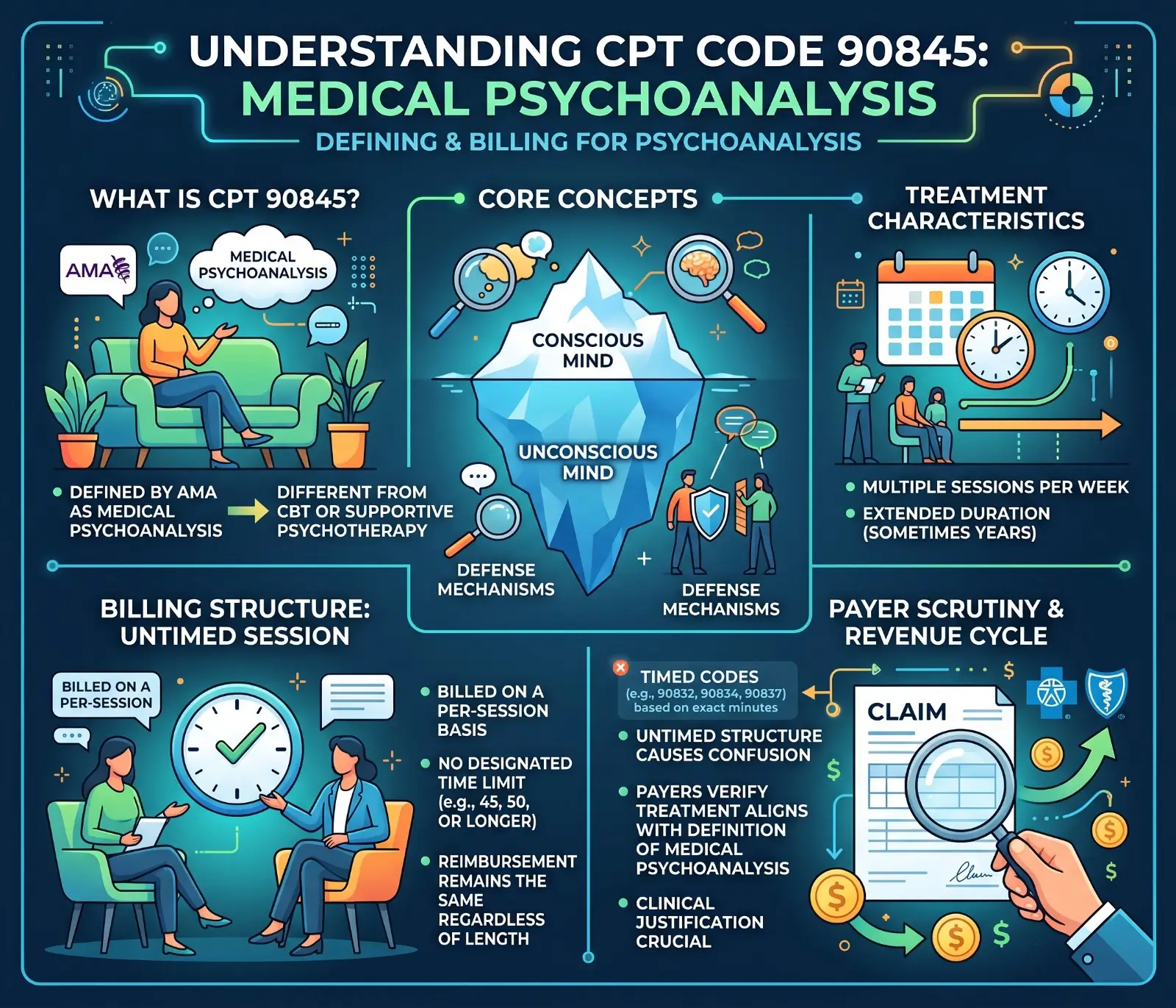
The American Medical Association defines CPT code 90845 as "Medical psychoanalysis".
Psychoanalysis differs functionally and clinically from cognitive behavioral therapy or general supportive psychotherapy. It involves the prolonged investigation of unconscious mental processes, defense mechanisms, and transference. Patients undergoing psychoanalysis typically attend multiple sessions per week over an extended period, sometimes lasting several years.
Standard psychotherapy codes (such as 90832, 90834, and 90837) are billed based on the exact time spent with the patient (30, 45, and 60 minutes, respectively). CPT code 90845 does not have a designated time limit in its official descriptor. Practitioners bill this code on a per-session basis. The reimbursement remains the same whether the clinical session lasts 45 minutes, 50 minutes, or longer.
This untimed structure frequently causes confusion during the revenue cycle management process. Commercial insurers and federal payers scrutinize claims submitted under 90845 to verify the treatment provided aligns with the strict definition of medical psychoanalysis.
Provider qualifications and credentialing
Not all licensed mental health professionals can legally or ethically bill CPT code 90845. Insurers restrict this code to providers who have completed specialized post-graduate training from recognized psychoanalytic institutes.
Eligible providers typically include:
- Psychiatrists (MD or DO)
- Licensed Clinical Psychologists (PhD or PsyD)
- Licensed Clinical Social Workers (LCSW) who hold specialized psychoanalytic certification
Standard graduate programs in social work or psychology do not provide the clinical hours required to qualify for this billing code. Submitting claims under 90845 without the credentialing to support formal psychoanalytic training frequently triggers pre-payment audits and credentialing denials. Billing staff must manually verify a provider's specialized credentials with specific payer networks before submitting claims using this code.
Relative value units and fee schedule calculations
Reimbursement rates for CPT code 90845 fluctuate based on the payer, geographic location, and the provider's contracted fee schedule. The Centers for Medicare & Medicaid Services (CMS) dictates baseline reimbursement rates annually through the Medicare Physician Fee Schedule. While private insurance companies negotiate their own rates, they heavily rely on the Medicare fee schedule as a baseline metric.
Medicare determines reimbursement using Relative Value Units (RVUs). The total RVU for a code is calculated by combining three elements: provider work, practice expense, and malpractice insurance costs.
According to the Centers for Medicare & Medicaid Services public use files, the work RVU for CPT 90845 is historically set at 2.15. This figure is lower than the work RVU for a 60-minute psychotherapy session (90837, which carries a work RVU of 2.80). Consequently, some private payers reimburse 90845 at a lower rate than an extended psychotherapy session. Practices must evaluate these fee schedules annually to accurately project revenue.
Reimbursement also differs based on the site of service. Medicare and commercial payers differentiate between facility settings (hospitals or registered clinics) and non-facility settings (private offices). Non-facility rates are typically higher to compensate the private practitioner for overhead costs.
Telehealth regulations and modifiers for psychoanalysis
The transition toward digital care delivery fundamentally changed how psychoanalysis is conducted. The Centers for Medicare & Medicaid Services finalized regulations allowing behavioral health services to be permanently delivered via telehealth, provided specific conditions are met.
If psychoanalysis is conducted via interactive audio and video, billers must apply the correct Place of Service (POS) codes to the CMS-1500 claim form. Modifiers and POS codes dictate the final reimbursement amount.
- POS 10: Telehealth provided in the patient’s home. Medicare reimburses POS 10 at the higher, non-facility rate.
- POS 02: Telehealth provided in a location other than the patient’s home (such as a separate medical clinic). Medicare reimburses POS 02 at the lower, facility rate.
During the initial expansion of telehealth, billers universally appended modifier 95 to indicate synchronous audio-video services. While many commercial payers still require modifier 95 alongside POS 10 or 02, Medicare now relies primarily on the Place of Service code to process the claim. Billing departments must query individual commercial payer policies, as private insurers do not uniformly adopt CMS telehealth rules.
Documentation standards for medical necessity
Proper clinical documentation acts as the primary defense against recoupments and post-payment audits. Because psychoanalysis is highly intensive, insurance companies routinely request medical records to establish medical necessity before paying the claim.
The medical record for a 90845 encounter must contain:
- A specific, supporting diagnosis: The patient's condition must warrant long-term psychoanalysis. Conditions that respond well to brief, solution-focused interventions often fail medical necessity reviews for this specific code.
- Evidence of psychoanalytic technique: The clinical notes must reflect psychoanalytic terminology and concepts. The provider should document the exploration of defense mechanisms, transference, resistance, or unconscious conflicts.
- A specialized treatment plan: A detailed plan outlining long-term clinical goals that require the specific depth of psychoanalytic treatment.
- Session parameters: The date, start time, and stop time must be recorded. Even though 90845 is untimed for billing purposes, documenting the exact clinical time remains a strict compliance standard for medical records.
If the documentation reads like a standard supportive therapy session (such as notes stating the patient discussed workplace stress and the provider taught breathing exercises), the payer will deny the claim or forcibly downcode it to a standard psychotherapy code.
Navigating prior authorization requirements
Psychoanalysis represents a significant financial commitment from the insurer. Patients often attend three to five sessions per week for a period of two to five years. Due to this high utilization rate, prior authorization is almost universally required by commercial payers and managed care organizations.
To secure this authorization, the billing and clinical team must submit a thorough clinical rationale. The request must outline why shorter-term, evidence-based treatments have failed or why they are medically contraindicated for the patient's specific presentation. The provider must prove how the intensive nature of psychoanalysis is clinically necessary to achieve psychiatric stability or prevent hospitalization.
Failure to obtain this authorization before initiating the first session results in claim denials. The patient then bears the full financial responsibility for the treatment. Practices must establish a clear workflow verifying authorization dates, approved session counts, and expiration dates.
Coding alongside evaluation and management services
Medical billing offices routinely encounter claim rejections when billing 90845 due to specific administrative errors regarding Evaluation and Management (E/M) codes.
Psychiatrists and psychiatric nurse practitioners often manage patient medications in the same visit they provide therapy. For standard psychotherapy, providers use an E/M code (such as 99213 or 99214) in conjunction with a psychotherapy add-on code (such as +90833 for 30 minutes of therapy or +90836 for 45 minutes of therapy).
CPT code 90845 does not function as an add-on code. According to the National Correct Coding Initiative (NCCI) edits published by CMS, a provider cannot bill an E/M code and 90845 on the exact same date of service without expecting an automated denial.
If a provider performs a completely separate and identifiable evaluation and management service on the same day as a psychoanalysis session, the biller must append modifier 25 to the E/M code. The documentation must clearly separate the time and medical decision-making used for medication management from the time used for the psychoanalysis session. Even with perfect documentation and modifier 25, payers heavily audit this combination.
Office of Inspector General audits and compliance risks
Behavioral health billing operates under strict federal oversight. According to a 2024 report published by the Department of Health and Human Services Office of Inspector General (OIG), behavioral health services experience high improper payment rates due to insufficient documentation.
The OIG actively monitors claims data for statistical anomalies. If a practitioner who is not certified in psychoanalysis begins billing 90845, or if a clinic bills 90845 exclusively while entirely ignoring standard psychotherapy codes, algorithms flag the provider for review.
Misrepresenting supportive therapy as medical psychoanalysis constitutes upcoding or miscoding. Submitting incorrect CPT codes to federal healthcare programs (like Medicare, Medicaid, or TRICARE) carries serious financial penalties under the False Claims Act. Practices must conduct internal chart audits quarterly to verify the documentation matches the CPT code billed.
The appeals process for denied 90845 claims
When a payer denies a 90845 claim, the billing team must act within the payer's specific timely filing limits to recover the revenue. Claim denials for this code typically fall into two categories: administrative errors and clinical necessity denials.
For administrative errors (such as a missing modifier or an incorrect date of birth), the biller can submit a corrected claim through the clearinghouse.
- Level 1 Appeal (Redetermination): The billing office submits the claim along with the session notes, the initial treatment plan, and a letter from the provider explaining why the service met the definition of medical psychoanalysis.
- Level 2 Appeal (Reconsideration): If the first appeal is denied, the provider can request a peer-to-peer review. During this review, the treating psychoanalyst speaks directly with a medical director employed by the insurance company to argue the clinical merits of the case.
When to use standard psychotherapy alternative codes
Proper coding requires matching the intervention provided to the exact CPT definition. If a provider does not meet the strict training criteria for psychoanalysis, or if the clinical session utilizes a mix of different modalities, standard timed psychotherapy codes are the legal and appropriate choice.
- Use 90832 for 30 minutes of psychotherapy (16 to 37 minutes).
- Use 90834 for 45 minutes of psychotherapy (38 to 52 minutes).
- Use 90837 for 60 minutes of psychotherapy (53 minutes or longer).
- Use 90839 for the first 60 minutes of psychotherapy for a patient in crisis.
Accurate code selection ensures proper reimbursement and maintains the legal integrity of the patient's medical record. Understanding the specific mechanics, constraints, and documentation requirements of CPT 90845 protects both the provider's private practice and the patient's uninterrupted access to highly specialized behavioral healthcare.