



When a patient experiences a mental health crisis that requires urgent intervention, healthcare providers use Current Procedural Terminology (CPT) code 90839 to bill for the services provided.
This code represents psychotherapy for a patient in crisis and is distinctly different from routine psychotherapy codes. Understanding the specific time rules, documentation requirements, and billing guidelines for 90839 prevents claim denials and ensures accurate reimbursement for the specialized care delivered during acute psychological emergencies.
What Constitutes a Crisis Under CPT Guidelines?
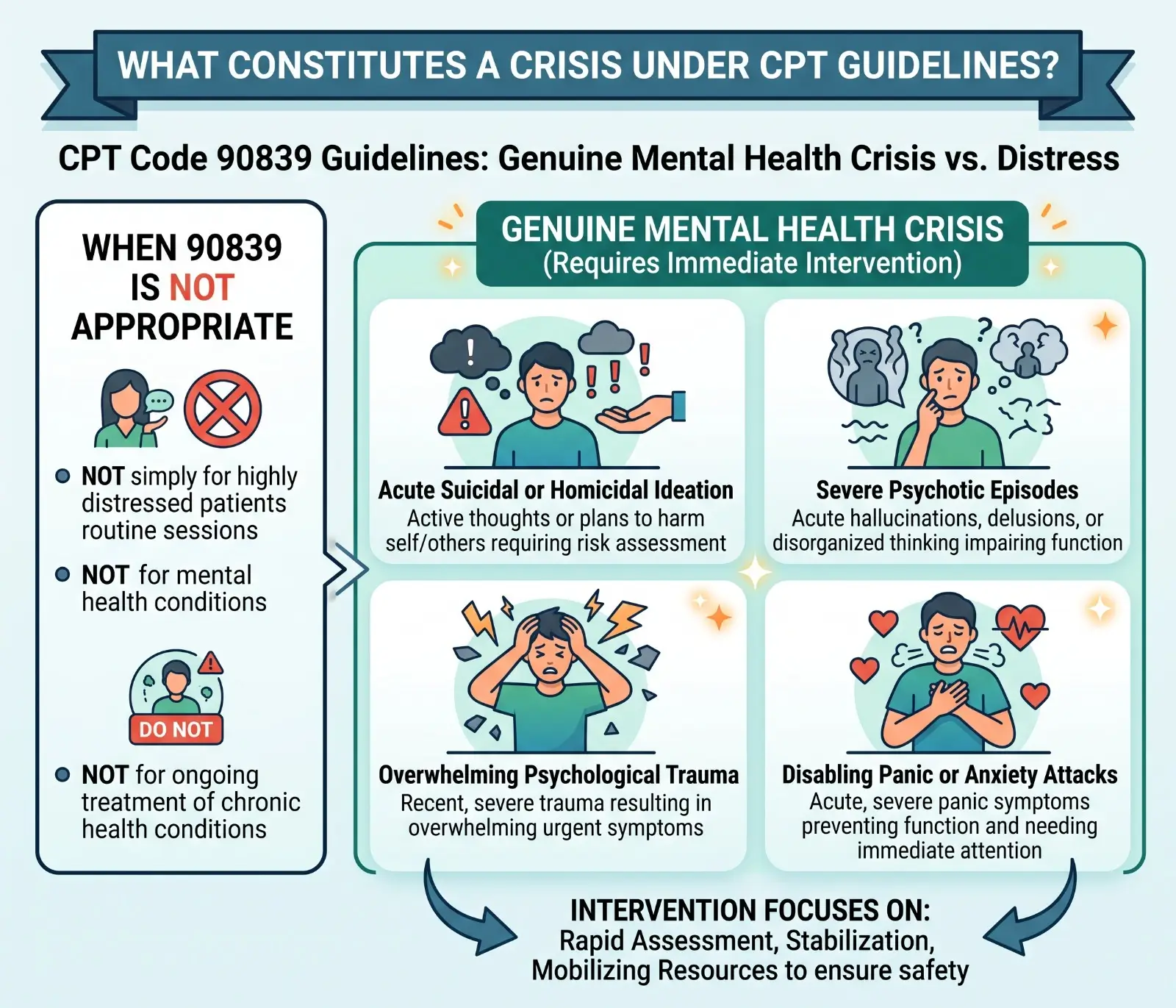
CPT code 90839 cannot be used simply because a patient is highly distressed or experiencing an intense emotional reaction during a routine scheduled session. To bill 90839, the situation must meet specific clinical criteria that define a genuine mental health crisis requiring immediate intervention.
The American Medical Association (AMA) guidelines define a crisis as a situation where a patient presents with a life-threatening or complex state that requires immediate attention to prevent severe consequences. The intervention focuses on rapid assessment, stabilization, and mobilizing resources to ensure safety.
Specific examples of when 90839 is appropriate include:
- Acute Suicidal or Homicidal Ideation: The patient expresses active thoughts or plans of harming themselves or others, requiring immediate risk assessment and safety planning.
- Severe Psychotic Episodes: The patient is experiencing acute hallucinations, delusions, or disorganized thinking that severely impairs their ability to function safely.
- Overwhelming Psychological Trauma: The patient has experienced a recent, severe trauma resulting in overwhelming symptoms that demand urgent stabilization.
- Disabling Panic or Anxiety Attacks: The patient is experiencing acute, severe panic symptoms that prevent them from functioning and require immediate intervention.
The presenting problem must be an actual crisis, and the intervention provided must reflect the urgency of the situation. Providers cannot use 90839 for ongoing treatment of chronic mental health conditions.
90839 Time Rules and Thresholds
CPT code 90839 is a time-based code, meaning the duration of the crisis intervention dictates how it is billed. The code descriptor defines 90839 as "psychotherapy for crisis; first 60 minutes." However, specific time thresholds determine when the code can actually be applied.
The critical time rules for 90839 are:
- Minimum Time Threshold: The intervention must last a minimum of 30 minutes to bill 90839. If a provider spends less than 30 minutes managing a crisis, they cannot use this code. They must use standard psychotherapy codes or Evaluation and Management (E/M) codes instead, assuming the clinical documentation supports those services.
- The 30-74 Minute Window: CPT code 90839 is billed for crisis interventions lasting between 30 and 74 minutes. A 45-minute crisis intervention and a 70-minute crisis intervention are both billed using the single 90839 code.
- Cumulative Time on the Same Date: If a provider delivers multiple segments of crisis psychotherapy on the same date of service, the time is cumulative. For example, if a provider spends 40 minutes with a patient, takes a brief break, and then provides another 20 minutes of crisis intervention later that day, the total time (60 minutes) is billed as a single unit of 90839. The documentation must clearly record the start and stop times for both segments.
Using Add-On Code 90840 for Extended Sessions
When a crisis intervention extends beyond 74 minutes, providers must use the add-on CPT code 90840. The descriptor for 90840 is "each additional 30 minutes."
Key rules for using 90840:
- Never Billed Alone: Code 90840 is an add-on code and must always be billed in conjunction with the primary base code, 90839, on the same date of service. It cannot stand alone on a claim.
- The 75-Minute Threshold: The first unit of 90840 is applied only when the total intervention time reaches 75 minutes. At 74 minutes, the billing is strictly 90839. At 75 minutes, the billing becomes 90839 + 90840.
- The Midpoint Rule: Medicare and most commercial payers follow the midpoint rule for add-on time. Providers must reach the midpoint (15 minutes) of the next 30-minute block to bill an additional unit of 90840.
The time breakdown for extended crisis sessions is:
- 30 to 74 minutes: Bill 90839
- 75 to 104 minutes: Bill 90839 + 90840 (one unit)
- 105 to 134 minutes: Bill 90839 + 90840 (two units)
- 135 to 164 minutes: Bill 90839 + 90840 (three units)
Documentation Requirements for 90839
Because crisis codes offer higher reimbursement rates than standard psychotherapy codes, they are subject to frequent payer audits. Accurate, detailed documentation is the primary defense against claim denials and recoupment.
Documentation for 90839 must clearly demonstrate that the clinical situation met the definition of a crisis and that the interventions provided were medically necessary to manage that crisis.
The patient record must include:
- Exact Start and Stop Times: Because 90839 is time-based, precise documentation of minutes is mandatory. Vague phrases like "approximately one hour" or "session lasted 45 minutes" fail audits. The record must state specific times (e.g., "Crisis intervention provided from 2:15 PM to 3:05 PM. Total time: 50 minutes").
- Description of the Crisis State: The note must detail the specific symptoms and behaviors that constituted the crisis. This includes documenting acute distress, disorganized thinking, or specific statements regarding self-harm.
- Risk Assessment: A thorough evaluation of the patient's risk to themselves or others must be documented. This is a core component of managing a mental health emergency.
- Mental Status Examination (MSE): The record should include relevant findings from an MSE performed during the crisis intervention.
- Specific Interventions Provided: The documentation must detail the actions taken by the provider to de-escalate the crisis and stabilize the patient. This might include supportive counseling, conflict resolution, or coordinating care with other professionals.
- Disposition and Safety Plan: The note must conclude with a clear plan for the patient's immediate safety. This could involve outlining a specific safety plan agreed upon with the patient, mobilizing family support, or initiating a referral for inpatient hospitalization.
A strong documentation example: "Patient presented in acute distress with active suicidal ideation following the sudden loss of employment. Crisis intervention provided from 10:00 AM to 11:15 AM (Total time: 75 minutes). Conducted urgent risk assessment; patient identified specific plan and means. Interventions focused on immediate de-escalation and safety planning. Mobilized patient's spouse to remove firearms from the home and establish a 24-hour safety watch. Patient contracted for safety. Follow-up appointment scheduled for tomorrow at 9:00 AM."
Billing Rules and Payer Variations
Providers face specific billing restrictions when using 90839.
- No Same-Day Routine Psychotherapy: Providers cannot bill 90839 and routine psychotherapy codes (such as 90832, 90834, or 90837) on the same date of service. The assumption is that if a patient is in a crisis state requiring 90839, routine therapeutic work is superseded by the need for immediate stabilization.
- Evaluation and Management (E/M) Codes: Psychiatrists and other prescribing providers can often bill an E/M code on the same day as 90839, provided the E/M service is distinct and separately identifiable from the crisis intervention.
- Telehealth Considerations: Many commercial insurers reimburse crisis psychotherapy provided via telehealth at the same rate as in-person services, particularly in states with strong parity laws. However, providers must verify specific payer policies regarding place-of-service codes and modifiers required for telehealth billing.
- Medicare Specific Codes: While Medicare accepts 90839 and 90840, they also utilize specific HCPCS codes for crisis psychotherapy provided in non-facility settings: G0017 (first 60 minutes) and G0018 (each additional 30 minutes). Providers billing Medicare must check local coverage determinations (LCDs) to confirm which codes are required.
Accurate application of CPT code 90839 requires strict adherence to the 30-minute minimum threshold, proper use of the 90840 add-on code for sessions exceeding 74 minutes, and exact documentation of start and stop times. Providers who document the clinical necessity of the crisis intervention and the specific steps taken to ensure patient safety minimize audit risks and ensure appropriate reimbursement for these critical services.