



CPT Code 90840: Time Requirements, Rules & Best Practices
CPT code 90840 reports additional time spent providing psychotherapy for crisis. It is an add-on code used with 90839, and the first unit becomes reportable at 75 minutes of qualifying crisis psychotherapy. An appointment running beyond an hour does not, by itself, support crisis coding.
Accurate billing requires three decisions: whether the encounter qualifies as crisis psychotherapy, how much reportable time occurred, and which codes the payer accepts for the setting. Reviewing those questions separately helps prevent a correct time calculation from concealing an unsupported service.
What CPT code 90840 covers
The Centers for Medicare & Medicaid Services (CMS), in Psychotherapy for Crisis, updated February 25, 2026, describes urgent assessment, relevant history, a mental status examination, psychotherapy, and decisions about the patient’s next level of care. Treatment can include mobilizing resources to restore safety and interventions intended to limit psychological trauma.
The coding distinction is the crisis service itself. A lengthy discussion about longstanding symptoms does not establish an urgent crisis simply because it takes 90 minutes.
A useful review question is: what required immediate clinical intervention, and what did the practitioner do about it? The note should answer both parts. Labels such as “difficult session” or “patient very upset” provide little explanation of the actual service.
CPT code 90840 time requirements
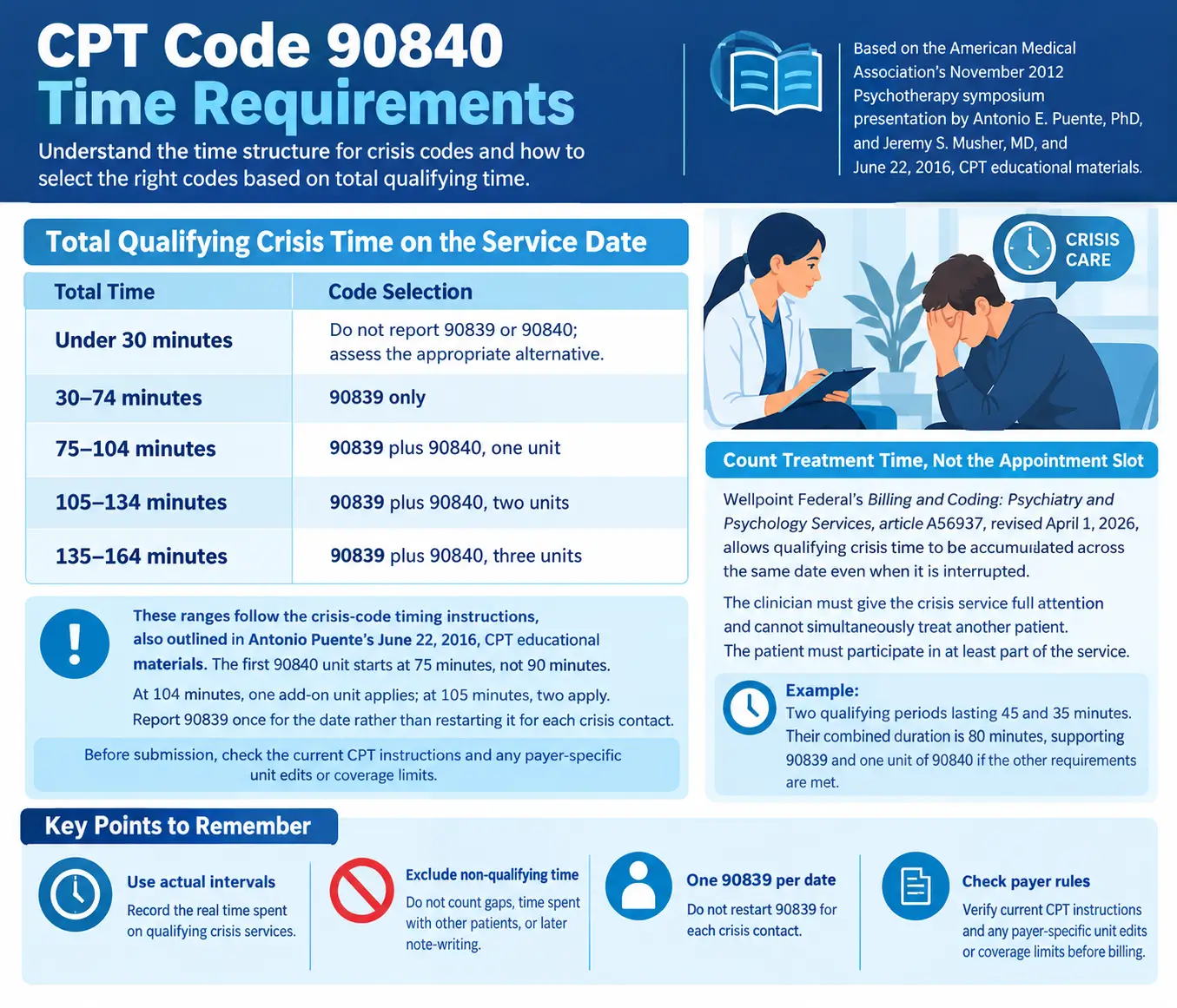
The American Medical Association’s November 2012 Psychotherapy symposium presentation, by Antonio E. Puente, PhD, and Jeremy S. Musher, MD, explains the time structure introduced for the crisis codes: 90839 covers 30–74 minutes, with 90840 added for subsequent 30-minute ranges.
Total qualifying crisis time on the service date | Code selection |
Under 30 minutes | Do not report 90839 or 90840; assess the appropriate alternative |
30–74 minutes | 90839 only |
75–104 minutes | 90839 plus 90840, one unit |
105–134 minutes | 90839 plus 90840, two units |
135–164 minutes | 90839 plus 90840, three units |
These ranges follow the crisis-code timing instructions, also outlined in Antonio Puente’s June 22, 2016, CPT educational materials.
The first 90840 unit starts at 75 minutes, not 90 minutes. At 104 minutes, one add-on unit applies; at 105 minutes, two apply. Report 90839 once for the date rather than restarting it for each crisis contact.
These are code-selection ranges. Before submission, check the current CPT instructions and any payer-specific unit edits or coverage limits.
Count treatment time, not the appointment slot
Wellpoint Federal’s Billing and Coding: Psychiatry and Psychology Services, article A56937, revised April 1, 2026, allows qualifying crisis time to be accumulated across the same date even when it is interrupted. The clinician must give the crisis service full attention and cannot simultaneously treat another patient. The patient must participate in at least part of the service.
For example, consider two qualifying periods lasting 45 and 35 minutes. Their combined duration is 80 minutes, supporting 90839 and one unit of 90840 if the other requirements are met.
Record the actual intervals. Exclude gaps when no qualifying service occurs, work for another patient, and later note-writing. A two-hour calendar reservation does not establish two hours of reportable crisis treatment.
Documentation that supports the additional time
First Coast Service Options’ article A57520, Billing and Coding: Psychiatric Diagnostic Evaluation and Psychotherapy Services, effective January 1, 2025, requires records that support the reported procedure and diagnosis. It permits relevant time to be recorded as start and stop times or total time. Records also need patient identification, service dates, and clinician authentication. These are contractor requirements, not a separate national scoring system.
Use the following prompts to make the encounter understandable:
- Reason for urgent care: Describe the presenting change, immediate concern, and why intervention could not be deferred.
- Assessment: Record relevant history, mental status findings, and the risk assessment actually performed.
- Interventions: Explain the psychotherapy and stabilization work delivered.
- Response: Describe changes in the patient’s presentation, participation, or ability to engage in the plan.
- Disposition: State what happened next, including transfer, referral, or follow-up arrangements where applicable.
- Time: Identify qualifying minutes and explain interruptions when they affect the calculation.
- Extended treatment: Explain why continued crisis intervention remained necessary.
These prompts are an editorial checklist, not a claim that every payer mandates identical fields.
First Coast’s related coverage policy, L33252, revised July 1, 2020, calls for descriptions of interventions, patient response, and reasons for extending psychotherapy. A generic statement that therapy occurred does not provide that detail.
For an original hypothetical example, a note might explain that continuing risk required further assessment and work with a support person before disposition could be arranged. The entry should describe what actually occurred. Never insert template language about risk, safety planning, or family involvement that the encounter does not support.
Billing rules and incompatible code combinations
Use 90840 with its correct primary code
Do not submit 90840 alone or attach it to 90837 as an extension of routine psychotherapy. Colorado’s State Behavioral Health Services Billing Manual, effective January 1, 2024, expressly identifies 90839 as the primary code and requires the total crisis service to exceed 74 minutes before 90840 is used.
A practical claim edit can flag any 90840 line without its corresponding primary service. That check should also compare dates and rendering practitioners so an unrelated claim line does not satisfy the edit accidentally.
Review other psychiatric services before submission
Wisconsin Physicians Service’s article A57480, Billing and Coding: Psychiatry and Psychology Services, effective January 1, 2026, restricts reporting crisis psychotherapy with psychiatric diagnostic evaluations, standard psychotherapy, and interactive complexity. Examples include 90791, 90792, 90832, 90834, 90837, and 90785.
Family participation or difficult communication does not independently justify adding 90785 to crisis psychotherapy. Similarly, an assessment performed as part of crisis care should not automatically generate a separate diagnostic-evaluation charge.
If several services appear on the same date, review the applicable CPT instructions, claim edits, and payer policy. Do not add a modifier simply to force a prohibited combination through billing software.
Medicare’s alternative codes for eligible settings
Medicare has a setting-specific distinction that can change the claim.
CMS directs providers to use G0017 and G0018 for crisis psychotherapy at eligible places of service where the non-facility rate applies, excluding the office setting. Payment for those qualifying services equals 150% of the applicable non-facility fee-schedule amount. This does not mean every 90840 service receives an increased payment.
Confirm the actual setting before selecting the code family. Avoid treating “outside the office” as sufficient evidence that every requirement is satisfied.
For reimbursement estimates, use the applicable payer fee schedule and contract. A dollar figure from another practice, location, or year is not a dependable estimate for the claim being prepared.
Can crisis psychotherapy be provided through telehealth?
Yes, subject to the applicable requirements. The U.S. Department of Health and Human Services lists 90839 and 90840 in Billing for Telebehavioral Health, updated July 29, 2025, as services with permanent Medicare telehealth coverage. The same guidance directs providers to check current Medicare policies and state or commercial payer rules.
For each claim, verify the permitted communication method, place-of-service reporting, modifiers, and practitioner eligibility. Telehealth coverage does not remove the crisis-service or time requirements.
Keep a payer reference sheet with the policy link, effective date, and date checked. That makes future reviews more useful than an undocumented note saying “telehealth allowed.”
Three examples of code selection
The following scenarios are hypothetical applications of the rules, not published case studies.
A 74-minute crisis encounter
A clinician provides 74 minutes of qualifying crisis psychotherapy. The assessment and treatment support crisis coding, but the add-on threshold has not been reached. Report 90839 alone where the CPT code family applies. Do not round the encounter to 75 minutes.
A 105-minute crisis encounter
Qualifying crisis treatment totals 105 minutes. The documentation supports continued intervention throughout that time. The time calculation supports 90839 and two units of 90840, subject to the payer’s coverage and unit rules. A new 90839 unit is unnecessary.
A long visit without documented crisis treatment
An 85-minute appointment addresses ongoing symptoms through planned psychotherapy, with no documented crisis service. Its duration cannot establish eligibility for 90840. Review the appropriate psychotherapy coding and payer policy for the service delivered.
Best practices for reviewing a claim
Check the clinical note before calculating add-on units. Ask the clinician to clarify an ambiguous record rather than inferring crisis severity from the diagnosis or visit length.
Next, reconcile time across the note, appointment record, and claim. Investigate discrepancies, especially near a unit threshold. A calendar entry can help identify a question; it should not replace documented treatment time.
Finally, inspect the primary code, additional units, service date, setting, and other same-day charges. If a claim denies, identify the specific reason before resubmitting. Missing primary-code information requires a different correction from an unsupported service or a payer coverage restriction.
For CPT code 90840, a defensible claim connects the urgent clinical need, the intervention performed, and the qualifying minutes. Calculate the units only after those elements are established, then apply the payer’s rules for the actual service setting.