



The 90832 CPT code reports individual psychotherapy, commonly described as a 30-minute service. The actual billing range is 16–37 minutes. A session does not have to last exactly half an hour, but the documented psychotherapy time must meet that range. Accurate billing also requires evidence that psychotherapy was medically necessary and delivered by an eligible professional. A calendar entry establishes that an appointment was scheduled. The clinical record must establish what treatment occurred and why the patient needed it.
What the 90832 CPT code covers
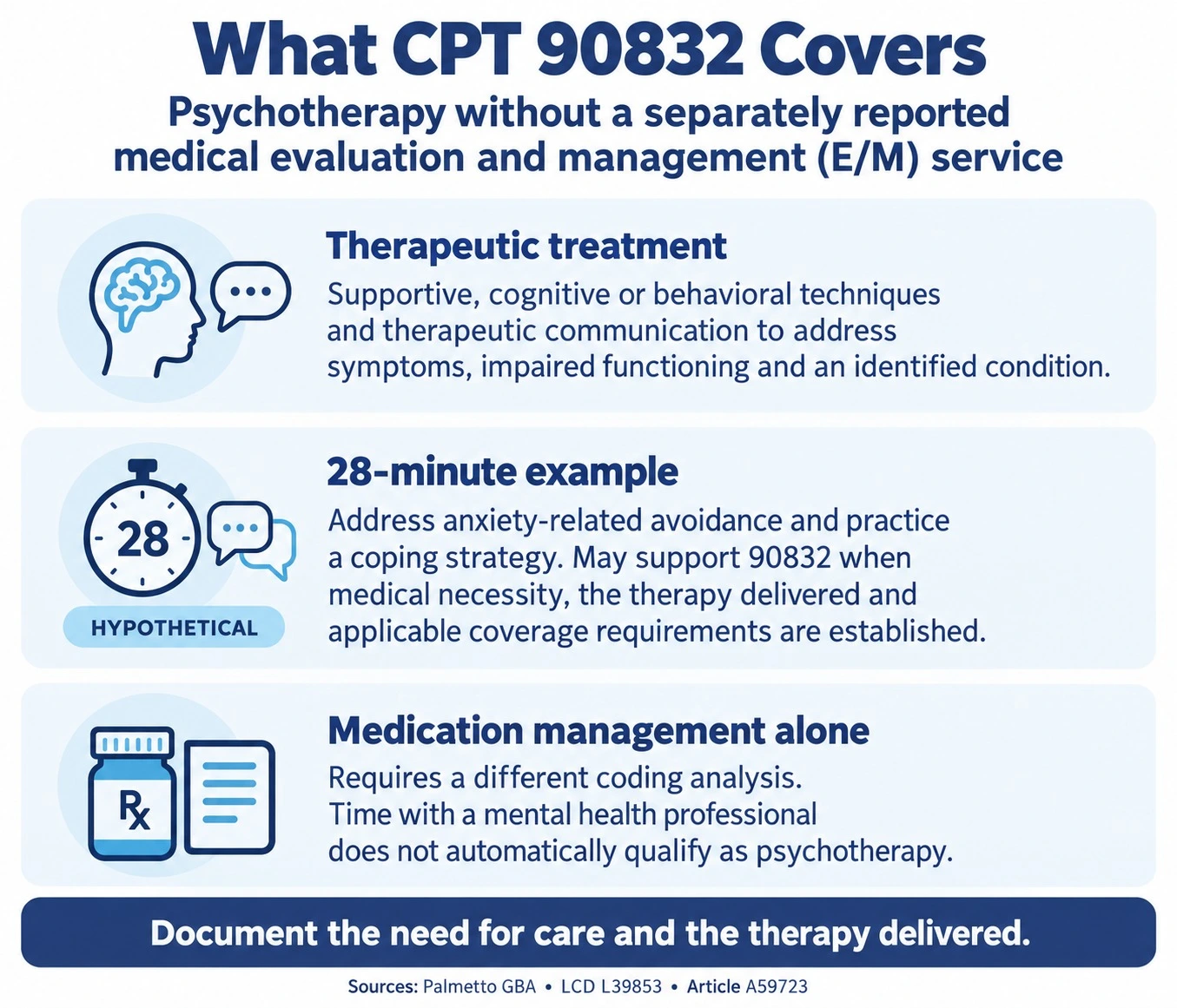
90832 describes psychotherapy provided without a separately reported medical evaluation and management (E/M) service. It can involve supportive therapy, cognitive or behavioral techniques, and other therapeutic communication directed at the patient’s condition. Palmetto GBA’s Outpatient Psychotherapy coverage policy, effective October 20, 2024, connects coverage to symptoms, impaired functioning, and treatment of an identified condition.
For example, a clinician might spend 28 minutes helping a patient examine anxiety-related avoidance and practice a coping strategy. This hypothetical encounter could support 90832 if the record establishes medical necessity, the treatment delivered, and the applicable coverage requirements.
An appointment devoted only to medication management requires a different coding analysis. Time spent with a mental health professional does not automatically qualify as psychotherapy.
Time requirements and comparison with related codes
First Coast Service Options’ Psychotherapy services guidance, published August 6, 2026, specifies these intervals:
| CPT code | Psychotherapy time | Reporting purpose |
|---|---|---|
| 90832 | 16–37 minutes | Individual psychotherapy without separate E/M |
| 90834 | 38–52 minutes | Individual psychotherapy without separate E/M |
| 90837 | 53 minutes or longer | Individual psychotherapy without separate E/M |
| 90833 | 16–37 minutes | Psychotherapy add-on to an eligible E/M service |
Count the treatment actually provided
Use the psychotherapy time delivered, excluding administrative work and documentation completed after the patient encounter. First Coast requires either start and stop times or the total psychotherapy duration.
Consider a scheduled 45-minute appointment where a patient arrives late and receives 31 minutes of psychotherapy. The supported code is 90832. Eight additional minutes spent completing the note afterward do not convert it to 90834.
The boundaries are exact: 37 minutes falls under 90832; 38 minutes falls under 90834. These examples apply the documented-time approach in CGS Administrators’ Psychotherapy Services Decision Tree (accessed October 6, 2026).
Fifteen minutes does not meet 90832’s minimum. Do not round it upward. Any alternative code must independently describe the service actually furnished.
For a routine individual outpatient session, choose the code for the entire psychotherapy duration. Do not split one 60-minute session into two units of 90832. CMS’s NCCI manual identifies different unit-reporting provisions for partial hospitalization and intensive outpatient programs, so those institutional settings require their own separate billing review.
Which professionals can bill 90832?
Medicare recognizes several professional categories for outpatient mental health services, including psychiatrists, clinical psychologists, clinical social workers, nurse practitioners, physician assistants, clinical nurse specialists, marriage and family therapists, and mental health counselors. Services must fall within the practitioner’s authorized scope, and Medicare enrollment requirements apply.
CMS’s Marriage and Family Therapists & Mental Health Counselors guidance, updated July 20, 2026, confirms that qualifying MFTs and MHCs have been able to bill Medicare independently since January 1, 2024.
For billing staff, verify the individual clinician’s eligibility rather than relying on the practice’s specialty label. State licensure, Medicare enrollment, and participation in a commercial payer’s network are separate checks.
Documentation that supports reimbursement
A useful progress note connects the patient’s symptoms to the intervention and the response. Palmetto GBA’s Billing and Coding: Outpatient Psychotherapy (A59723), revised October 1, 2026, calls for treatment details, time, patient participation, and progress toward treatment goals.
The record should identify:
- The condition being treated and its effect on functioning.
- Psychotherapy duration and the technique or intervention used.
- The patient’s participation, response, and progress or continuing difficulty.
- The treatment plan and next steps.
- The date of service and the treating professional’s signature.
Illustrative documentation excerpt
“Individual psychotherapy provided from 10:05 to 10:34 a.m., totaling 29 minutes. Addressed anxiety-related avoidance interfering with work attendance. Used cognitive restructuring to examine anticipated workplace criticism. Patient identified an alternative interpretation and agreed to practice the strategy before the next appointment.”
This excerpt illustrates specificity; it is not a complete patient record. The actual note must reflect the actual encounter.
For ongoing treatment, document why continued care remains necessary. CGS’s decision tree recognizes both expected improvement and expected deterioration if treatment is withdrawn. A patient’s stable symptoms therefore require clinical context when supporting continued treatment.
Distinguishing 90832 from 90833 and diagnostic evaluations
A psychiatrist who provides a separately identifiable E/M service and 22 minutes of psychotherapy during the same encounter would consider an appropriate E/M code plus 90833, provided both services meet their requirements. WPS’s Billing and Coding: Psychiatry and Psychology Services, revised January 1, 2026, distinguishes standalone psychotherapy from psychotherapy accompanying E/M.
The psychotherapy minutes must be separate from the medical management work. Reviewing medication effects does not, by itself, establish an additional psychotherapy service. Document the therapeutic intervention and its duration distinctly.
Diagnostic evaluation presents another issue. CMS’s 2026 NCCI Policy Manual, Chapter XI, states that 90791 and 90792 are not separately reportable with psychotherapy by the same clinician on the same date under its applicable coding rules. Check same-day combinations before submitting the claim.
Family participation also needs context. A relative supplying information during individual therapy does not automatically create a separately billable family psychotherapy service. NCCI distinguishes that involvement from a separate family intervention delivered during a distinct time interval.
How much does 90832 reimburse in 2026?
Medicare national benchmarks
Using CMS’s October 2026 Physician Fee Schedule relative value file, released August 26, 2026, the following amounts are calculated with geographic adjustment factors set to 1.000 and the standard non-QP conversion factor of $33.4009:
| Setting | Total relative value units | Calculated national benchmark |
|---|---|---|
| Office or other non-facility setting | 2.57 | $85.84 |
| Facility setting, professional service | 2.08 | $69.47 |
These are fee-schedule benchmarks before locality, practitioner, and claim-level adjustments. They are not guaranteed insurer payments. Clinicians who qualify for the alternative payment model participant (QP) conversion factor have a different calculation.
To estimate a specific practice’s allowance, use the CMS Physician Fee Schedule lookup for the service year, code, locality, and setting. Its PFS Look-up Tool Overview, updated February 9, 2026, explains how geographic practice cost indices adjust the underlying values.
Practitioner category and patient responsibility
CMS’s Medicare & Mental Health Coverage booklet, published March 2026, places clinical social worker, MFT, and MHC allowances at 75% of the clinical psychologist fee-schedule amount. Other practitioner categories have their own payment rules.
The allowed amount also differs from the amount Medicare sends. For covered outpatient treatment under Original Medicare, the beneficiary generally owes 20% of the Medicare-approved amount after satisfying the Part B deductible. Secondary coverage may affect what the patient pays.
For commercial claims, check the clinician’s contracted fee schedule and the member’s benefits. Do not substitute a Medicare benchmark for the payer’s applicable allowance. Aetna’s June 2026 Provider and behavioral health manual, for example, directs practices to plan-specific eligibility, payment, and claims resources.
Telehealth billing and current Medicare requirements
HHS’s Billing for telebehavioral health guidance lists 90832 as a service with permanent Medicare telehealth coverage. The psychotherapy time requirement still applies.
For professional Medicare telehealth claims, distinguish the patient’s location:
- POS 10: The patient receives telehealth at home.
- POS 02: The patient receives telehealth somewhere other than home.
Confirm modifier requirements with the payer and document whether the session used video or audio only. Audio-only eligibility has additional conditions. HHS describes home-based audio-only coverage where the clinician can provide video but the patient cannot use it or does not consent to it.
There is a dated policy distinction to retain: HHS’s Medicare payment policies, updated February 5, 2026, states that the initial and recurring in-person visit requirements for behavioral or mental telehealth are not required through December 31, 2027. Older guidance may show earlier deadlines. Verify the rule applicable to the service date.
Checks before submission and after a denial
Before releasing a claim, reconcile the documented time, ICD-10-CM diagnosis, rendering clinician, place of service, and any separately billed services. Check the patient’s benefit and authorization requirements through the payer’s current resources.
If payment is denied, read the explanation before changing the code. A timing discrepancy calls for reviewing the recorded minutes. A same-day bundling issue calls for checking the other billed services. An eligibility or authorization problem requires reviewing the member’s coverage and payer response.
Use a corrected claim for an actual claim error. If disputing the payer’s decision, follow its appeal instructions and provide the supporting record. Aetna’s provider manual, for example, directs disputes to the instructions on the explanation of benefits or denial letter.
The 90832 CPT code supports a documented, medically necessary psychotherapy service within its time range. Before submission, make sure the clinical note supports the claim and the expected payment reflects the payer, clinician, location, and service date.