



90838 CPT Code: Documentation Requirements and Common Mistakes
Psychiatric visits that pair medication management with therapy are among the most commonly miscoded encounters in behavioral health. The 90838 CPT code sits at the center of that problem. On paper it looks like a simple add-on, yet it carries strict rules about who may report it, how much time counts, and what the note has to prove.
This guide explains what 90838 covers, the documentation an auditor expects to see, and the errors that lead payers to deny or claw back payment. The audience is prescribers and the billing staff who support them, so the focus stays on rules you can apply the same day.
What the 90838 CPT code covers
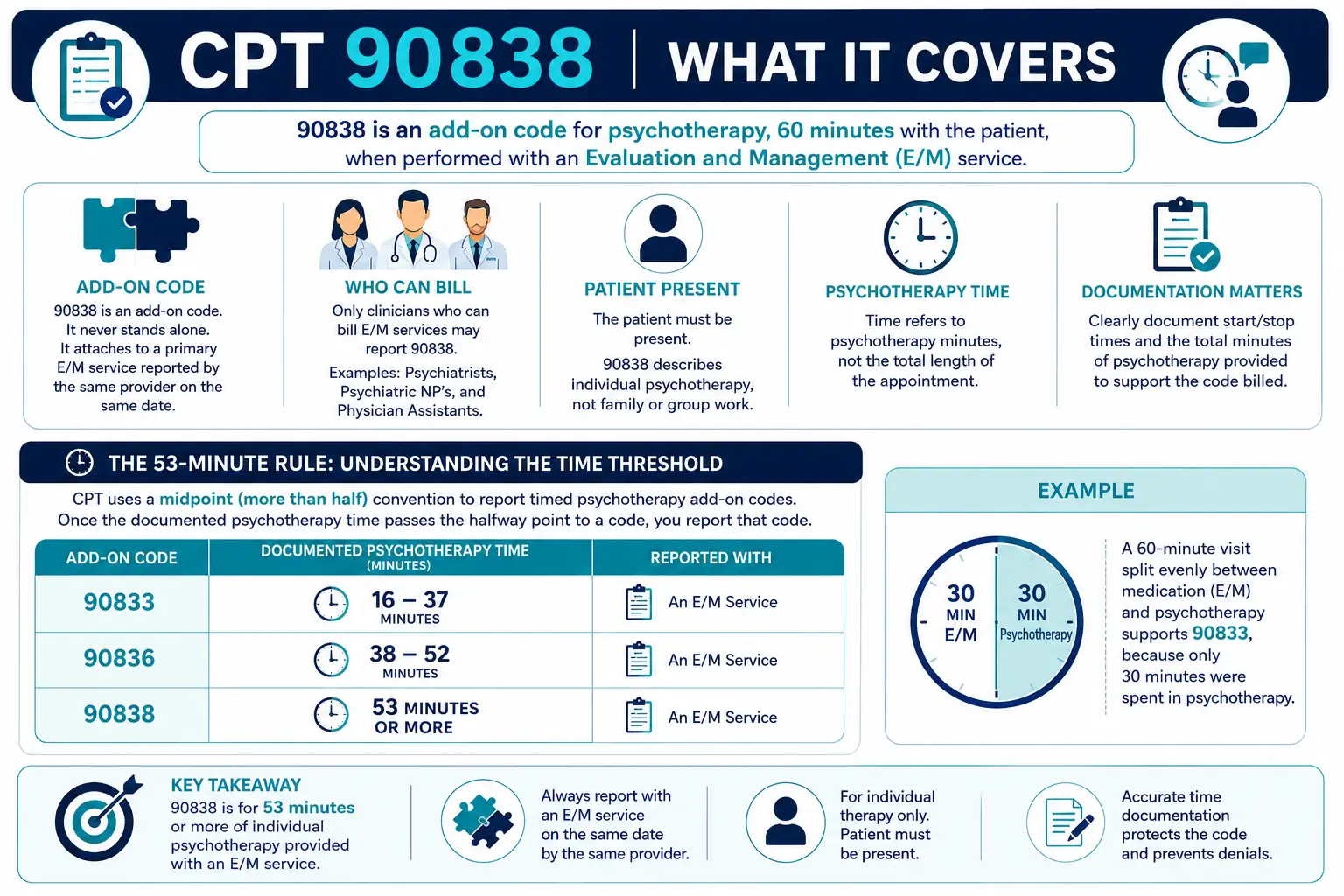
The American Medical Association’s CPT descriptor for 90838 is psychotherapy, 60 minutes with the patient, when performed with an evaluation and management (E/M) service. It is an add-on code. That single fact drives most of the rules around it. An add-on code never stands alone. It attaches to a primary service, and for 90838 the primary is always an E/M visit reported by the same provider on the same date.
Only clinicians who can bill E/M services may report 90838. In practice that means psychiatrists, psychiatric nurse practitioners, and physician assistants. Therapists, counselors, and psychologists without prescribing authority bill standalone psychotherapy instead, using 90832, 90834, or 90837.
The patient has to be present. 90838 describes individual psychotherapy, not family or group work.
The 53-minute rule the descriptor does not mention
The CPT descriptor says 60 minutes, but the billing threshold is 53, and that gap confuses new coders every year.
CPT reports timed psychotherapy using a convention tied to the midpoint between codes. You report a code once the documented time passes the halfway mark toward it. That produces three time bands for the psychotherapy add-ons:
Add-on code | Documented psychotherapy time | Reported with |
90833 | 16 to 37 minutes | An E/M service |
90836 | 38 to 52 minutes | An E/M service |
90838 | 53 minutes or more | An E/M service |
The times in that table refer to psychotherapy minutes, not the length of the appointment. A 60-minute visit split evenly between medication work and therapy supports 90833, because only 30 minutes went to psychotherapy. That distinction is where most 90838 denials begin, and the sections below return to it.
How the 2013 code changes created today’s rules
Knowing why 90838 works this way helps you document it correctly. The rules trace back to one revision.
Before 2013, psychiatrists reported medication management under a psychiatry-specific code, 90862, and used combined therapy-plus-medical codes such as 90805 and 90807. The American Psychiatric Association and the Centers for Medicare and Medicaid Services (CMS) reworked the family effective January 1, 2013. Code 90862 was eliminated. The combined 908XX codes went away. In their place came the current structure: an E/M code for the medical work, plus a psychotherapy add-on (90833, 90836, or 90838) for the therapy.
The revision also changed how time is counted. The old codes used time ranges. The new ones assign specific times and follow standard CPT timing conventions, which is the reason the 53-minute threshold exists.
That shift changed billing behavior in ways researchers could measure. A study published in the journal Psychiatric Services examined psychiatrist billing from 2012 through 2014, the years surrounding the change. In 2012, the most common code was 90862. By 2013, the three most frequently reported codes were the E/M code 99213, the E/M code 99214, and the 90833 psychotherapy add-on. The change moved psychiatrists onto the same E/M coding the rest of medicine already used.
That history carries one practical consequence. E/M rules, not psychiatry-specific rules, now govern half of every combined claim. When E/M documentation standards changed again in 2021, those changes flowed straight into how 90838 has to be reported.
Documentation requirements for 90838
A clean 90838 claim proves two separate services happened in one visit. The evaluation and management service is one. The psychotherapy is the other. The note has to stand up for each on its own.
The most common reason these claims are denied or recouped on audit is that the record blends the two services together and cannot show two separately identifiable pieces of work. Payer medical policies from Moda Health and Molina Healthcare state the requirement in nearly identical terms: the E/M and psychotherapy must be significant and separately identifiable, with documentation that keeps their time apart.
Here is what a defensible note contains.
For the E/M component:
- The reason for the medication visit and a relevant history
- A mental status examination
- A medication review covering current drugs, doses, adherence, and effect
- A risk assessment from a medical standpoint, including suicidality and medication safety
- Medical decision-making, with the plan for continuing, changing, starting, or stopping medication and the reasoning behind it
For the psychotherapy component:
- The therapeutic modality used (for example, cognitive behavioral therapy or supportive therapy)
- The specific intervention delivered, not a generic phrase such as “supportive counseling provided”
- The patient’s response to the intervention
- Progress toward defined treatment goals
- The number of minutes spent on psychotherapy, recorded separately from the E/M work
Two more items round out the record. Every note needs a diagnosis that supports medical necessity, and specific ICD-10-CM codes hold up better under review than unspecified ones. An “unspecified” depression code invites scrutiny, while a recurrent, moderate major depressive disorder code that matches the chart holds up. The note also needs the rendering provider’s credentials and signature.
A worked example
Consider an established patient seen for 70 minutes. The first 15 minutes cover a medication review, a check for side effects, and a dose adjustment. Prescription drug management of that kind generally supports a moderate-complexity E/M level, so the medical work here maps to 99214 selected on medical decision-making. The remaining 55 minutes go to cognitive behavioral therapy for the patient’s panic symptoms, with the specific intervention, the patient’s response, and progress toward goals written in their own section of the note. The record shows 15 minutes of medical work and 55 minutes of psychotherapy, 70 minutes in total. That encounter supports 99214 plus 90838. Change the therapy portion to 40 minutes and the correct add-on becomes 90836, even though nothing else about the visit changed.
When to add interactive complexity (90785)
Some sessions involve communication difficulty that goes beyond the therapy itself, such as working through a language interpreter, managing disruptive third-party dynamics, or involving caregivers who complicate the discussion. CPT provides a separate add-on, 90785, for interactive complexity in those situations, and it can be reported in addition to the psychotherapy service when the specific factors are documented. It is not a routine add-on and should not be attached to standard sessions. Used correctly, it captures extra clinical effort that would otherwise go unreported.
The time-separation rule
One rule sits above the rest. Psychotherapy time and E/M time cannot overlap, and the same minutes can never count twice.
CMS guidance and payer policies are explicit here. Time spent on history, examination, and medical decision-making belongs to the E/M service and is excluded from psychotherapy time. Only distinct, additional minutes of therapeutic work count toward the add-on. If a note claims 53 minutes of psychotherapy plus a plausible amount of medication management inside a 45-minute appointment, the math fails, and auditors notice.
The cleanest records state both numbers. A note that reads “20 minutes on medication management, 35 minutes on psychotherapy, 55 minutes total” gives an auditor everything needed in a single line.
Selecting the E/M level
The 2021 office-visit rules let clinicians choose an E/M level based on either total time or medical decision-making. Combined psychotherapy claims lose the time option.
Because psychotherapy minutes are carved out of the visit, they cannot count toward E/M time, which usually leaves too little time to support the E/M level reliably. So the E/M level for a visit billed with 90833, 90836, or 90838 must be selected on medical decision-making. Headway, Optum, and several payer policies state this directly. Prolonged service codes are also unavailable here. CMS instructs that prolonged services may not be reported when a psychotherapy add-on is billed with the E/M service.
Common mistakes that trigger denials
Most 90838 denials come from a short list of errors. Each one is preventable at the point of documentation.
- Billing 90838 without a primary E/M code. Add-on codes require a paired primary on the same claim and date. A standalone 90838 generates an automatic denial.
- Pairing 90838 with a standalone psychotherapy code. The add-on attaches to an E/M service, not to 90837. Reporting 90837 with 90838 is a coding error, and reporting a standalone psychotherapy code (90832, 90834, or 90837) alongside an E/M service on the same day runs into National Correct Coding Initiative edits. That conflict is part of why the add-on codes exist: they are the sanctioned way to report therapy delivered during a medical visit.
- Choosing the E/M level by time. When an add-on is present, the E/M level must rest on medical decision-making. Selecting it by time is one of the most frequent technical mistakes in this code family.
- Counting overlapping minutes. Medication review, history, and medical decision-making cannot be counted as psychotherapy time. Overlap is a primary audit trigger.
- Reporting 90838 when therapy ran under 53 minutes. Forty minutes of psychotherapy supports 90836, not 90838. Selecting the higher-paying code without the time to support it is upcoding.
- Vague therapy documentation. “Provided supportive therapy” does not describe an intervention. The record needs a modality, a specific intervention, and the patient’s response.
- The wrong provider reporting the code. A licensed clinical social worker or licensed professional counselor cannot bill 90838, because they cannot bill the required E/M service. They report 90832, 90834, or 90837 instead.
- Missing modifier 25 when a payer requires it. Some plans want modifier 25 on the E/M code to flag a separately identifiable service on the same day. Confirm the payer’s rule before submitting.
One payer-specific pattern deserves attention. Some plans, including Molina Healthcare, deny psychotherapy add-ons billed alongside the highest-level E/M codes (99204, 99205, 99214, and 99215), on the reasoning that the combined time is unlikely to be both significant and separately identifiable. When you report a high-level E/M with an add-on, the documentation has to make the two distinct services obvious.
Reimbursement and where to confirm current rates
90838 carries its own relative value units, so a combined claim pays more than an E/M code billed alone. Medicare payment runs through the CMS Physician Fee Schedule, which is recalculated every year.
The conversion factor, the dollar multiplier applied to each code’s relative value units, fell to $32.35 for calendar year 2025 and rose for 2026 under CMS’s Physician Fee Schedule, to roughly $33.40 for clinicians outside the Quality Payment Program. That multiplier and the geographic adjustments applied to it change annually, so the reliable way to confirm the exact amount for 90838 is the CMS Physician Fee Schedule Look-Up Tool, entered for your own locality, rather than a static figure from a billing blog. Medicare pays 80 percent of the approved amount, and the patient is responsible for the remaining 20 percent coinsurance after meeting the Part B deductible.
Coverage also depends on diagnosis. Medicare Administrative Contractors publish Local Coverage Determinations and billing articles that list the ICD-10-CM codes accepted as supporting medical necessity for the psychotherapy family, 90838 among them. A claim carrying a diagnosis outside that list can be denied even when the clinical documentation is otherwise complete, which is why the diagnosis code deserves the same attention as the procedure code. Commercial payer rates and coverage rules vary more widely and depend on your contract.
One current point matters for prescribers. Medicare made mental health telehealth a permanent benefit, so 90838 can be furnished by telehealth when clinical and payer requirements are met.
Putting it together
The pattern behind almost every 90838 CPT code problem is the same. The code pays for real additional work, therapy delivered on top of a medical visit, but only when the record proves that work as a separate service with its own documented time and its own clinical content. Four habits prevent most denials: document the E/M and psychotherapy components independently, keep their minutes from overlapping, select the E/M level on medical decision-making, and report 90838 only for 53 or more documented psychotherapy minutes. A note built that way gives a payer very little to deny.