


Mental Health RCM Billing Explained: From Claims to Payments
Revenue cycle management is the financial spine of any practice. In behavioral health, it carries more weight than most people outside the billing office realize. A single 45-minute therapy session touches eligibility checks, time-based coding, prior authorization rules, and payer-specific documentation standards before a dollar arrives. Mental health RCM billing is the process of moving that session from the moment a patient books an appointment to the moment the claim is paid and reconciled.
The work is harder here than in general medical billing. Codes are tied to the clock. Session limits show up where they never would for a cardiology visit. Payers apply medical necessity reviews that many primary care claims skip entirely. This guide follows a claim through the full cycle and points to the places where behavioral health claims tend to stall.
What makes mental health RCM billing different
Behavioral health has its own coding logic. Most outpatient therapy is billed with time-based CPT codes, which means the code depends on documented face-to-face minutes rather than the type of visit. That single rule creates more audit exposure than almost any other feature of the specialty.
Then there are limits that medical benefits rarely carry. Some plans require prior authorization after a set number of sessions. Others cap covered visits per year, or route behavioral health through a separate vendor (often called a carve-out) with its own network and rules. A patient can hold one insurance card while their therapy benefit sits with a company like Optum or Magellan.
Documentation carries a heavier load too. When a payer questions whether care was medically necessary, the progress note is the evidence. Start and stop times, symptoms, functional impact, and the treatment plan all decide whether a claim survives review.
The billing cycle from claim to payment
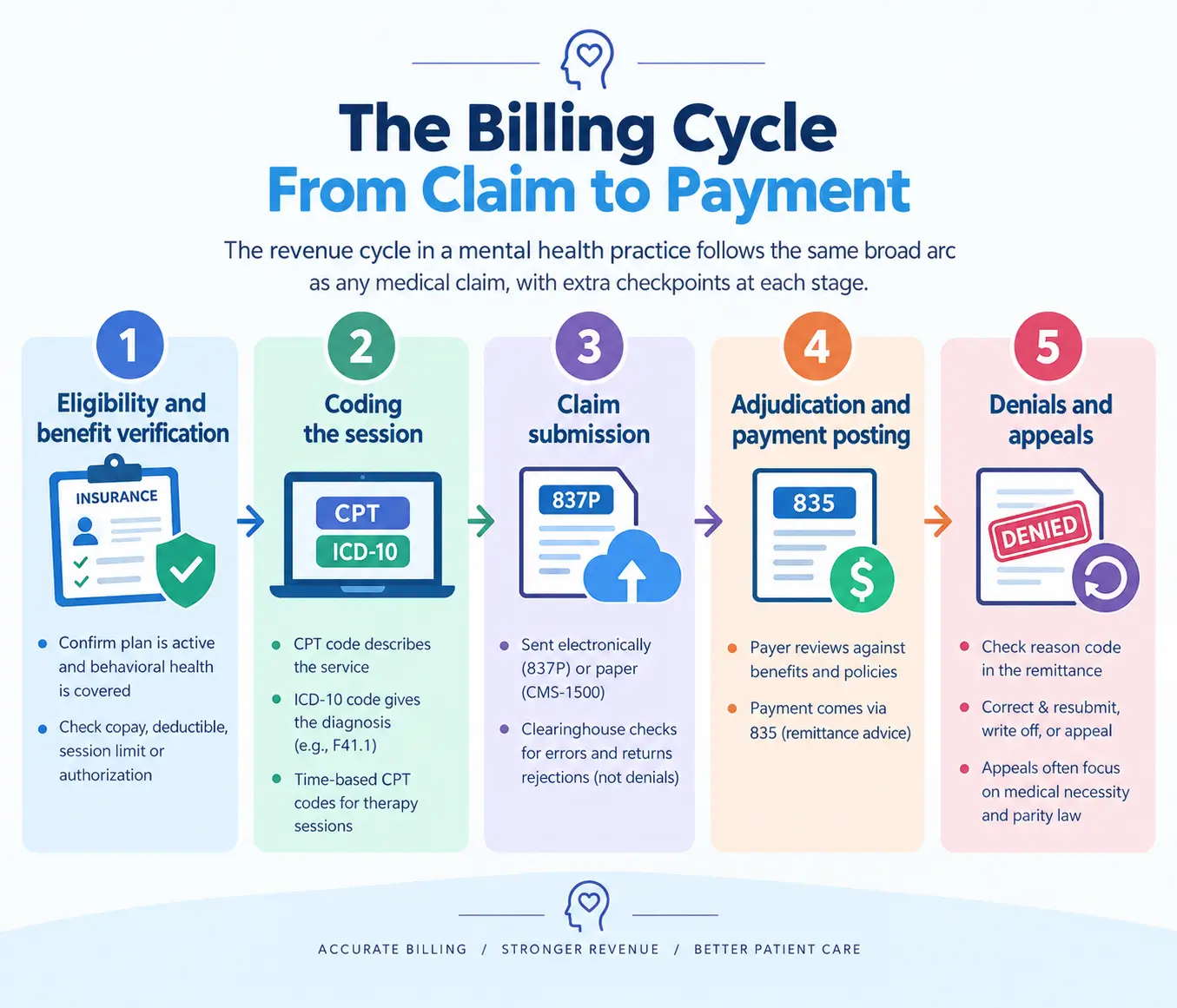
The revenue cycle in a mental health practice follows the same broad arc as any medical claim, with extra checkpoints at each stage.
Eligibility and benefit verification
The cycle starts before the patient sits down. Verification confirms that the plan is active, that behavioral health is covered, and whether a copay, deductible, session limit, or authorization applies. Electronic eligibility runs on the X12 270/271 transaction, a request-and-response exchange between provider and payer. Skipping this step is the most common preventable cause of denials, because coverage in behavioral health changes often: employers switch carve-out vendors mid-year, and patients reach visit caps without warning.
Coding the session
After the visit, the clinician’s work is translated into CPT and ICD-10 codes. The CPT code describes the service. The ICD-10 code (for example, F41.1 for generalized anxiety disorder) gives the diagnosis that justifies it. In therapy, the CPT choice usually comes down to time. A 40-minute session and a 55-minute session carry different codes and different payments.
Claim submission
Most claims leave the practice electronically in the 837P format (the professional claim standard, ANSI ASC X12N 837P version 5010A1), per CMS. Paper claims use the CMS-1500 form. Before a claim reaches the payer, a clearinghouse scrubs it for errors like mismatched codes, missing modifiers, or invalid patient data, and returns rejections for correction. A rejection is not a denial. It never reached adjudication, so it can be fixed and resubmitted quickly.
Adjudication and payment posting
The payer then adjudicates the claim against the member’s benefits and its own policies. The result comes back as an electronic remittance advice (the 835 transaction), which the biller posts against the original charge. Posting reconciles what was billed, what was paid, what the patient owes, and what was adjusted or denied. Accurate posting is where practices catch underpayments that would otherwise go unnoticed.
Denials and appeals
When a claim is denied, the remittance carries a reason code. The biller decides whether to correct and resubmit, write it off, or appeal. In behavioral health, appeals often turn on medical necessity and, increasingly, on parity law.
The codes that carry behavioral health revenue
A handful of CPT codes account for most outpatient behavioral health billing. The individual psychotherapy codes are separated only by time, following the American Medical Association’s midpoint rule.
Code | Service | Time |
90791 | Psychiatric diagnostic evaluation (no medical services) | Not time-based |
90832 | Individual psychotherapy | 16 to 37 minutes |
90834 | Individual psychotherapy | 38 to 52 minutes |
90837 | Individual psychotherapy | 53 minutes or more |
90846 | Family psychotherapy, patient not present | 50 minutes (typical) |
90847 | Family or couples psychotherapy, patient present | 50 minutes (typical) |
90853 | Group psychotherapy | Per session |
A few rules trip up new billers. The diagnostic evaluation codes 90791 and 90792 (the second version includes medical services and is used by prescribers) are not separately reportable with a psychotherapy code on the same day by the same provider, because ongoing evaluation is already built into psychotherapy. The add-on code 90785 (interactive complexity) never stands alone; it attaches to another service. And 90837 draws more payer scrutiny than any other therapy code, because the jump from 90834 pays more and invites upcoding. If a note reads “about an hour” instead of recorded start and stop times, a payer can down-code the claim or deny it on review.
How parity law shapes getting paid
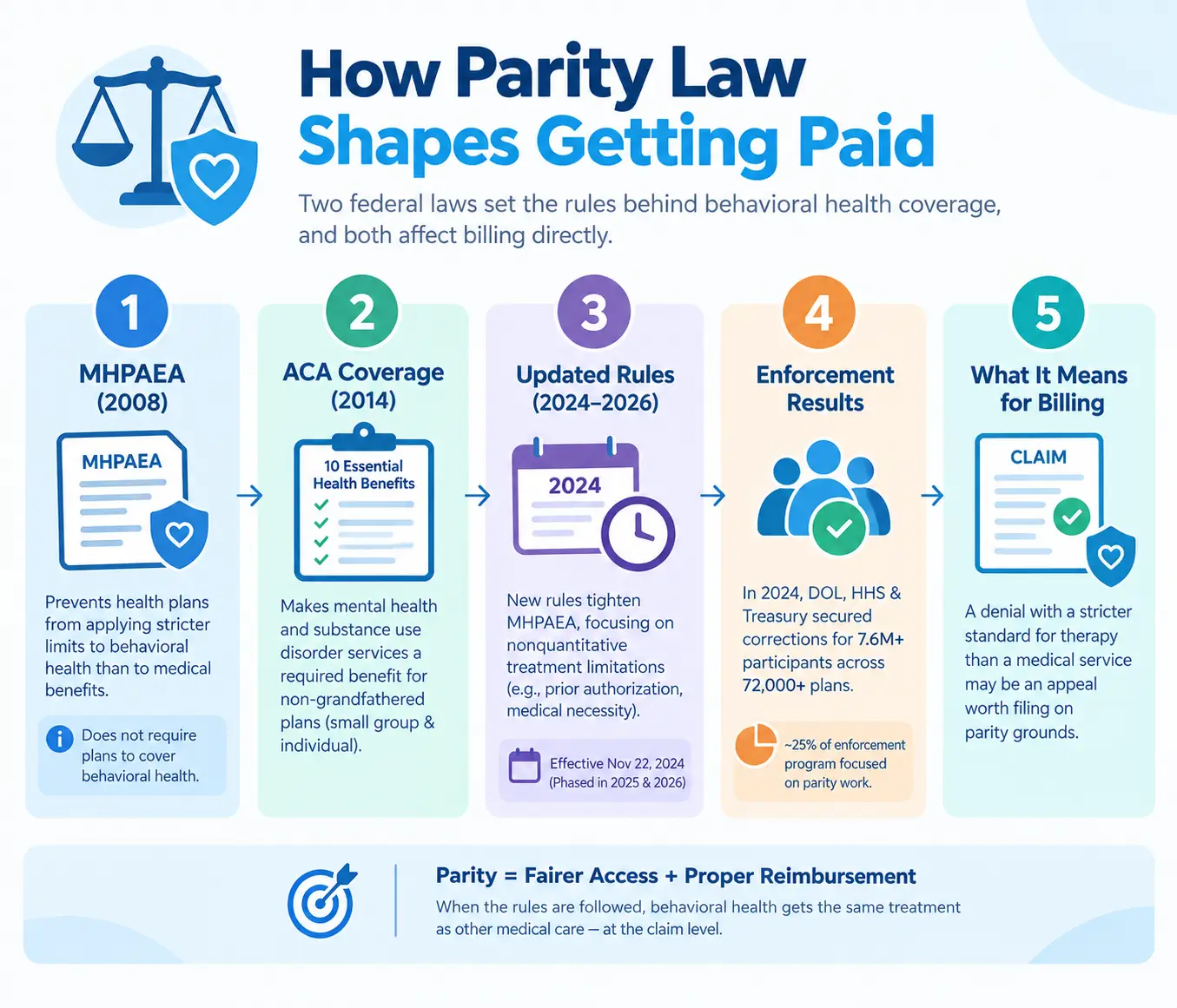
Two federal laws set the rules behind behavioral health coverage, and both affect billing directly.
The first is the Paul Wellstone and Pete Domenici Mental Health Parity and Addiction Equity Act of 2008, known as MHPAEA. According to guidance from the Centers for Medicare and Medicaid Services, the law prevents health plans that offer mental health or substance use disorder benefits from applying stricter limits to them than to medical and surgical benefits. One point is easy to miss: MHPAEA does not force a plan to cover behavioral health at all. It only requires parity when the plan does.
The coverage requirement came later. The Affordable Care Act named mental health and substance use disorder services as one of ten essential health benefit categories that non-grandfathered individual and small group plans must cover, effective 2014, and required those plans to meet parity rules. CMS lists the ten categories, which also include hospitalization, prescription drugs, and maternity and newborn care.
Parity is where enforcement now sits. On September 9, 2024, the Departments of Labor, Health and Human Services, and the Treasury released final rules tightening MHPAEA, effective November 22, 2024, with requirements phasing in on January 1, 2025 and January 1, 2026. The rules focus on nonquantitative treatment limitations, the non-numeric restrictions (such as prior authorization and medical necessity standards) that plans apply. Regulators later granted enforcement relief on the provisions new to the 2024 rule, so billers should confirm current requirements with each payer rather than assume.
Enforcement has produced measurable results. The 2024 MHPAEA Report to Congress, published in January 2025 by the three departments, states that the Department of Labor’s Employee Benefits Security Administration obtained corrections removing impermissible behavioral health treatment barriers for more than 7.6 million participants across over 72,000 plans. The same agency reported devoting close to a quarter of its enforcement program to parity work. That record matters at the claim level: a denial that reflects a stricter standard for therapy than for a comparable medical service may be an appeal worth filing on parity grounds.
Medicare’s 2024 expansion for therapists and counselors
For years, Medicare would not pay two of the most common types of behavioral health clinicians. That changed in 2024.
Under Section 4121 of the Consolidated Appropriations Act, 2023, marriage and family therapists (MFTs) and mental health counselors (MHCs) became eligible to enroll in Medicare Part B and bill for services furnished on or after January 1, 2024, according to CMS. The agency assigned new specialty codes (E1 for MFTs and E2 for MHCs) and set payment at 75 percent of the amount a clinical psychologist receives under the Medicare Physician Fee Schedule. Enrollment runs through the CMS-855I application, and each clinician uses the taxonomy code tied to their profession (106H00000X for MFTs, 101YM0800X for MHCs).
The result is a larger pool of billable providers, especially in rural areas where counselors are often the only behavioral health clinicians available. For billing teams, it also means new enrollments to track and a payment rate that differs from the psychologist and social worker rates already on the fee schedule.
Where mental health claims break down
Denials cost more than the claim itself. Every denied claim is care already delivered, now waiting on rework, an appeal, or a write-off, while staff time piles up on the back end.
Reliable, behavioral-health-specific denial data has been thin, which is part of the problem. An analysis by KFF of 2024 Affordable Care Act marketplace claims found that, among the limited information insurers disclose, the most common in-network denial reasons were an unspecified “Other” category (36 percent) and administrative reasons (25 percent). KFF also notes that federal certification will require insurers to report to CMS, starting with plan year 2027, whether denied claims were for behavioral health services, a breakdown not consistently available today.
Most behavioral health denials trace back to a short list of causes:
- Eligibility gaps. Coverage lapsed, the benefit sat with a carve-out vendor, or a session limit was already reached.
- Missing prior authorization. Intensive outpatient programs, psychological testing, and many recurring therapy arrangements require authorization before the service.
- Time and documentation mismatches. The billed CPT code does not match the documented minutes, or the note lacks start and stop times.
- Medical necessity. The payer decides the documentation does not justify the level or frequency of care.
The pattern behind these is consistent. The cheapest denial is the one that never happens. Verifying eligibility before each visit, securing authorizations ahead of the first session, and recording exact session times close most of the gaps before a claim leaves the office. Chasing denials afterward costs far more than preventing them.
Mental health RCM billing rewards precision at every checkpoint, from the eligibility screen to the remittance posting. The specialty’s time-based codes, session limits, and medical necessity reviews create more failure points than general medical billing, and federal parity law now gives billers a documented basis to challenge denials that treat behavioral health more strictly than medical care. Two recent shifts, Medicare’s 2024 opening to marriage and family therapists and mental health counselors, and the 2024 parity rules, have widened who can bill and sharpened how plans are held to account. The practices that get paid cleanly are the ones that treat the front end of the cycle (verification, authorization, and accurate coding) as seriously as the appeal.