



AI-Powered Mental Health Billing Companies: The Future of RCM
Behavioral health practices lose money in a way most medical specialties do not. A therapist finishes a 55-minute session, writes the note, and bills 90837. Three weeks later an explanation of benefits arrives with a denial, and revenue that felt earned turns into a line in a work queue. Multiply that across a full caseload and the arithmetic gets uncomfortable.
That gap between service delivered and dollar collected is the problem revenue cycle management (RCM) exists to close. It is also where a set of AI-powered mental health billing companies now competes for the work that used to sit entirely on a biller’s desk. The pitch is consistent across vendors: software reads the documentation, checks eligibility, flags coding problems before submission, and predicts which claims a payer is likely to reject. What follows separates the verified results from the marketing.
Why behavioral health billing breaks more often than other specialties
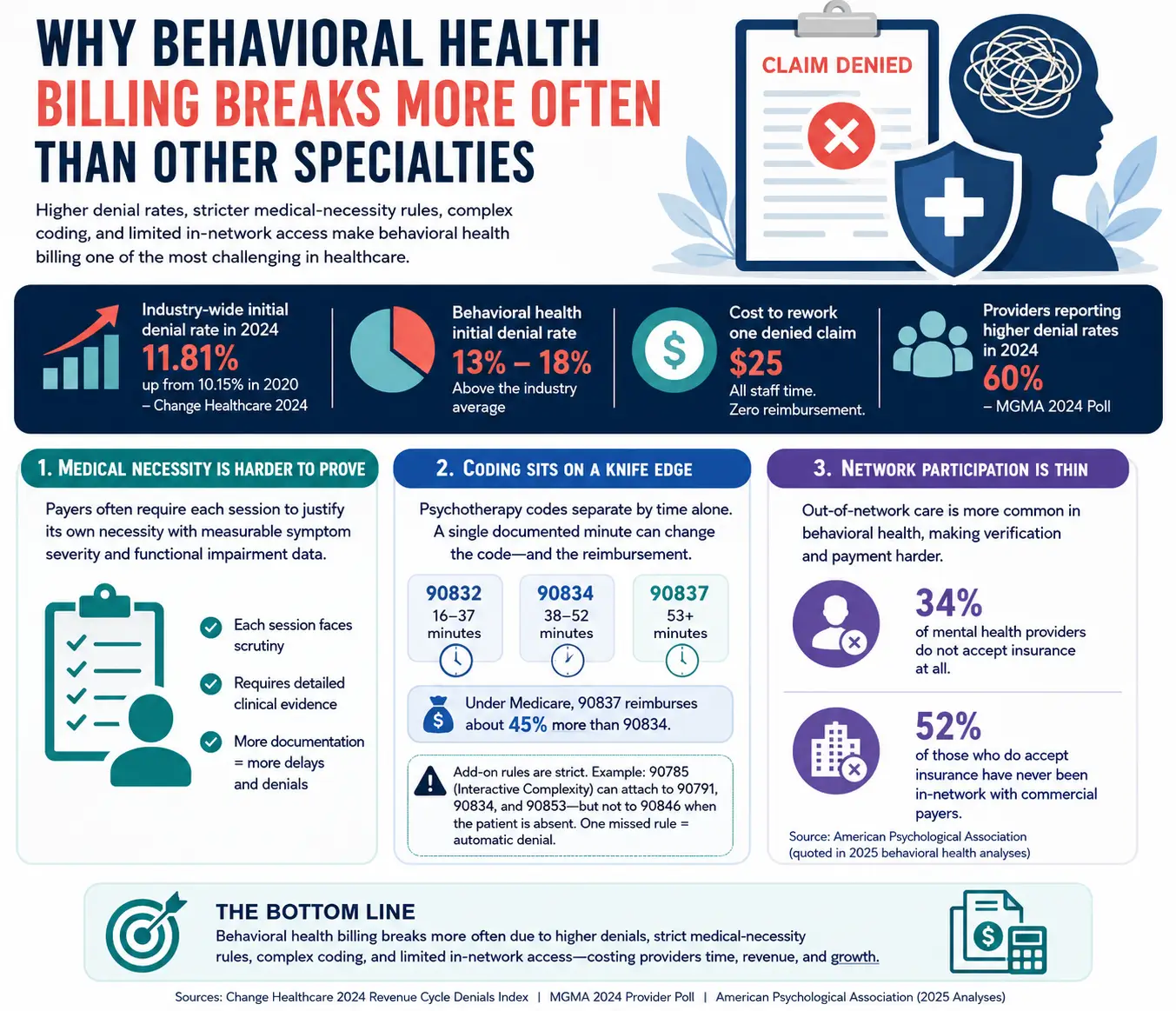
Denials are the clearest measure of how hard this work is. The Change Healthcare 2024 Revenue Cycle Denials Index put the industry-wide initial denial rate at 11.81%, up from 10.15% in 2020. Behavioral health sits above that average. Benchmark data compiled from the same index places initial denial rates for behavioral health in the 13% to 18% range, driven mostly by medical-necessity determinations rather than the eligibility errors that dominate primary care.
Providers feel the trend directly. In a 2024 poll from the Medical Group Management Association, 60% of providers said insurance denial rates rose that year. Each rejected claim carries a cost that never appears on an invoice. Industry estimates put the average expense of reworking a single denied claim at roughly $25, all of it staff time spent identifying, investigating, and resubmitting, none of it billable.
Several features of behavioral health make the problem worse than a single denial rate suggests.
Medical necessity is harder to prove
In most specialties, a diagnosis drives a treatment plan and individual visits draw little scrutiny. Behavioral health works differently, because payers often expect each session to justify its own necessity with measurable symptom severity and functional impairment data.
Coding sits on a knife edge
The everyday psychotherapy set (90832 for 16 to 37 minutes, 90834 for 38 to 52 minutes, and 90837 for 53 minutes or more) separates by time alone. A single documented minute decides whether a session is billed as 90834 or 90837, and under Medicare the longer code reimburses roughly 45% more. Add-on rules compound the risk. The interactive complexity code 90785 can attach to 90791, 90834, and 90853, for example, but not to family code 90846 when the patient is absent, and a missed pairing rule generates an automatic denial.
Network participation is thin
According to figures from the American Psychological Association cited in 2025 behavioral health analyses, 34% of mental health providers do not accept insurance at all, and 52% of those who do have never been in-network with commercial payers. When clients go out of network more often than in any other specialty, coverage verification and payment both get harder.
What the current AI adoption numbers actually show
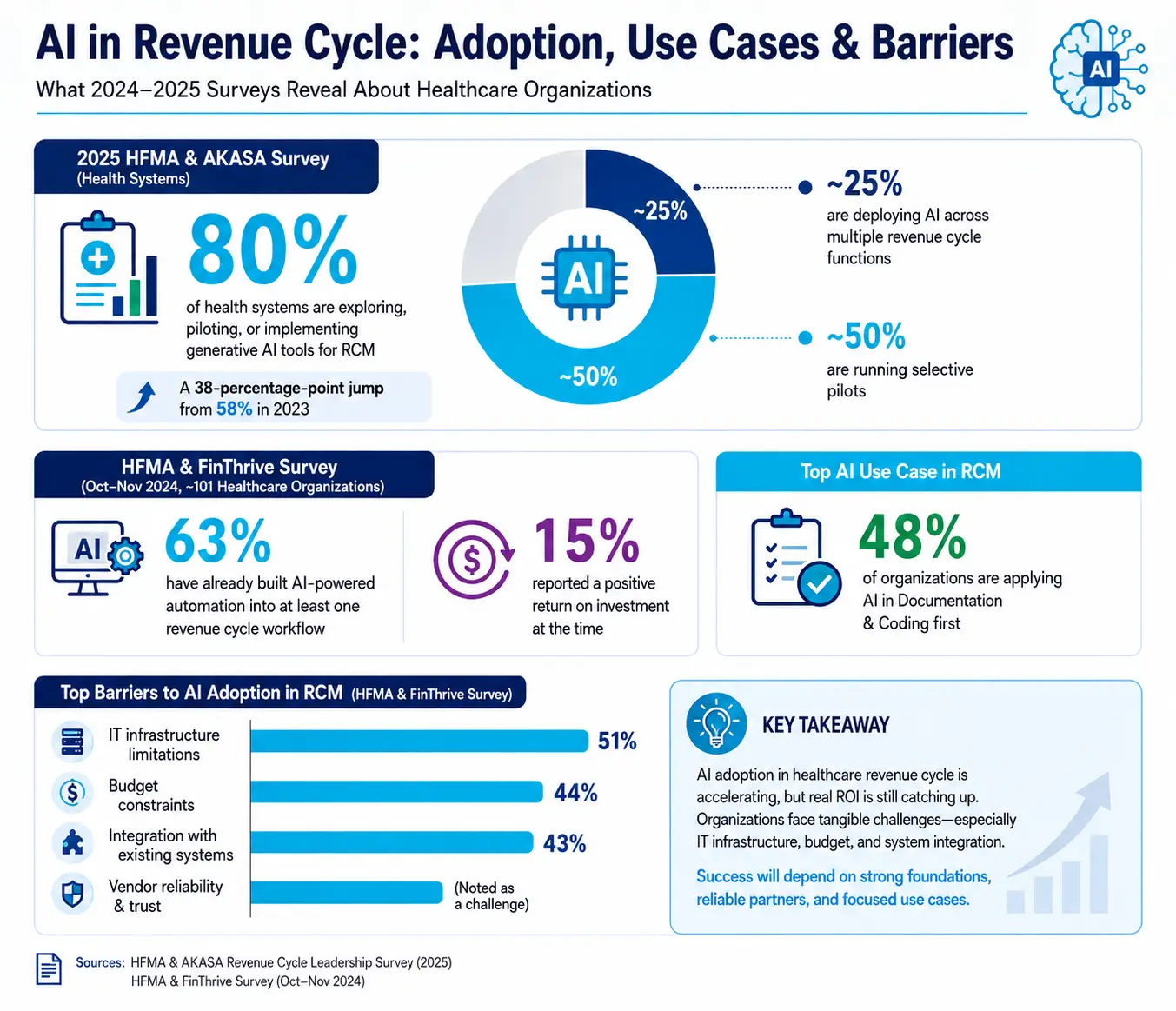
Interest in automating this work is no longer speculative. A 2025 revenue cycle survey from the Healthcare Financial Management Association (HFMA) and AKASA found that 80% of health systems were exploring, piloting, or implementing generative AI tools for RCM, a 38-percentage-point jump from the 58% that were merely considering it in 2023. Inside that group, roughly a quarter were deploying AI across multiple revenue cycle functions, and about half were still running selective pilots.
A parallel survey conducted by HFMA and FinThrive between October and November 2024, covering about 101 healthcare organizations, found that 63% had already built AI-powered automation into at least one revenue cycle workflow. Only 15% reported a positive return on investment at the time, a reminder that adoption and payoff are not the same thing. Documentation and coding led the use cases, with 48% of organizations applying AI there first.
The obstacles are practical rather than philosophical. In the same HFMA and FinThrive survey, 51% of respondents named IT infrastructure limitations as the biggest barrier to adoption, followed by budget (44%) and integration with existing systems (43%). Vendor reliability came up too, which matters for smaller behavioral health groups that cannot absorb a failed implementation.
How AI-powered mental health billing companies handle the revenue cycle
The revenue cycle is a sequence of stations, and current tools touch nearly every one. Understanding where the software actually helps is more useful than a general claim that it “automates billing.”
Eligibility and benefit checks
Automated verification confirms coverage and estimates patient responsibility before the session, which reduces the front-end errors that turn into back-end denials. This is one of the earliest and most reliable applications, because the task is rules-based and repetitive.
Coding support and claim scrubbing
Natural language tools read a clinician’s note and suggest ICD-10 and CPT codes, then a scrubbing layer applies payer rules and National Correct Coding Initiative edits before a claim goes out. Vendors report measurable gains here. Autonomous medical coding vendor Nym has reported that Geisinger reached a denial rate below 0.1% on coded claims, and that one large health system cut its radiology professional-fee coding-related denials by 97%. Speed figures are striking as well: an Advalorem AI report in March 2026 described Cleveland Clinic coding 100 documents in about 1.5 minutes with an autonomous engine.
Denial prediction and prevention
Instead of fixing denials after they land, predictive tools study historical claims and payer behavior to flag risky claims before submission. RCM analytics firm Plutus Health estimates that predictive denial prevention reduces denials by roughly 20% to 30%. The shift is from reactive rework to front-end correction, which is exactly where behavioral health leaks the most revenue.
The platforms independent clinicians use
For independent behavioral health clinicians, the most visible players are the credentialing-and-billing platforms rather than hospital coding engines. Three firms dominate that segment, and their size and structure differ.
Platform | Founded | Reported provider base | Model |
Headway | 2019 | 34,000 providers | No fee to therapists; managed credentialing and insurance billing; commercial plans and limited Medicare Advantage |
Alma | 2018 | 21,000 providers | Membership (about $125 per month) bundling credentialing, billing, EHR, and telehealth |
Grow Therapy | 2020 | 15,000 providers | Accepts 125+ insurance plans, including Medicaid and Medicare in select states |
These companies credential clinicians under their own payer contracts, handle claim submission, and pay providers on a set schedule. That arrangement removes administrative work, and it also concentrates billing decisions inside the platform. On the hospital side, AKASA has worked with Methodist Health System since 2019 to speed claims resolution, redirecting staff from insurance follow-up to other revenue cycle tasks.
Where AI still needs a human
The honest version of this story includes clear limits, and behavioral health is where several of them concentrate.
Time-based psychotherapy codes resist automation
A 2026 analysis by billing firm Zedtreeo noted that autonomous coding remains unreliable for behavioral health time-based codes (90832 through 90837), because documentation context and clinical judgment, not just keyword matching, determine which code applies. The same session note can support two different codes depending on how a coder reads the time and content, and that is a decision current tools do not make well.
Complex denials and appeals still require people
Routine claim scrubbing, eligibility checks, and payment posting are well suited to software. Parity-based appeals, payer-relationship escalation, and exception management are not. A wrongful denial that cites a parity violation is legally stronger than one that argues medical necessity alone, but building that appeal takes a human who knows the payer, the plan documents, and the state rules.
Credentialing carries exceptions automation cannot resolve
Provider enrollment involves payer-specific requirements, panel closures, and state variation that break neat workflows. This is one reason the platform model exists at all: clinicians trade a share of revenue for someone else to manage the parts that do not standardize.
The practical takeaway for a practice is a hybrid arrangement. Software carries the routine, repetitive volume, and certified coders and billers handle the complex cases, the appeals, and the judgment calls. For students of medical billing and coding, that division is the career-relevant part. The routine keystroke work is shrinking. The exception handling, the appeals writing, and the parity knowledge are not.
The other side of the algorithm: payers use AI too
Any account of AI in mental health billing that stops at the provider side is incomplete, because insurers automate too, and their tools work in the opposite direction.
Two lawsuits define the concern. UnitedHealth faces class-action litigation in Minnesota federal court over nH Predict, an algorithm developed by its naviHealth subsidiary (acquired in 2020) and used to evaluate post-acute care. Plaintiffs allege the tool carried a 90% error rate, meaning nine of ten denials were reversed on appeal, while, according to the complaint, only about 0.2% of policyholders ever filed an appeal. In 2026 a federal court ordered UnitedHealth to disclose how the algorithm worked, rejecting a trade-secret defense. UnitedHealth states that nH Predict is a guide, not a coverage decision, and that determinations follow Medicare and plan criteria.
Cigna faces a separate suit in California over a system called PxDx. Court filings allege that over two months in 2022 the tool reviewed and denied more than 300,000 claims, at an average of about 1.2 seconds per claim. A judge allowed the case to proceed in March 2025. Cigna maintains that PxDx is a sorting technology used for a limited set of low-cost procedures and does not involve AI or machine learning.
There is behavioral-health-specific evidence too. One study cited in 2025 denial-management analyses found that preauthorization denial rates rose by as much as 108% when insurers used AI tools to review claims. For a provider, the lesson is direct: the same automation that speeds a clean claim out the door can meet an automated rejection on arrival, which makes strong documentation and a working appeals process more valuable, not less.
What providers and billing students should track
The regulatory ground has shifted, and it changes the calculus for anyone billing behavioral health.
Parity enforcement is paused, but the statute is intact
The Mental Health Parity and Addiction Equity Act (MHPAEA), enacted in 2008, requires plans to cover mental health and substance use services on terms no more restrictive than comparable medical benefits. A 2024 final rule, issued September 9, 2024, and effective November 22, 2024, added tougher requirements, including new documentation for nonquantitative treatment limitations. On May 15, 2025, the Departments of Labor, Health and Human Services, and the Treasury announced they would not enforce the parts of the 2024 rule that were new relative to the 2013 rule, pending litigation brought by the ERISA Industry Committee plus an additional 18 months. The 2013 regulations and the statutory obligation to produce written comparative analyses under the Consolidated Appropriations Act, 2021, remain in effect. Parity is still enforceable law; the strictest new provisions are paused.
Reimbursement moved in the other direction
The Centers for Medicare and Medicaid Services set a plan to raise the relative value unit work values for psychotherapy and health behavior codes by 19.1% over four years, which for 2024 translated to roughly $3 to $6 more per psychotherapy visit, according to an Osmind analysis of the CMS fee schedule. Small per-visit changes compound across a full panel, and they change which codes are worth documenting carefully.
Skills that hold their value
For a working biller or a student entering the field, three skills hold their value against automation. First, time-based coding judgment for psychotherapy, where the software still struggles. Second, denial and appeals work grounded in parity rules, where the payer relationship and the legal argument decide the outcome. Third, an understanding of how payer-side algorithms reject claims, because writing the appeal that reverses an automated denial is human work that pays for itself.
AI-powered mental health billing companies have already changed the front of the revenue cycle, where eligibility checks, coding support, and denial prediction now run faster and catch more errors than a manual process. The measured gains are real: denial reductions in the 20% to 30% range from predictive tools, coding denial rates driven toward a fraction of a percent at systems like Geisinger, and adoption climbing from 58% to 80% of health systems in two years. The limits are just as real. Behavioral health’s time-based codes, parity appeals, and credentialing exceptions still need trained people, and the same technology that clears a clean claim can meet an automated denial from the payer on the other side. The practices and billers who do best will pair the software with the judgment it cannot replace.