



99214 CPT Code Audit Risks and Compliance Best Practices (2026)
Current Procedural Terminology (CPT) code 99214 represents a moderate complexity evaluation and management service for an established patient. Healthcare providers utilize this code more frequently than almost any other billing classification. The Centers for Medicare and Medicaid Services Comprehensive Error Rate Testing program regularly identifies established patient office visits as a primary source of improper payments. Insufficient documentation remains the leading cause of these financial errors.
Because 99214 carries a higher relative value unit than lower-level visits, it attracts sustained attention from federal regulators. Commercial payers and Medicare Administrative Contractors rely on data analytics to identify practices billing this code at rates higher than their regional peers. Understanding 99214 CPT code audit risks and compliance best practices (2026) requires a precise interpretation of the American Medical Association guidelines governing medical decision making and time-based billing.
The defining criteria for 99214 in 2026
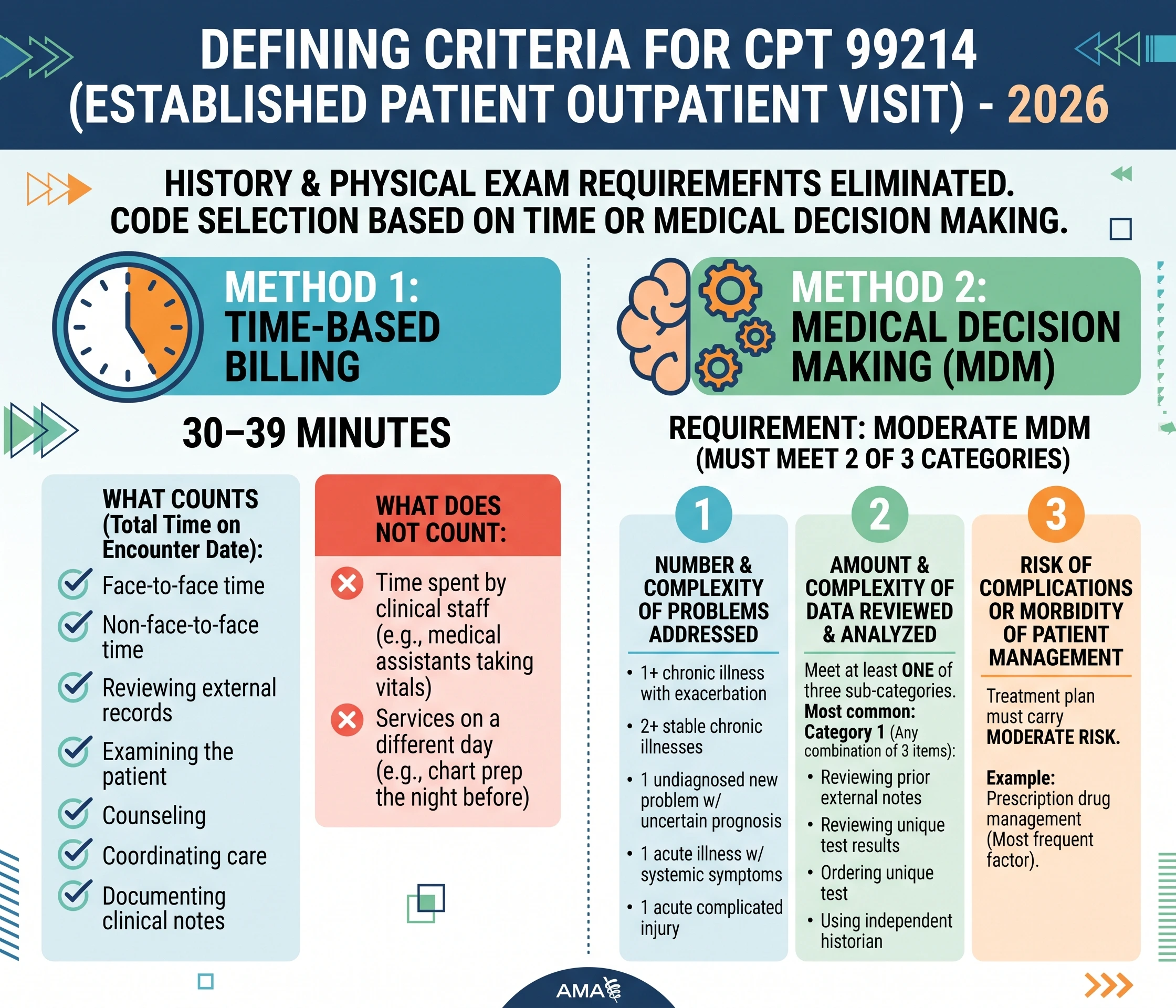
The American Medical Association eliminated history and physical exam requirements for evaluation and management code selection in 2021. Providers now select codes based entirely on total time spent on the date of the encounter or the complexity of medical decision making.
Time-based billing parameters
To bill 99214 using time, the billing provider must spend between 30 and 39 minutes on the patient’s care on the exact date of the encounter. This includes face-to-face time and non-facing time. Providers can count time spent reviewing external records, examining the patient, counseling, coordinating care, and documenting clinical notes.
Time spent by clinical staff, such as medical assistants taking vitals, does not count toward the provider’s total time. Services performed on a different day, including chart prep done the night before, are strictly excluded from the calculation.
Medical decision making requirements
When providers do not use time to determine the billing level, they must satisfy the requirements for moderate medical decision making. The American Medical Association requires the documentation to meet or exceed the threshold in two of the following three categories:
- Number and complexity of problems addressed: This requires documentation of one or more chronic illnesses with an exacerbation, two or more stable chronic illnesses, one undiagnosed new problem with an uncertain prognosis, one acute illness with systemic symptoms, or one acute complicated injury.
- Amount and complexity of data to be reviewed and analyzed: Providers must meet at least one of three sub-categories. The most common is Category 1, which requires any combination of three items from the following list: reviewing prior external notes, reviewing the results of a unique test, ordering a unique test, or using an independent historian.
- Risk of complications or morbidity of patient management: The treatment plan must carry a moderate risk to the patient. Prescription drug management is the most frequently documented moderate risk factor.
Major evaluation and management audit risks
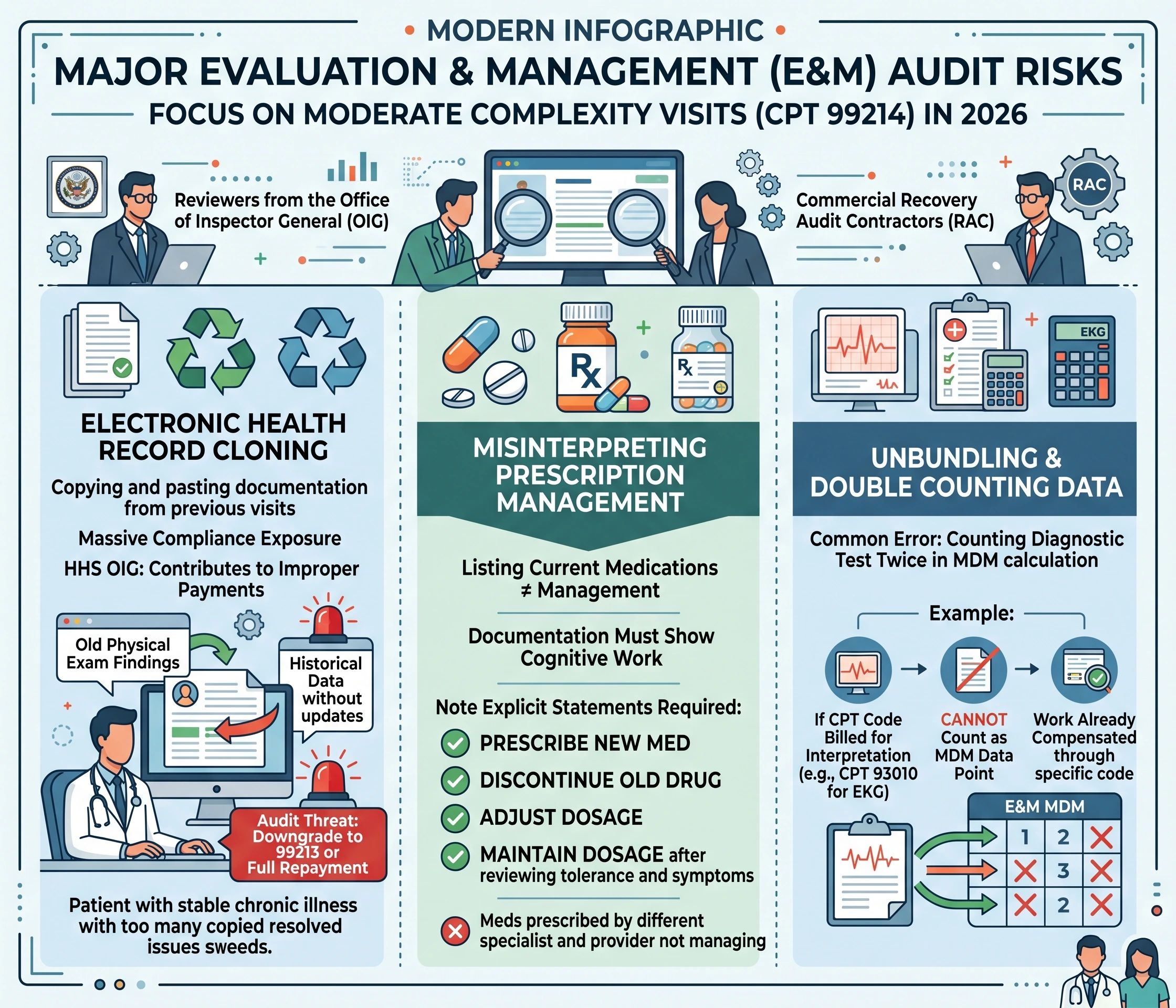
Medical practices face specific audit vulnerabilities when billing moderate complexity visits. Reviewers from the Office of Inspector General and commercial recovery audit contractors look for specific patterns in electronic health records that suggest over-coding.
Electronic health record cloning
Copying and pasting documentation from previous visits creates massive compliance exposure. According to the Department of Health and Human Services Office of Inspector General, electronic health record copy-paste functionalities contribute directly to improper Medicare payments. When a provider carries forward old physical exam findings or historical data without updating the medical decision making to reflect the current date of service, auditors view the note as mathematically unsupportable.
If a patient presents with a stable chronic illness but the provider copies a long list of resolved medical issues into the assessment section, the actual complexity of the specific encounter becomes obscured. Auditors will downgrade the claim to 99213 or demand full repayment if the specific work performed that day does not clearly justify moderate complexity.
Misinterpreting prescription management
Simply listing a patient’s current medications in the health record does not qualify as prescription drug management. To count this as a moderate risk factor for a 99214, the provider must document the cognitive work associated with the medication.
The note must explicitly state whether the provider is prescribing a new medication, discontinuing an old drug, adjusting a dosage, or making the specific medical decision to maintain the current dosage after reviewing the patient’s tolerance and current symptoms. If the patient is merely taking a medication prescribed by a different specialist and the billing provider is not actively managing it, the risk factor remains low.
Unbundling and double counting data
A common error occurs when providers attempt to count a diagnostic test twice within the medical decision making calculation. If a provider bills a CPT code for the interpretation of an electrocardiogram (CPT 93010) during the visit, they cannot also count the review of that electrocardiogram as a data point in the medical decision making grid for the evaluation and management service. The work is already compensated through the specific diagnostic code.
Comparing 99213 and 99214 documentation
The line between low complexity (99213) and moderate complexity (99214) is the most heavily audited boundary in medical billing. The table below outlines the differences required to transition from low to moderate complexity based on the American Medical Association criteria.
|
Clinical category |
99213 (Low complexity) |
99214 (Moderate complexity) |
|
Total time required |
20 to 29 minutes |
30 to 39 minutes |
|
Stable chronic illnesses |
One stable chronic illness |
Two or more stable chronic illnesses |
|
Acute illnesses |
One acute, uncomplicated illness |
One acute illness with systemic symptoms |
|
Data requirements |
Two documents, tests, or sources |
Three documents, tests, or sources |
|
Patient risk level |
Low risk (Over-the-counter drugs) |
Moderate risk (Prescription drug management) |
Compliance best practices for billing accuracy
Medical coders and healthcare providers can reduce their audit liability by implementing specific documentation habits. Clear language directly tied to the medical decision making grid prevents auditor misinterpretation.
Quantifying data complexity
Providers should explicitly list the distinct tests ordered or reviewed. Instead of writing “labs reviewed”, the documentation should state “reviewed complete blood count and comprehensive metabolic panel”. Each unique test counts as one data point. The American Medical Association defines a unique test by its specific CPT code. A comprehensive metabolic panel is one unique test, even though it contains multiple individual results.
Documenting the independent historian
When a patient cannot provide a complete medical history due to dementia, severe acute illness, or language barriers, providers often rely on a parent, caregiver, or spouse. This qualifies as an independent historian, which adds significant weight to the data complexity calculation. Providers must document exactly who provided the history and the specific medical reason the patient could not provide it themselves. Writing “history obtained from daughter” is insufficient. The record should read “history obtained from daughter due to patient’s advanced Alzheimer’s disease.”
Defining the status of chronic conditions
Auditors require clinical confirmation of a disease’s status to award moderate complexity. A provider treating two stable chronic conditions meets the problem threshold for a 99214. The documentation must clearly state the status of each condition in the assessment and plan.
For example, noting “Type 2 Diabetes, current A1C 6.8 percent, well-controlled on Metformin” and “Essential Hypertension, blood pressure 120/80 today, stable on Lisinopril” provides the auditor with unquestionable evidence of two stable chronic illnesses.
How Medicare tracks provider billing patterns
Medicare Administrative Contractors employ advanced data mining techniques to identify outliers in evaluation and management billing. They calculate the utilization rate of 99214 for every provider and compare it against the bell curve of peers within the same geographic region and medical specialty.
Providers who bill 99214 for 80 percent of their established patient visits while their specialty average sits at 45 percent will trigger a Comparative Billing Report. This report serves as an educational warning. If the billing pattern does not normalize, the contractor will initiate a Targeted Probe and Educate audit.
During a Targeted Probe and Educate audit, the contractor requests 20 to 40 specific patient charts. Clinical reviewers evaluate the documentation to determine if the medical necessity and medical decision making support the 99214 level. If the provider fails this pre-payment review, they face 100 percent prepayment scrutiny for all future claims.
Applying accurate time-based workflows
When a clinical encounter lacks moderate medical decision making but requires extended counseling, time-based billing provides the safest compliance route. A patient presenting with a simple upper respiratory infection (a low-complexity problem) might require 35 minutes of provider time due to extensive counseling regarding medication interactions, smoking cessation, and treatment adherence.
To survive an audit on a time-based 99214 claim, the provider must document the total minutes and briefly describe the activities performed. The phrasing should be specific to the encounter.
For instance, a compliant time-based statement would read: “I spent 32 minutes total time on the date of the encounter. Time was spent reviewing prior records from the pulmonologist, examining the patient, and providing extensive face-to-face counseling regarding smoking cessation strategies and the mechanics of the new inhaler prescription.”
Addressing preventative and sick visits on the same day
Providers occasionally perform a routine preventative exam (such as CPT 99396) and address a significant, separately identifiable medical problem on the same day. Billing a 99214 alongside a preventative visit requires modifier 25.
Auditors target modifier 25 claims heavily. To justify the 99214, the documentation must show that the sick visit required work significantly beyond the standard preventative exam components. The assessment and plan for the preventative visit must be separated physically in the chart from the assessment and plan for the acute or chronic problems. If the provider simply refills a stable medication during an annual physical, the work does not rise to the level of a separately billable 99214.
Managing audit exposure through clinical accuracy
The criteria for CPT code 99214 demand exact alignment between the clinical reality of the patient encounter and the codified rules of medical decision making. By explicitly naming the status of chronic diseases, identifying the specific medications managed, and avoiding duplicated text from prior encounters, medical practices build records that withstand federal and commercial scrutiny. Accurate evaluation and management coding relies on capturing the precise medical necessity and cognitive labor required to safely treat the patient on the specific date of service.