



A psychotherapy claim denial requires a specific response. Missing authorization, incorrect billing information, and a disputed medical necessity decision each call for different evidence. Sending the same appeal letter for every denial leaves the payer’s actual objection unanswered.
To appeal a denied psychotherapy claim, identify the reason, confirm the applicable deadline, and connect your supporting records to the disputed requirement. Before filing an appeal, first determine whether the claim should be corrected instead.
This guide explains how healthcare providers and medical billing students can review a denial, assemble an appropriate appeal, and track the decision through payment or further review.
Step 1: Read the complete denial
Gather the explanation of benefits (EOB), electronic remittance advice (ERA), and any separate denial notice. Review the affected service line, including the procedure code, date of service, adjustment reason, and accompanying remarks.
Create a working record containing:
- Patient name, member ID, and claim number.
- Rendering provider and billed service.
- Denial reason and notice receipt date.
- Disputed amount.
- Appeal instructions and submission deadline.
Avoid interpreting a short denial description without checking the accompanying explanation. “Documentation insufficient,” for example, does not identify whether the reviewer lacked the treatment plan, session time, signature, or evidence supporting continued treatment.
If the reason remains unclear, ask the payer which requirement was unmet and which policy applied on the service date. Record the representative’s name, call reference number, and response.
Step 2: Decide whether to correct or appeal
A rejection generally means the claim did not pass initial processing requirements. A denial follows a payer determination. Check the actual claim status before choosing the next action.
Use this distinction to organize your review:
| Finding | Appropriate next step |
|---|---|
| Claim rejected for an invalid member ID | Correct the information and resubmit through the required process |
| Processed claim contains a billing error | Follow the payer’s corrected-claim or adjustment procedure |
| Payer disputes coverage or medical necessity | Prepare an appeal addressing the stated reason |
| Payer overlooked an existing authorization | Submit authorization evidence through the designated dispute process |
For Original Medicare, CMS’s First Level of Appeal: Redetermination by a Medicare Contractor, reviewed October 17, 2026, specifically directs minor errors and omissions away from the appeals process and toward claim correction procedures.
Do not change an accurate diagnosis or procedure code simply to obtain payment. Any correction should reflect the service actually documented.
Step 3: Confirm the deadline and who may appeal
There is no universal psychotherapy appeal deadline. Identify the coverage type and whether the practice is pursuing its own provider payment dispute or acting on the patient’s behalf.
HealthCare.gov’s Internal appeals guidance, reviewed October 17, 2026, describes a 180-day filing period after receipt of a denial for the consumer appeal process it covers. That period should not be assumed to govern every contractual provider dispute.
Original Medicare follows a separate route. CMS allows 120 days from receipt of the initial determination to request first-level redetermination. Its guidance generally presumes receipt five calendar days after the notice date unless evidence shows otherwise.
For Medicare Advantage, Medicaid, and commercial provider disputes, check the applicable notice and program or contract instructions.
Confirm whether a signed authorized-representative form is required. Do not assume an assignment of benefits satisfies every representation requirement. Set an internal submission target before the deadline, and do not assume a telephone inquiry extends it.
Step 4: Audit the psychotherapy coding
Compare the submitted claim with the clinical record before defending the billed code.
For individual psychotherapy without an evaluation and management service, check the documented psychotherapy duration:
| CPT code | Psychotherapy time |
|---|---|
| 90832 | 16–37 minutes |
| 90834 | 38–52 minutes |
| 90837 | 53 minutes or more |
First Coast Service Options’ Medicare billing article A57520, Billing and Coding: Psychiatric Diagnostic Evaluation and Psychotherapy Services, reviewed October 17, 2026, specifies these ranges and requires start-and-stop times or total time. It also distinguishes psychotherapy time from separately identifiable evaluation and management services. This is contractor guidance, so confirm the policy applicable to the claim.
A scheduled one-hour appointment alone does not establish 53 minutes of psychotherapy.
Also check the rendering provider, diagnosis, units, authorization dates, place of service, and any required modifiers. For telehealth, consult the payer’s rules effective on the service date rather than assuming today’s requirements applied previously.
If the claim is inaccurate, address that error through the appropriate correction process.
Step 5: Match the evidence to the denial
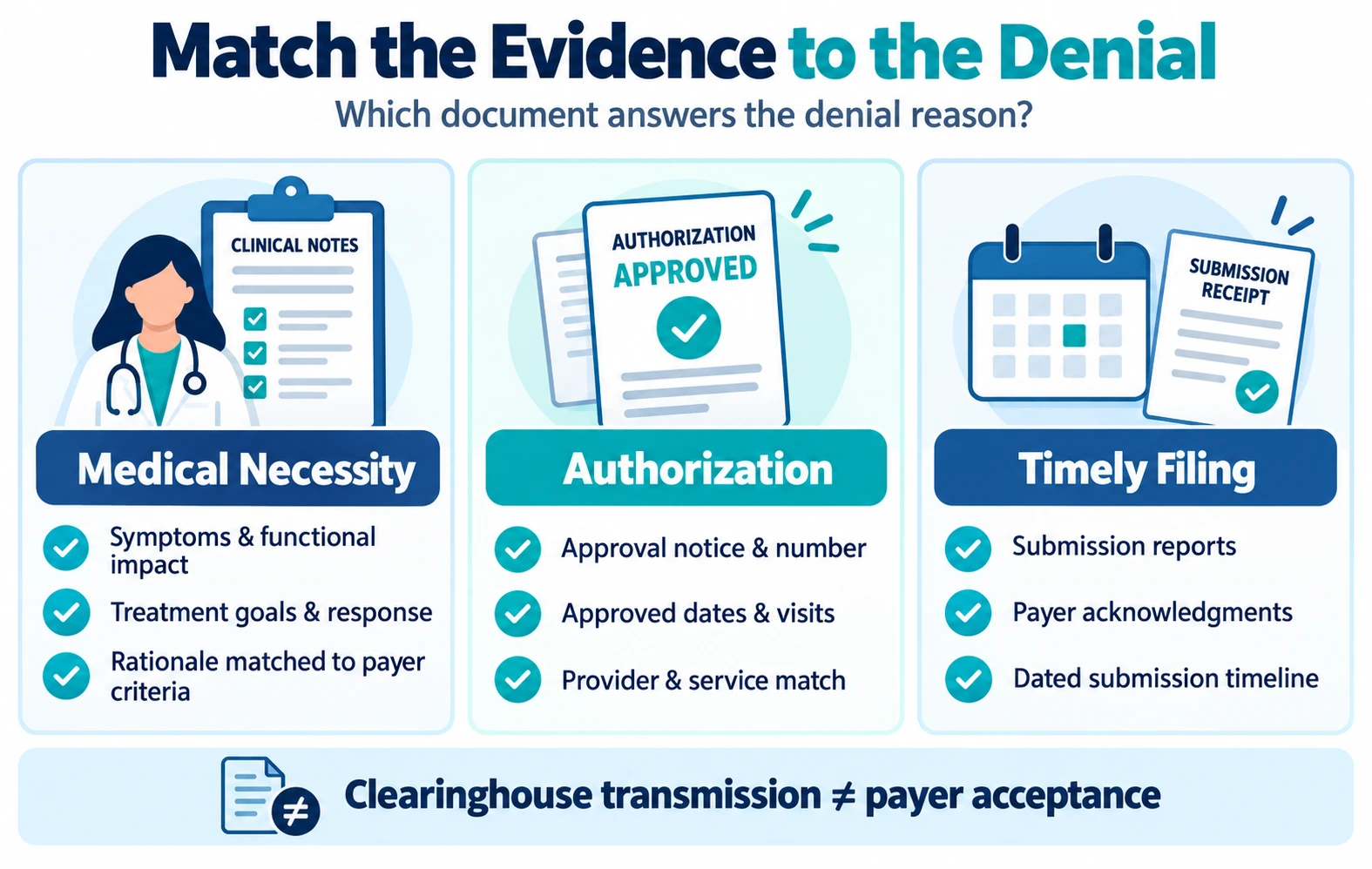
Organize the appeal packet to directly address the payer’s stated reason for denial. Use a simple working question: Which document answers this reason for denial?
For medical necessity denials
Ask the clinician to explain the symptoms, functional impairment, treatment goals, interventions, response, and rationale for the disputed frequency or duration.
Ask for the specific medical necessity criteria. The U.S. Department of Labor’s FAQs About Mental Health and Substance Use Disorder Parity Implementation, Part 39, published on September 5, 2019, states that applicable plans must provide these criteria upon request to participants, beneficiaries, and contracting providers.
Organize the clinical explanation around those criteria. A diagnosis label alone leaves the reviewer without a clear explanation of why the disputed service was needed.
For authorization denials
Include the approval notice, authorization number, approved dates, services, visits or units, and relevant communications. Check whether the authorization matches the treating provider and disputed date.
If authorization was never obtained, investigate whether the payer permits retrospective review or an applicable exception. Describe the circumstances accurately.
For timely-filing denials
Gather submission reports, payer acknowledgments, and claim-status records. Distinguish a clearinghouse transmission from evidence that the payer accepted the claim. Include a dated timeline so the reviewer can follow the submission history.
Step 6: Select records carefully
Assemble the relevant progress notes, treatment plan, assessment, authorization records, and clinician explanation. Number the pages and reference them in the appeal.
Avoid sending an entire chart without checking its contents.
HIPAA provides additional privacy protections for psychotherapy notes maintained separately from the rest of a patient’s medical record. These are distinct from ordinary clinical progress notes. HHS’s Summary of the HIPAA Privacy Rule, reviewed October 17, 2026, explains that most uses or disclosures of psychotherapy notes for payment require authorization.
Have the clinician or privacy lead review sensitive material before release. Identify the records needed to support the claim and follow applicable disclosure requirements.
Preserve the original documentation. If clarification is necessary, use an appropriately identified, dated addendum under the practice’s documentation policy. Never backdate an entry or create details that were not established.
Step 7: Write a focused appeal
Keep the letter organized around the disputed determination. Include the claim identifiers, denial date, service dates, billed code, and requested action.
The body should explain:
- What the payer denied.
- Why the practice disputes that reason.
- Which attached records support the position.
- What review or reprocessing is requested.
For a hypothetical 90837 medical necessity denial, the clinician might explain that the documented session lasted 55 minutes, identify the interventions performed, and connect them to the patient’s documented impairment and treatment goals.
The time establishes support for code selection. The clinical explanation addresses necessity.
Reference specific pages instead of asking the reviewer to locate the evidence. For example, identify where the treatment plan states the goal and where the disputed session note documents the intervention.
Do not promise that a longer letter, a particular diagnosis, or a physician signature will secure approval.
Step 8: Submit and track the appeal
Use the destination and method specified for that appeal type. Verify whether the submission belongs with the insurer, a behavioral health administrator, or another designated reviewer.
Save the complete packet and proof of submission. Record the appeal reference number, receipt date, expected response date, and staff member responsible for follow-up.
HealthCare.gov’s Internal appeals guidance states that the covered consumer process must generally conclude within 60 days for services already received and 30 days for services not yet received. These timelines should not be applied automatically to every provider dispute.
During follow-up, confirm that the appeal and attachments are linked to the correct claim. Ask whether anything is missing and document the answer.
Step 9: Review the outcome and escalation options
An approval requires follow-through. Compare the new remittance with the appealed services and verify the payment and patient responsibility.
If the denial remains, review the written reasoning before escalating. Identify any evidence the reviewer did not address and check the next deadline.
For eligible disputes, external review may be available. HealthCare.gov’s External Review guidance, reviewed October 17, 2026, describes a four-month request period and decisions generally within 45 days. Eligibility depends on the coverage and dispute; an ordinary provider rate disagreement should not be assumed eligible. Follow the final notice’s instructions.
Original Medicare uses its own subsequent appeal levels. Medicaid and Medicare Advantage also require program-specific review.
Make the next appeal easier to review
To appeal a denied psychotherapy claim effectively, preserve the deadline, defend accurate billing, and answer the payer’s stated objection with identifiable evidence. Before closing the account, verify that the decision was implemented correctly.
Record the underlying cause, such as an authorization mismatch or missing time documentation, and assign a specific workflow correction. That gives the practice a usable response to the next similar claim.