


96125 CPT Code: Complete Billing Guide, Description, Requirements, Reimbursement, and Medicare Rules (2026)
A speech-language pathologist finishes a full cognitive-linguistic evaluation on a stroke patient. She administers a standardized battery, scores it, and writes the report. The claim goes out with 92523 and 96125 on the same date. Two weeks later it comes back with a bundling denial, and nobody in the front office can say why.
This happens in therapy clinics, rehab groups, and integrated care practices all the time. The 96125 CPT code looks simple until you meet its time rules, its same-day edits, and the modifier requirements that change with the payer. This guide covers how it is defined, who bills it, how Medicare pays it in 2026, and where claims go wrong.
What Is 96125 CPT Code?
96125 is the CPT code for standardized cognitive performance testing. It is billed per hour of a qualified health care professional’s time. That time covers face-to-face test administration, plus the time spent interpreting results and writing the report.
Quick answer: The 96125 CPT code reports one hour of standardized cognitive performance testing by a qualified health care professional. It includes administration, scoring and interpretation, and the written report. It is timed, it has no add-on code, and Medicare pays about $102.87 per unit nationally in 2026.
96125 Overview Table
Element | Detail |
Code | 96125 |
Category | Central nervous system assessments/tests (96105–96146 range) |
Service type | Standardized cognitive performance testing |
Billing unit | Per hour of professional time (timed code) |
Add-on code | None |
Medicare MUE (same provider, patient, date) | 2 units |
2026 Medicare national payment | ≈ $102.87 (3.08 total RVUs) |
Typical performers | Speech-language pathologists, occupational therapists, some physicians and other QHPs, depending on payer |
Common supporting modifiers | GN/GO/GP, 59 (or an X modifier), KX |
96125 CPT Code Description
The AMA descriptor says that a standardized cognitive instrument is administered and interpreted, and that the code is counted per hour of the clinician’s time. The descriptor gives the Ross Information Processing Assessment as an example. That example tells you the category of tool, not the only tool allowed. I’m paraphrasing here because the exact CPT language is AMA copyrighted material. Check the official CPT code set for the precise wording.
Three words in the description do most of the work.
- Standardized. The instrument needs published administration rules and norms. Informal bedside tasks and home-grown checklists don’t count.
- Cognitive performance. The test targets domains like attention, memory, executive function, and processing. It is not a mood or personality measure.
- Per hour. Time is the unit, and the clock includes the report. ASHA’s Medicare guidance flags 96125 as an exception among SLP timed codes because interpretation and report time are allowed.
96125 CPT Code Definition
In plain billing language, 96125 is a timed professional service. The unit of work is the clinician’s hour spent testing, scoring, interpreting, and reporting. It is not a flat per-test fee, and it is not a screening code. A five-minute screen doesn’t become a billable hour because the tool has a norm table.
What Services Are Reported With 96125?
Typical uses include:
- Cognitive-communication assessment after stroke, traumatic brain injury, or in progressive neurological conditions
- Standardized cognitive testing in memory clinics or geriatric rehab programs
- Executive function testing tied to a therapy plan of care
- Reassessment when a patient’s status has changed and the plan needs updating
CMS billing articles for psychological and neuropsychological testing point providers to 96125 for cognitive performance testing and to 96105 for aphasia assessment. Psychologists doing full psychological or neuropsychological batteries usually report the 96130–96139 families instead. Payers differ on who may use 96125, so confirm provider eligibility before you build a workflow around it.
When to Use 96125 CPT Code
Use it when all of these are true:
- A standardized, norm-referenced cognitive instrument was administered.
- A qualified health care professional performed the service within their licensed scope.
- The record shows why testing was needed.
- You can document the hour or fraction of an hour: face-to-face time, plus scoring, interpretation, and report time.
When Not to Use 96125
- The “test” was a brief screening or an informal clinical observation.
- The tool was not standardized.
- The service belongs to a different family, such as a neurobehavioral status exam (96116) or a full neuropsychological evaluation (96132).
- The documented time doesn’t reach the midpoint of an hour.
- A same-day edit applies and the services weren’t clinically distinct.
96125 CPT Code Requirements
Requirements fall into four buckets: clinical, credentialing, documentation, and payer-specific.
Clinical. The instrument is standardized, and the testing addresses a documented cognitive concern.
Credentialing. Under the Medicare contractor article on psychological and neuropsychological testing, the practitioner needs Medicare enrollment and a state license for the services performed. See CMS’s Billing and Coding article A57481 for one contractor’s framing. Contractors differ, so read your own MAC’s policy.
Documentation. Covered in detail below.
Payer-specific. Some commercial plans require prior authorization, a physician referral, or a specific provider type. These vary, so state this to your team rather than assuming.
How 96125 Billing Works
The workflow in a well-run practice looks like this:
- Eligibility and benefits check before the visit, including visit limits and authorization rules.
- Clinical testing, with start and stop times captured in the note.
- Time calculation across face-to-face testing, scoring, interpretation, and report writing.
- Code selection and unit calculation.
- Claim scrub against NCCI edits and MUEs.
- Submission, then denial monitoring and follow-up.
How Units Are Counted
Most payers follow CPT’s midpoint convention for timed codes. For an hourly code, the first unit needs more than 30 minutes, and a second unit needs more than 90 minutes. Medicare’s MUE caps 96125 at two units per day for the same provider and patient, according to ASHA’s MUE reference.
Practice scenario: A clinician spends 50 minutes testing and 40 minutes scoring and writing the report. That is 90 minutes in total, which is one unit. It is not two. If the report takes 10 minutes longer and the note shows it, the second unit becomes supportable. Auditors read time totals closely, and the difference is exactly one unit.
Documentation Requirements
Element | What the record should show |
Reason for testing | Referral source, symptoms, or clinical question |
Instrument | The name of the standardized test, not just “cognitive testing” |
Administration time | Start/stop or total minutes, face-to-face |
Scoring and interpretation time | Separate minutes for scoring, interpretation, and report |
Results | Scores, norms used, and findings by domain |
Interpretation | What the results mean for function and care |
Plan impact | How findings change goals, treatment, or referrals |
Diagnosis linkage | ICD-10-CM codes that support the testing |
Authentication | Signature, credentials, date |
Plan of care | Certification or order if the service is a therapy service |
A typical weak note says “Cognitive testing completed, 60 min.” A defensible note names the instrument, splits the time, and shows what the findings meant for treatment.
Medical Necessity
Medical necessity is the question under most 96125 denials. Payers want to see a clinical reason: new symptoms, a change in status, a decision the results will inform. Routine testing without a decision attached tends to fail review. Tie the test to the plan, and write that link into the record as a sentence the reviewer can find.
Modifier Usage for 96125
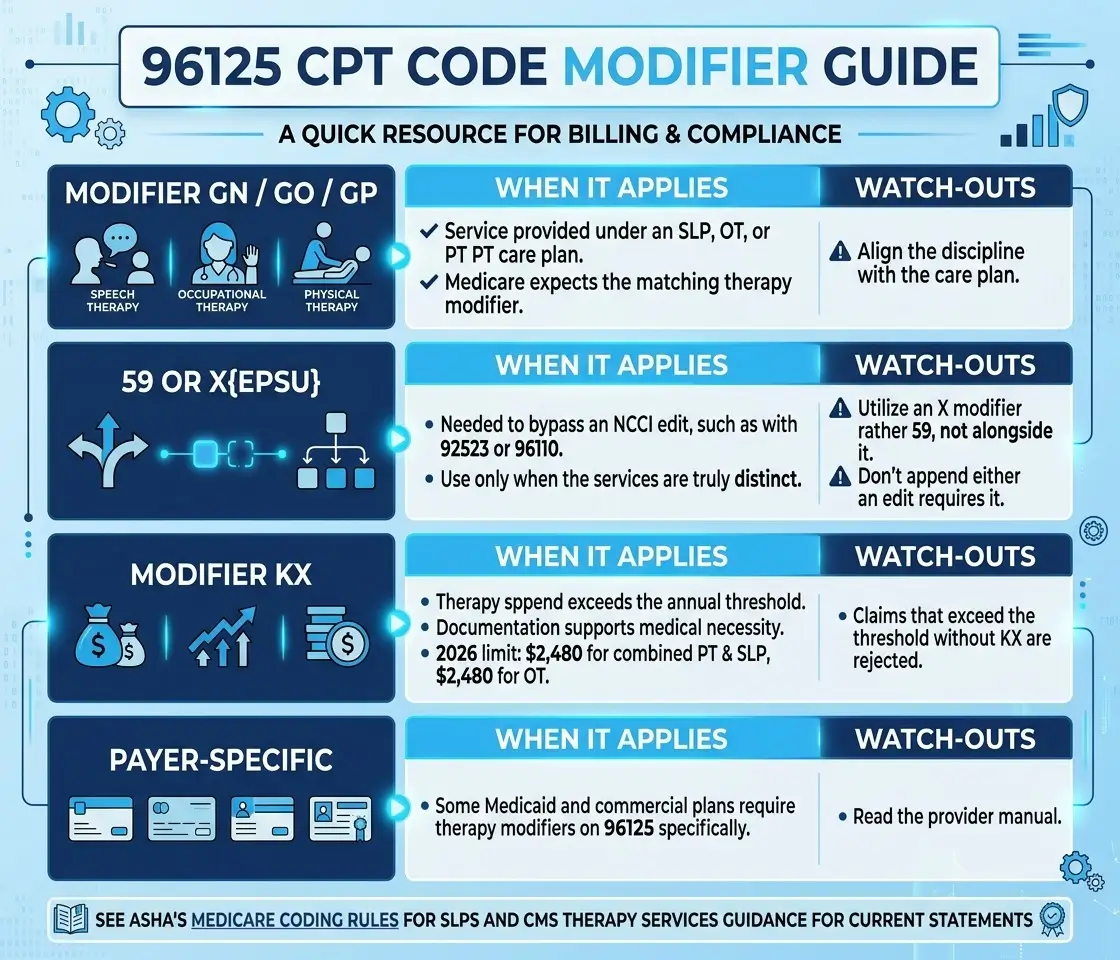
Is a modifier required for 96125? The code itself doesn’t carry a built-in modifier requirement. Modifiers get added by context: the payer, the setting, and what else appears on the claim.
Medicare Billing Considerations
Is 96125 billable with Medicare? Yes, when the service is medically necessary, performed by an eligible and enrolled practitioner, and documented properly. The 96125 CPT code Medicare rules in short:
- Compensation is derived from the Medicare Physician Fee Schedule.
- It is a therapy-related service, so GN/GO/GP modifiers apply when it is furnished under a plan of care.
- The KX threshold and targeted medical review limits pertain to therapy expenditures.
- The MUE is two units per day.
- NCCI edits restrict some same-day pairings.
- Your MAC’s local coverage articles can add requirements.
96125 CPT Code Medicare Reimbursement (2026)
ASHA’s 2026 analysis lists 96125 at 3.08 total RVUs (1.70 work, 1.34 practice expense, 0.04 malpractice). Multiplied by the $33.40 conversion factor used for providers not in a qualifying APM, that gives about $102.87 per unit nationally. The 2025 figure was $99.63, per ASHA’s 2026 Medicare fee schedule. Your actual payment shifts with the geographic adjustment for your locality, applicable reductions, and the patient’s cost-sharing. Medicare typically pays 80% of the allowed amount after the deductible, with the patient responsible for the rest.
You may see lower figures on third-party code lookup sites. Verify against the CMS fee schedule or your MAC’s locality file before building revenue projections.
Commercial Insurance Considerations
96125 CPT code reimbursement from commercial payers rarely mirrors Medicare. Contracts set rates, often as a percentage of Medicare or as a fixed schedule. The bigger variation is in rules.
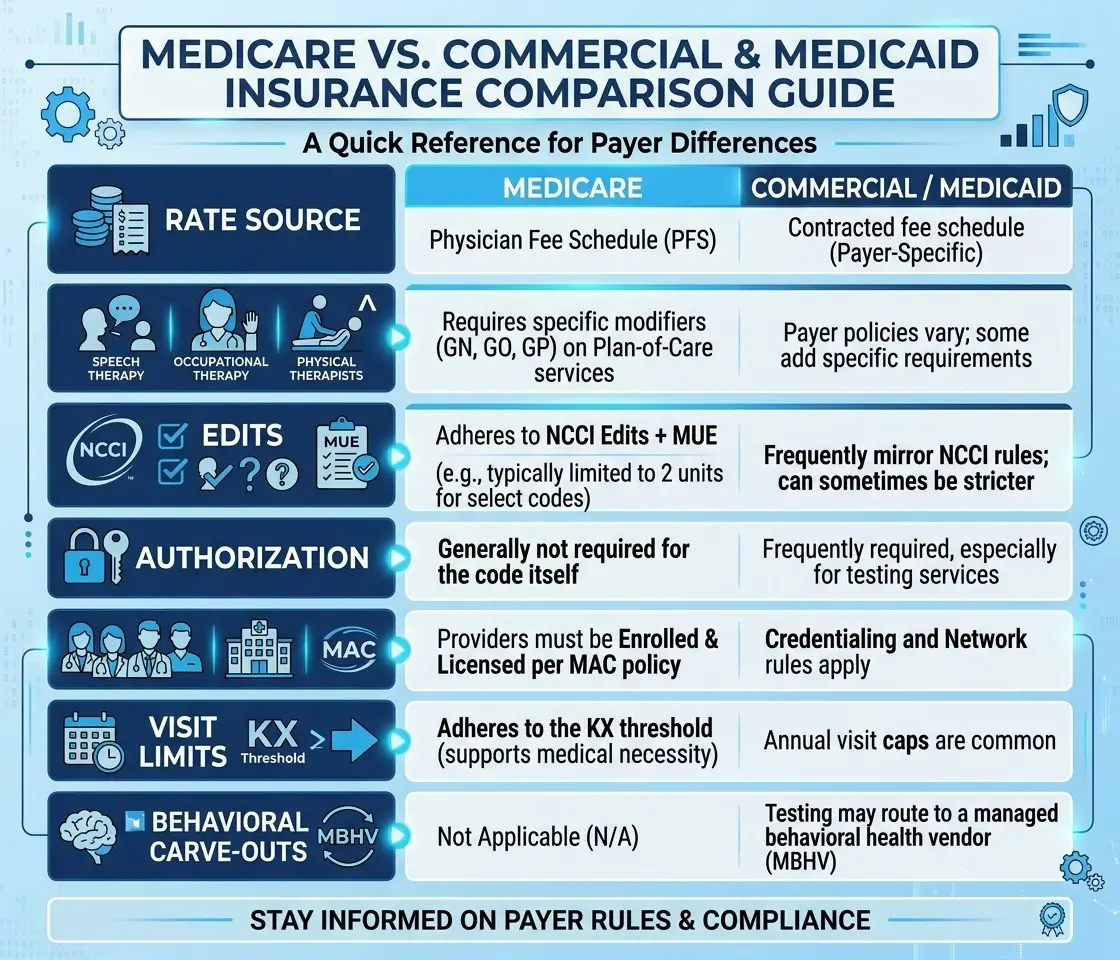
When a practice treats both therapy and behavioral health patients, carve-outs create real confusion. A cognitive testing claim can land with a medical payer or with a behavioral health vendor depending on the diagnosis and plan design. Verify which one owns it before you submit.
Reimbursement and Payment Factors
Several things move what you collect:
- Time capture. Rounding down a unit you could have supported costs revenue. Rounding up one you can’t support creates audit exposure.
- Edit handling. A missing modifier on a legitimate pair means a denial. An unneeded modifier invites a payment hold.
- Contract terms. Check allowed amounts against your payer contracts quarterly.
- Authorization status. Testing done before a required authorization is a write-off waiting to happen.
- Timely filing. Denied claims that sit beyond the filing window can’t be recovered.
Can You Bill 92523 and 96125 Together?
Yes, with conditions. This is the inquiry that many readers come with.
According to ASHA’s NCCI edit table, 92523 and 96125 form a code pair with a modifier indicator that permits bypass with 59 (or the appropriate X subcategory) when clinically appropriate. The conditions that make it legitimate:
- A complete speech-sound-production and language evaluation was performed (92523).
- A separate, complete standardized cognitive performance test was also performed (96125).
- The note shows two distinct services with their own time and findings.
Don’t use the modifier as a habit. If cognitive testing is simply folded into a language evaluation, you can’t split it out. ASHA specifically cautions against appending 59 when the NCCI system doesn’t require it.
Correct vs. Incorrect Billing Scenarios
Scenario | Correct | Incorrect |
Full language eval plus separate standardized cognitive test, both documented | 92523-GN + 96125-GN-59 (payer rules permitting) | 92523 + 96125 with no modifier, then appealing the denial |
90-minute total test time | 1 unit | 2 units |
3 hours of testing on one date | Cap at 2 units per MUE unless a valid override exists | 3 units |
Brief screening tool, 8 minutes | Don’t bill 96125 | 96125 × 1 |
Note says “cognitive testing” with no instrument | Name the test | Submit as-is |
Common Billing Mistakes
- Billing 96125 for a screening. The service didn’t meet the standardized-testing standard or the time threshold.
- Ignoring the midpoint rule. Units get inflated or underbilled.
- Forgetting the therapy modifier. Medicare and some Medicaid plans reject the line.
- Adding 59 to everything. It flags the claim and doesn’t solve anything when no edit exists.
- Skipping the report time. The code counts it, but only if the note records it.
- Exceeding the MUE. Three units on a single date cannot be compensated without a valid justification.
- Overlooking authorization. Common with commercial and Medicaid plans.
- Mixing code families. Using 96125 where 96116 or 96132 describes the service better.
Common Denials
Denial type | Likely cause | Fix |
Bundling (commonly CO-97) | NCCI edit with 92523 or 96110 | Add 59/X modifier if distinct and documented; otherwise accept the bundle |
Medical necessity | Weak diagnosis link or no decision tied to the test | Correct ICD-10 linkage; appeal with the clinical rationale |
Units exceed limit | MUE or payer cap | Correct units; appeal only with documentation |
Missing therapy modifier | No GN/GO/GP | Corrected claim |
Provider not eligible | Credentialing or scope mismatch | Verify enrollment; resubmit under the right provider |
No authorization | Prior auth required | Retro-auth request if the payer allows it |
When should 96125 be denied or corrected? Correct it before it goes out if the time doesn’t support the units, the instrument isn’t named, or an edit applies and no modifier is attached. Accept the denial when the service was a screening or lacked documentation, because appealing those wastes effort.
Examples of Correct Coding
Example 1: Single-code claim. An SLP tests a post-stroke patient with a standardized cognitive-communication battery. Face-to-face: 55 minutes. Scoring, interpretation, report: 45 minutes. Total: 100 minutes, which is two units.
Claim line: 96125-GN × 2, with the diagnosis for the cognitive-communication deficit (such as R41.841) linked alongside the underlying condition.
Example 2: Same-day evaluation pair. A child with language delays gets a full speech-language evaluation and a separate standardized cognitive assessment. Both are documented as separate services.
Claim lines: 92523-GN and 96125-GN-59, if the payer follows the NCCI bypass.
Example 3: Short session. Total documented time is 25 minutes. Nothing reaches the midpoint. Don’t bill 96125.
Real Practice Scenarios
Scenario A: Rehab group. The practice bills therapy and testing under one group NPI. Three clinicians do cognitive testing on the same patient over two days. Because MUEs apply per provider and date, the billing team has to confirm each rendering provider is attached to the correct line, a point ASHA stresses.
Scenario B: Behavioral health and integrated care. A multidisciplinary clinic runs memory evaluations for older adults with depression and cognitive complaints. Psychology bills 96130-series testing. The SLP bills 96125 for a separate cognitive performance battery. The claims team needs to keep the services distinct and pick the right payer for each. This is where specialists in behavioral health billing earn their keep. A team like Mental Health Billing, which works inside outpatient and integrated behavioral settings, sees these cross-discipline claims routinely.
Scenario C: Medicare threshold. A patient receiving SLP services approaches the annual KX threshold. Without a process to flag it, claims after that point are denied. Front-end tracking prevents the surprise.
Coding Tips for Better Reimbursement
- Build a time-capture field into the note template: start, stop, scoring, report.
- Name the instrument every time.
- Run a pre-submission scrub against current NCCI edits and MUEs. They update quarterly.
- Keep a payer matrix for authorization, modifiers, and visit limits.
- Track Medicare therapy spend against the KX threshold throughout the year.
- Audit a sample of 96125 claims each quarter. Look at time totals, instrument names, and modifier use.
- Reconcile payments against the fee schedule, not just against whether the claim paid.
Compliance Checklist
- The instrument is standardized and named in the record
- The performing clinician is licensed, credentialed, and enrolled where required
- Time is documented by component and meets the midpoint for each unit billed
- The medical necessity rationale is stated in the note
- ICD-10-CM codes support the service
- Therapy modifiers match the plan-of-care discipline
- NCCI edits and MUEs checked before submission
- 59/X modifiers used only when documentation supports distinct services
- Authorization confirmed where required
- KX threshold monitored for Medicare patients
- The report is signed, dated, and in the record
How Professional Billing Support Helps
Most 96125 problems are workflow problems. Time isn’t captured, edits aren’t checked, authorizations are missed, and denials sit in a queue nobody owns. A dedicated billing team fixes those in the places they start:
- Front end: eligibility and benefits verification, authorization tracking
- Coding: code selection, unit calculation, modifier review
- Back end: payment posting, denial appeals, accounts receivable follow-up
For practices that blend therapy, behavioral health, and rehab, specialized support matters because payer rules for testing differ across those lines. If your organization runs outpatient and inpatient behavioral programs alongside cognitive testing, the inpatient and outpatient mental health billing services at Mental Health Billing cover the claim-tracking and compliance work that tends to get thin when staff are stretched.
Future Billing Updates for 2026
Several moving pieces are worth watching.
- Medicare rates. The 2026 national payment for 96125 rose to about $102.87 from $99.63 in 2025, driven by the new conversion factor. The CY 2027 Physician Fee Schedule rule historically finalizes around early November, so check for rate and policy changes then.
- KX threshold. It resets each year ($2,480 in 2026). Expect a new number in January.
- NCCI and MUE updates. These change quarterly. Rescrub your 96125 pairs each time.
- CPT updates. The AMA publishes annual changes effective January 1. Review the testing families for descriptor changes.
- Payer policy. Commercial plans revise authorization and provider-type rules without much notice.
I haven’t verified any CY 2027 changes to 96125 specifically, so treat anything you read about 2027 as unconfirmed until CMS publishes the final rule.
Conclusion
The 96125 CPT code rewards practices that treat it as a documentation and workflow issue rather than a coding trivia question. Name the instrument, capture the time, check the edits, and confirm payer rules before the patient walks in. When your claims span therapy, behavioral health, and rehab, the number of places a claim can go wrong multiplies. If you want a second set of eyes on that process, the team at Mental Health Billing can review your workflow, and policies always differ by payer, so verify against your own contracts and MAC guidance.
Frequently Asked Questions
What is 96125 CPT code used for?
It reports standardized cognitive performance testing, counted per hour of a qualified health care professional’s time, including administration, interpretation, and the report.
Does the CPT code 96125 need a modifier?
Not by itself. Modifiers depend on context: GN/GO/GP for therapy plans of care, 59 or an X modifier to bypass an NCCI edit, and KX when therapy spending passes the threshold.
Can you bill 92523 and 96125 together?
Yes, when both a full speech-language evaluation and a separate standardized cognitive test were performed and documented. The pair has an NCCI edit that can be bypassed with 59 or the appropriate X modifier.
What is the current reimbursement rate for CPT code 96125?
Medicare’s 2026 national payment is approximately $102.87 per unit, based on 3.08 RVUs and a $33.40 conversion factor. Local adjustments and commercial contracts change the real figure.
Is 96125 covered by Medicare?
Yes, with medical necessity, an eligible enrolled practitioner, and adequate documentation. Contractor policies can add conditions.
What documentation is required for 96125?
The named standardized instrument, clinical reason, time by component, results, interpretation, diagnosis linkage, and an authenticated report.
Is 96125 time-based or service-based?
Time-based. It is reported per hour, with units counted using the midpoint convention for most payers.
Can 96125 be denied for lack of medical necessity?
Yes. It is among the most common reasons. A clear rationale and a plan-of-care connection are the best defense.
Which specialties commonly bill 96125?
Speech-language pathologists and occupational therapists most often, with some physicians and other qualified professionals depending on payer rules.
How do payer rules affect 96125 billing?
They change authorization requirements, modifier use, provider eligibility, unit caps, and rates. Always check the specific plan.
How many units of 96125 can I bill per day?
Medicare’s MUE is two units per date of service for the same provider and patient. Other payers may differ.
Does the time spent writing the report count?
Yes. The descriptor includes interpretation and report preparation, but the note has to show that time.
Is a screening tool billable as 96125?
Generally no. A brief screen doesn’t meet the standardized-testing and time expectations for the code, though payer policies vary.
Key Takeaways
- 96125 is an hourly code for standardized cognitive performance testing, and the report time counts.
- Count units with the midpoint rule, and remember the Medicare MUE of two.
- Medicare pays about $102.87 nationally in 2026, adjusted by locality.
- GN/GO/GP, 59/X, and KX each apply in specific situations. None is automatic.
- 92523 and 96125 can be billed together only when the services are genuinely distinct and documented.
- Denials trace back to time, modifiers, edits, authorization, and necessity.