


H0033 CPT Code: Coverage, Documentation Requirements & Billing Tips
Billers who search for the H0033 CPT code are usually trying to answer one of three questions: does my payer cover it, what has to be in the chart to support it and how many times can I bill it in a day. All three answers depend heavily on which state and sometimes which county program, is processing the claim.
H0033 stands for oral medication administration, direct observation. The Centers for Medicare & Medicaid Services (CMS) added the code to the Healthcare Common Procedure Coding System (HCPCS) on January 1, 2003 and it has not been revised since. It turns up constantly in opioid treatment programs, tuberculosis clinics and behavioral health practices, yet most billing resources treat it as a single, uniform code. It isn’t. This guide pulls from state Medicaid manuals, CMS data and county billing bulletins to show where H0033 is covered, where it has been quietly removed and what a payer expects to see in the record before it pays the claim.
The pattern worth noticing is not any single rule but how recently several of them changed. New York’s rate adjustment, California’s telehealth expansion and New Hampshire’s full removal of the code all took effect within the same 18-month window, which means a fee schedule pulled even two years ago can be actively wrong today.
Los Angeles County’s Substance Abuse Prevention and Control division added another layer in early 2026, removing the GC and HL modifiers from H0033 claims processed through its Sage billing system effective the week of January 12, 2026. That change applies only within that county’s program, which underlines a point worth repeating: H0033 policy is frequently set below the state level, not just above it.
Is H0033 actually a CPT code?
Not technically. CPT (Current Procedural Terminology) is a five-digit, numeric code set owned and maintained by the American Medical Association. HCPCS Level II codes, which include every code starting with a letter, are maintained by CMS to cover services, supplies and drugs that CPT does not describe well, including ambulance transport, durable medical equipment and a large share of Medicaid-funded behavioral health and substance use services. H0033 sits in that second group. The habit of calling it a “CPT code” is common in day-to-day billing conversation and this article uses both terms where that reflects how people actually search and talk. For claim submission purposes, though, it matters: H0033 is entered as a HCPCS Level II code on the CMS-1500 or UB-04 form, not a CPT code and payer edits sometimes flag the difference. CMS assigns H0033 to Berenson-Eggers Type of Service category Z2, an “undefined” grouping, which in practice reflects how many different clinical programs, from methadone clinics to TB units, have adapted the same code to their own workflows.What the H0033 code covers
The official long descriptor is oral medication administration, direct observation. In plain terms, a qualified provider watches a patient take a specific oral medication, confirms the correct patient, drug and dose and observes the medication being swallowed rather than simply handed over. CMS classifies it under type of service 9, “other medical items or services,” meaning it is billed as a discrete service rather than folded into an evaluation and management visit. The route matters more than most billers expect. Because the descriptor specifies “oral,” it does not apply to injectable, intramuscular, or subcutaneous administration. Sublingual formulations, such as buprenorphine/naloxone film or tablets, are generally treated as oral for this purpose, which is why H0033 shows up so often in opioid treatment programs.Where H0033 shows up in practice
Medication-assisted treatment and opioid treatment programs
New York’s Office of Addiction Services and Supports (OASAS) allows opioid treatment programs to bill H0033 multiple times in a single day for buprenorphine and other directly observed oral medications, excluding methadone, which is billed separately under H0020. OASAS also adjusted the procedure weight tied to H0033 within its Ambulatory Patient Group (APG) payment methodology from 0.1335 to 0.1179, effective January 1, 2024. Its APG manual specifically notes that H0033 should also be added to the claim when a program directly observes ingestion of other oral medications, such as hepatitis C treatment, not just buprenorphine. California takes a different approach. Under the Drug Medi-Cal State Plan, non-narcotic treatment program providers bill H0033 together with the medication’s National Drug Code (NDC) to capture both the observation service and the drug cost on the same claim. A 2025 update to the state’s Drug Medi-Cal Organized Delivery System (DMC-ODS) policy, summarized in county behavioral health billing guidance, expanded H0033 to cover all modes of medication administration, retroactive to July 1, 2023, opening the door to telehealth-based observation in that program.Tuberculosis directly observed therapy
Directly observed therapy predates its use in behavioral health by decades. The World Health Organization built its global tuberculosis control strategy, DOTS (directly observed treatment, short-course), around watching patients swallow their TB medication for at least the first two months of a six-to-eight-month regimen. American public health departments carried that same logic into Medicaid billing using H0033. California’s Medi-Cal tuberculosis program manual authorizes H0033 for TB-infected patients under directly observed therapy, delivered by community health workers or public health nurses and reimburses it on a fee-for-service basis separate from case management. Minnesota’s Department of Human Services runs a similar model: T1016 covers TB case management, H0033 covers the directly observed dose and the two cannot be billed for the same patient on the same day, nor can an office or home visit be billed alongside case management. A 2024 presentation for the Curry International Tuberculosis Center at the University of California, San Francisco, by billing specialist Claudette Serrano, laid out what auditors look for on a TB DOT claim built around H0033: the primary diagnosis coded as tuberculosis, TB-related manifestations coded secondary, documented justification for both the morning and evening dose, complete patient demographics, a valid place of service and the supervising physician’s name on file.Behavioral health and home health medication compliance
Connecticut’s Department of Social Services pays $22 per visit for H0033 when a home health aide prompts a Medicaid member to take oral medication, but the code is restricted to members already receiving other authorized home health services. When that condition isn’t met, the state directs providers toward substitute codes: T1502 for oral, intramuscular, or subcutaneous medication administration per visit, T1503 for non-oral administration, or S9123 for general skilled nursing visits.Does Medicare pay for H0033?
Rarely and not as a standalone line item. CMS’s own pricing data lists H0033 under a category meaning the service is not separately priced under Medicare Part B; it is either bundled, not covered, or handled through a different payment mechanism entirely. For opioid treatment programs specifically, traditional Medicare instead pays through weekly or monthly bundled HCPCS G-codes (G2067 through G2075), authorized under section 1861(jjj) of the Social Security Act, which already fold medication administration into the bundle. Billers who see H0033 denied by Medicare Part B are usually looking at a coverage gap rather than a documentation problem and the fix is switching to the correct OTP bundle code rather than appealing the H0033 denial itself.Medicaid coverage varies sharply by state
Because H0033 sits outside CPT and outside most Medicare fee schedules, state Medicaid agencies set their own rules for whether to pay it, how much and how often. The table below reflects six states with documented, sometimes conflicting, policies.| State | Program context | Key rule |
| Connecticut | Home health medication prompting | $22 per visit; limited to members already receiving other authorized home health services (DSS Provider Bulletin PB15-75) |
| New York | Opioid treatment programs (OASAS APG) | Billable multiple times per day for buprenorphine and other oral medications, excluding methadone; procedure weight set at 0.1179 as of January 1, 2024 |
| California | Drug Medi-Cal / DMC-ODS | Non-NTP providers bill H0033 with the drug’s NDC for MAT; expanded to cover telehealth-based administration retroactive to July 1, 2023 |
| Wisconsin | TB directly observed therapy | Capped at 12 units per date of service; no patient copayment required (ForwardHealth Update 2010-120) |
| New Hampshire | Opioid treatment programs | H0033 and H0020 stopped being billable in Medicaid as of January 1, 2024, replaced by Medicare-aligned G-codes |
| Minnesota | TB case management and DOT | H0033 covers the observed dose, T1016 covers case management; the two cannot be billed on the same date of service |
Documentation that supports an H0033 claim
Regardless of state, most payers expect the clinical record to show:- The exact medication name and dosage administered
- The time the dose was given
- Confirmation that the patient was directly observed swallowing the medication, not simply handed the dose
- Any patient reaction, side effect, or adherence concern noted at the time
- Evidence that the observed dose is part of a broader, active treatment plan (counseling notes, a physician’s order, or care coordination records), rather than an isolated event
Billing tips and mistakes worth avoiding
- Confirm the medication route before coding. Injectable formulations, including extended-release buprenorphine products like Sublocade or Brixadi, belong under 96372 plus the appropriate drug code, not H0033.
- Check the daily unit limit for your state before submitting multiple lines on one date. Wisconsin caps H0033 at 12 units per day; New York allows multiple daily doses for buprenorphine but limits methadone administration under H0020 to one per day.
- Do not combine H0033 with case management codes on the same date in states, such as Minnesota, that specifically prohibit it.
- Verify that your state still recognizes the code before building it into a new program’s workflow. New Hampshire eliminated it for OTP billing in 2024 and other states may follow.
- Treat Medicaid as the payer of last resort. If the patient has other coverage, bill that payer first and only submit the balance to Medicaid.
- Check whether telehealth-based observation is allowed under your specific program. California’s DMC-ODS now permits it; most other states have not yet published equivalent guidance.
- Confirm current modifier requirements with your local program administrator rather than assuming last year’s list still applies, given changes like LA County’s 2026 modifier removal.
How H0033 compares with similar administration codes
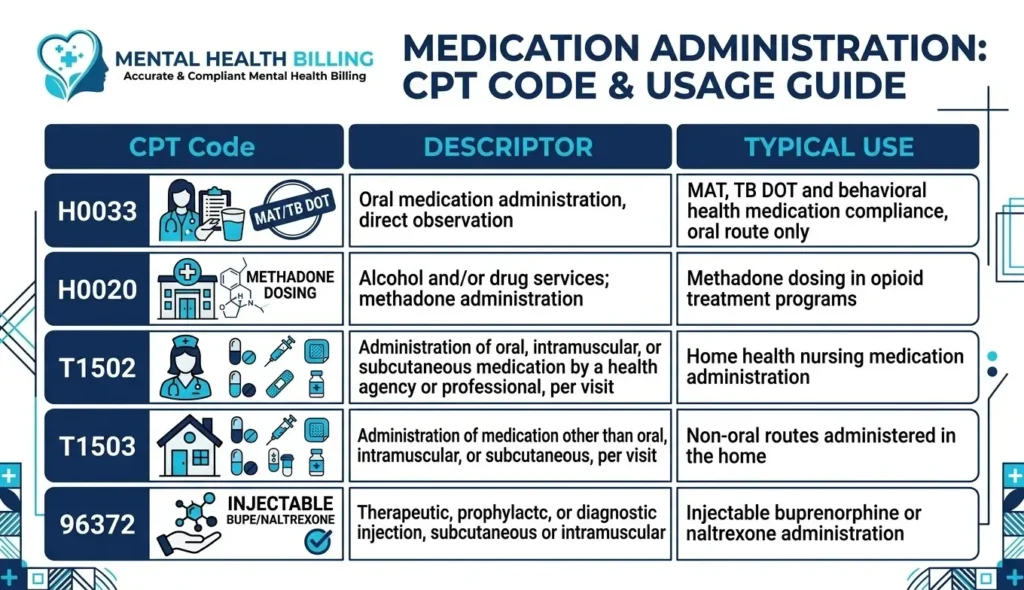
| Code | Descriptor | Typical use |
| H0033 | Oral medication administration, direct observation | MAT, TB DOT and behavioral health medication compliance, oral route only |
| H0020 | Alcohol and/or drug services; methadone administration | Methadone dosing in opioid treatment programs |
| T1502 | Administration of oral, intramuscular, or subcutaneous medication by a health care agency or professional, per visit | Home health nursing medication administration |
| T1503 | Administration of medication other than oral, intramuscular, or subcutaneous, per visit | Non-oral routes administered in the home |
| 96372 | Therapeutic, prophylactic, or diagnostic injection, subcutaneous or intramuscular | Injectable buprenorphine or naltrexone administration |