


G0444 CPT Code for Depression Screening: Rules, Time, and Documentation
Most Medicare Part B patients are eligible for one depression screening a year at no cost to them, and the G0444 CPT code for depression screening is how that service gets paid. The code looks simple on a claim form. In practice it generates a steady stream of denials, mostly over setting, frequency, and whether time has to be documented. Part of the trouble starts with the name itself. G0444 is routinely called a CPT code, but it is a HCPCS Level II code maintained by CMS, not a CPT code owned by the American Medical Association. This guide covers what the code pays for, who can bill it, the time rules, and the documentation that keeps a claim clean.
What the code covers, and what it leaves out
CMS created G0444 under National Coverage Determination 210.9, “Screening for Depression in Adults,” effective October 14, 2011, and the code first appeared in the January 2012 Medicare Physician Fee Schedule. It pays for one thing: administering a standardized, validated screening instrument, scoring it, and passing the result to the clinician who decides what happens next. The PHQ-9 and the shorter PHQ-2 are the instruments most practices use, though the coverage rule does not lock a practice into a specific tool.
The benefit stops at screening. NCD 210.9 states that coverage does not include treatment for depression or its complications, and it excludes pharmacotherapy, combined counseling and medication, self-help materials, telephone calls, and web-based counseling. If a visit turns into a diagnostic evaluation or the start of treatment, that work is billed under different codes, and the screening has to stand on its own as a separate, identifiable service.
The clinical case for screening is well established. The U.S. Preventive Services Task Force, in a recommendation finalized on June 20, 2023, advised screening for depression in all adults, including pregnant and postpartum patients and adults 65 and older, and assigned it a Grade B rating. NCD 210.9 itself notes that among people older than 65, one in six has depression, and that depression occurs in an estimated 25 percent of older adults who also live with illnesses such as cancer, arthritis, stroke, chronic lung disease, or cardiovascular disease.
Who can bill G0444, and where
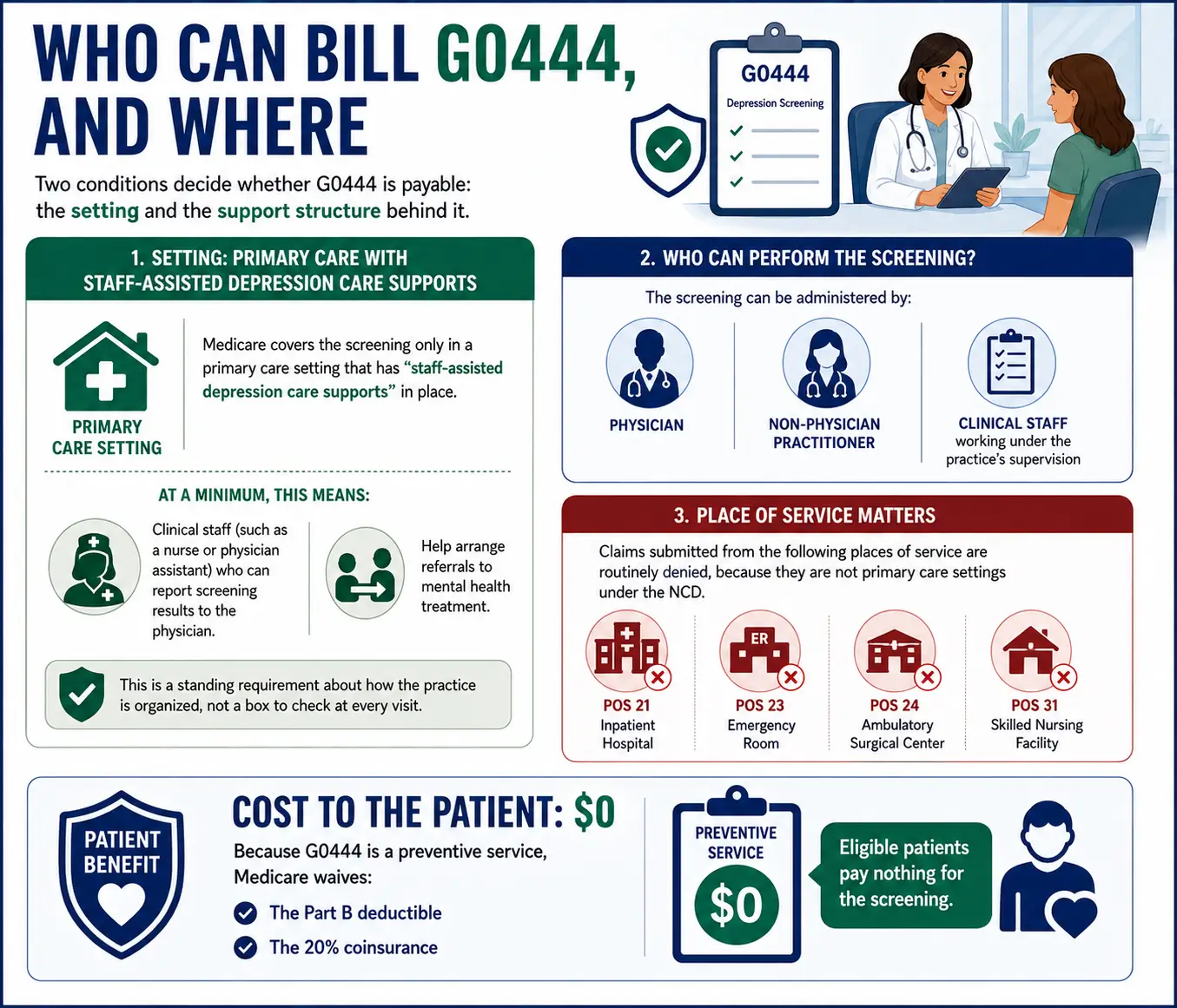
Two conditions decide whether G0444 is payable: the setting and the support structure behind it. Medicare covers the screening only in a primary care setting that has “staff-assisted depression care supports” in place. At a minimum, that means clinical staff (a nurse or physician assistant, for example) who can report screening results to the physician and help arrange referrals to mental health treatment. This is a standing requirement about how the practice is organized, not a box to check at every visit.
The screening can be administered by a physician, a non-physician practitioner, or clinical staff working under the practice’s supervision. Place of service matters as much as who performs it. Claims submitted from an inpatient hospital (POS 21), an emergency room (POS 23), an ambulatory surgical center (POS 24), or a skilled nursing facility (POS 31) are routinely denied, because those are not primary care settings under the NCD.
There is a benefit for patients worth stating plainly. Because G0444 is a preventive service, Medicare waives both the Part B deductible and the 20 percent coinsurance, so an eligible patient pays nothing for the screening.
The 15-minute question
No part of G0444 causes more confusion than time. The descriptor in NCD 210.9, Section B reads “up to 15 minutes.” For years, every CMS document matched that language. Then a January 2023 Medicare Learning Network education document described the code as “annual depression screening, 5 to 15 minutes,” and the shift to a range led many coders to assume a five-minute minimum had been added.
It had not. The American Medical Association addressed this directly, stating that CMS has no requirement to document the amount of time spent on the screening when billing G0444, and that the underlying CMS manual guidance was never rewritten to introduce a five-minute floor. The practical reading is simple. Document that a validated screening was completed, and record the result. Counting minutes is effort the payer does not ask for.
How often you can bill it
G0444 is a once-a-year benefit, and Medicare enforces the interval strictly. Only one screening is covered in a 12-month period, and 11 full months must pass after the month of the last screening before the next one is payable. A patient screened in January 2025 becomes eligible again in January 2026. Billing inside that window produces a frequency denial, so checking the patient’s claim history through the MAC portal before the visit is worth the minute it takes.
G0444 and the annual wellness visit
The relationship between G0444 and the Annual Wellness Visit trips up a lot of practices, and the answer depends on which wellness visit is on the claim. Depression screening is a built-in element of the initial Annual Wellness Visit (G0438), so G0444 is generally bundled into it and typically cannot be billed separately on the same date. The subsequent Annual Wellness Visit (G0439) works differently. It does not include depression screening as a required component, which means a PHQ-9 administered during a subsequent AWV can usually be reported on its own line with G0444. Knowing which AWV you are billing is the difference between separate payment and a bundling denial.
Documentation that holds up in an audit
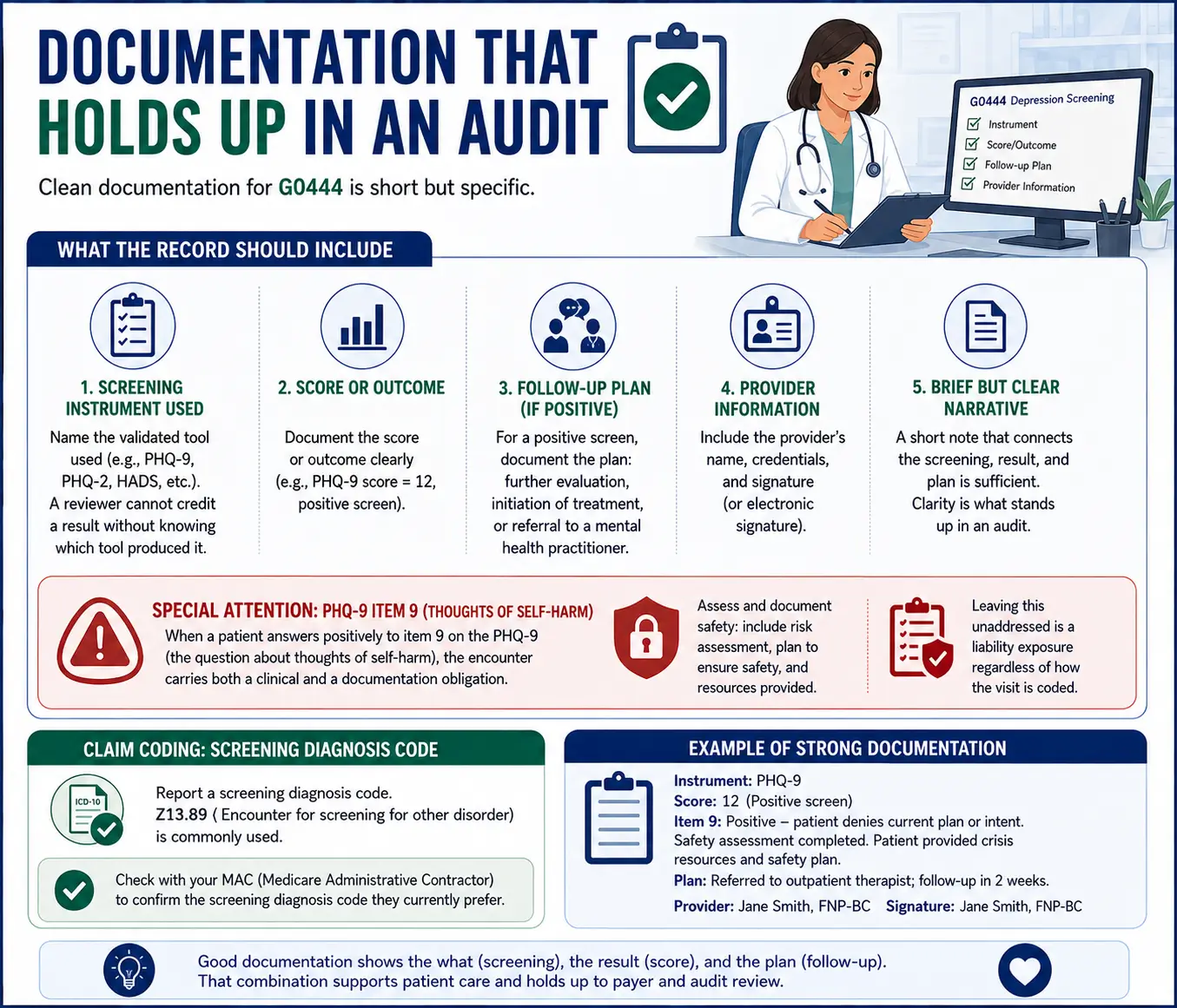
Clean documentation for G0444 is short but specific. The record should name the screening instrument used, because a reviewer cannot credit a result without knowing which validated tool produced it. It should show the score or outcome, and, for a positive screen, a follow-up plan: further evaluation, the start of treatment, or a referral to a mental health practitioner. The provider’s name, credentials, and signature belong in the note as well.
One item deserves extra attention. When a patient answers positively to item 9 on the PHQ-9 (the question about thoughts of self-harm), the encounter carries both a clinical and a documentation obligation to assess and record safety. Leaving that unaddressed is a liability exposure regardless of how the visit is coded. On the claim, practices report a screening diagnosis code (Z13.89, encounter for screening for other disorder, is commonly used), and it is worth confirming the screening code your MAC currently prefers.
G0444 compared with CPT 96127
Because both codes involve short standardized assessments, G0444 and CPT 96127 get mixed up. They serve different purposes.
Feature | G0444 | CPT 96127 |
Code type | HCPCS Level II (CMS) | CPT (AMA) |
Purpose | Annual Medicare depression screening (preventive) | Brief emotional or behavioral assessment |
Typical payer | Medicare Part B | Commercial and other payers |
Frequency | Once per 12 months | Per assessment, can be reported more than once |
Patient cost | Deductible and coinsurance waived | Standard cost sharing may apply |
For a Medicare patient’s yearly preventive screen, G0444 is the correct code. For brief behavioral assessments outside that preventive benefit, or for non-Medicare payers that accept it, 96127 is the one to use.
Payment is modest. Medicare’s national amount for G0444 sits around $18 for 2026 under the Physician Fee Schedule, with small variations by locality, so the code is less about revenue than about closing a required preventive care gap and supporting quality measures tied to depression screening.
Getting it right
The G0444 CPT code for depression screening rewards attention to a few specifics: a primary care setting with staff-assisted supports, one screening per 12-month period with 11 full months in between, a named validated tool with a documented result, and separate billing only alongside a subsequent Annual Wellness Visit rather than the initial one. Time is the smallest concern of all, since CMS does not require a minute count. Get the setting, frequency, and documentation right, and the denials mostly disappear.