


CPT Code 99211: Complete Description, Time Guidelines & Nurse Visit Info
CPT code 99211 applies to an established patient’s office or outpatient E/M service that may be provided without the direct, in-person involvement of a physician or other qualified healthcare professional. It is often called the nurse visit code. There is no minimum time requirement. The American Medical Association’s office E/M revisions, effective January 1, 2021, specifically exclude 99211 from time-based code selection.
That flexibility requires careful judgment. A nurse’s involvement, a scheduled appointment, or a recorded blood pressure does not automatically establish a billable visit. The record must support medically necessary evaluation and management, with the payer’s supervision and payment requirements satisfied.
What does CPT code 99211 cover?
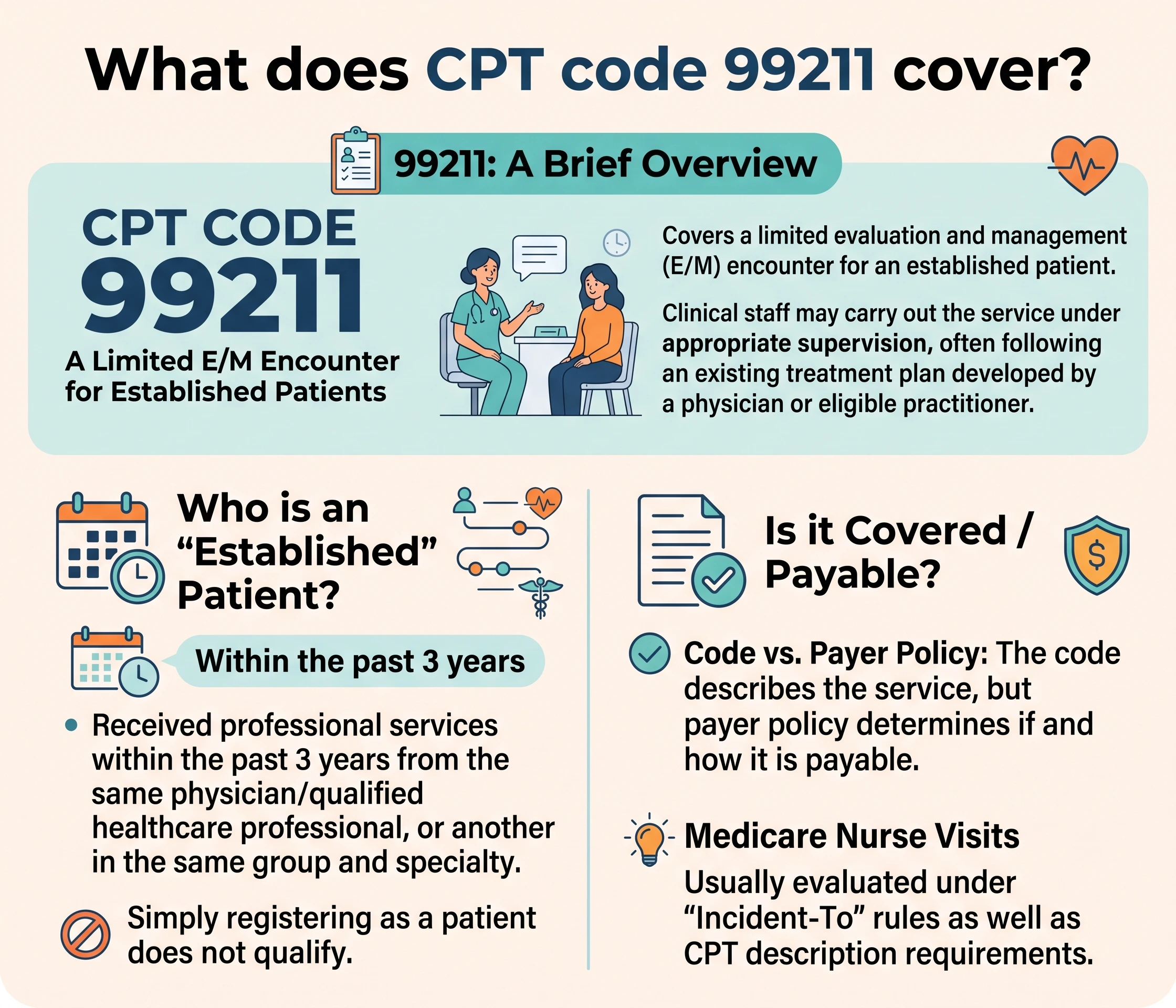
In plain language, 99211 covers a limited E/M encounter for an established patient. Clinical staff may carry out the service under appropriate supervision, often while following a treatment plan already developed by a physician or eligible practitioner.
In CPT coding, the term “established” has a specific definition. Generally, a patient qualifies as established if they have received professional services within the past three years from the same physician or qualified healthcare professional, or from another professional in the same group who shares the exact specialty and subspecialty. Simply registering as a patient does not meet this requirement.
The code describes the service, while payer policy determines whether and how it is payable. For Medicare nurse visits, that usually means evaluating the encounter under incident-to rules as well as the CPT description.
CPT code 99211 time guidelines
99211 is not a five-minute code.
Older references describe five minutes as the typical duration. The American College of Surgeons’ comparison of pre-2021 and 2021 office E/M rules shows that this time reference was removed. It does not create a current five-minute minimum or a five-to-nine-minute billing range.
Three practical consequences follow:
- A medically necessary encounter does not become ineligible solely because it lasts fewer than five minutes.
- A 15- or 20-minute visit with a nurse does not, by itself, justify billing CPT 99212 or 99213.
- Recording elapsed time cannot replace documentation of the evaluation and management performed.
Clinical staff time also cannot be added to a physician’s or qualified practitioner’s time to reach a higher office E/M threshold. The AMA’s 2021 guidance distinguishes personally performed practitioner work from activities normally performed by clinical staff.
Time can provide context about the services delivered during an encounter, but it is not the deciding factor when selecting CPT code 99211.
Who can perform a nurse visit?
Registered nurses, licensed practical nurses, and other appropriately qualified clinical staff may perform services that support 99211, subject to state scope-of-practice rules and payer requirements. Medicare recognizes nurses, technicians, and other auxiliary personnel within its incident-to framework.
A nurse practitioner is different from a staff nurse for E/M billing purposes. An eligible NP who personally evaluates and manages a patient may report the appropriate practitioner E/M service. The appointment should not be assigned 99211 merely because the clinician’s title includes “nurse.” Noridian’s E/M provider guidance distinguishes practitioner services from ancillary-staff services.
Medicare incident-to requirements and supervision
CMS’s Incident To Services & Supplies, updated April 30, 2026, requires an initial service personally performed by the physician or eligible practitioner, followed by continued active involvement in treatment. The auxiliary service must also meet requirements concerning practice expense, setting, applicable state law, and supervision.
For a typical medical nurse follow-up, verify that the visit implements the established treatment plan. An unrelated new complaint should prompt practitioner assessment and review of the appropriate billing pathway.
The supervising professional’s identity matters. CMS states that the professional supervising an incident-to service is the one who may bill it. Do not automatically select the clinician who originally wrote the order.
Does the physician have to be physically present?
The physician is not required to be physically present in the examination room.
CMS’s 2026 Medicare Physician Fee Schedule Final Rule fact sheet, published October 31, 2025, permanently permits real-time audio-video direct supervision for applicable incident-to services, excluding services with 10-day or 90-day global surgery indicators. Audio-only availability does not meet this virtual supervision standard.
Consequently, an older statement that every Medicare 99211 visit requires the supervising practitioner to be physically in the office suite is incomplete for 2026.
Virtual supervision and patient telehealth are separate questions. Permission to supervise staff remotely does not, by itself, authorize every remote patient encounter. Verify the patient service’s own coverage and billing requirements.
Documentation that supports 99211
A short note can support a legitimate service, but “nurse visit completed” explains very little.
The American Academy of Family Physicians’ FPM Editors, in Six keys to coding 99211 visits (August 20, 2018), identify the reason for the encounter, relevant assessment, plan, service date, staff identity, and supervising-physician interaction as useful documentation elements. Its older supervision guidance should be read alongside current rules.
A practical note should record:
- Why the patient needed assessment that day.
- The existing order or treatment plan being followed.
- Relevant symptoms, findings, medication concerns, and measurements.
- The assessment and management actually performed.
- Instructions, follow-up arrangements, and any escalation.
- Who performed the service and who supervised it.
Avoid copying a standard paragraph into every chart. If medication tolerance was not discussed, do not document that it was. Templates should prompt an accurate account of the encounter, including findings that required the clinician’s attention.
Examples of appropriate and inappropriate use
The following scenarios are hypothetical illustrations, not patient case reports.
Follow-up blood pressure assessment
A physician requests a nurse follow-up after changing hypertension treatment. The nurse checks blood pressure, reviews adherence and reported symptoms, communicates relevant findings, and provides instructions consistent with the treatment plan.
This may support 99211 when medical necessity, supervision, and documentation requirements are met. A walk-in reading recorded without assessment or management presents a different billing situation. Emily Hill, PA-C, discusses these distinctions in AAFP’s Understanding When to Use 99211 (June 2004); current supervision requirements still apply.
Anticoagulation follow-up
Noridian’s 99211 and Incident To, updated July 30, 2025, describes an encounter involving symptom review, observation for bruising, vital signs, a prothrombin-time result, and communication with the physician about medication and follow-up.
That example illustrates clinical evaluation surrounding a test. It does not make every INR collection a separate E/M visit. Review applicable anticoagulation-management codes and edits before submitting overlapping services.
Blood draw or prescription pickup
A patient arrives only for ordered venipuncture. Without a separate medically necessary E/M service, report the applicable collection service, such as 36415, rather than adding 99211.
Similarly, collecting a routine prescription does not establish an E/M encounter. Hill’s AAFP article specifically distinguishes these administrative or procedure-only visits from billable evaluation and management.
99211 versus 99212 and 99213
These codes differ in the work supporting them, not simply appointment length.
|
Requirement |
99211 |
99212 |
99213 |
|
Patient status |
Established |
Established |
Established |
|
Practitioner personally evaluates patient |
May not be required |
Required |
Required |
|
MDM level used for selection |
No specified MDM level |
Straightforward |
Low |
|
Minimum practitioner time if selecting by time |
Not applicable |
10 minutes |
20 minutes |
|
Nurse-only service supports this level |
May qualify |
No |
No |
The 2024 CPT revisions replaced office E/M time-range wording with minimum thresholds. Kent Moore, Emily Hill, and Erin Solis explain this change in AAFP’s January/February 2024 Medicare and CPT Update. Noridian’s E/M guidance confirms the distinction between practitioner and ancillary-staff services.
A physician visit lasting fewer than ten minutes may still support 99212 when its MDM requirements are met. Conversely, a lengthy nurse encounter cannot be upgraded merely by counting minutes.
Injections, same-day services, and modifier 25
Medicare’s 2026 NCCI Policy Manual, Chapter XI, revised January 1, 2026, states that drug and chemotherapy administration services include the work and practice expense associated with 99211. It prohibits separately reporting 99211 with the specified chemotherapy and non-chemotherapy drug/substance administration services.
Appending modifier 25 does not remove that restriction.
A higher-level office E/M service may be separately reportable with modifier 25 when a physician or eligible practitioner performs a significant, separately identifiable evaluation that meets the applicable requirements. The documentation must support that additional service.
Routine nursing intake before the physician’s visit also does not justify another 99211 charge. Vital signs and preparation that form part of the same E/M encounter should not be billed as a separate nurse visit.
Apply the code to the documented service
CPT code 99211 supports medically necessary established-patient E/M care without a minimum time threshold. Before releasing a claim, confirm the clinical purpose, actual assessment and management, supervision arrangement, and absence of prohibited overlapping charges. An appointment label alone cannot answer those questions; the encounter record must.