



CPT Code 96112: Complete Billing Guide (2026)
Picture a developmental-behavioral clinic that spends 105 minutes on a Bayley-4 evaluation, scores it over two days, writes a full report, and submits one line: 96112, one unit. It pays, so nobody looks twice, and the unbilled add-on time quietly adds up. Flip the error, a parent-completed screener billed as full testing, and you get denials, records requests and sometimes recoupment.
Developmental testing punishes mistakes in both directions. This guide follows 96112 from descriptor to clean claim, including time rules, documentation and what changes in 2026 and 2027.
Quick answer: CPT 96112 reports the first hour of standardized developmental testing by a physician or other qualified health care professional (QHP), including scoring, interpretation and a written report. It requires at least 31 minutes of documented time. CPT 96113 adds each additional 30 minutes, with the first unit starting around 77 total minutes. Brief scored screeners belong under CPT 96110.
What Is CPT Code 96112?
CPT 96112 is the developmental testing CPT code. A physician or QHP administers standardized developmental instruments, interprets the results and writes a report. The first hour can span fine and gross motor skills, language, cognitive level, social functioning, memory and executive function. It's the formal pediatric developmental assessment that follows a concerning screen.
96112 and its add-on, 96113, took effect January 1, 2019, replacing 96111, which capped reporting at one unit however long the evaluation ran.
Three ideas define the code:
- It's testing, not observation. Screening relies on an observer's report on a validated form; testing measures what the child can actually do on a standardized instrument.
- Interpretation and report are included, not extras.
- Name the instrument. The descriptor's "when performed" wording is looser than 96110's, but APA's 2026 guide expects a standardized developmental instrument in the battery (Bayley, Mullen, Battelle, or a scorable ADOS-2 workflow).
Who can report it: most often developmental-behavioral pediatricians, pediatric neurologists, psychiatrists and psychologists; speech-language pathologists and occupational therapists may qualify depending on state scope and payer credentialing. There's no technician-level developmental testing code (psychological testing has 96138/96139), so technician-administered sessions don't map cleanly onto 96112.
96112 CPT Code Time: The Rule Most Guides Get Wrong
Online explanations contradict each other: some say only face-to-face minutes count, some call 96113 "each additional hour," some say 15 extra minutes earns an add-on. None matches the code family's structure. 96112 attaches at 31 minutes; each 96113 unit covers 30 minutes, but the midpoint rule delays the first one well past the hour:
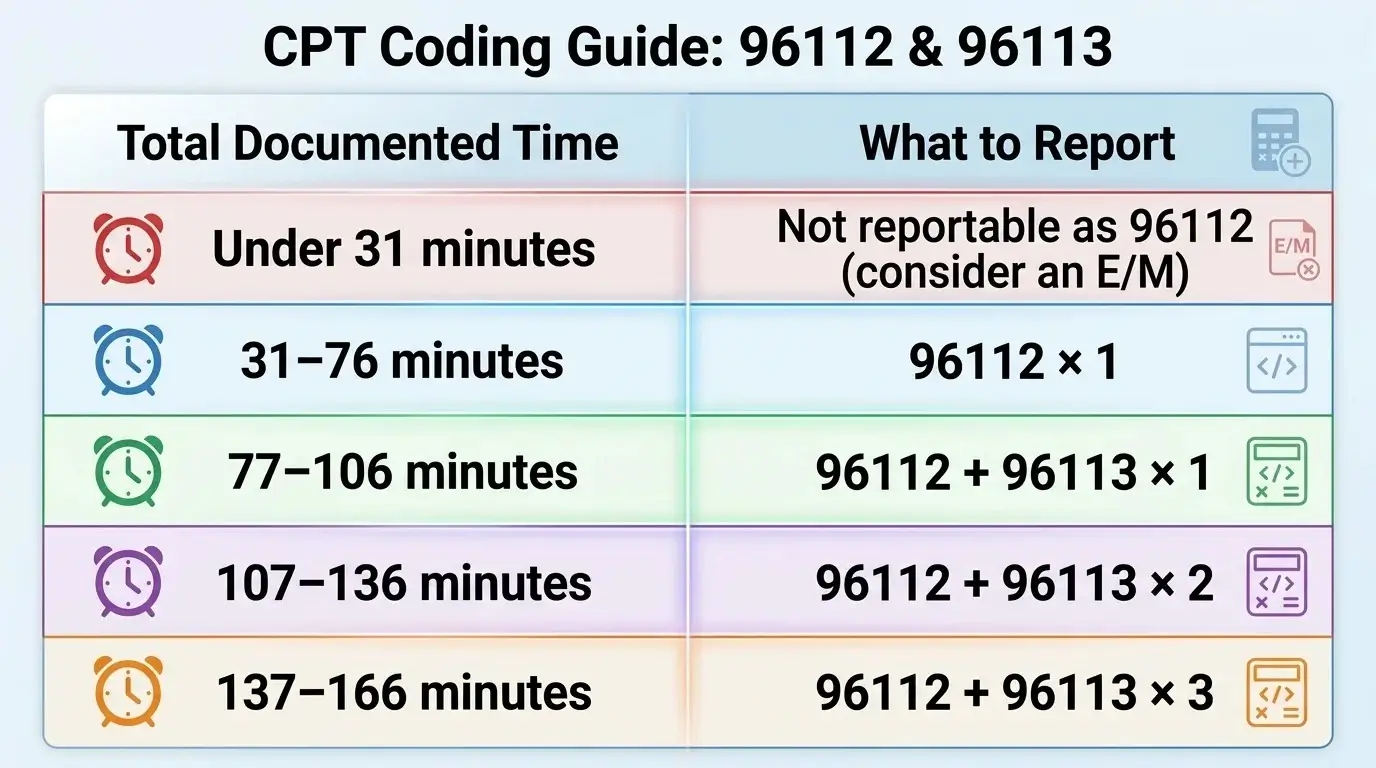
Some coders draw the first boundary a minute earlier; never bill at an edge without defensible start and stop times.
What counts? Review, scoring, interpretation and report writing count, even across multiple days. Some payers read time more narrowly, so log two numbers: minutes with the child and family, and minutes scoring, interpreting and writing.
How 96112 Billing Works
- Verify benefits and authorization first. Some payers restrict developmental testing, require prior authorization or cap 96113 units.
- Confirm provider enrollment. Behavioral health carve-outs can require separate credentialing, payer IDs and authorization contacts.
- Log time as it happens, with dates.
- Report what the minutes support: 96112 once, then 96113 units. 96113 never goes on a claim without 96112.
- Link a supporting diagnosis (see medical necessity).
- File on time. Commercial filing limits commonly run 90 to 180 days, and a report stuck in a queue eats that window. When work spans several dates, ask each payer which date of service it expects.
96112 has no new-versus-established split. Patient status matters in the E/M you pair with it (99202–99205, 99212–99215 or the preventive families) and in re-testing, where many payers limit frequency. Document what changed clinically.
Choosing the Correct Code
| Code | What it reports | Time basis | Watch-outs |
|---|---|---|---|
| 96110 | Scored developmental screening | Per instrument | ASQ-3, M-CHAT-R/F; two instruments = two units |
| 96112 | Standardized developmental testing, first hour | 31+ minutes | Name the instrument |
| 96113 | Add-on, each additional 30 minutes | Midpoint rule | Never alone; first unit ~77 minutes |
| 96127 | Brief emotional/behavioral assessment | Per instrument | Not alongside 96112/96113 in AAP-aligned guidance |
| 96116 / 96121 | Neurobehavioral status exam | Time-based | Work not built on a scorable standardized instrument |
| 96130–96139 | Psychological/neuropsychological testing | Time-based | Evaluation and administration codes both required |
Screening vs. testing. Under Bright Futures, general developmental screening happens at 9, 18 and 30 months and autism screening at 18 and 24 months. Billing 96112 for a parent questionnaire is overcoding; billing 96110 for a full battery leaves money uncollected.
Developmental vs. psychological testing. The referral question decides. APA's 2026 guide points to 96112/96113 for skill acquisition or failure to reach expected skills. Guidance isn't perfectly aligned on edge cases: pediatric DBP guidance leans toward psychological or neuropsychological codes when skills are lost after an event such as brain injury. In that gray zone, check payer policy and document why you chose the family.
Documentation Requirements
Auditors tend to start with the time record, then the instrument, then the report. Build templates in that order.
- Referral and history: who referred, the concern, prior screening results
- Instruments: names, versions, domains assessed
- Time: start/stop for direct testing; dated minutes for scoring, interpretation and report
- Results and report: scores, norm comparisons, clinical impression, and a signed, dated report with recommendations
- Family feedback and modality: discussion with the caregiver; in person or telehealth
Medical Necessity
Payers want a story: concern, screen, abnormal or inconclusive result, testing, diagnosis, plan. Testing done mainly for academic placement is often treated as educational, not medical. Developmental delay billing works best with diagnoses that match the documented concern:
- R62.0 delayed milestone
- F80.x language disorders · F82 motor disorder · F84.0 autistic disorder
- F88 other disorders of psychological development, including global developmental delay
Keep Z13.4 screening-encounter codes on screening claims. Coverage by diagnosis varies by payer and state.
Modifier Usage
| Modifier | Where | When | Caution |
|---|---|---|---|
| 25 | E/M code | Separately identifiable same-day E/M | Never on the testing code |
| 59 / XE, XS, XP, XU | 96112 | Distinct service, or payer prefers it to 25 | Last resort; document why |
| 95 or GT | Telehealth lines | Synchronous audio-video, per payer | Check POS 02/10 rules |
AAP guidance puts 25 on the E/M, or 59 on the testing code, to show the testing was separate. NCCI treats 59 as a last resort, and testing time shouldn't count toward the E/M level.
Telehealth. CPT's 2026 manual lists 96112/96113 among codes deliverable by real-time audio-video telemedicine, but not audio-only. Payer policy still governs, and instrument publishers may restrict remote administration.
Coding Examples and Practice Scenarios
Illustrative examples; verify against payer policy.
1. Toddler language delay. Bayley-4 for 60 minutes plus 45 minutes of scoring and report over two days: 105 total. Report 96112 + 96113 × 1; diagnosis R62.0 while unclear, or a specific F80 code once established.
2. Autism evaluation with a same-day visit. New school-age patient, 75 minutes of testing plus 50 for scoring and report: 125 total. Report 99204-25 + 96112 + 96113 × 2, diagnosis F84.0. Set the E/M level by medical decision making so testing minutes never need carving out; some payers prefer 59 on 96112.
3. Eighteen-month well visit. ASQ-3 and M-CHAT-R/F: 99392-25 + 96110 × 2; diagnoses Z00.129, Z13.42, Z13.41. Two units or two lines; 59 may be required.
4. The overlap denial. A clinic bills 96112 + 96113 × 2 for 125 minutes plus 96136 for 30 minutes of the same testing; the payer denies the developmental lines as included in another service (CO-97). Choose the family that matches the referral question. If two distinct batteries were truly given, document them separately and get payer guidance before appealing.
Integrated settings raise this risk: a child may see a psychiatrist Monday, a therapist Wednesday and a psychologist for testing Friday. Clinics mixing these services need billing teams comfortable with inpatient and outpatient mental health billing, so each service's time and documentation stay separate.
Common Billing Mistakes and Denials
| Mistake | Likely outcome | Fix |
|---|---|---|
| Screener billed as testing | Downcoding, recoupment | Use 96110 per instrument |
| One unit on every long evaluation | Lost revenue | Build the time table into charge entry |
| 96113 without 96112, or on a separate claim | Rejection | Same claim, provider and date |
| 96110/96127 alongside testing | CO-97 (included in another service) | One family; check edits |
| Modifier 25 on 96110 | CO-4 (modifier error) | Put 25 on the E/M |
| Instrument not named | CO-16 / CO-50 (missing information, necessity) | Name tool, version, scores |
| Provider not enrolled, no authorization, or units over cap | Credentialing denial, CO-197, CO-151 | Verify before scheduling |
Nearly all of this is preventable up front, which is where structured revenue cycle management support earns its keep. Some payers also bundle 96110 into the preventive visit, though AAP guidance supports separate reporting.
Medicare Billing Considerations
Medicare beneficiaries are mostly older adults and people with disabilities, so pediatric testing rarely reaches a Medicare claim, and 96110 generally isn't covered stand-alone. Its fee schedule still anchors many other contracts.
96112 CPT Code Reimbursement: What to Expect in 2026
96112 carries a work RVU of 2.56 and 96113 a work RVU of 1.16. ASHA's 2025 table lists national non-facility payment near $127 for 96112 and $53 for 96113, and its analysis of the 2026 final rule shows 96112 down about 1% (conversion factor $33.4009). That puts the 2026 national non-facility figure near $126 before locality adjustment. Treat it as a planning estimate; confirm your locality in the CMS lookup tool.
Commercial Insurance and Medicaid Considerations
| Factor | Medicare | Medicaid / EPSDT | Commercial |
|---|---|---|---|
| Rules | RVU-based; screening generally not covered | State rules, unit caps, authorization | Covered with authorization to restricted |
| Watch for | NCCI edits, enrollment category | Unit and provider-type limits | Developmental-delay exclusions, carve-outs |
EPSDT obliges state programs to cover medically necessary diagnostic and treatment services for under-21 beneficiaries, which is why Medicaid carries so much developmental testing volume. State rules vary; New York's clinic guidance at the 2019 launch capped 96113 at one unit, so check caps before scheduling long batteries.
Commercial policy varies more: one psychology practice's billing guide reports that commercial plans in its market generally don't pay for 96112/96113 while state Medicaid usually does. Read each plan's developmental-delay language before promising coverage.
Coding Tips and Compliance Checklist
Tip: audit paid versus contracted rates each January, and review denials by code pair to spot template or provider patterns.
- Standardized instrument named; referral reason documented
- Time record supports the units billed
- Signed, dated report in the chart
- Rendering provider enrolled and within scope
- Authorization on file where required
- No screening code or second testing family for the same work
- Modifiers checked against payer policy and current NCCI edits
How Professional Billing Support Helps
Good billing support works earlier in the cycle: eligibility verification and prior authorization before the visit, credentialing checks before the date of service, unit calculations from time logs, edit scrubbing before submission, then denial management, AR follow-up and payment posting.
Ask any prospective partner how it calculates 96113 units from time records, handles NCCI edits and same-day E/M pairings, and works with your payers' developmental testing policies.
Mental Health Billing provides mental health billing services for small practices and large behavioral health organizations, focused on accurate coding, faster reimbursement and fewer denials. If your clinic runs testing alongside psychiatric evaluations and therapy, confirm how any billing team handles time-based testing codes before you sign.
Future Billing Updates for 2026 and 2027
CPT 2026. The set carried 418 editorial changes (288 new codes, 84 deletions, 46 revisions), centered on remote monitoring, hearing devices, AI-enabled services and leg revascularization. As far as public summaries show, none touches the 96110–96113 descriptors; the relevant change is the audio-video telehealth listing for 96112/96113.
CPT 2027. Released September 9, 2026 and effective January 1: 453 editorial changes (299 new codes, 74 revisions, 80 deletions). Public summaries don't flag a rewrite of 96112/96113, so confirm against the code change file. Autism-related clinics face the bigger shift: six new adaptive behavior codes, revisions to 97151–97158 and deletion of the temporary T codes. Update your charge master and templates before January.
Key Takeaways
- 96112 covers the first hour and is reportable at 31 documented minutes; interpretation and report time count.
- 96113 begins around 77 total minutes and never travels without 96112.
- 96110 is for scored screeners; 96112 is formal testing.
- Modifier 25 goes on the E/M; 59 is a documented last resort.
- With Medicaid and commercial payers, verify authorization, unit caps and provider eligibility first.
Frequently Asked Questions
What are the billing guidelines for CPT code 96112?
Report it once for the first hour when a physician or QHP administers standardized instruments and documents at least 31 minutes, including interpretation and report. Name the instruments, keep a signed report, link a supporting diagnosis, and add 96113 as time allows.
Can 96112 and 96113 be billed together?
Yes, and they must be. 96113 is an add-on and can't be billed without 96112 on the same claim.
What is the CPT code 96113?
The add-on for each additional 30 minutes of developmental testing, starting around 77 total minutes.
What are the billing guidelines for CPT code 96110?
Report it per standardized instrument, with scoring and documentation. Two instruments mean two units or lines, and modifier 59 may be required. With a same-day visit, modifier 25 goes on the E/M. Payers often set age and frequency limits.
Which CPT codes are bundled?
It depends on current NCCI edits and payer policy. Pediatric DBP guidance says 96110 and 96127 can't accompany 96112/96113, and 96116/96121 or 96130–96139 shouldn't overlap the same battery. Indicator 0 edits can't be bypassed; indicator 1 edits can, with supporting documentation.
What are the new CPT codes in 2026?
288 new codes, mostly outside developmental testing. The relevant change is the audio-video telehealth listing for 96112/96113.
How many minutes do I need to bill 96112?
At least 31 documented minutes.
Does Medicare cover 96112?
Yes, under the fee schedule, though it rarely applies to children; see the 2026 estimate above.
Can 96112 be delivered by telehealth?
CPT recognizes audio-video delivery, not audio-only; payers set their own policies, and some instruments aren't validated for remote use.
Can I bill 96112 with an E/M on the same day?
Yes, when the E/M is separately identifiable: modifier 25 on the E/M or 59 on 96112 per payer, with testing time excluded from the E/M level.
Conclusion
96112 rewards clinics that treat time, instruments and reports as billing data. Get the unit table right, keep screening and testing apart, and check payer rules before scheduling, and most denials never happen. If your team is stretched, a specialist mental health billing partner can keep verification and follow-up consistent.