



Best EHR for Billing and Insurance Claims in Mental Health (2026 Guide)
Behavioral health practices lose more revenue to claim denials than almost any other specialty. Billing-industry analyses published in 2025 and 2026 put mental health denial rates between 15 and 25 percent, roughly double the single-digit-to-low-double-digit range typical of general medical and surgical claims. The software you use to build, submit, and reconcile those claims decides how much of that gap you can close. This guide compares the best EHR options for billing and insurance claims in mental health as they stand in 2026, with current pricing, clearinghouse details, and the features that separate a system that gets you paid from one that only stores notes.
Why mental health billing is harder than general medical billing
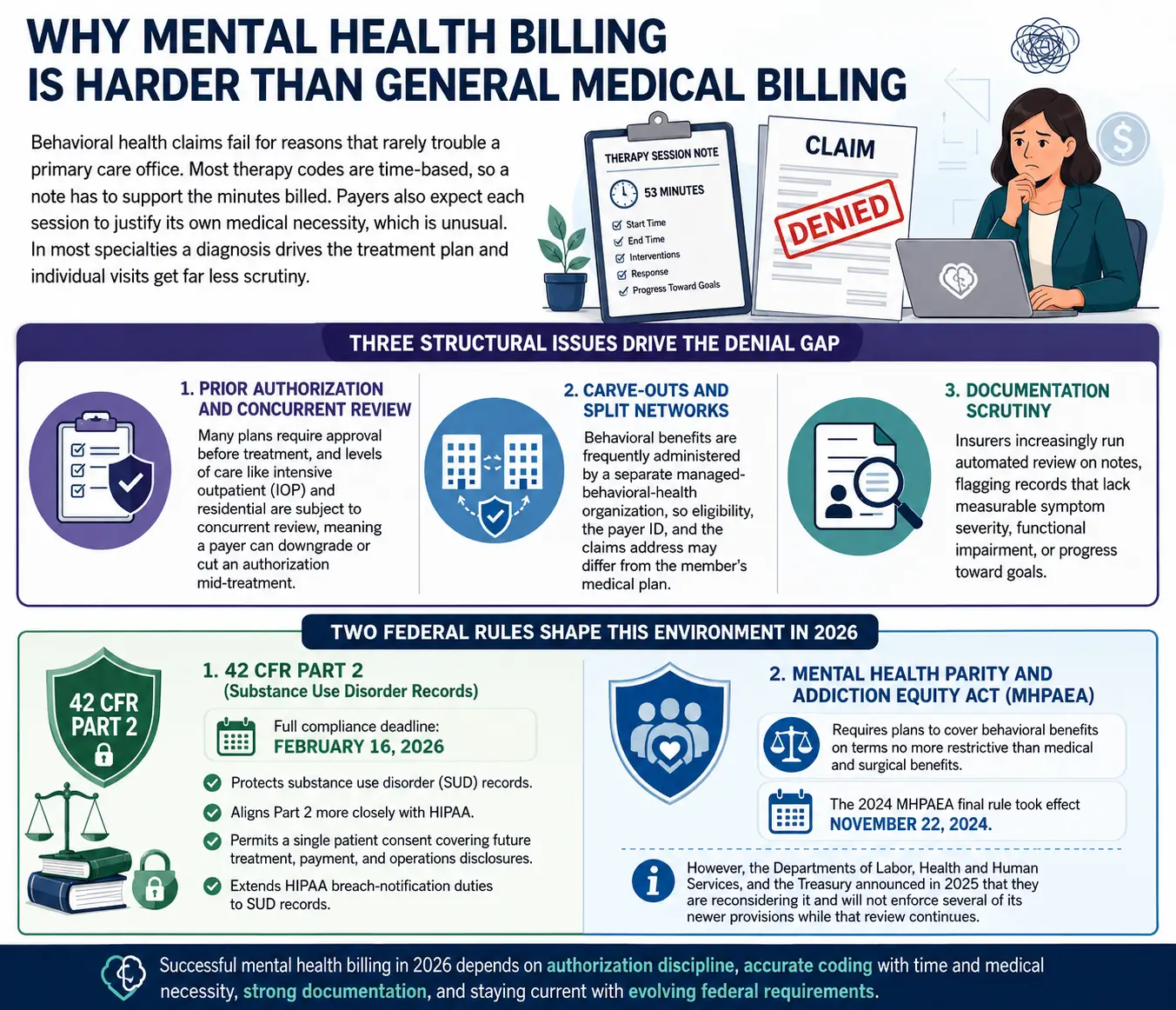
Behavioral health claims fail for reasons that rarely trouble a primary care office. Most therapy codes are time-based, so a note has to support the minutes billed. Payers also expect each session to justify its own medical necessity, which is unusual. In most specialties a diagnosis drives the treatment plan and individual visits get far less scrutiny.
Three structural issues drive the denial gap:
- Prior authorization and concurrent review. Many plans require approval before treatment, and levels of care like intensive outpatient (IOP) and residential are subject to concurrent review, meaning a payer can downgrade or cut an authorization mid-treatment.
- Carve-outs and split networks. Behavioral benefits are frequently administered by a separate managed-behavioral-health organization, so eligibility, the payer ID, and the claims address may differ from the member’s medical plan.
- Documentation scrutiny. Insurers increasingly run automated review on notes, flagging records that lack measurable symptom severity, functional impairment, or progress toward goals.
Two federal rules shape this environment in 2026. The updated 42 CFR Part 2, which protects substance use disorder records, carried a full compliance deadline of February 16, 2026, according to the U.S. Department of Health and Human Services. It aligns Part 2 more closely with HIPAA, permits a single patient consent covering future treatment, payment, and operations disclosures, and extends HIPAA breach-notification duties to SUD records. Separately, the Mental Health Parity and Addiction Equity Act requires plans to cover behavioral benefits on terms no more restrictive than medical and surgical benefits. The 2024 MHPAEA final rule took effect November 22, 2024, though the Departments of Labor, Health and Human Services, and the Treasury announced in 2025 that they are reconsidering it and will not enforce several of its newer provisions while that review continues.
What to look for in an EHR for billing and insurance claims
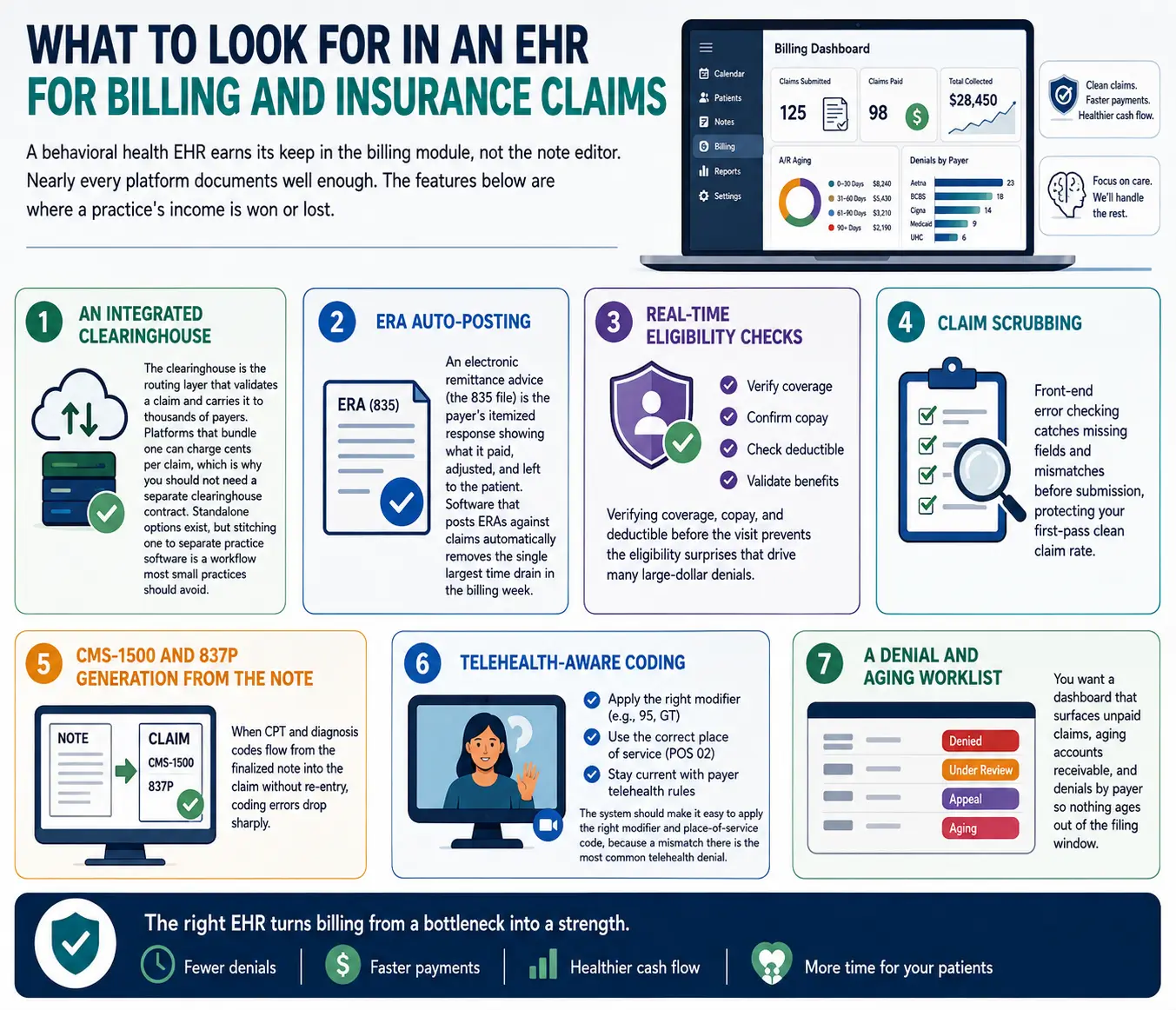
A behavioral health EHR earns its keep in the billing module, not the note editor. Nearly every platform documents well enough. The features below are where a practice’s income is won or lost.
- An integrated clearinghouse. The clearinghouse is the routing layer that validates a claim and carries it to thousands of payers. Platforms that bundle one can charge cents per claim, which is why you should not need a separate clearinghouse contract. Standalone options exist, but stitching one to separate practice software is a workflow most small practices should avoid.
- ERA auto-posting. An electronic remittance advice (the 835 file) is the payer’s itemized response showing what it paid, adjusted, and left to the patient. Software that posts ERAs against claims automatically removes the single largest time drain in the billing week.
- Real-time eligibility checks. Verifying coverage, copay, and deductible before the visit prevents the eligibility surprises that drive many large-dollar denials.
- Claim scrubbing. Front-end error checking catches missing fields and mismatches before submission, protecting your first-pass clean claim rate.
- CMS-1500 and 837P generation from the note. When CPT and diagnosis codes flow from the finalized note into the claim without re-entry, coding errors drop sharply.
- Telehealth-aware coding. The system should make it easy to apply the right modifier and place-of-service code, because a mismatch there is the most common telehealth denial.
- A denial and aging worklist. You want a dashboard that surfaces unpaid claims, aging accounts receivable, and denials by payer so nothing ages out of the filing window.
Best EHR for billing and insurance claims in mental health: platform comparison
The table below compares the platforms most widely used for behavioral health billing in 2026. Prices are monthly and reflect vendor pages and current published rates verified in mid-2026; most vendors discount annual plans, and per-claim fees apply on top of subscription cost.
Platform | Starting price | Per-claim fee | Clearinghouse | Managed billing service | Best fit |
TherapyNotes | $69 / solo | $0.14 | Waystar (built in) | No (self-service) | Insurance-heavy solo and small practices |
SimplePractice | $49 (Starter) | $0.25 | Multiple (Waystar, Availity) | No | Mixed self-pay and insurance solos |
Valant | Custom (roughly $100–$300 per provider) | Integrated | Integrated | Optional RCM team | Psychiatry, group, and TMS practices |
Ensora Health (formerly TheraNest) | $29 | Capped by tier | Integrated | No | Budget-conscious small practices |
Tebra (formerly Kareo) | Custom | Integrated | Large network | Optional | Multi-specialty and behavioral mix |
TherapyNotes
TherapyNotes is built around a note-to-claim pipeline that suits clinicians handling their own insurance. Pricing starts at $69 per month for a solo therapist, and electronic claims run $0.14 each through the built-in Waystar clearinghouse. After a scheduled appointment and a completed note, the platform’s to-do list prompts you to submit the electronic claim or generate the CMS-1500, and it automatically produces those forms. Real-time eligibility checks, claim scrubbing, and assisted ERA posting are included, and integrated card processing runs 3.1 percent plus 30 cents per transaction. Reviewers consistently rate its phone billing support highly, which matters when a denied claim needs a human. The trade-off: TherapyNotes does not offer a fully managed billing service, and its denial-management and reporting depth is lighter than billing-first platforms. One preventable pitfall specific to the system is a mismatch between the taxonomy on your NPI record at NPPES and the code submitted, a frequent cause of denials.
SimplePractice
SimplePractice has the largest user base in the category and leans toward the client experience, scheduling, and intake alongside billing. Its 2026 solo plans are Starter at $49, Essential at $79, and Plus at $99 per month, with electronic claims at $0.25 each. Billing integrates with documentation so CPT and diagnosis codes flow from the note into an 837P claim, and the platform runs eligibility checks, auto-posts 835 ERAs from enrolled payers, and tracks claim status. It routes claims through multiple clearinghouses, including Waystar and Availity, to reach as many payers as possible. Direct Medicare Part B billing requires a separate EDI enrollment. Practices that live in the billing module sometimes find the workflow slightly less direct than a billing-first tool, since claims are one layer inside a broader client-facing product.
Valant
Valant is a behavioral-health-only EHR built for psychiatry, group therapy, and higher-acuity workflows. Third-party listings estimate pricing at roughly $100 to $300 per provider per month, with implementation and data-migration costs quoted separately; Valant itself uses custom, tiered quotes. The practice-management side includes an integrated clearinghouse, eligibility checking, a claim-assist feature, fee-schedule rules that adjust rates by payer, and aging and payment reports. Practices can run billing in-house or hand it to Valant’s revenue cycle management team, which works inside the same EHR. It fits multi-provider groups and prescriber-heavy practices better than solo cash-pay therapists. User reviews are mixed on billing depth and occasional downtime, so a demo focused on your payer mix is worth the time.
Ensora Health (formerly TheraNest)
Ensora rebranded from TheraNest and now publishes clearer per-therapist pricing across three tiers: Essentials at $29, Advanced at $59, and Premier at $89 per month, each including unlimited clients. Insurance billing scales by tier. The Advanced plan includes 30 monthly insurance claims, and Premier adds unlimited claims and reminders. That structure makes Ensora one of the lower-cost entries for a small practice, though a high-volume insurance biller will move past the mid-tier claim cap quickly and should price the top plan.
Others worth knowing
Tebra (the merger of Kareo and PatientPop) offers behavioral-health-tuned billing workflows and a large clearinghouse network, and it suits practices that mix behavioral and general medical billing. ICANotes pairs structured behavioral-health documentation with electronic claims, ERA management, and patient billing, plus optional revenue cycle services for organizations that would rather outsource. PracticeEHR publishes a bundled plan at $229 per provider per month that folds telehealth, e-prescribing, and billing into one price, which can beat platforms that sell those as add-ons once you total the extras.
The 2026 rules your EHR needs to keep up with
Software only helps if it is configured to current coding rules. Three areas change most often.
Psychotherapy codes and time. The most-billed codes remain 90791 (psychiatric diagnostic evaluation), 90832, 90834, and 90837 for individual therapy by length, 90846 and 90847 for family therapy, and 90853 for group therapy billed per patient. Session length governs the individual codes: 90832 covers roughly 16 to 37 minutes, 90834 covers 38 to 52, and 90837 requires 53 minutes or more. Routinely billing 90837 without notes that support the time is a documented audit flag.
Telehealth modifiers and place of service. For telehealth, the CPT code does not change. What tells the payer it was virtual is the modifier and the place-of-service code. Most payers, including Medicare, use modifier 95 for synchronous video and modifier 93 for audio-only, while some state Medicaid programs still expect the older GT modifier. Place of service matters to your bottom line: POS 10 signals the patient was at home and pays the higher non-facility rate, while POS 02 (patient at another location) pays the facility rate. For 90837 the gap is about $40 per session under 2026 Medicare rates. A practice running 20 home-based telehealth sessions a week loses several hundred dollars weekly by defaulting to POS 02. Forgetting modifier 95 on a telehealth claim, or pairing a telehealth POS with an in-person modifier, remains a routine denial trigger.
Records confidentiality. If your practice touches substance use disorder treatment, your EHR must support the updated 42 CFR Part 2 consent model and data segmentation described above. Systems that let you capture a single, revocable consent and track redisclosures cut compliance risk that now carries HIPAA-level breach penalties.
How to reduce denials whatever EHR you choose
The cheapest denial is the one that never happens. Software features help, but configuration and habits decide the outcome. A short setup and workflow checklist prevents most preventable losses:
- Match your NPI taxonomy to the codes you bill. A mismatch between the taxonomy on your NPPES record and the CPT code submitted is one of the most common and most avoidable denials.
- Enroll in ERA and EFT for every payer. Electronic remittance and direct deposit enrollment typically takes several business days to a couple of weeks per payer. Practices still posting paper explanations of benefits by hand lose hours each week and introduce transcription errors.
- Keep fee schedules current. Payers update contracted rates, and your EHR will not refresh them for you. A stale schedule quietly underbills or misposts.
- Finalize the note before the claim. Some systems will let a claim go out on an unsigned note, which is an audit exposure. Lock documentation first.
- Verify eligibility before the visit, not after. Lapsed coverage, out-of-network status, and provider-type exclusions produce the largest-dollar denials, and all three are visible on an eligibility check.
- Appeal, and appeal fast. Many behavioral health practices formally appeal only about half their denials, letting the rest age out of the filing window into permanent write-offs. Categorize each denial within a day and build the appeal workflow into someone’s routine.
The strongest EHR choice depends on how you get paid. A solo clinician billing insurance directly is well served by TherapyNotes at $69 a month with $0.14 claims and automatic ERA posting. A therapist balancing self-pay and insurance may prefer SimplePractice for its client-facing tools, accepting the $0.25 claim fee. A psychiatry group or an agency running IOP and concurrent review will get more from Valant’s integrated clearinghouse and optional billing team, and a cost-sensitive small practice can start on Ensora at $29. Whichever you pick, the platform is only as good as its configuration: current codes, correct modifiers and place of service, matched NPI taxonomy, enrolled ERAs, and a denial worklist that no claim ages out of.