


A psychotherapy claim to Aetna can carry the right CPT code and still come back unpaid. The cause is usually administrative. An authorization was missing for a service that needed one, the telehealth modifier didn't match the member's plan, the claim landed after the filing window closed, or the progress note didn't support the minutes billed. This guide covers the Aetna mental health billing guidelines that trip up therapists, psychiatric prescribers, and the billing staff who support them, drawing on Aetna's own published policies wherever they exist.
One caution first. Aetna, a CVS Health company, does not operate under a single rulebook. Its fully insured commercial plans, the self-funded employer plans it administers, Aetna Medicare Advantage, and the state-run Aetna Better Health Medicaid plans can each set different authorization lists, filing limits, and telehealth rules. Confirm the member's product line before you code anything.
The core CPT codes for Aetna behavioral health claims
Aetna uses standard AMA CPT definitions for outpatient mental health services. The codes below account for the bulk of claims from a typical outpatient practice.
| Service | CPT code(s) | Billing note |
|---|---|---|
| Psychiatric diagnostic evaluation | 90791, 90792 | 90792 includes medical services, so it is limited to prescribers |
| Individual psychotherapy | 90832, 90834, 90837 | Selected by face-to-face time |
| Psychotherapy with an E/M visit | +90833, +90836, +90838 | Add-on codes; always paired with an E/M code |
| Psychotherapy for crisis | 90839, +90840 | 90839 covers the first 30 to 74 minutes |
| Family psychotherapy | 90846, 90847 | 90846 without the patient present, 90847 with |
| Group psychotherapy | 90853 | Billed per patient in the group |
| Interactive complexity | +90785 | Add-on for sessions complicated by communication barriers |
| Psychological testing evaluation | 96130, +96131 | Per hour of evaluation services |
| Test administration and scoring | 96136 to 96139 | Split by who administers the test |
Matching psychotherapy time to the right code
Time drives code selection. Under CMS billing article A57520, which most commercial payers mirror, 90832 and 90833 cover 16 to 37 minutes, 90834 and 90836 cover 38 to 52 minutes, and 90837 and 90838 apply at 53 minutes or more. Sessions under 16 minutes are not reportable as psychotherapy at all.
Write start and stop times in the note. A 50-minute session documented only as "session completed" gives an auditor nothing to verify, and 90837 is the code payers review most often because it pays the most.
That payment gap is shrinking for some clinicians. In a June 4, 2026 letter to Aetna president Steve Nelson, the American Psychiatric Association and American Psychological Association Services, Inc. objected to reported changes for clinicians contracted through the Alma platform: 90837 paid at the 90834 rate, 99215 paid at the 99214 rate, and no pay difference between master's-level clinicians and psychologists or between nurse practitioners and psychiatrists. Aetna told Becker's Payer Issues on June 10, 2026 that its rate policies are based on level of care and outcomes, not on how providers connect with members. Reimbursement aside, the coding rule does not change. Bill the code the documented time supports.
Psychotherapy billed with an E/M service
Psychiatrists, psychiatric nurse practitioners, and physician assistants often provide medication management and therapy in one visit. The E/M code is primary, and the psychotherapy add-on is chosen by psychotherapy minutes alone. The American Academy of Family Physicians has noted that CMS listed blended time (one total for both services) as a common billing error.
Consider a 30-minute visit billed as 99214 plus +90833. If 22 of those minutes went to psychotherapy, only eight remain for a moderate-complexity medication visit. Unless medical decision-making clearly supports the 99214, a reviewer will question one of the two codes.
Interactive complexity (+90785) fits sessions where a third party, such as a parent in conflict or an interpreter, changes how care is delivered. CPT bars it with crisis codes 90839 and 90840, and it cannot ride on an E/M code alone.
When Aetna requires precertification for mental health services
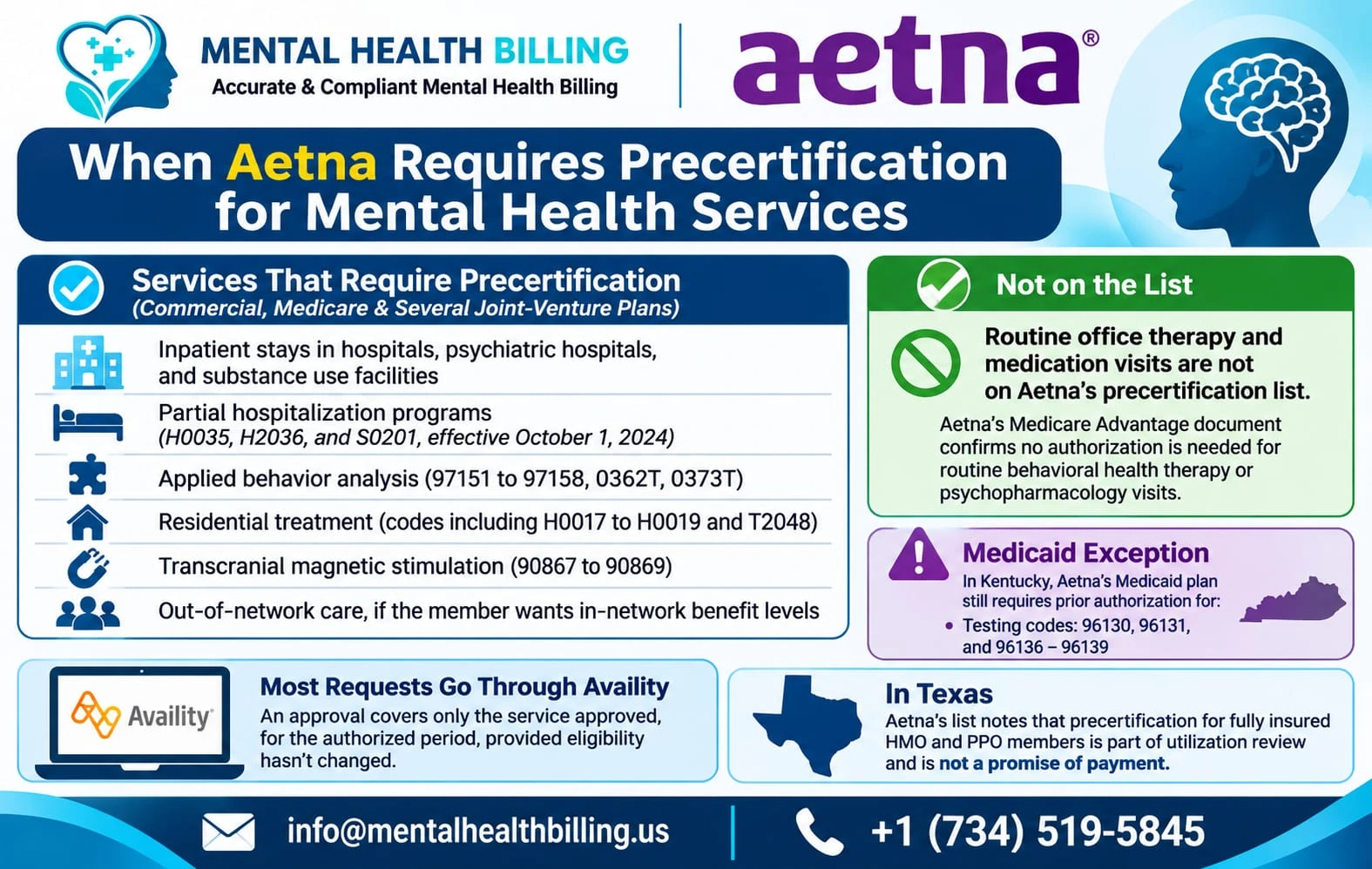
Aetna's participating-provider behavioral health precertification list, effective August 1, 2024, names these services for its commercial, Medicare, and several joint-venture plans:
- Inpatient stays in hospitals, psychiatric hospitals, and substance use facilities
- Partial hospitalization programs (H0035, H2036, and S0201, the last effective October 1, 2024)
- Applied behavior analysis (97151 to 97158, 0362T, 0373T)
- Residential treatment (codes including H0017 to H0019 and T2048)
- Transcranial magnetic stimulation (90867 to 90869)
- Out-of-network care, if the member wants in-network benefit levels
Routine office therapy and medication visits are not on that list. Aetna's Medicare Advantage precertification document states plainly that it does not require authorization for routine behavioral health therapy or psychopharmacology visits. Psychological and neuropsychological testing came off the commercial list in January 2019, according to an Aetna precertification list from that year.
Medicaid is the exception to watch. Kentucky's August 2025 comparison of managed care plans shows Aetna's Medicaid plan still requires prior authorization for testing codes 96130, 96131, and 96136 to 96139.
Most requests go through the Availity portal. An approval covers only the service approved, for the authorized period, provided eligibility hasn't changed. In Texas, Aetna's list notes that precertification for fully insured HMO and PPO members is part of utilization review and is not a promise of payment.
Telehealth billing rules: modifiers, place of service, and plan type
Aetna's telemedicine policy recognizes modifier 95 (synchronous audio-video, per CPT Appendix P) and modifier GT (CMS-recognized interactive audio-video). Appending either one certifies that the patient was seen over a live audiovisual connection.
Beyond that, the rules split by product:
- Self-funded commercial plans. For dates of service on or after December 1, 2023, Aetna stopped covering a list of virtual services under these plans, according to a November 14, 2023 post by AAFP commercial insurance strategist Brennan Cantrell. The list included audio-only behavioral health counseling (HCPCS G0443 to G0447, billed with modifiers 93 or FQ). A December 2023 update put self-funded plans at about 70% of Aetna's commercial business.
- Medicare Advantage. CMS's pandemic-era telehealth flexibilities lapsed on September 30, 2025. Aetna's November 2025 OfficeLink Updates told providers it would keep covering Aetna MA telehealth services and that claims did not need to be held.
- Medicaid. State rules govern. Aetna Better Health of Louisiana, for example, requires modifier 95 plus POS 02 or POS 10, and pays only when both appear on the claim.
Use POS 10 when the patient is at home and POS 02 for other remote locations, unless the specific plan instructs otherwise. A missing or conflicting modifier is a fast route to a denial.
Facility claims: the February 2026 revenue code change
Programs that bill on institutional claims face a newer rule. Starting February 1, 2026, Aetna requires valid CPT or HCPCS codes on behavioral health services billed with bill types 86x and 89x and revenue codes 900, 904, 907, 910, 911, 914 through 919, and 961. The change applies to commercial and Medicare plans; Washington's commercial date was left pending regulatory review. Programs that once billed a bare revenue code for intensive outpatient or partial hospitalization days need a matching procedure code on every line.
Timely filing limits and corrected claims
Filing deadlines depend on network status and plan line:
- Nonparticipating providers: 12 months for traditional medical claims since January 1, 2022, down from 27 months.
- Participating providers: set by the provider agreement and state law. Check your contract rather than a generic chart.
- Aetna Better Health (Medicaid): 180 days from service in Illinois and Oklahoma, 95 days in Texas. In Illinois, claims where Aetna is secondary are due within 90 days of the primary payer's decision.
Appeal windows also vary by state. Aetna's state exceptions table lists one year in Arizona, 365 days in Maryland, and 365 days for California HMO members. For electronic corrected claims, Aetna Better Health plans require frequency code 7 (replacement) or 8 (void); code 5 claims are not paid.
Common Aetna mental health claim denials and how to fix them
Denials arrive as Claim Adjustment Reason Codes (CARCs) on the 835 remittance. These appear most often on behavioral health claims.
| CARC | Meaning | Typical behavioral health cause | Fix |
|---|---|---|---|
| CO-197 | Precertification absent | PHP, TMS, or ABA delivered without authorization | Request retro review where the plan allows; build an authorization check into intake |
| CO-50 | Not medically necessary | Notes lack symptoms, functional impairment, or progress toward goals | Appeal with treatment plan and measurement-based outcomes |
| CO-16 | Missing or invalid information | Missing rendering NPI, missing modifier, revenue code with no CPT after February 2026 | Correct and resubmit with frequency code 7 |
| CO-4 | Modifier inconsistent with procedure | Modifier 95 with in-office POS 11, or audio-only modifier on a self-funded plan | Align modifier and POS with plan policy |
| CO-97 | Included in another service | E/M and psychotherapy time not separated | Document separate times and resubmit |
| CO-29 | Filing limit expired | Late submission, often after a coordination-of-benefits delay | Appeal only with proof of timely original filing |
| CO-B7 | Provider not eligible for this service | Non-prescriber billed 90792 or an E/M code; credentialing incomplete | Confirm scope of license and enrollment before billing |
| CO-27 | Coverage terminated | Member's plan ended before the date of service | Verify eligibility at every visit, not only intake |
Medical necessity appeals and parity law
When a medical necessity denial looks inconsistent with how the plan treats medical care, the Mental Health Parity and Addiction Equity Act (MHPAEA) is still the governing law. On May 15, 2025, the Departments of Labor, Health and Human Services, and the Treasury announced they would not enforce the new portions of the September 2024 parity final rule until litigation brought by the ERISA Industry Committee ends, plus 18 months. The statute, the 2013 final rule, and existing guidance remain in force, and state insurance regulators can still enforce parity for fully insured plans. In an appeal, ask for the clinical criteria Aetna applied to the denial and compare them with the criteria used for comparable medical services.
Summary of Aetna mental health billing guidelines
Most Aetna behavioral health denials trace back to a short list of checks: the member's product line, the precertification list (inpatient, PHP, residential, ABA, TMS, and out-of-network care), modifier 95 or GT with the correct place of service, documented psychotherapy minutes that match 90832, 90834, or 90837, and a filing deadline taken from the contract rather than memory. Facility programs now need CPT or HCPCS codes beside behavioral health revenue codes for claims on or after February 1, 2026. Practices with Alma contracts should also watch how 90837 and 99215 are paying against prior rates while the APA's June 2026 objections remain unresolved.