



How to Identify Underpayments in Mental Health Insurance Claims
A claim that comes back paid looks finished. The payment posts, the balance clears, and nobody opens the remittance again. That habit is how a practice loses money on mental health insurance claims without ever receiving a denial.
Therapy practices are more exposed than most specialties. The same CPT code pays a different amount depending on the clinician's license, and a full caseload produces hundreds of small, repeating claims where a $12 shortfall per session is easy to miss. This guide explains how to identify underpayments in mental health insurance claims by checking each payment against the amount the contract or fee schedule requires. It also covers the adjustment codes, payment rules and deadlines a biller needs to know.
What counts as an underpayment
An underpayment is a claim the payer processed and paid, but at less than the amount owed under the provider contract, the plan document or a government fee schedule. A denial pays nothing and gets worked. An underpayment posts as income and gets ignored.
Every paid service line carries three figures: the billed charge, the allowed amount and the paid amount. The allowed amount is what the payer accepts as the full price of the service. The paid amount is the allowed amount minus whatever the patient owes as copay, coinsurance or deductible.
The test for an underpayment belongs on the allowed amount. A $31 check for a 53-minute session can be correct if the patient still owes $97 toward a deductible. A $110 check can be wrong if the contract sets the allowed amount at $128 and the copay is zero.
Underpayments fall into two groups:
- Rate errors. The payer applied the wrong fee schedule, the wrong year or the wrong provider tier, so the allowed amount itself is too low.
- Adjudication errors. The rate is right, but the payer cut units, bundled an add-on code, took too much patient cost share or reduced the line under a rule that does not apply.
Why behavioral health claims deserve closer review
Behavioral health rates start lower than rates for comparable medical visits, so a practice has less room to absorb a shortfall. In April 2024, RTI International published Behavioral Health Parity: Pervasive Disparities in Access to In-Network Care Continue, by Tami L. Mark and William J. Parish. The study covered commercial claims for more than 22 million people from 2019 through 2021. It found that in-network office visit reimbursement averaged 22% higher for medical and surgical clinicians than for behavioral health clinicians. Physician assistants were paid 19% more than psychiatrists for office visits, according to Psychiatric News, the American Psychiatric Association's news service.
Those figures describe contracted rates. They do not measure processing errors, and no public dataset reports how often paid behavioral health claims fall short of contract. Each practice has to measure that for itself.
Regulators are looking at the same question from the plan side. The Mental Health Parity and Addiction Equity Act of 2008 treats provider reimbursement methodology as a nonquantitative treatment limitation, which plans cannot apply more restrictively to mental health benefits. The Department of Labor's Field Assistance Bulletin 2026-03, issued September 8, 2026, lists network admission standards and provider reimbursement methodologies among its three enforcement priorities, as summarized by the law firm Mayer Brown. The newer provisions of the September 2024 parity rule remain unenforced, and the agencies told a federal court on March 30, 2026 that they intend to propose a replacement by December 31, 2026, the consulting firm Mercer reported.
One limitation matters for billers. Parity law governs how a plan designs its rates. It gives a provider no direct route to dispute a single short-paid claim. That dispute runs through the provider contract or, for Medicare, the appeals process.
Build the expected payment before you read the remittance
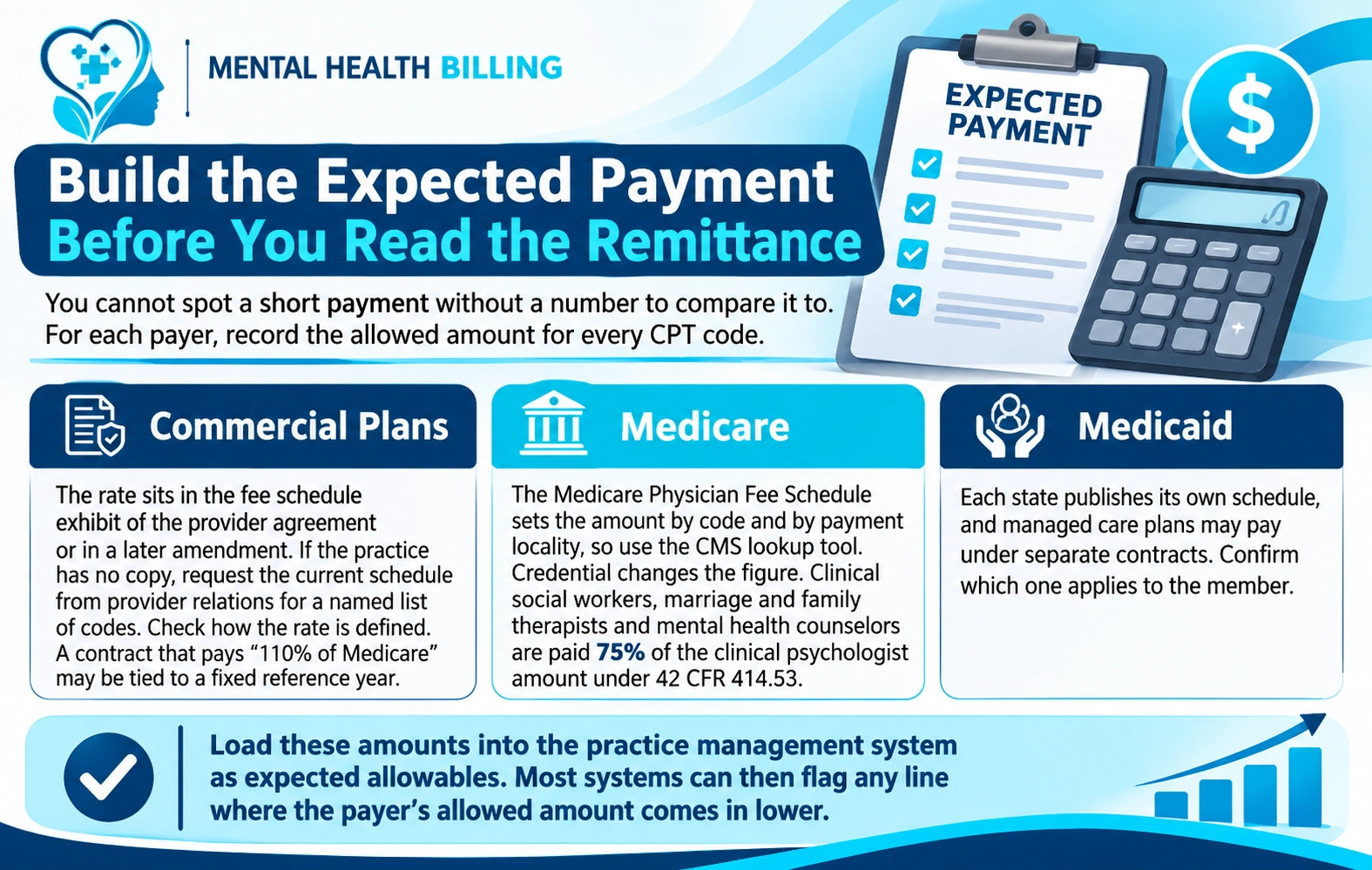
You cannot spot a short payment without a number to compare it to. For each payer, record the allowed amount for every CPT code the practice bills, separately for each license type.
Commercial plans
The rate sits in the fee schedule exhibit of the provider agreement or in a later amendment. If the practice has no copy, request the current schedule from provider relations for a named list of codes. Check how the rate is defined. A contract that pays "110% of Medicare" may be tied to a fixed reference year, in which case the rate does not move when Medicare's does.
Medicare
The Medicare Physician Fee Schedule sets the amount by code and by payment locality, so use the CMS lookup tool with the practice's own locality. Credential changes the figure. Clinical social workers, marriage and family therapists and mental health counselors are paid 75% of the clinical psychologist amount under 42 CFR 414.53. Marriage and family therapists and mental health counselors have been able to bill Part B only since January 1, 2024, according to CMS.
Medicaid
Each state publishes its own schedule, and managed care plans may pay under separate contracts. Confirm which one applies to the member.
Load these amounts into the practice management system as expected allowables. Most systems can then flag any line where the payer's allowed amount comes in lower.
How to read the remittance for a short payment
The electronic remittance advice (the 835 file) explains every dollar between the billed charge and the payment. Each adjustment carries a group code and a claim adjustment reason code (CARC) from the list maintained by X12.
The group code says who absorbs the amount. CO is a contractual write-off the provider cannot bill to the patient. PR is patient responsibility: PR-1 for deductible, PR-2 for coinsurance, PR-3 for copay.
CARC 45 deserves the most attention. Its definition is "charge exceeds fee schedule/maximum allowable or contracted/legislated fee arrangement," and it appears on nearly every paid line. Because billers expect it, they write it off without checking. A rate underpayment has no code of its own. It sits inside an oversized CO-45.
The check takes one subtraction: billed charge minus the CO-45 amount equals the payer's allowed amount. Compare that result with the contracted rate. The size of the CO-45 itself proves nothing, since it grows with whatever the practice chooses to charge.
Other codes to question on a therapy claim:
- CARC 97 (payment included in the allowance for another service) on an add-on code such as 90785 or 90833, which should pay in addition to the primary code.
- CARC 59 (multiple or concurrent procedure rules) on psychotherapy lines, where such reductions are unusual and worth asking the payer to justify.
- CARC 253 (sequestration) on Medicare claims. This one is legitimate. Medicare withholds 2% of its own payment after deductible and coinsurance, so a $40.00 payment becomes $39.20, as an example published by Noridian Healthcare Solutions shows. Do not appeal it.
Five underpayment patterns in psychotherapy billing
Most short payments in a therapy practice trace back to a handful of repeating causes. Each one leaves a recognizable mark on the remittance.
| Pattern | What the remittance shows | How to confirm |
|---|---|---|
| Wrong provider tier | A psychologist's claim allowed at the master's-level rate | Compare the rendering NPI and taxonomy on the claim with the payer's enrollment record |
| Outdated fee schedule | Allowed amount equals last year's rate after a contract increase | Check the amendment's effective date against the date of service |
| Session downcoded | 90837 billed, allowed amount matches the 90834 rate | CPT assigns 90837 to sessions of 53 minutes or more and 90834 to 38 to 52 minutes, so check the documented time |
| Add-on code unpaid | 90785, 90833 or 90840 line paid $0 with CO-97 | Confirm the add-on was billed on the same claim as its primary code |
| Telehealth site-of-service cut | Home video visit allowed at the lower facility rate | Check the place of service code; Medicare pays POS 10 (patient at home) at the non-facility rate |
The provider tier error is the one most specific to mental health. A group that employs psychologists, social workers and counselors bills the same codes under several rate tiers, and a payer that loads one clinician under the wrong license will underpay every claim that clinician submits until someone notices.
Downcoding needs care. If the note documents 50 minutes, the payer is right and the claim was overcoded. Dispute only what the record supports.
A worked example
The figures below are illustrative. A licensed clinical social worker bills 90837 at $180. Her contract with the plan sets the allowed amount at $128, and the patient has a $25 copay. The expected payment is $103.
The remittance shows CO-45 of $66, PR-3 of $25 and a payment of $89. Subtract the CO-45 from the charge and the payer's allowed amount is $114, which is $14 under contract. Nothing on the remittance flags a problem. At 22 such sessions a week over 48 weeks, that clinician loses $14,784 in a year.
Deadlines for disputing a short payment
A confirmed underpayment has a filing window. For Medicare Part B, a redetermination request must arrive within 120 days of receiving the initial determination, and a clerical error reopening must be requested within one year, according to CGS Medicare, a Medicare Administrative Contractor.
Commercial windows are set by the contract's payment dispute clause and differ by payer. Record each payer's window next to its fee schedule, and send disputes with the contract page, the remittance and the calculation attached. When the same error repeats across many claims, ask the payer for a bulk reprocessing project instead of filing appeals one at a time.
Summary: identifying underpayments in mental health insurance claims
The method is short. Know the contracted allowed amount for each code and each license type. Derive the payer's allowed amount from the remittance by subtracting CO-45 from the charge. Investigate every line where the two differ, starting with provider tier, fee schedule year, session length, add-on codes and place of service. File within the payer's window, which for Medicare is 120 days.
A practice that runs this comparison monthly, payer by payer, will find its repeat errors within the first few cycles, because the same loading mistake tends to hit every claim from the same clinician.