


CPT code 96131 reports additional time spent on psychological testing evaluation. It accompanies 96130, which represents the initial hour of that professional service. The work can include interpreting findings, integrating clinical information, developing recommendations, preparing the report, and providing feedback. It does not represent every activity performed during a testing appointment.
Accurate billing requires answers to three questions: What work occurred? Who performed it? How much qualifying time did it take?
A useful review therefore starts with the clinical record and time log, before anyone calculates claim units. The following mistakes show where that review needs particular attention.
Reporting CPT code 96131 without the correct primary service
96131 is an add-on code, with 96130 as its corresponding primary code. A psychiatric diagnostic evaluation, psychotherapy session, or test administration service does not substitute for that primary service. The American Psychological Association’s January 2019 article, Psychologists’ testing codes have changed, explains the separate code families introduced for evaluation and administration.
For example, a claim containing 90791 and 96131 needs review. The presence of a diagnostic interview does not establish that the initial psychological testing evaluation service was reported.
Before submitting an add-on line, locate the corresponding evaluation record and primary-code entry. If 96130 was omitted, correct the claim from the documentation. Do not insert it merely to satisfy an edit.
Adding a unit before the time threshold is met
An hour-based code does not mean that any work beyond 60 minutes supports another unit.
APA Services’ Psychological Testing coding resource, effective January 1, 2019, explains that the first 96131 unit requires at least 31 additional minutes beyond the initial hour. Consequently, 91 minutes of qualifying evaluation time supports the first add-on unit.
Applying that midpoint rule produces these unit calculations:
| Total qualifying evaluation time | 96130 units | 96131 units |
|---|---|---|
| 60 minutes | 1 | 0 |
| 90 minutes | 1 | 0 |
| 91 minutes | 1 | 1 |
| 150 minutes | 1 | 1 |
| 151 minutes | 1 | 2 |
| 211 minutes | 1 | 3 |
These calculations concern evaluation time alone.
Consider a hypothetical record showing 90 minutes of evaluation. Rounding it to “about two hours” would create an unsupported add-on unit. Preserve actual minutes in the record, and let the billing calculation follow those minutes.
Combining evaluation with test administration and scoring
Separate the clinician’s evaluative work from administering and scoring instruments.
APA’s January 2019 coding explanation distinguishes 96130/96131 from 96136/96137 for clinician administration and scoring, and 96138/96139 for technician administration and scoring. The latter two families concern two or more tests and use 30-minute increments.
Suppose a psychologist documents:
- 100 minutes administering and scoring tests.
- 80 minutes interpreting findings and developing the evaluation report.
The practice should not combine those entries into 180 minutes under 96130/96131. Each activity belongs in its appropriate service category.
A practical improvement is to give the time log separate fields for administration/scoring and evaluation. A single “testing hours” field forces the billing team to reconstruct information that the clinician could record directly.
Treating technician time as the psychologist’s evaluation time
A psychologist’s involvement in a testing episode does not make every staff member’s work professional evaluation time.
APA Services’ 2026 Psychological and Neuropsychological Testing Billing and Coding Guide separates technician activities from the qualified professional’s evaluation responsibilities. It also emphasizes appropriate training and state licensure for the professional performing evaluation services.
For each time entry, record the person who actually performed the activity. Avoid entries such as “team completed assessment, four hours,” which leave the reviewer unable to distinguish personnel or services.
Before assigning an unfamiliar provider’s work to 96131, verify that provider’s qualifications and the payer’s eligibility requirements. A supervisory signature should prompt review of the underlying work, rather than an assumption that all recorded minutes belong to the supervisor.
Restarting 96130 whenever the calendar date changes
An assessment may involve interpretation on one date, report preparation on another, and feedback later.
APA’s 2026 guide directs practices to accumulate time by service category across the assessment episode and use the initial evaluation code once. Additional qualifying evaluation time belongs under the add-on code.
Claim-date instructions also need attention. First Coast Service Options’ article A57780, Billing and Coding: Psychological and Neuropsychological Tests, revised effective October 1, 2025, directs providers in its Medicare jurisdiction to combine testing time and report it on the last service date. That local instruction should not be treated as every insurer’s claim-format rule.
Keep the actual work dates in the clinical record. Maintain a separate payer instruction for translating those dates onto the claim.
Counting the same work twice
Report preparation and interactive feedback can be components of psychological testing evaluation. APA’s explanation of the evaluation codes includes both activities.
A feedback appointment should therefore not automatically generate a psychotherapy charge for the same work already counted toward evaluation time. Separately reportable treatment requires its own support.
CMS’s 2026 Medicare National Correct Coding Initiative Policy Manual, Chapter I, effective January 1, 2026, prohibits separately reporting services that are integral to another reported procedure.
Use a timeline to review potential overlap. If a note allocates 2:00–2:45 p.m. to testing feedback, compare that interval with other billed services before submission. Resolve conflicting entries with the clinician instead of assuming that different code descriptions justify duplicate time.
Substituting psychological and neuropsychological evaluation codes
96131 and 96133 describe different evaluation families. The former accompanies psychological testing evaluation; the latter accompanies neuropsychological testing evaluation.
APA’s 2026 guide advises selecting the predominant service when instruments overlap between the two types of assessment. It also states that the psychological and neuropsychological evaluation families should not be billed together within the same assessment episode.
Do not change families because a claim denied or another code appears to reimburse better.
Ask the clinician to clarify the evaluation’s purpose and approach if the report and selected codes disagree. The billing team should be able to explain the selection from the documented service without relying solely on a test name or diagnosis.
Documenting hours without explaining the clinical work
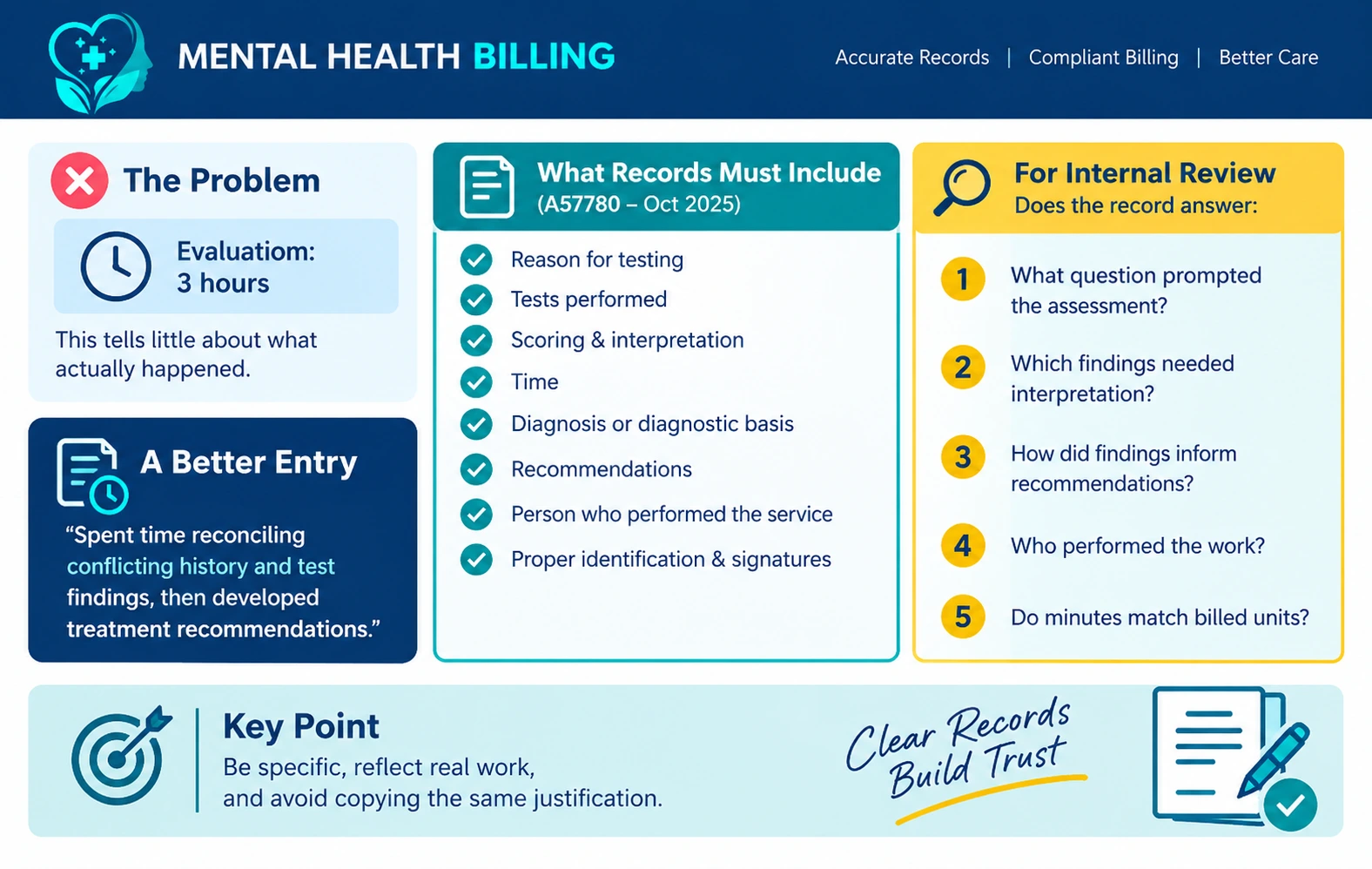
A total such as “evaluation: three hours” offers little explanation of what occurred.
First Coast’s October 2025 revision of article A57780 requires records supporting the reason for testing, tests performed, scoring and interpretation, time, diagnosis or diagnostic basis, recommendations, and the person performing the service. It also requires appropriate identification and signatures.
For an internal review, ask whether the record answers:
- What question prompted the assessment?
- Which findings required interpretation?
- How did those findings inform recommendations?
- Which professional performed the work?
- Do documented minutes reconcile with billed units?
A useful entry might identify time spent reconciling conflicting history and test findings, then developing treatment recommendations. That description should reflect actual work. Avoid copying an identical justification into every patient’s record.
Assuming authorization covers every requested unit
Authorization requirements are plan-specific. Optum’s Provider Express page, Psychological and Neuropsychological Testing, accessed October 16, 2026, explicitly advises checking individual plan requirements because not all plans require prior authorization.
Build a verification record that captures the approved codes, units, service dates, provider, and authorization identifier when applicable.
For example, an approval for administration services should trigger a separate check of evaluation services. Likewise, a general reference to “testing approved” needs clarification if the written determination does not identify what was approved.
Compare the completed episode against that record before billing. If additional work became necessary, document the clinical reason and ask the payer about its applicable authorization process. Avoid assuming that an original approval automatically expanded with the assessment.
Adding modifiers without investigating the denial
Modifier 59 should not become a routine response to a rejected testing claim.
CMS’s January 2026 NCCI manual describes its use for qualifying distinct services and explains that modifier use must fit the circumstances. A modifier does not supply missing documentation or create an unperformed primary service.
Review the actual denial reason before changing the claim. Check for a missing primary code, incorrect units, service-date formatting, authorization issues, or a specific code-pair edit.
Keep an internal denial log with the original error and verified correction. “Added modifier, claim paid” is an incomplete explanation because it does not establish whether the modifier was appropriate.
A practical final review for CPT code 96131
Before releasing the claim, reconcile the professional’s evaluation minutes with the primary code and add-on units. Confirm that administration, technician work, and separately reported services remain identifiable in the record.
CPT code 96131 supports additional psychological evaluation time when the underlying service and time requirements are met. The strongest claim is one a reviewer can follow from the clinical question, through the documented work, to the exact units submitted.