


F90.0 Diagnosis Code Explained: ADHD Predominantly Inattentive Type
The Centers for Disease Control and Prevention reports that millions of children and adults carry an attention-deficit hyperactivity disorder diagnosis. The ICD-10-CM manual provides specific alphanumeric codes to classify this neurodevelopmental condition based on clinical presentation. Health care providers and medical coders use the F90.0 diagnosis code to document ADHD predominantly inattentive type. Accurate application of this code requires a precise understanding of clinical documentation, coding exclusions, and payer rules.
The transition from the ICD-9 system in 2015 retired the older 314.00 code for Attention Deficit Disorder (ADD). The medical billing industry now relies entirely on the F90 category to track attention disorders, requiring specific subtype documentation for successful claim adjudication.
Clinical definition and DSM-5-TR alignment
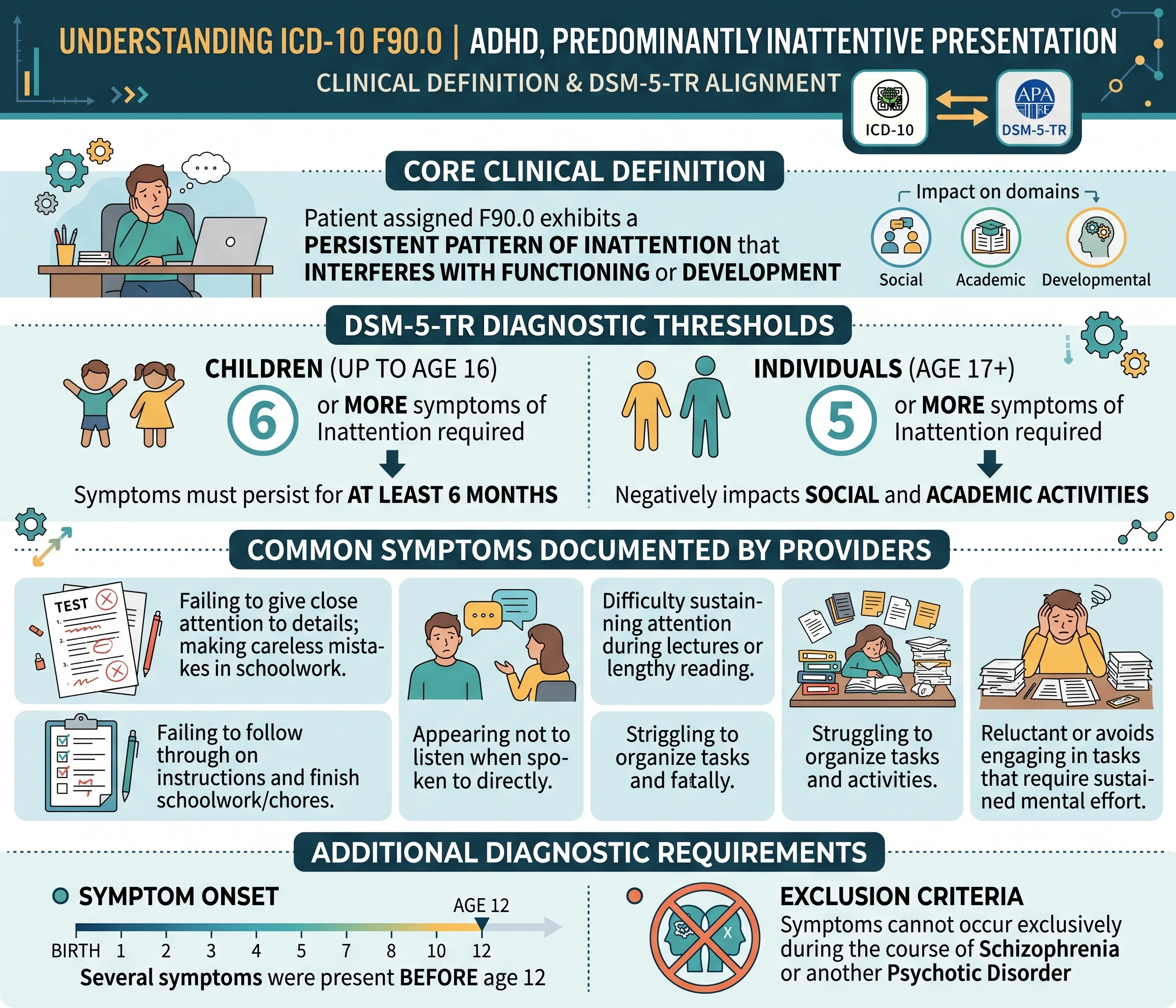
F90.0 directly corresponds to the American Psychiatric Association (APA) DSM-5-TR diagnostic criteria for ADHD predominantly inattentive presentation. The World Health Organization (WHO) structures the ICD-10 mental and behavioral disorders section to mirror these clinical guidelines. A patient assigned F90.0 exhibits a persistent pattern of inattention that interferes with functioning or development.
The diagnostic threshold requires six or more symptoms of inattention for children up to age 16. Individuals aged 17 and older require five symptoms. These symptoms must persist for at least six months to a degree that negatively impacts social and academic activities.
Symptoms documented by providers often include failing to give close attention to details, making careless mistakes in schoolwork, and experiencing difficulty sustaining attention during lectures or lengthy reading. Patients might appear not to listen when spoken to directly. They frequently fail to follow through on instructions and struggle to organize tasks. Providers must also verify that several inattentive symptoms were present before age 12 to validate the F90.0 classification. The symptoms cannot occur exclusively during the course of schizophrenia or another psychotic disorder.
F90.0 diagnosis code explained: ADHD predominantly inattentive type coding guidelines
Medical coders must follow specific ICD-10-CM conventions when reporting F90.0. The code falls under Chapter 5 (Mental, Behavioral and Neurodevelopmental disorders) and belongs to the F90 block specifically covering attention-deficit hyperactivity disorders.
The Centers for Medicare & Medicaid Services (CMS) enforces strict Excludes1 and Excludes2 notes for this category. An Excludes1 note indicates mutually exclusive conditions that a coder cannot report together on the same claim. For the F90 category, Excludes1 directs coders to avoid reporting F90.0 alongside anxiety disorders, bipolar disorder, and schizophrenia. If the provider determines the inattention stems from a separate anxiety disorder, the F90.0 code is invalid.
An Excludes2 note means a specific condition is not included in the F90 definition, but a patient may have both conditions at the same time. The F90 block carries an Excludes2 note for specific learning disorders (F81.-), autism spectrum disorder (F84.0), and conduct disorder (F91.-). Coders can report F90.0 alongside these codes if the provider’s medical record supports both diagnoses.
Code comparison for ADHD presentations
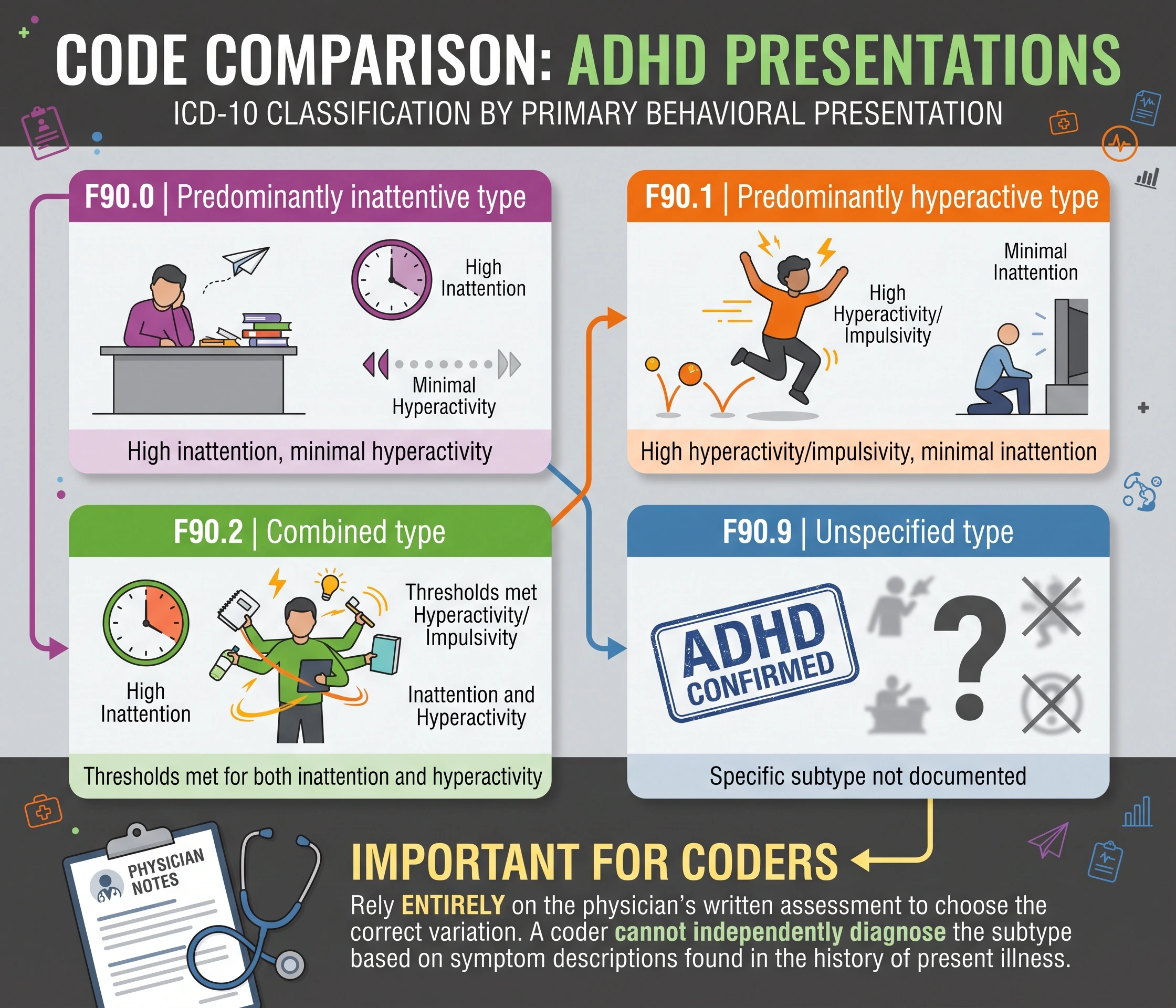
Providers must differentiate the inattentive type from other manifestations of ADHD. The ICD-10 manual separates the condition by primary behavioral presentation.
|
ICD-10 Code |
Clinical Presentation |
Primary Diagnostic Requirement |
|
F90.0 |
Predominantly inattentive type |
High inattention, minimal hyperactivity |
|
F90.1 |
Predominantly hyperactive type |
High hyperactivity/impulsivity, minimal inattention |
|
F90.2 |
Combined type |
Thresholds met for both inattention and hyperactivity |
|
F90.9 |
Unspecified type |
ADHD confirmed but specific subtype not documented |
Coders rely entirely on the physician’s written assessment to choose the correct variation. A coder cannot independently diagnose the subtype based on symptom descriptions found in the history of present illness.
Documentation requirements for medical billing
Clear medical record documentation protects practices from recoupments during payer audits. Providers must describe the patient’s condition with enough specificity to justify F90.0 over an unspecified code.
A complete clinical note for inattentive ADHD details the specific settings where symptoms occur. The APA requires evidence that symptoms present in two or more settings, such as home and school, or work and home. Physicians and psychiatric nurse practitioners often use standardized assessment tools to gather this data. The Vanderbilt Assessment Scale and the Adult ADHD Self-Report Scale (ASRS) provide quantifiable metrics that support the F90.0 diagnosis. Mentioning the scores or interpretations of these scales in the assessment and plan section strengthens the clinical validity of the claim.
Coders look for the exact word “inattentive” in the final assessment. If a provider writes “ADHD” without specifying the subtype, the coder must assign F90.9. Commercial payer policies increasingly flag claims using unspecified diagnostic codes for manual review or denial. For pediatric patients enrolled in Medicaid managed care organizations, exact coding impacts clinical quality metric reporting under the Chronic Illness and Disability Payment System (CDPS).
Linking F90.0 to procedural CPT codes
Outpatient psychiatric and pediatric practices frequently pair F90.0 with specific Current Procedural Terminology (CPT) codes published by the American Medical Association (AMA).
Evaluation and Management (E/M) services (99202-99215) represent the most frequent procedural codes linked to F90.0. When treating a patient with inattentive ADHD, the provider’s medical decision-making determines the E/M level. Prescribing or adjusting FDA-approved medications for F90.0, such as methylphenidate (Ritalin), dextroamphetamine-amphetamine (Adderall), or atomoxetine (Strattera), qualifies as moderate risk under AMA guidelines. Moderate risk usually justifies a level four E/M code (99204 or 99214) if the data review and problem complexity elements also meet the mandatory thresholds.
Practices also bill psychological and neuropsychological testing codes (96130, 96131, 96136, 96137) when confirming an initial F90.0 diagnosis. These codes require detailed documentation of the time spent administering, scoring, and interpreting the cognitive tests. For shorter evaluations, providers use 96127 for brief behavioral assessments. F90.0 also validates medical necessity for individual psychotherapy (90832, 90834, 90837) and family psychotherapy (90846, 90847).
Common claim denials and compliance risks
Medical billing professionals encounter specific denial patterns related to F90.0. The most frequent denial reason is the lack of medical necessity due to conflicting secondary diagnoses. Payer automated adjudication systems reject claims where F90.0 appears on the same line as an Excludes1 condition.
Another compliance risk involves adult patient populations. Historical clinical guidelines categorized ADHD strictly as a childhood disorder. The DSM-5-TR explicitly expanded the criteria to accommodate adult diagnoses by lowering the symptom threshold from six to five. Some commercial insurance carriers still maintain outdated logic pathways that automatically deny F90.0 for patients over age 18. Billers must appeal these denials by submitting the clinical notes and referencing the current APA criteria validating adult onset and continuation.
Documentation must also establish that the inattentive symptoms are not a secondary effect of substance use or medication side effects. Auditors look for a differential diagnosis section in the provider’s note proving other medical causes were ruled out. Missing this information leaves the chart vulnerable during post-payment reviews.
Accurate application of the F90.0 code requires strict alignment between the provider’s clinical assessment and the medical coder’s claim submission. The diagnosis requires verifiable documentation of inattentive symptoms across multiple settings based on APA guidelines. Practices prevent claim denials by avoiding Excludes1 code combinations, specifying the inattentive subtype in the medical record, and updating prior authorizations when patients transition from pediatric to adult care. Precise charting ensures payers process claims for pharmacological management and behavioral therapy without administrative delays.