



99203 CPT Code: Description, Requirements & Reimbursement Guide (2026)
A hospitalist walks into a room at 7 a.m. The patient has three active problems, a stack of overnight labs, and a family member asking questions in the hallway. By the time the note is closed, 80 minutes have passed. That encounter, if the documentation supports it, is CPT code 99223, the highest level of the initial hospital inpatient or observation care family.
For coders and billing staff at Mental Health Billing, 99223 shows up constantly in hospitalist, intensivist, and specialist charts. It’s also one of the more misunderstood codes in the inpatient set, because the rules changed in 2023 and were clarified again in 2024. This guide walks through what procedure code 99223 actually requires, how it compares to the inpatient consultation codes like 99253, and where claims tend to get denied.
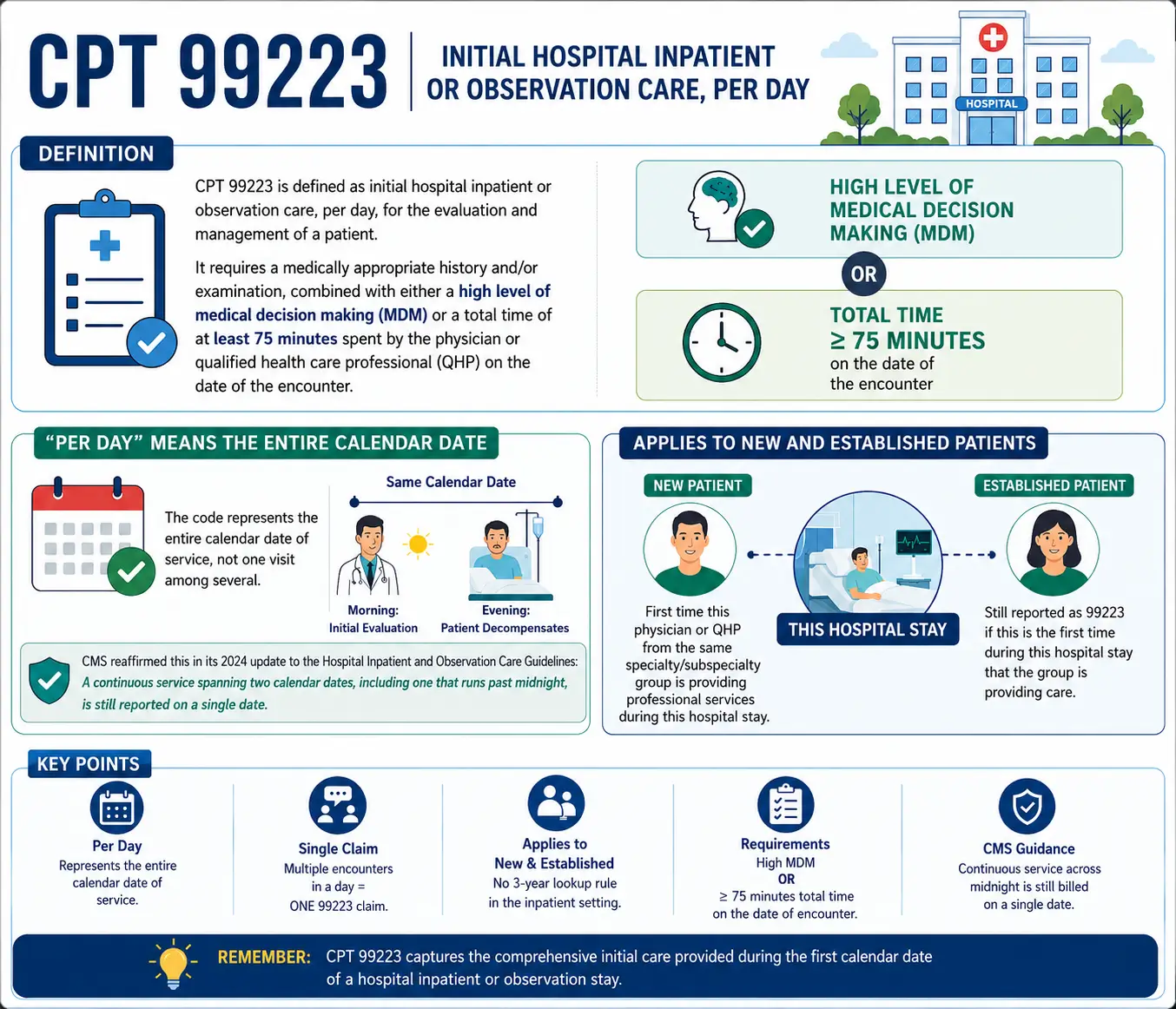
CPT 99223 is defined as initial hospital inpatient or observation care, per day, for the evaluation and management of a patient. It requires a medically appropriate history and/or examination, combined with either a high level of medical decision making (MDM) or a total time of at least 75 minutes spent by the physician or qualified health care professional (QHP) on the date of the encounter. That single sentence carries a lot of weight, so it’s worth breaking apart. “Per day” means the code represents the entire calendar date of service, not one visit among several. If a hospitalist sees a newly admitted patient in the morning and returns that evening because the patient decompensated, both encounters still get bundled into one 99223 claim, not two separate line items. The Centers for Medicare & Medicaid Services (CMS) reaffirmed this in its 2024 update to the hospital inpatient and observation care guidelines, noting that a continuous service spanning two calendar dates, including one that runs past midnight, is still reported on a single date. 99223 applies equally to new and established patients. Unlike office visit codes, where a patient’s status depends on whether they’ve been seen by that physician’s group in the past three years, the inpatient family doesn’t distinguish based on prior visits. What matters is whether this is the first time a physician or QHP from a given specialty and subspecialty group is providing professional services during this particular hospital stay.
Here’s the catch: Medicare stopped recognizing consultation codes entirely back on January 1, 2010, and that policy has not changed. If the patient is a Medicare Part B beneficiary, a consulting physician cannot bill 99253. Instead, that consulting provider bills from the same 99221 to 99223 range used for the admitting physician, provided this is genuinely the consultant’s first encounter with the patient during that stay. Subsequent visits by the same consultant get billed with the subsequent hospital care codes, 99231 through 99233.
Some commercial payers still accept 99252 through 99255. Before submitting a consultation code, billing staff should verify payer policy directly rather than assuming it mirrors Medicare, because coverage genuinely varies by contract.
One more distinction worth remembering: CPT deleted the lowest-level consultation codes, 99241 (outpatient) and 99251 (inpatient), effective December 31, 2022. If an old superbill or EHR template still lists 99251, it needs to be retired from the workflow.
What CPT code 99223 covers
CPT 99223 is defined as initial hospital inpatient or observation care, per day, for the evaluation and management of a patient. It requires a medically appropriate history and/or examination, combined with either a high level of medical decision making (MDM) or a total time of at least 75 minutes spent by the physician or qualified health care professional (QHP) on the date of the encounter. That single sentence carries a lot of weight, so it’s worth breaking apart. “Per day” means the code represents the entire calendar date of service, not one visit among several. If a hospitalist sees a newly admitted patient in the morning and returns that evening because the patient decompensated, both encounters still get bundled into one 99223 claim, not two separate line items. The Centers for Medicare & Medicaid Services (CMS) reaffirmed this in its 2024 update to the hospital inpatient and observation care guidelines, noting that a continuous service spanning two calendar dates, including one that runs past midnight, is still reported on a single date. 99223 applies equally to new and established patients. Unlike office visit codes, where a patient’s status depends on whether they’ve been seen by that physician’s group in the past three years, the inpatient family doesn’t distinguish based on prior visits. What matters is whether this is the first time a physician or QHP from a given specialty and subspecialty group is providing professional services during this particular hospital stay.
Why 99223 replaced the old observation codes
Before 2023, hospitals used a separate set of observation codes (99218 through 99220, 99224 through 99226) alongside the inpatient codes. The American Medical Association eliminated that duplication effective January 1, 2023, folding observation care into the same 99221 to 99223 family used for inpatient admissions. CMS confirmed the change in its CY 2023 Physician Fee Schedule transmittal, stating that hospital inpatient and observation care would be billed using the same CPT codes going forward, regardless of whether the patient’s status was inpatient or observation. This matters for anyone coding claims from 2022 or earlier. If you’re auditing an old chart, don’t be surprised to find an observation-specific code that no longer exists. For anything dated 2023 onward, 99223 is the only option for a high-complexity initial encounter, whether the patient sits in an observation bed or a full inpatient bed. A further clarification arrived in the 2024 CPT manual. If an observation stay lasts fewer than 8 hours total, even if it crosses midnight into a second calendar day, the encounter should be reported only with an initial hospital care code (99221 to 99223). No separate discharge code gets billed in that scenario. Discharge management codes (99238 or 99239) only apply when the stay crosses calendar days and runs longer than 8 hours.The medical decision making standard for 99223
Since the 2023 overhaul, history and physical exam no longer determine the level of an inpatient E/M code. They still have to be documented, and they have to be “medically appropriate,” but the level itself is set by MDM or time. For 99223, MDM has to reach the high complexity threshold under the AMA’s MDM table, which asks coders to confirm at least two of three elements:- A high number and complexity of problems addressed at the encounter, such as a chronic illness with severe exacerbation or a new problem carrying an uncertain prognosis
- An extensive amount and complexity of data reviewed and analyzed, including independent interpretation of tests, discussion with external physicians, or review of prior external records
- A high risk of complications, morbidity, or mortality from the patient’s condition or from the management options under consideration, such as decisions about hospitalization, major surgery with risk factors, or drug therapy requiring intensive monitoring
Reporting 99223 by time instead of MDM
Physicians can also select 99223 based on time alone, as long as total time on the date of the encounter reaches 75 minutes or more. Total time includes activities the physician performs personally on that date: reviewing results before the visit, the face-to-face encounter itself, documenting in the chart, and care coordination, provided none of that time is separately billed under another code. For Medicare patients, once time exceeds the threshold for 99223 by a meaningful margin, additional time can be captured through HCPCS code G0316, the Medicare-specific prolonged services code for hospital inpatient or observation visits. According to a February 2024 reference guide published by the Infectious Diseases Society of America, G0316 requires a minimum of 90 minutes tied to a 99223-level visit and is billed in 15-minute increments beyond that point. Commercial payers that recognize AMA’s own prolonged services code, 99418, apply a similar structure: it can be reported once total time exceeds 15 minutes beyond the 75-minute threshold for 99223, but only when the visit was already selected based on time and the top level was reached. Medicare does not recognize CPT 99417 or 99418 for these services. Practices billing Medicare need to default to G0316, while commercial payer contracts should be checked individually, since not every plan has adopted the AMA prolonged services codes at the same pace.99223 versus the inpatient consultation codes, including 99253
This is where a lot of confusion sits, and it’s the reason “99253 cpt code description time” gets searched almost as often as 99223 itself. CPT 99253 belongs to a different family entirely: inpatient or observation consultation codes (99252 through 99255). A consultation happens when one physician or QHP asks another, typically from a different specialty, to evaluate a patient and render an opinion, with the findings reported back to the requesting provider. 99253 specifically represents a consultation involving low-complexity MDM, or a total time of at least 45 minutes on the date of the encounter, according to the AMA’s 2023 E/M guidelines summarized by coding resource TLD Systems. The four consultation levels break down by time as follows, based on the 2023 guidelines referenced in University of Rochester Medical Center’s inpatient consultation summary:| Code | Total time threshold |
| 99252 | 35–44 minutes |
| 99253 | 45–59 minutes |
| 99254 | 60–79 minutes |
| 99255 | 80–94 minutes |
Modifier -AI and multiple providers on the same day
Hospital admissions frequently involve more than one physician billing an initial E/M code on the same date, for example a hospitalist admitting the patient and a cardiologist consulting the same day. Because Medicare no longer recognizes separate consult codes, both providers may end up reporting from the 99221 to 99223 range for their respective first encounters. To distinguish the admitting provider from everyone else, CPT requires a modifier -AI (principal physician of record) appended to the admitting physician’s claim. Every other physician billing an initial hospital care code that same day reports it without the modifier, and payers use -AI to identify who holds primary responsibility for the admission.Practical documentation checklist
Coders reviewing charts for 99223 support should confirm the note includes:- A medically appropriate history and exam, documented even though it doesn’t drive the code level
- Either two of three high-complexity MDM elements, or a clear statement of total time meeting or exceeding 75 minutes
- Specific problems addressed, not just a diagnosis list, since severity and uncertainty are what elevate MDM
- Data reviewed, named explicitly (which labs, which imaging, which outside records or specialist discussions)
- Risk discussion tied to the actual management decisions made that day, not a generic risk statement copied from a template