



A parent attends therapy without their child. A spouse meets with a clinician while the identified patient stays home. Both situations may support CPT 90846, but attendance alone does not establish a billable service.
The 90846 CPT code description covers family psychotherapy conducted without the identified patient present. The clinical work must address that patient’s treatment through interactions with family members. A scheduling conversation, progress update, or general discussion about parenting does not automatically qualify.
For providers and billing students, accurate reporting requires answering three questions: What therapeutic service occurred? Whose condition was being treated? Does the documentation support the code and the payer’s coverage requirements?
Understanding the 90846 CPT code description
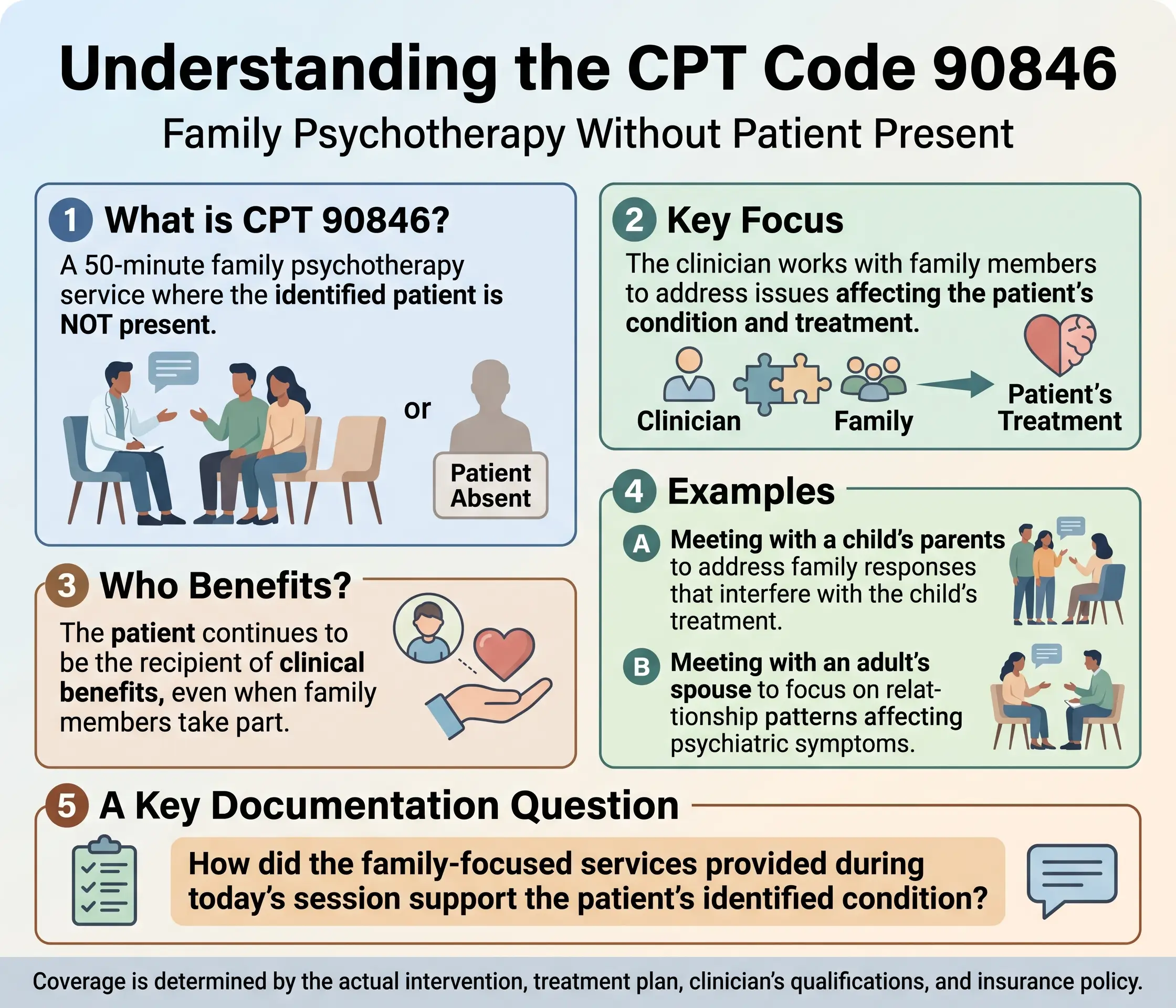
CPT 90846 describes a 50-minute family psychotherapy service during which the identified patient is absent. A qualified clinician works with family members to address issues affecting the patient’s condition and treatment.
The patient continues to be the recipient of clinical benefits, even when family members take part in the encounter.
For example, a therapist might meet with a child’s parents to address family responses that interfere with the child’s treatment. Another session could involve an adult patient’s spouse and focus on relationship patterns affecting the patient’s psychiatric symptoms.
These are illustrative situations, not automatic coverage decisions. The actual intervention, treatment plan, clinician’s qualifications, and insurance policy determine whether reporting 90846 is appropriate.
A key documentation question is: How did the family-focused services provided during today’s session support the patient’s identified condition?
How 90846 differs from related psychotherapy codes
The patient’s involvement and the treatment format help differentiate family psychotherapy from other types of services.
| Code | Service category | Main distinction |
|---|---|---|
| 90846 | Family psychotherapy | Identified patient is absent |
| 90847 | Family psychotherapy | Identified patient participates |
| 90832, 90834, 90837 | Individual psychotherapy | Treatment centers on individual psychotherapy, with code selection based on time |
| 90849 | Multiple-family group psychotherapy | Several families participate in a group format |
A relative’s presence during individual psychotherapy does not automatically make the encounter family psychotherapy. Relatives may provide information during an individual session without changing its clinical structure.
Likewise, two parents attending a session about one child do not make it a multiple-family group.
Choose the code from the service performed. Avoid selecting whichever code has the highest contracted payment.
What is the minimum time for 90846?
Although the descriptor specifies 50 minutes, the reporting threshold is at least 26 minutes. A shorter family psychotherapy session does not qualify for 90846.
The U.S. Department of Health and Human Services lists this threshold in its “Billing for telebehavioral health” guidance, reviewed for this article in October 2026.
Consider these examples:
- A 20-minute family psychotherapy encounter does not meet the threshold.
- A 30-minute encounter may qualify if the remaining requirements are satisfied.
- A 50-minute encounter matches the descriptor’s stated duration.
Document actual treatment time. A scheduled 50-minute appointment does not establish that 50 minutes of psychotherapy occurred.
As a precaution, document the session’s start and end times and clearly separate therapeutic activities from administrative conversations. Do not round a short encounter upward or assume a longer visit automatically permits additional units. Check the applicable reporting rules before billing an extended session.
Establishing medical necessity
Medicare’s National Coverage Determination 70.1, “Consultations with a Beneficiary’s Family and Associates,” reviewed in October 2026, ties covered family counseling to treatment of the beneficiary’s condition.
That connection should be visible in the record.
Suppose a therapist meets with the parents of a child receiving treatment for anxiety. A note that says “discussed home concerns” gives a reviewer little information. A stronger account explains the family interaction addressed, the psychotherapy intervention, and its relationship to the child’s treatment objectives.
General relationship advice or support for a relative’s separate difficulties does not establish medical necessity under the identified patient’s benefit.
If the participating relative needs treatment for their own condition, assess that need separately. Their attendance does not justify assigning them the identified patient’s diagnosis or shifting the claim to their insurance.
What a useful 90846 note should contain
Build the note around the clinical service, rather than a checklist of billing terms. A practical format includes:
- Patient and participants: Identify the patient, participating relatives, and their relationships.
- Attendance: State that the identified patient was absent.
- Timing: Record the date and actual psychotherapy duration.
- Treatment connection: Describe the patient’s relevant symptoms, impairment, and treatment objective.
- Intervention: Explain the therapeutic work performed with the family.
- Response: Describe participation, difficulties, or changes observed during the session.
- Next steps: Document the agreed-upon plan and the criteria that will be used to evaluate progress.
- Authentication: Include the rendering clinician’s identity, credentials, and signature.
Explain why working with relatives was clinically appropriate. “Patient not present” describes attendance, but does not explain the purpose of treatment.
Avoid documenting observations that could not have occurred. For example, clearly distinguish a parent’s report about a child’s behavior from the therapist’s own observations.
An illustrative documentation example
The following fictional example shows the level of specificity a note might include:
“Met with the patient’s parents from 3:00 to 3:45 p.m.; patient absent. Session addressed parental responses to avoidance behaviors associated with the patient’s documented anxiety treatment goals. Used family psychotherapy interventions to examine conflicting responses and rehearse an agreed approach. Parents identified a recurring disagreement and practiced an alternative interaction. Plan: review implementation and reported avoidance behaviors at follow-up.”
This excerpt illustrates clinical linkage. It does not replace a complete record or establish that a particular payer will reimburse the encounter.
Billing under the correct patient and provider
Verify the identified patient’s coverage for the planned service. The relative attending the session is not automatically the patient for claim purposes.
Before submitting, confirm the diagnosis reflects the condition being treated and is supported by the clinician’s documentation. Do not add an unsupported diagnosis to satisfy a coverage edit.
Provider eligibility also requires attention. Check that the clinician’s license, scope of practice, enrollment, and payer contract support the service.
A useful benefits inquiry asks specifically about family psychotherapy without the patient present. Record authorization requirements, visit limits, and any provider restrictions, along with the verification date and reference number. A general confirmation of “mental health benefits” may leave these questions unanswered.
Can 90846 and individual psychotherapy be billed together?
Sometimes. Separate payment should never be assumed.
The Centers for Medicare & Medicaid Services’ National Correct Coding Initiative Policy Manual, Chapter XI, effective January 1, 2026, permits family psychotherapy and individual psychotherapy on the same date when they are distinct services delivered during separate time intervals.
For example, an individual session and a later family encounter require documentation that supports each service independently. The same minutes cannot support both claims.
Check the payer’s current code-pair edits and modifier instructions before submission. Do not append modifier 59 simply because a claim denied. A modifier must accurately describe circumstances allowed by the applicable edit.
Also, do not add interactive complexity code 90785 to 90846. Family psychotherapy is outside its permitted primary-code combinations; a difficult conversation does not change that restriction.
Telehealth considerations
HHS includes 90846 in its telebehavioral health billing guidance. However, listing the code does not establish coverage for every plan, communication method, or setting.
Before a remote encounter, verify whether the payer covers the planned modality and what consent, location, modifier, and place-of-service information it requires.
Because the identified patient is absent, avoid copying telehealth claim settings automatically from an individual therapy visit. Ask for the payer’s instructions if its location rules do not clearly address family-only participation.
Record the actual format of the encounter and the locations of all participants. A brief telephone update should not be converted into family psychotherapy merely because the discussion concerns treatment.
Understanding reimbursement and investigating denials
There is no single reimbursement amount that applies to every 90846 claim. Medicare publishes geographically specific fee schedules with facility and nonfacility amounts. Other payers use their own payment arrangements.
For a useful estimate, check the service date, rendering provider, applicable fee schedule, setting, and patient benefits. Distinguish the allowed amount from the insurer’s payment after patient responsibility is applied.
When a claim denies, investigate the stated reason before changing anything:
- Coverage or authorization: Confirm the benefit and approval requirements.
- Time or documentation: Compare the claim with the recorded service.
- Coding edit: Review other services reported on the same date.
- Provider eligibility: Check enrollment and contract details.
- Medical necessity: Explain the documented connection to the patient’s treatment.
Submit a corrected claim for an actual claim error. Use the payer’s appeal process when challenging a coverage or medical-necessity determination. Never rewrite the service merely to fit a payable code.
A final check before submission
The 90846 CPT code description supports family psychotherapy with the identified patient absent and a minimum reporting time of 26 minutes. Before submitting the claim, verify that the documentation identifies the patient being treated, describes the psychotherapy provided, and explains how family involvement supports the treatment plan. Next, review the payer’s coverage policies and billing requirements for the specific encounter.