



90833 CPT Code Reimbursement Rates & Guidelines
A psychiatrist spends 40 minutes with an established patient. Roughly 18 of those minutes go to reviewing a lithium level, adjusting the dose, and checking for tremor. The remaining 22 minutes are spent on structured cognitive work around the patient’s avoidance behavior. That single visit contains two billable services, and the second one is where most practices lose money or invite an audit. The 90833 CPT code exists for exactly this encounter, and the rules governing it are narrower than most billing teams assume.
What the 90833 CPT code covers
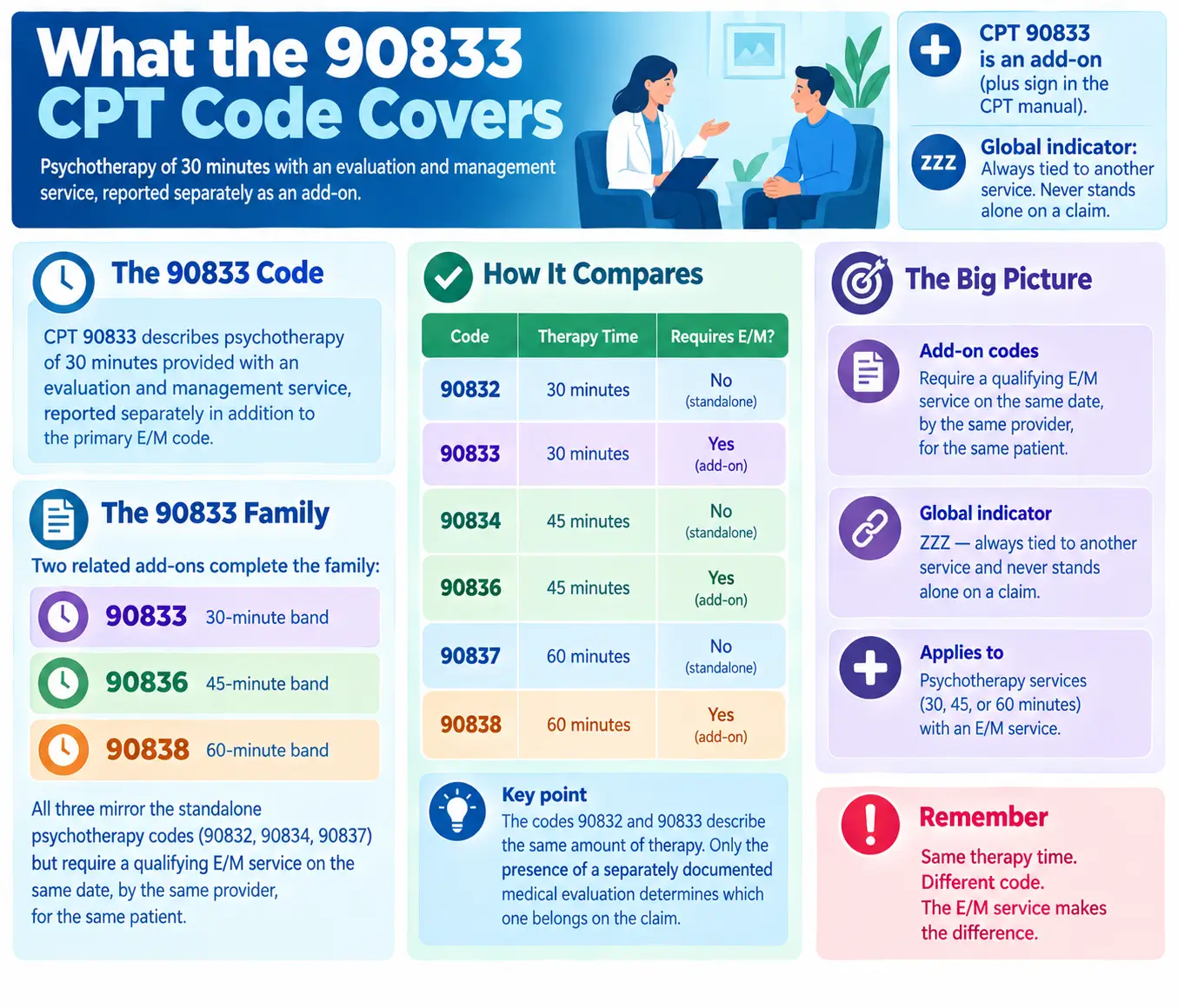
CPT 90833 describes psychotherapy of 30 minutes provided with an evaluation and management service, reported separately in addition to the primary E/M code. The plus sign in the CPT manual marks it as an add-on. It carries a ZZZ global indicator on the Medicare Physician Fee Schedule, meaning it is always tied to another service and never stands alone on a claim.
Two related add-ons complete the family. CPT 90836 covers the 45-minute band, and 90838 covers the 60-minute band. All three mirror the standalone psychotherapy codes (90832, 90834, 90837) but require a qualifying E/M service on the same date, by the same provider, for the same patient.
The distinction that trips up new coders: 90832 and 90833 describe the same amount of therapy. Only the presence of a separately documented medical evaluation determines which one belongs on the claim.
90833 CPT code reimbursement rates for 2026
Medicare pays for 90833 the same way it pays for everything else on the fee schedule, by multiplying total relative value units by a conversion factor and then applying geographic indices. CMS finalized two conversion factors for CY 2026 in the CMS-1832-F final rule, released October 31, 2025 and published in the Federal Register on November 5, 2025: $33.5675 for qualifying alternative payment model participants and $33.4009 for everyone else. Both are increases over the CY 2025 conversion factor of $32.3465, reflecting a statutory 2.5 percent update from the One Big Beautiful Bill Act and a 0.49 percent budget neutrality adjustment.
Applying the non-qualifying conversion factor to the 2026 relative value file produces these national unadjusted amounts:
Service | Non-facility | Facility |
90833 (add-on, 16 to 37 minutes) | $81.50 | $65.80 |
99214 (established patient, moderate MDM) | $135.61 | $84.50 |
99214 plus 90833 combined | $217.11 | $150.30 |
90837 (standalone, 60 minutes) | $167.00 | $135.27 |
Every figure above assumes geographic practice cost indices of 1.000. Real payment moves 10 to 20 percent in either direction depending on locality, so a Manhattan practice and a rural Arkansas practice will not see the same remittance for identical claims.
Two policy changes in the 2026 rule matter more than the conversion factor bump. CMS finalized a 2.5 percent efficiency adjustment to work RVUs for non-time-based services, but exempted time-based codes, services on the Medicare telehealth list, and new codes. Psychotherapy is time-based, so 90833 avoided the reduction that hit many procedural codes.
The second change cut the other way for hospital-based clinicians. CMS reduced the portion of facility practice expense RVUs allocated on the basis of work RVUs to half the amount allocated in the non-facility setting. Office-based practices gained; hospital outpatient departments lost. For 99214, the facility rate fell from $93.80 in 2025 to $84.50 in 2026 while the office rate rose from $125.18 to $135.61. A psychiatry group that moved its clinic under a hospital license in 2025 is now absorbing that gap on every combined visit.
State Medicaid programs and commercial plans set their own amounts. Kentucky’s Medicaid behavioral health fee schedule effective April 1, 2025, for example, lists tiered rates by provider type for the same psychotherapy services, with the lowest tiers falling well under half the top rate. Contracted commercial rates for 90833 are usually expressed as a percentage of the Medicare fee schedule, which is why a practice that never renegotiates stays anchored to whatever percentage it accepted years ago.
Time rules that decide which code you report
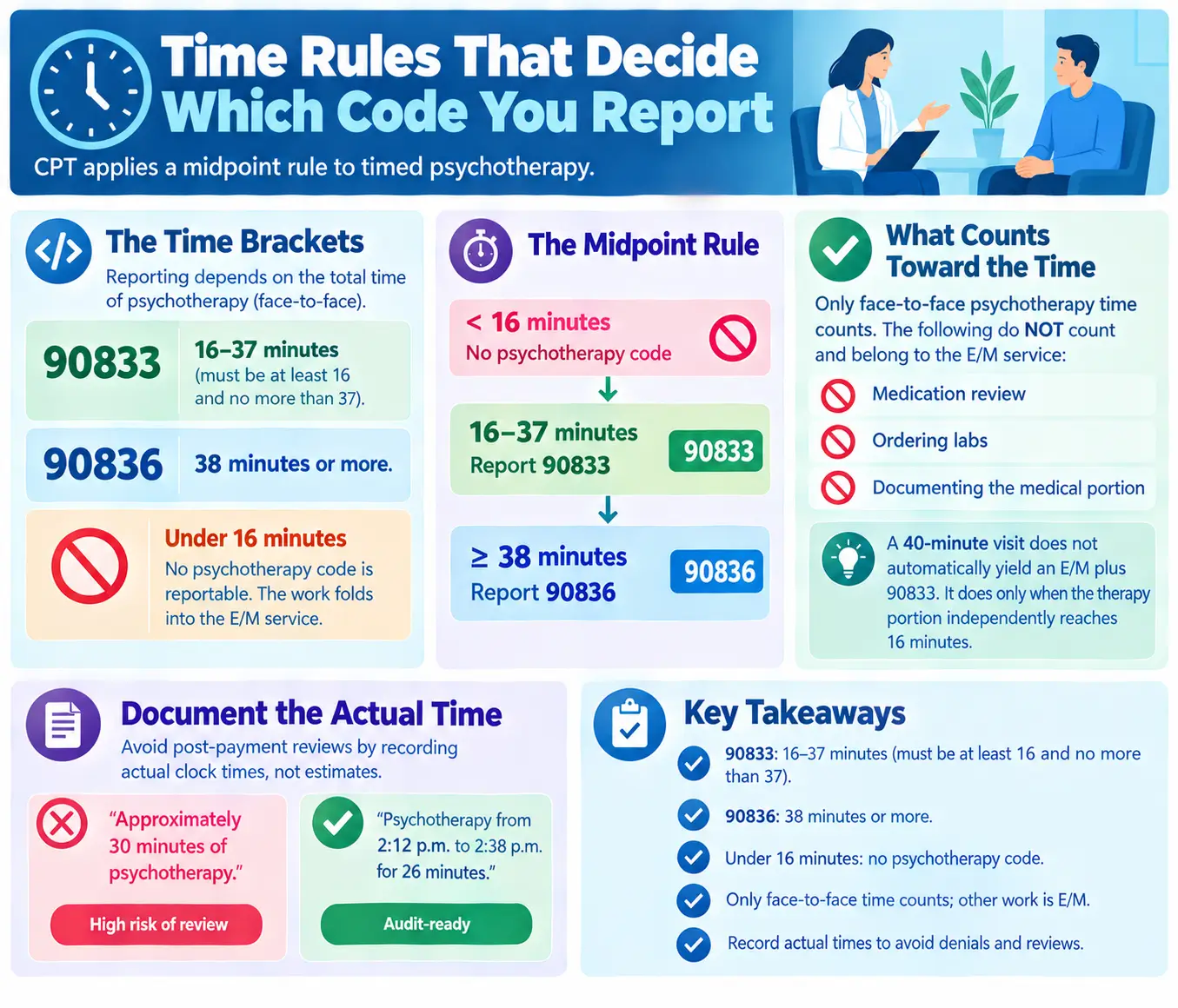
CPT applies a midpoint rule to timed psychotherapy. Reporting 90833 requires at least 16 minutes and no more than 37 minutes of psychotherapy. At 38 minutes the correct code becomes 90836. Under 16 minutes, no psychotherapy code is reportable at all, and the work folds into the E/M service.
Only face-to-face psychotherapy time counts. Time spent on medication review, ordering labs, or documenting the medical portion belongs to the E/M service and cannot be counted twice. A 40-minute visit does not automatically yield an E/M plus 90833. It yields that combination only when the therapy portion independently reaches 16 minutes.
Practices that record “approximately 30 minutes of psychotherapy” in the note are the ones that lose post-payment reviews. Recording actual clock times, such as psychotherapy from 2:12 p.m. to 2:38 p.m. for 26 minutes, gives a reviewer nothing to argue with.
Documentation and E/M level selection
Here is the requirement that surprises experienced prescribers. When an E/M service is reported with a psychotherapy add-on, the E/M level cannot be selected on the basis of total time, because the psychotherapy minutes are already being paid separately. Medical decision making has to carry the level.
That means the note needs the elements a reviewer expects for the chosen MDM level: the number and complexity of problems addressed, the data reviewed, and the risk associated with the management plan. A note that documents 22 minutes of cognitive behavioral work but shows only a one-line refill decision will support 90833 and a level 2 or 3 visit, not a 99214.
The therapy documentation is a separate matter. It should identify the therapeutic modality, the target of the intervention, the patient’s response, and the time. Two services, two distinct sets of content, one encounter note.
Who is eligible to report 90833
Because 90833 requires a primary E/M service, only clinicians whose scope includes E/M billing can use it. In practice that means psychiatrists, psychiatric nurse practitioners, physician assistants, and clinical nurse specialists.
Clinical psychologists, licensed clinical social workers, licensed professional counselors, and marriage and family therapists cannot bill E/M services and therefore cannot report the add-on. They report 90832, 90834, or 90837 instead. Marriage and family therapists and mental health counselors became eligible Medicare Part B providers on January 1, 2024, and are paid at 75 percent of the physician fee schedule amount, so their standalone psychotherapy payment is lower than a prescriber’s for the same session length.
Edits, modifiers, and pairings to watch
Chapter 11 of the Medicare National Correct Coding Initiative Policy Manual sets several boundaries that apply directly here:
- 90791 and 90792 are not separately reportable with any psychotherapy code on the same date of service, because psychotherapy already includes continuing psychiatric evaluation.
- Crisis psychotherapy codes 90839 and 90840 are not reported with 90833 on the same date.
- Interactive complexity (90785) may be added when communication barriers such as interpreters or third-party involvement increase the work.
Modifier 25 generates the most disagreement in the field. The add-on structure of 90833 does not itself require modifier 25, and Medicare contractors generally adjudicate the pair without it. Several commercial payer policies still require it on the E/M line. Rather than adopting a blanket habit either way, check the written policy of your top three payers and set the billing rule per payer. Submitting 90833 with no primary E/M code on the claim will be denied automatically in every scenario.
Telehealth and the 2026 behavioral health picture
Mental health telehealth to the patient’s home has statutory footing that general telehealth flexibilities do not, dating to the Consolidated Appropriations Act, 2021. The in-person visit requirement attached to that benefit has been delayed by Congress more than once, so confirm the current effective date before assuming it applies to your patients.
For CY 2026, CMS added multiple-family group psychotherapy (90849) and group behavioral counseling for obesity (G0473) to the Medicare telehealth services list. The digital mental health treatment codes G0552 through G0554, introduced in the prior rule cycle, remain available for devices furnished alongside ongoing treatment.
Practices billing 90833 should audit three things this quarter: whether therapy minutes are documented with start and stop times, whether E/M levels are being justified by medical decision making rather than total visit time, and whether the place of service on each claim matches where the encounter actually happened. At $81.50 per unit in the office setting and $65.80 in a facility, the 90833 CPT code rewards precise documentation and punishes shortcuts on both ends of that comparison.