



A therapy claim says more than most clinicians realize. CPT code 90837 tells the payer the session ran 53 minutes or longer, and an ICD-10-CM code from the F01 to F99 range names the diagnosis. Every claim, eligibility check, and denial appeal moves protected health information (PHI) between at least two organizations, and usually more once a clearinghouse and an outside billing company join in.
HIPAA compliance in mental health billing depends on a handful of rules that billers and providers apply every day: what legally counts as a psychotherapy note, how much a payer is entitled to see, when a patient can keep a service away from their insurer, and how substance use disorder records are handled now that the revised Part 2 rule is fully in force. Each is covered below with its regulation citation and the enforcement cases that show where practices slip.
Why Mental Health Billing Carries More Privacy Risk Than Other Claims
On paper, HIPAA treats most mental health information like any other PHI. The Privacy Rule lets a provider use and disclose PHI for treatment, payment, and health care operations without the patient's authorization (45 CFR 164.506). That permission covers submitting claims, verifying benefits, and answering a payer's medical necessity review.
The exposure is in the consequences. A diagnosis of bipolar disorder or opioid use disorder that reaches the wrong person can surface in an employment dispute, a custody case, or a life insurance application. Behavioral health practices also tend to be small, and many outsource billing entirely, so PHI sits with vendors the clinician rarely reviews.
Three categories of records get stricter treatment than the general rule. Psychotherapy notes need patient authorization for almost any disclosure, including to payers. Substance use disorder (SUD) records from federally assisted programs fall under 42 CFR Part 2 on top of HIPAA. Records covered by stricter state laws form the third group: HIPAA sets a federal floor, many states add their own consent requirements for mental health information, and billers working across state lines need to check each one.
Psychotherapy Notes and the Medical Record Are Different Records
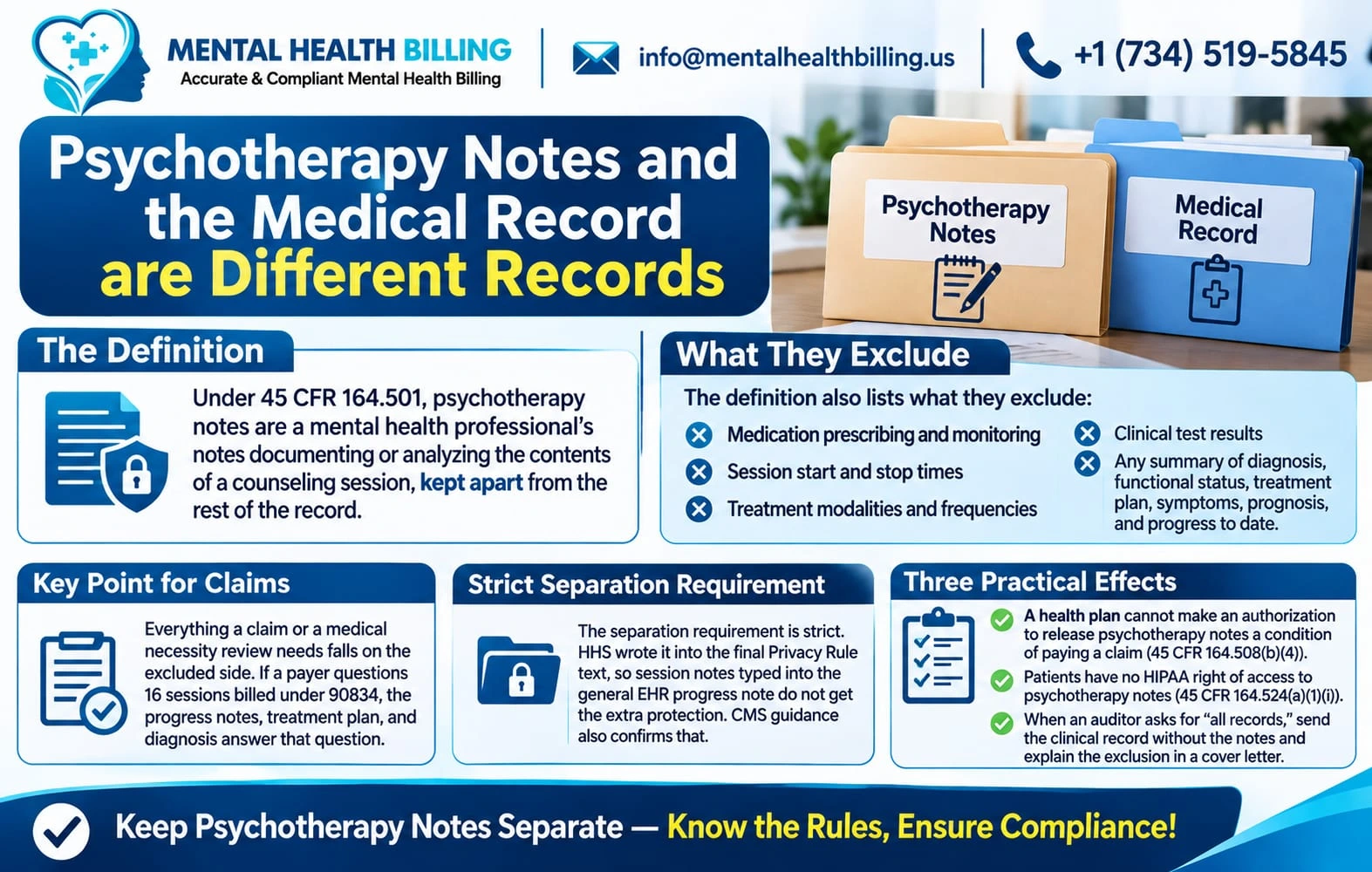
Billers should know this definition nearly word for word. Under 45 CFR 164.501, psychotherapy notes are a mental health professional's notes documenting or analyzing the contents of a counseling session, kept apart from the rest of the record. The definition also lists what they exclude: medication prescribing and monitoring, session start and stop times, treatment modalities and frequencies, clinical test results, and any summary of diagnosis, functional status, treatment plan, symptoms, prognosis, and progress to date.
Everything a claim or a medical necessity review needs falls on the excluded side. If a payer questions 16 sessions billed under 90834, the progress notes, treatment plan, and diagnosis answer that question, and none of them require authorization for payment purposes.
The separation requirement is strict. HHS wrote it into the final Privacy Rule text, so session notes typed into the general EHR progress note do not get the extra protection. CMS guidance to Medicare contractors made a related point: putting excluded information, such as a diagnosis, inside a psychotherapy note does not turn it into protected content.
This has three practical effects in a billing office. A health plan cannot make an authorization to release psychotherapy notes a condition of paying a claim (45 CFR 164.508(b)(4)). Patients have no HIPAA right of access to psychotherapy notes (45 CFR 164.524(a)(1)(i)), although the clinician may choose to share them. And when an auditor asks for "all records," the practice should send the clinical record without the separately kept notes and explain the exclusion in a cover letter.
How Much a Payer Is Entitled to See
The minimum necessary standard at 45 CFR 164.502(b) limits PHI disclosed for payment to what the purpose reasonably requires. It does not apply to disclosures for treatment, which is why a referral letter to a psychiatrist can say more than an appeal packet.
In daily billing work, the standard is specific. A records request for one date of service gets that date's documentation, not the full chart since intake. An eligibility call needs the member ID and the CPT code, and trauma history stays out of it. A collection agency, which is a business associate, gets the balance, service dates, and contact details, with no need for diagnosis codes.
There is a useful safe harbor. Under 45 CFR 164.514(d)(3)(iii), a provider may rely on another covered entity's request, such as a health plan's documentation list, as the minimum necessary when that reliance is reasonable. Billers can send what the payer specifically asked for. Volunteering extra pages falls outside that protection.
When Patients Pay Out of Pocket to Keep a Service Private
Many therapy clients pay cash precisely so their insurer never sees a mental health diagnosis. Since the 2013 Omnibus Rule, federal law backs that choice. Under 45 CFR 164.522(a)(1)(vi), a provider must agree to a patient's request not to disclose PHI to a health plan when three conditions are met: the disclosure is for payment or health care operations, it is not otherwise required by law, and the service was paid in full by the patient or someone other than the plan.
Most restriction requests under HIPAA can be declined. This one cannot, so the billing workflow has to support it. The restricted encounter needs a flag in the practice management system so it never drops into a claim batch. The restriction stays in place if the patient later uses insurance for other services, since only the paid service is shielded. Bundled services need care: when a service cannot be unbundled, HHS treats the bundle as one service, so the patient has to pay for all of it to restrict it.
Network contracts sometimes require providers to bill every covered service. OCR has indicated that a plan contract cannot override the patient's right to pay in full and restrict disclosure, a position the American Dental Association relays in its compliance guidance to members.
Substance Use Disorder Records After the February 2026 Part 2 Deadline
Practices that treat addiction, or that receive records from a federally assisted SUD program, work under a second rulebook. HHS issued a final rule revising 42 CFR Part 2 in February 2024 to carry out the CARES Act's direction to align Part 2 with HIPAA. The rule took effect April 16, 2024, and compliance became mandatory on February 16, 2026, according to the HHS Office for Civil Rights.
The changes that affect billing fall into two groups. On the consent side, a single patient consent can now cover all future uses and disclosures for treatment, payment, and health care operations, replacing consent tied to specific disclosures. Business associates were also added to the definition of a qualified service organization, which brings billing companies and clearinghouses into the rule's text.
Enforcement changed shape as well. Part 2 breaches now trigger HIPAA breach notification, violations carry HIPAA's civil and criminal penalty structure instead of criminal fines alone, and the HHS Office for Civil Rights has taken over enforcement from U.S. Attorneys.
OCR began accepting Part 2 complaints and breach reports on February 16, 2026, and HHS announced a new civil enforcement program on February 13, three days before the deadline. HIPAA covered entities that receive or keep Part 2 records also had to revise their Notices of Privacy Practices by the same date.
One protection survived the alignment. Part 2 records still cannot be used in civil, criminal, administrative, or legislative proceedings against the patient without specific consent or a court order. Any subpoena that touches SUD records belongs with legal counsel, not the billing desk.
Where Enforcement Lands: Security and Risk Analysis
Two recent OCR settlements with behavioral health organizations had nothing to do with a clinician oversharing. Both came down to a missing Security Rule risk analysis.
On July 7, 2025, OCR announced a $225,000 settlement with Deer Oaks (The Behavioral Health Solution), a San Antonio provider of psychological and psychiatric services to residents of long-term care and assisted living facilities. Patient discharge summaries had been reachable online without authorization, and a later ransomware attack was reported as affecting 171,871 people. OCR concluded the company had not conducted an accurate and thorough risk analysis. The agreement adds a corrective action plan and two years of OCR monitoring.
Top of the World Ranch Treatment Center, an Illinois SUD treatment provider, settled over the same failure as the 11th action in OCR's Risk Analysis Initiative.
The claims pipeline has its own warning. The February 2024 ransomware attack on Change Healthcare, a UnitedHealth Group clearinghouse, affected about 192.7 million people, the largest health data breach ever reported to HHS. In congressional testimony, UnitedHealth CEO Andrew Witty said attackers used compromised credentials to enter a Citrix remote access portal, and later reporting found that portal had no multifactor authentication.
For a small practice, the lesson is specific. A written risk analysis is required by 45 CFR 164.308(a)(1)(ii)(A), and it should cover the EHR, the practice management system, the clearinghouse connection, the billing company, and every laptop used for telehealth. It is typically the first document OCR asks for after a breach.
A Security Rule overhaul proposed in January 2025, which would make safeguards such as multifactor authentication mandatory, has been moved to HHS's long-term agenda with final action projected for July 2027. The current rule remains fully enforceable in the meantime.
HIPAA Penalty Amounts in 2026
HHS published inflation-adjusted civil money penalties on January 28, 2026. In an October 21, 2026 Federal Register notice, it confirmed those figures stay in place for the rest of 2026 because the Office of Management and Budget cancelled that year's adjustment. The amounts are set out in 45 CFR 102.3.
| Penalty tier | Violation category | Penalty amount |
|---|---|---|
| Tier 1 | Violations the provider did not know about and could not have known about with reasonable diligence | $145 to $73,011 per violation |
| Tier 2 | Reasonable cause without willful neglect | $1,461 to $73,011 per violation |
| Tier 3 | Willful neglect corrected within 30 days | $14,602 to $73,011 per violation |
| Tier 4 | Willful neglect left uncorrected for more than 30 days | $73,011 to $2,190,294 per violation |
The regulation caps each tier at $2,190,294 per calendar year for violations of the same provision.
Under a 2019 notice of enforcement discretion, OCR applies lower annual caps to tiers 1 through 3 (the tier 3 cap, for example, is $365,052). Most investigations end in a settlement and corrective action plan rather than a formal penalty. State attorneys general can also bring HIPAA actions under authority granted by the HITECH Act.
Compliance Steps for Mental Health Billing Teams
Record handling is the starting point. Psychotherapy notes belong in storage separate from progress notes, with access limited to the treating clinician. A written records-request procedure should release progress notes, treatment plans, and diagnoses for payer reviews while withholding psychotherapy notes unless the patient signs a specific authorization.
The systems need matching controls. A self-pay restriction flag in the practice management system should be tested to confirm flagged encounters stay out of claim batches. Business associate agreements should be in place with the billing company, clearinghouse, collection agency, and any cloud EHR or telehealth vendor.
Special records need their own review. Practices should identify which records are Part 2 records, confirm the single treatment, payment, and operations consent form meets 42 CFR 2.31, and check that the Notice of Privacy Practices was updated by February 16, 2026. A written, dated risk analysis should be redone whenever systems or vendors change, and state law should be checked for extra consent rules before mental health records cross state lines.
Conclusion
HIPAA compliance in mental health billing rests on four rules: payers get the clinical record they need for payment, psychotherapy notes stay separate and require authorization, self-pay patients can block disclosure to their plan, and SUD records now carry HIPAA-level penalties and breach duties under the revised Part 2. The behavioral health settlements OCR announced in 2025, including $225,000 from Deer Oaks, grew out of missing risk analyses rather than coding errors, so the security file deserves the same scrutiny as the claim file.