



Best Mental Health Billing Software in 2026: Complete Guide
Mental health billing runs on rules that general medical billing doesn’t have to think about. A missed modifier on a telehealth psychotherapy claim, a session limit that doesn’t match what the parity law actually requires, or a substance use disorder record shared without the right consent, and a practice loses revenue or picks up a compliance complaint. Choosing mental health billing software in 2026 means weighing platforms against a regulatory backdrop that shifted in real ways this year: a federal privacy rule for substance use disorder records hit its compliance deadline, federal regulators withdrew their defense of the newest mental health parity rule, and Medicare’s telehealth policy for behavioral health became close to permanent. This guide covers what changed, what the leading platforms actually cost, and how to match a system to a practice’s size and specialty.
Why mental health billing works differently
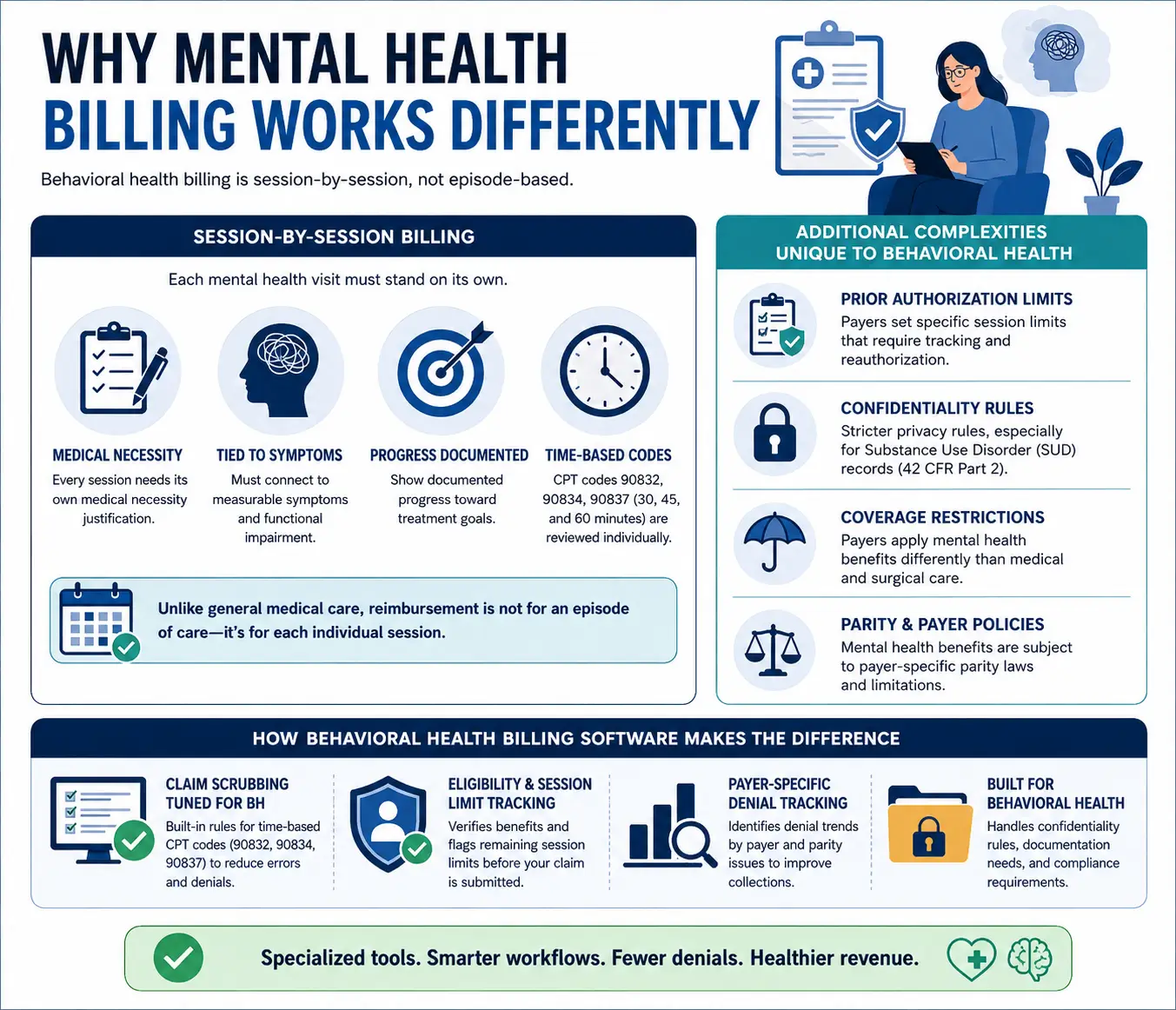
General medical billing usually ties reimbursement to a diagnosis and a treatment plan. Behavioral health billing works session by session. Each visit needs its own medical necessity justification, tied to measurable symptoms, functional impairment, and documented progress toward treatment goals, because time-based CPT codes such as 90832, 90834, and 90837 (30, 45, and 60 minute psychotherapy) get reviewed individually rather than as part of one broader episode of care. Layer on prior authorization limits tied to a specific number of sessions, separate confidentiality rules for substance use disorder records, and coverage restrictions payers apply to mental health differently than to medical and surgical care, and it’s clear why general practice management tools built for primary care or orthopedics tend to underperform for therapists, psychiatrists, and addiction treatment programs. Billing software built specifically for behavioral health typically bundles claim scrubbing tuned to these time-based codes, eligibility verification that flags remaining session limits, and denial tracking sorted by payer-specific parity issues, none of which a general EHR treats as a priority.
The regulatory backdrop shaping 2026 purchases
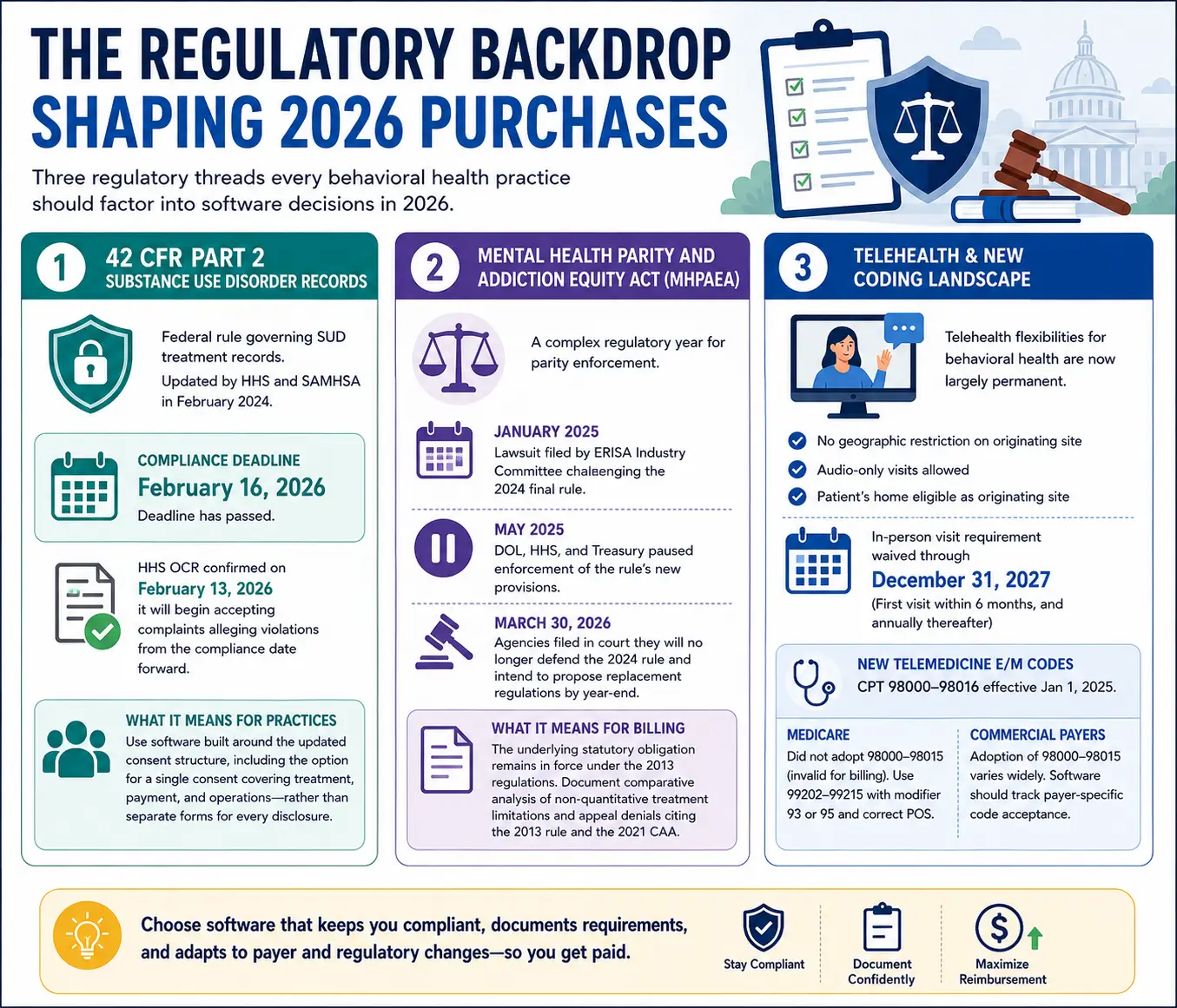
Three regulatory threads matter more this year than in the recent past, and any software evaluation should account for all three.
The first is 42 CFR Part 2, the federal rule governing substance use disorder treatment records. The Department of Health and Human Services and the Substance Abuse and Mental Health Services Administration finalized updates to Part 2 in February 2024, giving providers, health plans, and software vendors until February 16, 2026 to comply. That deadline has passed, and HHS’s Office for Civil Rights confirmed on February 13, 2026 that it would begin accepting complaints alleging violations from the compliance date forward. Practices billing for substance use disorder treatment need software built around the updated consent structure, including the option for a single consent covering treatment, payment, and operations, rather than a separate signed form for every disclosure.
Second is the Mental Health Parity and Addiction Equity Act (MHPAEA), and it has had a stranger regulatory year than most practices realize. The 2024 final rule, which added a “meaningful benefits” standard and outcomes testing for insurers, drew a lawsuit from the ERISA Industry Committee in January 2025. The Departments of Labor, Health and Human Services, and the Treasury paused enforcement of the rule’s new provisions in May 2025, and in a March 30, 2026 court filing went further, stating they would no longer defend the 2024 rule and intend to propose replacement regulations by the end of the year. The underlying statutory obligation, including the requirement to document a comparative analysis of non-quantitative treatment limitations, remains in force under the 2013 regulations regardless of what happens to the 2024 rule. For billing purposes, this means parity-related denials are still worth appealing, but an appeal should cite the 2013 rule and the 2021 Consolidated Appropriations Act rather than the shelved 2024 provisions.
The third thread is telehealth. According to the U.S. Department of Health and Human Services’ telehealth policy office, behavioral and mental health telehealth flexibilities are now largely permanent: no geographic restriction on originating site, audio-only visits allowed, and the patient’s home eligible as the originating site. The requirement for an in-person visit within six months of a patient’s first mental health telehealth appointment, and annually afterward, is waived through December 31, 2027. Non-behavioral telehealth flexibilities, extended by Congress on February 3, 2026, run on a similar timeline but stay subject to renewal. On top of this, the American Medical Association introduced a new telemedicine E/M code family, CPT 98000 through 98016, effective January 1, 2025. Medicare did not adopt codes 98000 through 98015 (CMS assigned them an invalid status for billing purposes) and instead expects providers to keep using standard office E/M codes 99202 through 99215 with modifier 93 or 95 and the correct place of service. Medicare does recognize CPT 98016, a brief virtual check-in that replaces the retired HCPCS code G2012. Commercial payers have been inconsistent about adopting the new code family, so software that tracks payer-specific code acceptance saves a fair amount of rework.
Why denial rates run so high in this specialty
Behavioral health claims are denied at a noticeably higher rate than general medical claims. The Medical Group Management Association’s 2024 Cost and Revenue Report put the average initial denial rate across specialties at 11.8%. Denial-rate analyses published in 2026 by revenue-cycle firms including Alleva and blueBriX put behavioral health specifically in the 12% to 25% range, roughly double the rate for medical and surgical claims. The causes cited most often are modifier and place-of-service errors on telehealth claims, authorization limits that lapse mid-treatment, and medical necessity documentation that doesn’t hold up under a payer’s utilization review. Because so much of behavioral health billing depends on documentation that lives inside the clinical note rather than the claim form, platforms that connect notes directly to claims tend to prevent more denials than billing software bolted onto a separate EHR.
What a platform needs to actually reduce denials
A handful of features separate software built for the specialty from general practice management tools adapted to it. Claim scrubbing needs to check time-based codes against documented session length, not just against a diagnosis code. Eligibility verification should flag remaining session limits and authorization status before the appointment happens, not after the claim bounces. Electronic remittance advice (ERA) posting should reconcile automatically against the contracted fee schedule so a biller catches underpayment, not only outright denial. For programs handling both mental health and substance use disorder treatment, the software also needs to segregate Part 2-protected records from the rest of the chart while still supporting the consolidated consent the 2026 rule permits.
Comparing mental health billing software platforms
Platform | Starting price (vendor pricing, verified mid-2026) | Best fit | Notable billing feature |
SimplePractice | $49/month (Starter) up to $99/month (Plus) | Solo and small group therapy practices | Integrated clearinghouse; roughly 35 free claims a month on the Plus plan |
TherapyNotes | $69/month solo; $79/month + $50/clinician for groups | Solo clinicians and small groups wanting self-managed billing | Electronic claims and ERA at $0.14 each; structured, self-managed insurance workflows |
TheraNest (Ensora Mental Health) | $29/month (Essentials) to $89/month (Premier), per therapist | Group practices and supervised training clinics | The only platform here offering fully outsourced billing (RCM) as an add-on |
ICANotes | $55/month (notes only) to $213/month (prescribing clinician) | Psychiatry and multidisciplinary practices | Automated E/M coding tied to documentation; clearinghouse scrubs claims pre-submission |
Valant | $100 to $300/month per provider, custom quoted | Multi-provider psychiatric and behavioral health organizations | Measurement-based care data feeds directly into documentation and billing |
SimplePractice raised its Starter plan from $29 to $49 a month in 2026, a change several independent pricing trackers documented, with roughly a month’s notice given to existing customers. Industry write-ups in 2026 put its user base above 250,000 therapists and wellness professionals, making it the largest platform in this group by count, and it suits solo practitioners who want scheduling, documentation, and billing in one system without a steep learning curve. TherapyNotes costs more per clinician as a group grows, but users and reviewers frequently point to it as the more dependable option for self-managed insurance billing, with workflows structured enough to leave less room for coding errors. TheraNest stands out for practices that would rather hand billing off entirely, since it’s the only platform in this set with a native outsourced revenue cycle management service built in. ICANotes and Valant both target practices with a heavier psychiatric caseload: ICANotes ties billing directly to a menu-driven documentation system that generates evaluation and management codes automatically, while Valant relies on structured outcomes data that larger, multi-location organizations often need for payer reporting.
Practices running addiction treatment programs, applied behavior analysis (ABA) clinics, or community mental health centers frequently need more than these five platforms offer. ABA billing in particular revolves around authorization-hour tracking tied to approved treatment plans, which is why specialty tools such as CentralReach exist alongside the therapy-focused platforms above; general therapy EHRs typically don’t track authorized hours the way ABA billing requires. Community mental health centers and Certified Community Behavioral Health Clinics more often evaluate larger systems built around cost-report and value-based payment requirements that solo-practice platforms were never designed to handle.
Matching software to practice type
A solo therapist running a private-pay or light-insurance caseload rarely needs more than SimplePractice or TherapyNotes offers out of the box. A group practice with five or more clinicians should weigh per-clinician pricing carefully: SimplePractice charges $69 to $74 per additional clinician on its Plus plan depending on group size, while TherapyNotes charges a flat $50, so the gap widens as headcount grows. Psychiatric practices billing E/M codes alongside psychotherapy add-on codes (90833, 90836, 90838) tend to benefit from ICANotes’ or Valant’s tighter documentation-to-billing integration, since those add-on codes have to pair correctly with the underlying E/M service to get paid. Addiction treatment programs subject to the updated 42 CFR Part 2 rules should confirm, before signing a contract, that a vendor’s consent management tools were actually rebuilt for the February 2026 compliance deadline rather than left at the pre-2024 standard.
What this means for billing and coding students entering the field
The Bureau of Labor Statistics classifies most billing and coding roles under medical records specialists, a category with a median annual wage of $50,250 as of May 2024 and projected employment growth of 7% from 2024 to 2034, adding roughly 14,200 openings a year nationally. Behavioral health billing is a reasonable specialization to aim for within that broader field, precisely because of the complexity outlined above: the CPT codes are time-based rather than diagnosis-driven, the parity law creates appealable denial categories general medical billers rarely encounter, and the 2026 changes to substance use disorder confidentiality rules add a compliance dimension most billing coursework only covers briefly. Students preparing for this specialty benefit from getting comfortable with the standard psychotherapy code set, 90791 for the initial diagnostic evaluation, 90832/90834/90837 for individual therapy by session length, 90847 for family therapy with the patient present, and 90853 for group therapy, alongside the newer telemedicine codes and Medicare’s narrower acceptance of them. Hands-on familiarity with one of the platforms above, many training programs now offer trial access to SimplePractice or TherapyNotes, gives a practical edge over coursework built entirely around generic billing software a future employer won’t actually use.
Choosing between these options
The right mental health billing software depends on where a practice’s denials actually come from, not on which vendor lists the most features. A solo practitioner losing time to scheduling friction needs a different tool than a group practice losing revenue to expired authorizations, and both need something different from an addiction treatment program managing Part 2 consent across multiple sites. Before signing an annual contract, it’s worth pulling six months of denial data, if the practice has any, and checking which platform’s claim-scrubbing rules would have caught those specific errors. That comparison tends to matter more than any pricing table, including the one above.