


Most denied mental health claims at Priority Health come down to a few questions. Is the clinician credentialed for that plan? Whose NPI is in box 24J? Does the member's care belong to Priority Health or to a regional PIHP? How many days are left on the filing clock?
None of these rules is secret. They are spread across more than a dozen pages of the Priority Health Provider Manual, and several changed in 2025 and 2026. This guide gathers the Priority Health mental health billing guidelines that Michigan providers, billers and coding students need most, and names the manual page or policy behind each rule. Priority Health revises these pages often, and the manual, not any article, controls payment.
The rules apply to commercial group HMO, EPO, POS and PPO plans, individual MyPriority plans, Medicare Advantage, and the Medicaid and Healthy Michigan Plan products run through Priority Health Choice. Where a rule differs by product, the sections below say so.
One baseline fact first. Priority Health pays behavioral health services fee-for-service, and its commercial and Medicaid behavioral health fee schedules are posted by date of service and updated quarterly. Medicare Advantage has no separate behavioral health schedule. Those services are priced from the Medicare physician fee schedule using Michigan's two localities: locality 01 (Macomb, Oakland, Washtenaw and Wayne counties) and locality 99 (every other county). A therapist in Grand Rapids and one in Detroit can therefore see different Medicare Advantage allowables for the same CPT code.
Who can bill Priority Health for mental health services
To be paid in network, a practitioner must be credentialed by Priority Health and hold a license on that product's list. The lists are not identical.
On commercial HMO, EPO, POS and PPO plans, Priority Health credentials MDs and DOs, licensed psychologists (LP), limited licensed psychologists (LLP), licensed master's social workers (LMSW), licensed professional counselors (LPC), licensed marriage and family therapists (LMFT) and licensed behavior analysts (LBA). The Medicaid and Healthy Michigan Plan list is the same, minus LBAs. Medicare Advantage began with MDs, DOs, LPs and LMSWs, then added LMFTs, LPCs and LLPs on Jan. 1, 2024.
The Jan. 1, 2024 Medicare Advantage expansion lines up with the federal Consolidated Appropriations Act, 2023, which made marriage and family therapists and mental health counselors eligible to bill Medicare from that date.
Timing catches many new hires. Practices add a clinician through the Enrollments & Requests tab in prism, Priority Health's provider portal, and Priority Health sends a notice once the clinician is added. Claims with dates of service before that notice are denied. A new therapist who starts seeing Priority Health members a week early is billing into a denial.
Limited license practitioners and the AJ and HO modifiers
Limited licensed master's social workers (LLMSW), limited licensed counselors (LLC) and temporary limited licensed psychologists (TLLP) cannot be credentialed or bill in their own names, in network or out. They may treat commercial and Medicaid members within their scope, under a fully licensed, credentialed supervisor. They may not treat Medicare Advantage members.
Each limited license has a matching supervisor and modifier. An LLMSW works under an LMSW and is billed with modifier AJ. An LLC works under an LPC, and a TLLP works under an LP; both are billed with modifier HO. In every case the modifier goes in box 24D, and the supervisor's Type 1 NPI goes in box 24J as the rendering provider.
Payment is made at the supervisor's licensure rate. The supervisor must also document in the member's record that they reviewed the limited licensee's note within one week of each visit. That signature trail is what a records request will look for.
Take a TLLP in a Lansing group practice who sees a commercial member for a 45-minute session. The claim carries the supervising psychologist's Type 1 NPI in 24J and HO in 24D, and pays at the LP rate. If the member's spouse is on Priority Health Medicare Advantage, the TLLP cannot treat the spouse at all.
Two exceptions apply. When a limited licensed psychologist (LLP) performs psychological testing, the supervising LP is billed as rendering provider. Appropriately licensed non-physician clinicians working in an accredited organization credentialed as an Organizational Provider do not need individual credentialing.
Prior authorization for behavioral health services
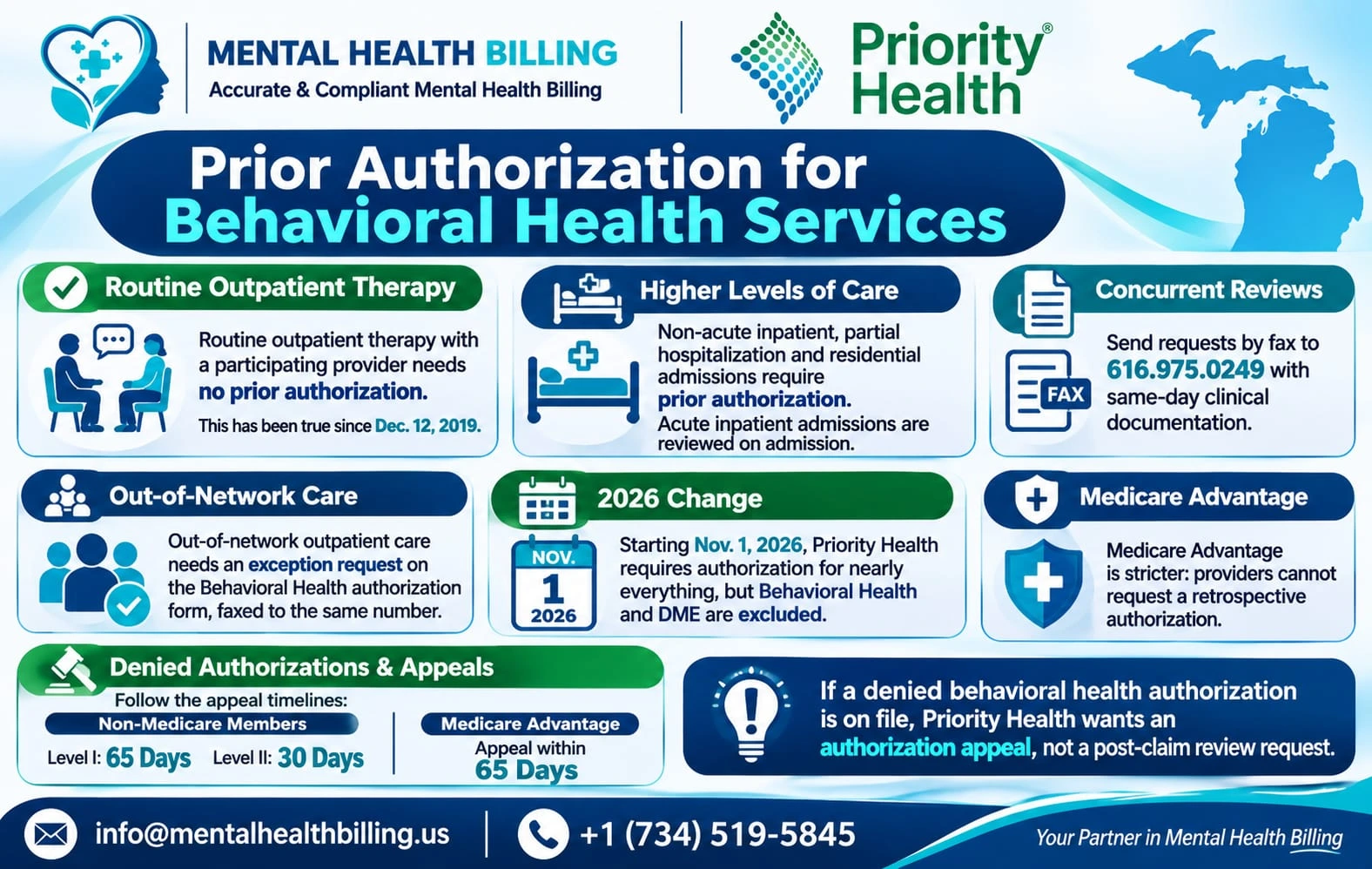
Routine outpatient therapy with a participating provider needs no prior authorization. That has been true for Medicaid outpatient behavioral health therapy since Dec. 12, 2019, when Priority Health dropped the requirement and stopped asking for clinical documentation on those requests.
Higher levels of care work differently.
Non-acute inpatient, partial hospitalization and residential admissions all require prior authorization. Acute (emergency) inpatient admissions are reviewed on admission instead, with the facility notifying Priority Health and sending clinical records. Concurrent review requests go by fax to 616.975.0249 with same-day clinical documentation, using the authorization form as the cover sheet.
Out-of-network outpatient care needs an exception request on the Behavioral Health authorization form, faxed to the same number. When Priority Health is the secondary payer, inpatient behavioral health does not need its authorization.
One 2026 change does not reach behavioral health. Starting Nov. 1, 2026, Priority Health requires authorization before the service for nearly everything on its list, but its announcement explicitly excludes behavioral health and durable medical equipment. Medicare Advantage is stricter on its own terms: providers cannot request a retrospective authorization for those members.
Denied authorizations follow their own appeal track. For non-Medicare members, a Level I behavioral health authorization appeal is due within 65 days of the initial decision, and a Level II appeal within 30 days of the Level I denial. Medicare Advantage appeals are filed through prism within 65 days of the denial notice. If a denied behavioral health authorization is on file, Priority Health wants an authorization appeal, not a post-claim review request.
Medicaid and Healthy Michigan Plan: Priority Health or the PIHP?
Michigan splits Medicaid behavioral health between health plans and Prepaid Inpatient Health Plans (PIHPs), and billing the wrong one is a common Medicaid denial.
Priority Health covers outpatient therapy for Medicaid and Healthy Michigan Plan members with mild to moderate mental health needs, plus some substance use disorder needs with minimal clinical risk. Adults with serious mental illness, children with serious emotional disturbance, and members with substance use disorders or developmental disabilities (as the Michigan Mental Health Code defines them) belong to the PIHP. For those services, providers refer the member and bill the PIHP in the member's county of residence, not Priority Health. A member already served in the PIHP system is generally not eligible for outpatient mental health services through Priority Health.
Priority Health's coordination-of-benefits page adds a limit that surprises some billers: under its Medicaid and Healthy Michigan Plan product, inpatient behavioral health and long-term psychotherapy are not covered. Eligibility questions go to the Priority Health Behavioral Health department at 616.464.8500. Providers not contracted for the Medicaid product are paid at the Michigan Medicaid fee schedule for covered services.
LOCUS and MichiCANS screening codes
Priority Health pays eligible providers for the state-required Level of Care Utilization System (LOCUS) and Michigan Child and Adolescent Needs and Strengths (MichiCANS) screenings for its Medicaid members, in person or by telehealth when clinically appropriate. Only these code and modifier pairs are accepted, whatever the national code descriptor says.
The MichiCANS screener is billed as H0002 with modifier 7Y, and LOCUS as H0031 with modifier WX.
Both appear in Behavioral Health billing policy #054. Priority Health added a modifier table to that policy in June 2026; modifiers marked with an asterisk deny when a global code was already billed for the service.
Telehealth billing for behavioral health
Priority Health says it aligns its virtual care billing with the AMA, CMS and the Michigan Department of Health and Human Services (MDHHS). In practice the rules split by product. Medicare Advantage follows CMS telehealth guidance. Medicaid follows MDHHS. Commercial plans have covered the AMA's new telehealth codes, 98000 through 98016, since Jan. 1, 2025, in addition to standard E/M codes. Medicare does not recognize that code range, so Priority Health does not cover it for Medicare Advantage members.
Audio-only visits need care. Priority Health's behavioral health virtual care page still says audio-only visits must be billed with 99441-99443 or 98966-98968 (a rule dated July 1, 2020), using the place of service you would normally report for your office. The AMA deleted 99441-99443 from CPT effective Jan. 1, 2025, so that instruction predates the current code set. Before billing an audio-only session, check medical policy #91604 (Telemedicine / Virtual Services) or ask provider services which codes apply to the member's product.
There is also a clinical limit. The manual says telehealth outside a hosted site should be limited to stable patients with straightforward needs, and that patients with acute psychiatric needs may not be candidates. Document why a virtual visit suited the patient that day.
Timely filing, corrected claims and audit flags
Priority Health gives providers 12 months from the date of service to finish billing, including fixing every claim discrepancy. When a denial arrives close to or past that mark, there are 90 days from the original denial to resolve it. Forgetting a claim does not earn an exception.
Corrections follow fixed mechanics.
Since June 2, 2025, every correction, professional or facility, must go in as a corrected claim with frequency code 7, whatever the original claim paid. On a CMS-1500, the original claim number goes in box 22, and the entire claim is resent, not only the changed lines.
Claims go electronically or by mail to Priority Health Claims, P.O. Box 232, Grand Rapids, MI 49501. Faxed, emailed and handwritten claims are refused. FQHCs, RHCs and tribal health centers bill behavioral health on the institutional 837I/UB form, under the same rules as their other services.
Appeals run on separate clocks. Medicaid post-claim appeals are due within 180 days of the remittance advice. Commercial appeals are accepted only after the Informal Claim Review step is complete.
Priority Health also screens behavioral health claims as part of its fraud, waste and abuse program. Its manual names three patterns that can flag a provider for review: excessive billing of high-level codes, exclusive use of one code level, and excessive units for a time-based code. Psychotherapy codes are time-based. Under CPT, 90832 covers 16 to 37 minutes, 90834 covers 38 to 52, and 90837 covers 53 minutes or more. A practice that bills 90837 for nearly every session fits two of those patterns at once, so start and stop times in the note matter.
Priority Health mental health billing checklist for Michigan providers
Before a behavioral health claim leaves the office, five checks prevent most Priority Health denials. Confirm the clinician is credentialed for the member's product and that the prism notice predates the visit. Put the right Type 1 NPI in box 24J, with AJ or HO in box 24D for limited licensees. Route Medicaid members with serious needs to the PIHP in their county. Obtain authorization for inpatient, partial and residential care, since outpatient therapy with a participating provider needs none. Submit within 12 months, and correct with frequency code 7. Fee schedules change quarterly and policy #054 changed in June 2026, so the manual pages below are worth rechecking each quarter.