



A couple books a weekly session. One partner has a documented major depressive disorder, and the other attends every appointment. Whether that hour gets paid depends less on the therapy itself than on three billing decisions: who the identified patient is, which family psychotherapy code fits the session, and whether the payer accepts the diagnosis on the claim.
Couples and family therapy billing is awkward because the CPT code set contains no code called "couples therapy." Claims go out under the family psychotherapy codes, which the American Medical Association (AMA) builds around one identified patient rather than around a relationship. That single design choice explains a large share of the denials coders see.
This guide covers the codes, the time rules, diagnosis requirements, Medicare policy as of November 2026, telehealth, and the documentation payers check in an audit.
The family psychotherapy CPT codes
Three codes cover couples and family therapy. The deciding question for 90846 versus 90847 is simple: was the identified patient in the session? A partner or relative who attends does not change who the claim belongs to.
Family psychotherapy without the patient
Family psychotherapy with family members or a partner while the identified patient is absent.
Family psychotherapy with the patient
Family psychotherapy with the identified patient present in the session.
Multiple-family group psychotherapy
Multiple families participating in one group psychotherapy session.
Both 90846 and 90847 list 50 minutes, with a 26-minute minimum, and Medicare covers both only when the session treats the beneficiary's own condition. Code 90849 brings together members of several families in one group, has no time in its descriptor, and is generally not covered by Medicare.
A typical couples session with both partners in the room goes on 90847, billed under the identified patient's name, insurance and diagnosis. Code 90846 fits narrower situations, such as a session with the parents of a hospitalized adolescent, or with the spouse of a patient with dementia whose caregiving patterns are aggravating the patient's agitation.
Code 90849 describes multiple-family group psychotherapy. According to the AAPC's Psychiatry Coding & Reimbursement Alert, it is reported once for each family group participating in the session. Commercial plans and Medicaid programs are more likely to pay for it than Medicare.
Time rules and same-day limits
Until 2016, 90846 and 90847 carried no time component at all. The 2017 CPT revision added "50 minutes" to both descriptors and, at the same time, removed the "and/or family member" language from the individual psychotherapy codes (90832 to 90838). Under the CPT time rule, a unit is earned once more than half the stated time has passed. The AMA's CPT Assistant (March 2017) confirmed that 90846 requires at least 26 minutes and cannot be reported for a 20-minute service.
There is no extended-session family code. A 90-minute couples session is still one unit of 90847.
Three same-day rules generate frequent edits. The first concerns the interactive complexity add-on. CPT's parenthetical note limits 90785 to 90791, 90792, 90832 to 90838 and 90853, so it cannot be reported with 90846 or 90847, where communication difficulty with family members is treated as built into the service. Second, most payers will not pay 90846 and 90847 for the same patient on the same date, even for two separate meetings. Third, individual and family psychotherapy on one date triggers National Correct Coding Initiative (NCCI) edits, so both services need separate documentation showing they were distinct.
The individual codes have their own presence rule. As Psychiatric News reported in November 2016, CMS requires the patient to be present for at least the majority of an individual psychotherapy session. A session where a parent talks for 35 of 45 minutes may belong on a family code, provided it reaches 26 minutes.
Diagnosis coding and the identified patient
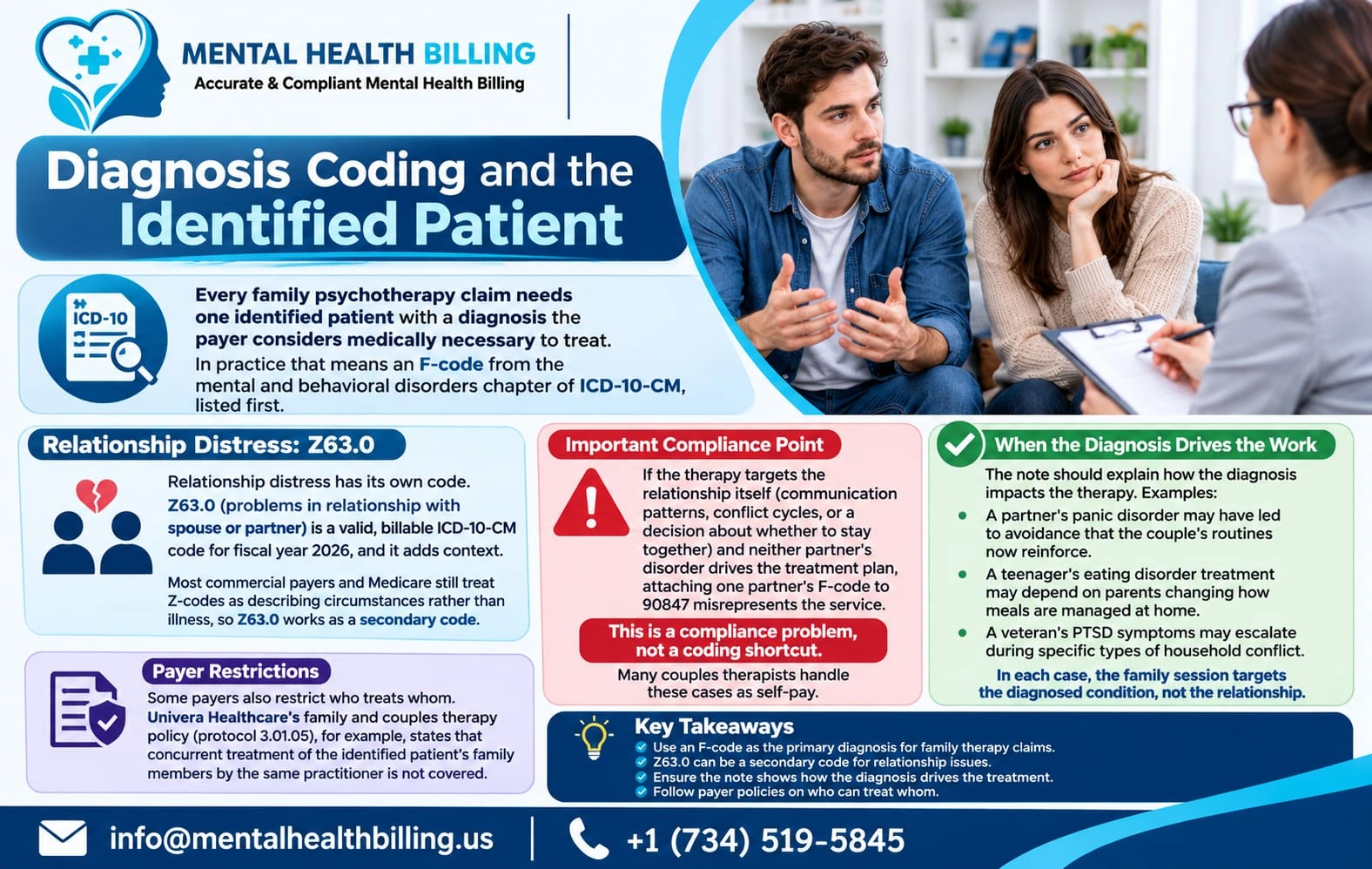
Every family psychotherapy claim needs one identified patient with a diagnosis the payer considers medically necessary to treat. In practice that means an F-code from the mental and behavioral disorders chapter of ICD-10-CM, listed first.
Relationship distress has its own code. Z63.0 (problems in relationship with spouse or partner) is a valid, billable ICD-10-CM code for fiscal year 2026, and it is the accurate description of what many couples present with. Most commercial payers and Medicare still treat Z-codes as describing circumstances rather than illness, so Z63.0 works as a secondary code that adds context, not as the diagnosis that carries the claim.
This creates the ethical pressure point in couples billing. If the therapy targets the relationship itself (communication patterns, conflict cycles, a decision about whether to stay together) and neither partner's disorder drives the treatment plan, attaching one partner's F-code to 90847 misrepresents the service. That is a compliance problem, not a coding shortcut. Many couples therapists handle these cases as self-pay.
When the diagnosis does drive the work, the note should say how. A partner's panic disorder may have led to avoidance that the couple's routines now reinforce. A teenager's eating disorder treatment may depend on parents changing how meals are managed at home. A veteran's PTSD symptoms may escalate during specific types of household conflict. In each case the family session targets the diagnosed condition, not the relationship for its own sake.
Some payers also restrict who treats whom. Univera Healthcare's family and couples therapy policy (protocol 3.01.05), for example, states that concurrent treatment of the identified patient's family members by the same practitioner is not covered.
Medicare insurance requirements for family therapy
Medicare covers 90846 and 90847 only when the primary purpose is treating the beneficiary's own condition. Coverage details sit in each Medicare Administrative Contractor's local coverage determination (LCD). Novitas Solutions' Psychiatric Codes LCD, as summarized by the Texas Medical Association, says family therapy fits when changing family interactions is expected to improve or stabilize the patient's emotional or behavioral disturbance.
The same LCD draws clear limits. A comatose patient does not qualify, because family interaction patterns cannot affect that patient's condition. A family member's own emotional disturbance is not covered under the patient's benefit. When both spouses have Medicare, though, conjoint therapy may be the most cost-effective treatment for both. Code 90846 does not cover routine consultation with facility staff about a patient's progress, and 90849 is generally not covered.
Marriage and family therapists in Medicare since 2024
The biggest change for this specialty came from Section 4121 of the Consolidated Appropriations Act, 2023. It created two new Medicare provider types, marriage and family therapists (MFTs) and mental health counselors (MHCs). Enrollment opened on November 2, 2023, and services became payable on January 1, 2024. CMS assigned them provider specialty codes E1 (MFT) and E2 (MHC).
To enroll, an MFT needs a master's or doctoral degree that qualifies for state licensure, a current state MFT license or certification, and at least two years or 3,000 hours of post-master's supervised clinical experience.
Payment is lower than for psychologists. Medicare pays 80 percent of the lesser of the actual charge or 75 percent of the psychologist fee schedule amount. For 2026, the base conversion factor is $33.4009 for clinicians outside qualifying alternative payment models (APMs) and $33.5675 for qualifying APM participants, the first year CMS has used two conversion factors. Part of the 2026 increase is a one-year 2.5 percent bump under the One Big Beautiful Bill Act, which expires on December 31, 2026. Billing teams should reload 90846 and 90847 rates from the CY 2027 fee schedule rather than rolling 2026 figures forward.
Commercial insurance, Medicaid and TRICARE
Outside Medicare, there is no single rulebook. Plans differ on whether they pay 90846 at all, and some set age limits of 18 or 21 for family therapy. Medicaid programs set their own family therapy policies state by state. TRICARE lists 90846, 90847 and 90849 among covered conjoint and family psychotherapy codes in its Policy Manual (Chapter 7, Section 3.10).
A benefits check for couples work should ask specific questions rather than "Is couples therapy covered?" Ask whether 90846 and 90847 are covered for this member's primary diagnosis, and whether the plan accepts the identified patient's diagnosis when the partner is not a member. Confirm whether prior authorization is required and how many sessions it covers, whether age or place-of-service limits apply to family codes, and whether the same clinician can bill individual and family sessions for this member.
Record the representative's name, date and call reference number. If the plan later denies a session it confirmed by phone, that record is the evidence the appeal needs.
Telehealth billing for couples and family sessions
Family psychotherapy is on Medicare's telehealth list, and MFTs and MHCs have counted as Medicare telehealth practitioners since January 1, 2024. The rules around location and in-person visits have shifted repeatedly. During the federal government shutdown that began October 1, 2025, many Medicare telehealth flexibilities briefly lapsed before being reinstated retroactively on November 12, 2025, according to KFF.
The current position comes from CMS's Telehealth FAQ, updated October 9, 2026. Beneficiaries can receive Medicare telehealth services from anywhere in the United States, including home, through December 31, 2027. Starting January 1, 2028, a new patient needs an in-person, non-telehealth visit within six months before the first mental health telehealth service delivered at home. Patients who began home mental health telehealth on or before December 31, 2027, are treated as established and need one in-person visit every 12 months after that date. Audio-only behavioral health services are allowed when the practitioner can offer video but the patient cannot use it or does not consent to it.
On the claim, Medicare uses place of service 10 for a patient at home and 02 for other locations, with modifier 93 for audio-only services. Commercial payers frequently require modifier 95 for synchronous video, so confirm each plan's convention during the benefits check. A practical complication with couples work: if partners join from two different locations, document where the identified patient was, because that location drives the place-of-service code.
Documentation that holds up, and the denials it prevents
An auditor reading a 90847 note wants to know why the other people were in the room. Each family or couples session note should name the identified patient, the primary diagnosis and any supporting Z-code. It should list every attendee by name and relationship, state whether the identified patient was present, and give start and stop times showing at least 26 minutes of psychotherapy.
The clinical content matters as much as the logistics
Record the interventions used, the family pattern they targeted, the goal in the identified patient's treatment plan that the session addressed, and the response observed. Keep consent and release forms for each participant where state law or practice policy requires them.
The denials coders see most often trace back to a handful of errors. Billing 90846 for a brief phone call with a parent leads to denial or recoupment, because a phone check-in is not family psychotherapy; bill only sessions of 26 minutes or more with psychotherapy content. Reporting 90846 and 90847 on the same date gets the second line denied, so choose the code that fits the longer, documented session.
Diagnosis order causes its own share. A claim with Z63.0 listed first is denied as not medically necessary, so the qualifying F-code goes first and Z63.0 second. A 90785 add-on attached to a family code will be denied. Multi-family groups billed to Medicare as 90849 are generally rejected as non-covered, so verify coverage before scheduling them. A claim filed under the attending partner rather than the identified patient's member ID produces an eligibility or diagnosis mismatch.
Couples and family therapy billing in summary
Couples and family therapy billing comes down to one identified patient, one qualifying diagnosis, and a session of at least 26 minutes that is documented as treating that patient's condition. Use 90847 when the patient attends and 90846 when they do not. Keep 90785 off family claims, list Z63.0 only as a secondary code, and treat 90849 as non-covered for Medicare unless a contractor says otherwise.
For Medicare, enrolled MFTs and MHCs have billed these codes since January 1, 2024, at 75 percent of the psychologist rate. Home telehealth stays available without an in-person visit through December 31, 2027. Practices that start new Medicare couples or family patients on video in 2027 should log each patient's telehealth start date now, since that date decides whether the six-month or the 12-month in-person rule applies in 2028.