



How Medicaid behavioral health billing differs from commercial billing
Three features catch new billers off guard.
The payer may not be the plan on the card
Many states "carve out" behavioral health, meaning a separate behavioral health organization or prepaid inpatient health plan (PIHP) pays for mental health services while a different managed care organization handles physical health. Others "carve in" both. A therapy claim sent to the medical MCO in a carve-out state will deny, no matter how clean it is.
Medicaid pays last
Under Section 1902(a)(25) of the Social Security Act, Medicaid is the payer of last resort. If a patient has Medicare, employer coverage, or a parent's commercial plan, that coverage must be billed first, and the Medicaid claim must show the primary payer's adjudication.
Parity rules apply
CMS extended the Mental Health Parity and Addiction Equity Act to Medicaid managed care plans, CHIP, and alternative benefit plans in a final rule published March 30, 2016, with compliance required by October 2, 2017. Plans cannot impose prior authorization or visit limits on mental health services that are more restrictive than those applied to comparable medical and surgical benefits. Billers who see a therapy visit cap with no equivalent cap on, say, physical therapy have grounds to escalate.
Verify eligibility on every date of service
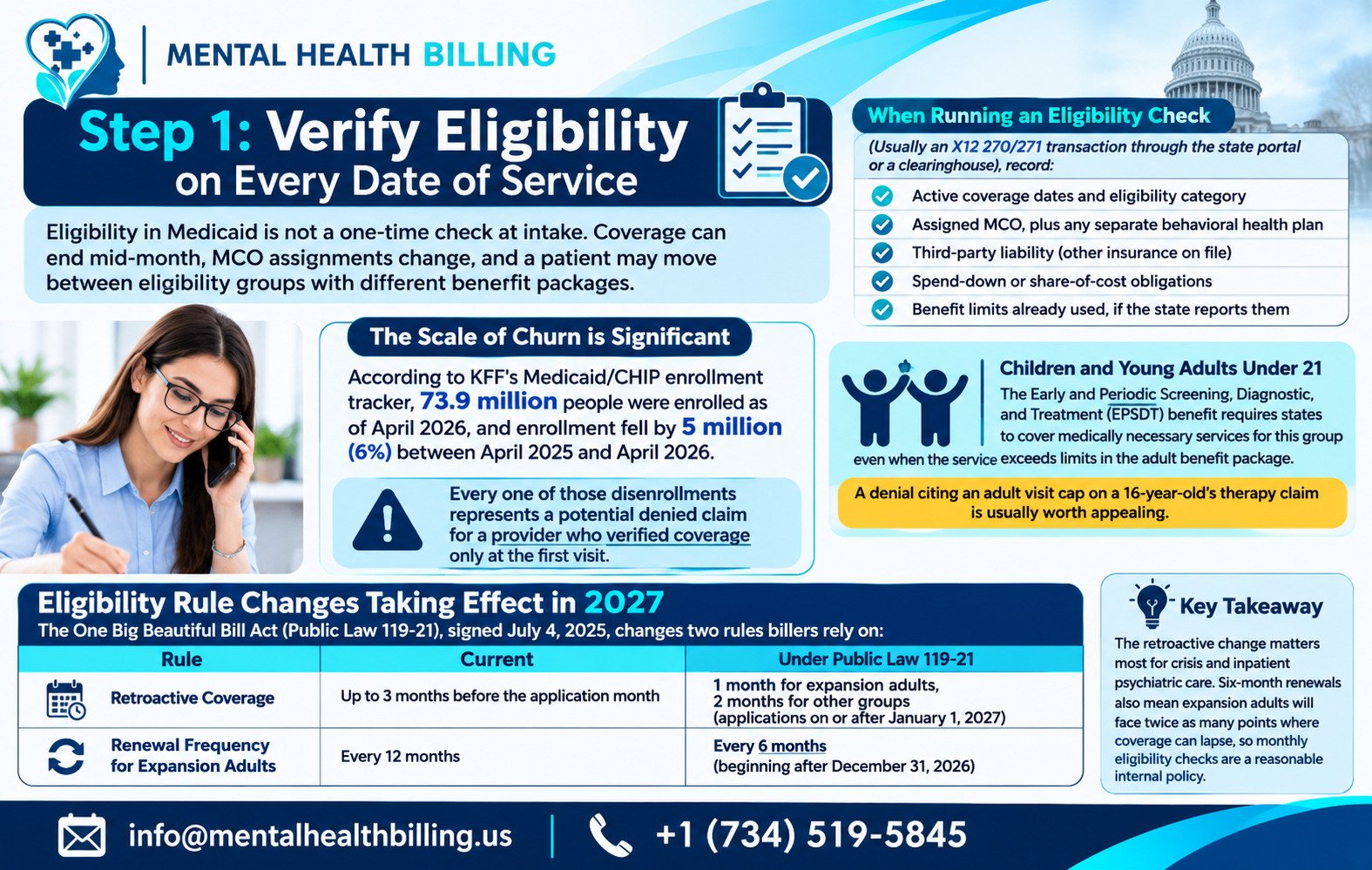
Eligibility in Medicaid is not a one-time check at intake. Coverage can end mid-month, MCO assignments change, and a patient may move between eligibility groups with different benefit packages.
The scale of churn is significant right now. According to KFF's Medicaid/CHIP enrollment tracker, 73.9 million people were enrolled as of April 2026, and enrollment fell by 5 million (6%) between April 2025 and April 2026. Every one of those disenrollments represents a potential denied claim for a provider who verified coverage only at the first visit.
When running an eligibility check (usually an X12 270/271 transaction through the state portal or a clearinghouse), record:
- Active coverage dates and eligibility category
- Assigned MCO, plus any separate behavioral health plan
- Third-party liability (other insurance on file)
- Spend-down or share-of-cost obligations
- Benefit limits already used, if the state reports them
Children and young adults under 21 deserve special attention. The Early and Periodic Screening, Diagnostic, and Treatment (EPSDT) benefit requires states to cover medically necessary services for this group even when the service exceeds limits in the adult benefit package. A denial citing an adult visit cap on a 16-year-old's therapy claim is usually worth appealing.
Eligibility rule changes taking effect in 2027
The One Big Beautiful Bill Act (Public Law 119-21), signed July 4, 2025, changes two rules billers rely on:
| Rule | Current | Under Public Law 119-21 |
|---|---|---|
| Retroactive coverage | Up to 3 months before the application month | 1 month for expansion adults, 2 months for other groups (applications on or after January 1, 2027) |
| Renewal frequency for expansion adults | Every 12 months | Every 6 months (beginning after December 31, 2026) |
The retroactive change matters most for crisis and inpatient psychiatric care, where patients often apply for Medicaid after treatment has already started. A practice that previously recovered three months of services through retroactive enrollment will have a narrower window. Six-month renewals also mean expansion adults will face twice as many points where coverage can lapse, so monthly eligibility checks for that population are a reasonable internal policy.
Prior authorization for mental health services
Which services need prior authorization depends entirely on the state and plan. Routine outpatient psychotherapy is often covered without authorization up to a set number of visits. Services that commonly require approval include:
- Psychological and neuropsychological testing (CPT 96130 through 96139)
- Intensive outpatient and partial hospitalization programs
- Inpatient psychiatric admissions
- Applied behavior analysis
- Therapy visits beyond a plan's initial threshold
Federal decision timeframes since January 1, 2026
The CMS Interoperability and Prior Authorization Final Rule (CMS-0057-F), published February 8, 2024, set new deadlines for Medicaid and CHIP fee-for-service programs and managed care plans. Since January 1, 2026, these payers must decide expedited (urgent) requests within 72 hours and standard requests within 7 calendar days, and every denial must include a specific reason. Virginia's Medicaid agency noted in a provider bulletin that this cut its standard managed care timeframe from 14 days to 7.
The rule's second phase arrives January 1, 2027, when payers must have a FHIR-based Prior Authorization API live. For practices, that should eventually mean checking authorization requirements and submitting requests from within the EHR rather than through a separate portal.
A practical point: an approval is only useful if the claim matches it. Payers compare the authorization against the claim's CPT or HCPCS code, units, date range, and rendering provider. Report the authorization number in item 23 of the CMS-1500 (or the corresponding prior authorization reference field in the 837P), and request a modification before the service if the treatment plan changes.
Code mental health services correctly
Core psychiatric CPT codes
| Code | Service | Billing note |
|---|---|---|
| 90791 | Psychiatric diagnostic evaluation | No medical services |
| 90792 | Psychiatric diagnostic evaluation with medical services | Restricted to prescribers in most states |
| 90832 | Psychotherapy, 30 minutes | 16 to 37 minutes |
| 90834 | Psychotherapy, 45 minutes | 38 to 52 minutes |
| 90837 | Psychotherapy, 60 minutes | 53 minutes or more |
| 90785 | Interactive complexity add-on | Not reportable with 90839 or 90840 |
| 90839 / 90840 | Psychotherapy for crisis | First 30 to 74 minutes, then each added 30 minutes |
| 90846 / 90847 | Family psychotherapy | Without / with the patient present |
| 90853 | Group psychotherapy | Billed per patient |
The psychotherapy time ranges are where audits concentrate. A 50-minute session is a 90834, not a 90837, and the note should record start and stop times rather than a rounded duration.
HCPCS codes and modifiers
Many state Medicaid programs also pay for community-based services using HCPCS Level II codes that commercial plans rarely recognize. Examples include H0031 (mental health assessment by a non-physician), H0036 (community psychiatric supportive treatment, per 15 minutes), H2011 (crisis intervention, per 15 minutes), H2017 (psychosocial rehabilitation, per 15 minutes), and H2019 (therapeutic behavioral services, per 15 minutes).
States frequently require modifiers that identify the clinician's education level: HO for master's level, HP for doctoral level, HN for bachelor's level, and HM for less than a bachelor's degree. Payment rates often differ by modifier, so a missing HO can trigger a denial or an underpayment.
Telehealth
Medicaid telehealth policy is state by state. Most programs use place of service 02 (telehealth outside the patient's home) or 10 (telehealth in the patient's home), and many require modifier 95 for audio-video visits or 93 for audio-only. The CPT telemedicine codes 98000 through 98015, introduced in January 2025, have been adopted unevenly, so check the state fee schedule before using them in place of standard psychotherapy codes.
NCCI edits
Section 6507 of the Affordable Care Act required state Medicaid programs to apply National Correct Coding Initiative (NCCI) edits, which took effect for claims filed on or after October 1, 2010. Medicaid NCCI includes procedure-to-procedure edits and medically unlikely edits (MUEs) that cap units per day. Billing two psychotherapy codes for one patient on the same date, or exceeding the daily unit cap on a 15-minute H-code, will trigger an automatic denial.
Submit, track, and correct the claim
Filing deadlines
Under 42 CFR 447.45(d)(1), state Medicaid agencies must require providers to submit claims no later than 12 months from the date of service. That is the federal ceiling, not a guarantee. Managed care contracts are often stricter: Arizona's AHCCCS policy, for example, bars contractors from paying claims first submitted more than six months after the date of service, and North Carolina allows its behavioral health LME/MCOs to require submission within 90 days. Always use the shortest deadline that applies.
The same regulation requires state agencies to pay 90% of clean practitioner claims within 30 days of receipt and 99% within 90 days. Fee-for-service claims that sit unpaid beyond those windows are worth a formal inquiry.
Denials that recur in behavioral health
- Rendering provider not enrolled. Every clinician listed on the claim, including supervisees, must be enrolled with the state Medicaid program, and with the MCO if billing managed care.
- Supervision billing errors. Medicare's "incident to" rules do not carry over to Medicaid. Some states let pre-licensed clinicians bill under their own NPI with a modifier; others require the supervisor as the rendering provider. The state manual decides.
- Taxonomy mismatch. The taxonomy code on the claim must match what is on file with the payer.
- Missing primary payer information. Claims for patients with other coverage need the primary payer's payment or denial attached.
Provider screening is also tightening. Public Law 119-21 requires states to check enrolled providers against termination databases monthly beginning January 1, 2028.
Documentation that survives an audit
A paid claim can still be recouped. Medicaid program integrity contractors and state auditors typically look for a current diagnosis that supports medical necessity, a signed treatment plan updated on the schedule the state requires, session notes with start and stop times, the clinician's credentials and signature, and a clear link between each note and the treatment plan goals. Group notes must be individualized to each patient, not copied across the roster.