



A psychiatric-mental health nurse practitioner can spend 30 minutes with an established patient, adjust a lamotrigine dose, deliver 20 minutes of cognitive behavioral therapy, and still be paid for only part of that work. The cause is rarely clinical. More often it is a coding decision: an E/M code billed alone when a psychotherapy add-on was supportable, or an add-on billed with no separate time recorded, which invites a denial or a later recoupment.
This guide sets out PMHNP billing guidelines as they apply in late 2026. It covers the code families used in outpatient psychiatry, the documentation each one requires, how Medicare calculates NP payment, and the telehealth rules that shifted several times during 2025 and 2026.
How payers reimburse PMHNP services
Medicare pays nurse practitioners 85% of the physician fee schedule amount when a service is billed under the NP's own NPI. The rule comes from Section 1833(a)(1)(O) of the Social Security Act and is restated in Chapter 12, Section 120 of the Medicare Claims Processing Manual. If a code is valued at $120 for a physician, the PMHNP receives $102.
The fee schedule itself moved upward this year. In its CY 2026 Physician Fee Schedule final rule, released October 31, 2025, CMS set the conversion factor for clinicians outside qualifying alternative payment models at $33.4009, a 3.26% increase over 2025. Of that increase, 2.5 percentage points came from H.R. 1 and are scheduled to expire at the end of 2026, so practices should not budget for the same rate in 2027.
The same rule applied a 2.5% "efficiency adjustment" to work RVUs, but time-based codes, including behavioral health services, were excluded. Psychotherapy codes therefore kept the full benefit of the conversion factor increase, while many procedural codes did not.
Incident-to billing
Services billed "incident to" a supervising physician are paid at 100% of the fee schedule, which explains why some group practices route NP visits this way. The conditions in Chapter 15, Section 60 of the Medicare Benefit Policy Manual are strict. The physician must have initiated the plan of care, and the NP must be following it. A new patient, or a new problem in an established patient, cannot be billed incident-to.
One exception favors psychiatry. Beginning with the CY 2023 fee schedule, CMS allows behavioral health services furnished incident-to by auxiliary personnel to be performed under general supervision rather than direct supervision, so the physician does not have to be in the office suite for those services.
Medicaid and commercial plans
No national standard exists outside Medicare. Medicaid NP payment rates are set state by state, and commercial carriers decide individually whether to credential NPs as independent providers and whether to pay them at a reduced percentage. Contract language, not assumption, should determine which NPI goes in box 24J of the CMS-1500.
Core CPT codes for PMHNP billing
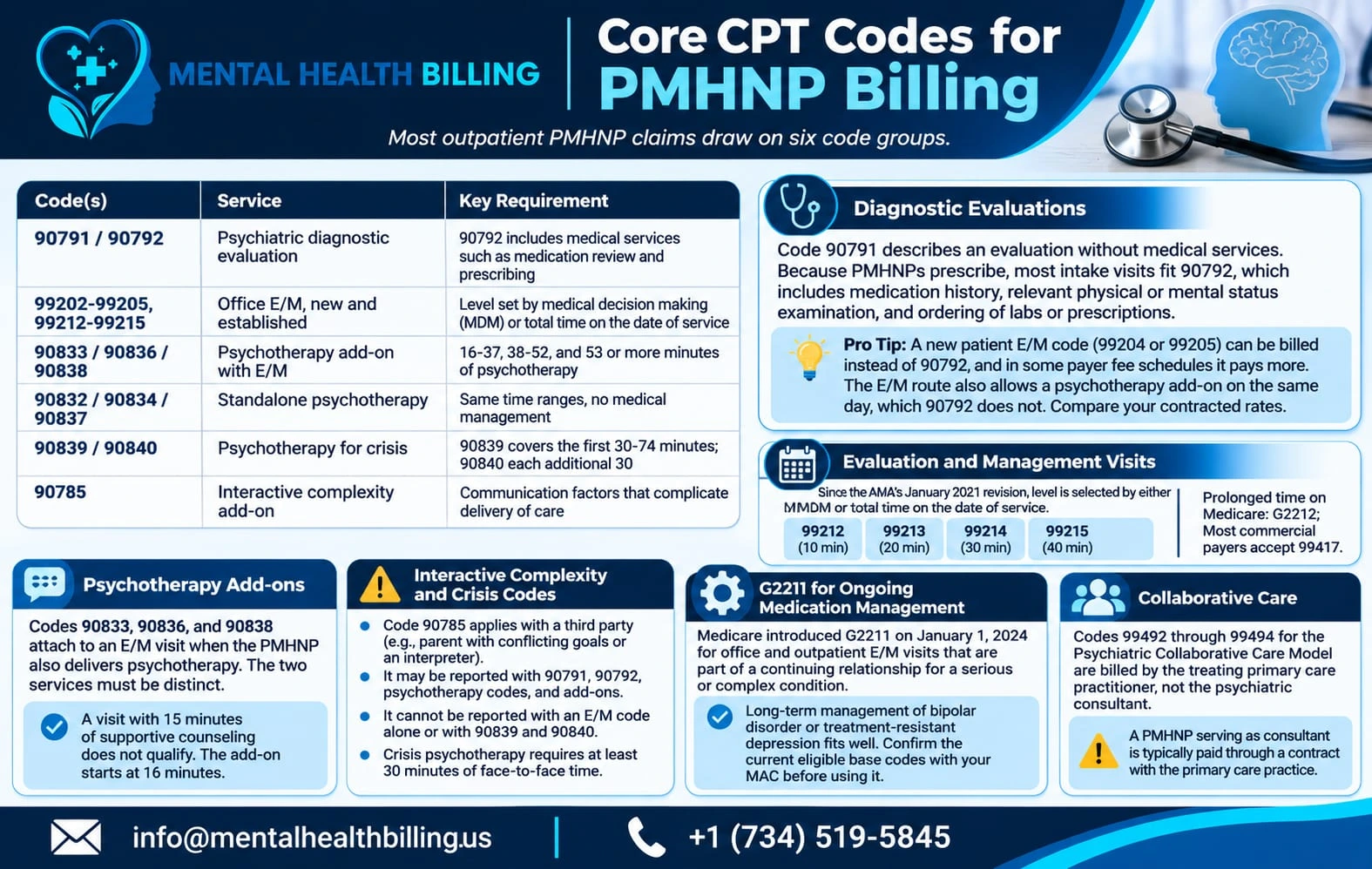
Most outpatient PMHNP claims draw on six code groups.
| Code(s) | Service | Key requirement |
|---|---|---|
| 90791 / 90792 | Psychiatric diagnostic evaluation | 90792 includes medical services such as medication review and prescribing |
| 99202-99205, 99212-99215 | Office E/M, new and established | Level set by medical decision making (MDM) or total time on the date of service |
| 90833 / 90836 / 90838 | Psychotherapy add-on with E/M | 16-37, 38-52, and 53 or more minutes of psychotherapy |
| 90832 / 90834 / 90837 | Standalone psychotherapy | Same time ranges, no medical management |
| 90839 / 90840 | Psychotherapy for crisis | 90839 covers the first 30-74 minutes; 90840 each additional 30 |
| 90785 | Interactive complexity add-on | Communication factors that complicate delivery of care |
Diagnostic evaluations
Code 90791 describes an evaluation without medical services. Because PMHNPs prescribe, most intake visits fit 90792, which includes medication history, relevant physical or mental status examination, and ordering of labs or prescriptions.
There is a choice here that many practices overlook. A new patient E/M code (99204 or 99205) can be billed for the same intake instead of 90792, and in some payer fee schedules it pays more. The E/M route also allows a psychotherapy add-on on the same day, which 90792 does not. Compare your contracted rates for both before setting a default.
Evaluation and management visits
Since the AMA's January 2021 revision of office E/M guidelines, the level is selected by either MDM or total practitioner time on the date of the encounter. For established patients, the time thresholds are 10 minutes for 99212, 20 for 99213, 30 for 99214, and 40 for 99215. Prolonged time on Medicare claims is reported with HCPCS G2212; most commercial payers accept CPT 99417 instead.
Psychotherapy add-ons
Codes 90833, 90836, and 90838 attach to an E/M visit when the PMHNP also delivers psychotherapy. The two services must be distinct. CPT does not allow time spent on psychotherapy to count toward E/M time, so in practice the E/M level should be chosen on MDM whenever an add-on is billed.
A visit with 15 minutes of supportive counseling does not qualify. The add-on starts at 16 minutes.
Interactive complexity and crisis codes
Code 90785 applies when a third party, such as a parent with conflicting goals or an interpreter, complicates communication. It may be reported with 90791, 90792, psychotherapy codes, and psychotherapy add-ons. It cannot be reported with an E/M code alone or with 90839 and 90840. Crisis psychotherapy requires at least 30 minutes of face-to-face time; anything shorter is billed as standard psychotherapy.
G2211 for ongoing medication management
Medicare introduced add-on code G2211 on January 1, 2024 for office and outpatient E/M visits that are part of a continuing relationship for a single serious or complex condition. Long-term management of bipolar disorder or treatment-resistant depression fits this description well. The CY 2026 final rule expanded billing for G2211, and practices should confirm the current list of eligible base codes with their Medicare Administrative Contractor (MAC) before applying it to home or residence visits.
Collaborative care
Codes 99492 through 99494 for the Psychiatric Collaborative Care Model are billed by the treating primary care practitioner, not by the psychiatric consultant. A PMHNP serving as consultant is typically paid through a contract with the primary care practice. Billing those codes under the PMHNP's own NPI is a frequent error.
Documentation requirements that withstand review
Audits of psychiatric E/M claims usually turn on whether the note supports the level billed. Under MDM, three elements are scored: the number and complexity of problems, the data reviewed, and the risk of patient management.
Risk is where psychiatric notes often undersell the work. Prescription drug management counts as moderate risk under the AMA table and, paired with one chronic illness showing progression or side effects, supports 99214. Drug therapy requiring intensive monitoring for toxicity, such as lithium with serum levels or clozapine with absolute neutrophil count monitoring, is classified as high risk and can support 99215 when the problem element also meets that level. A note that says "continue meds" documents none of this.
When a psychotherapy add-on is billed, the note needs its own section showing:
- Time spent in psychotherapy, separate from the E/M portion
- The modality used, for example CBT, motivational interviewing, or interpersonal therapy
- The patient's response and any changes to the treatment plan
Diagnosis coding matters as much as procedure coding. ICD-10-CM code F32.A (depression, unspecified), added October 1, 2021, is accepted by most payers but invites medical necessity questions on repeated visits. A specified code such as F32.1 (major depressive disorder, single episode, moderate) better supports ongoing treatment. Suicide risk assessments, standardized scale scores like the PHQ-9, and safety plans should be recorded with dates, since they document severity directly.
For telehealth visits, record the patient's physical location, the clinician's location, whether video or audio-only was used, and the reason audio-only was necessary when it applies.
Telehealth and insurance claims in 2026
The Consolidated Appropriations Act, 2021 permanently removed geographic restrictions for Medicare mental health telehealth delivered to the patient's home. Audio-only care is also allowed for mental health when the patient cannot use, or does not consent to, video. Medicare audio-only claims carry modifier 93, and place of service code 10 indicates a telehealth visit in the patient's home.
The in-person visit requirement has been delayed repeatedly. Under current law, beginning January 1, 2028, Medicare will require most beneficiaries to have an in-person visit within six months before their first mental health telehealth service and once every 12 months afterward. Patients who begin telehealth mental health services on or before December 31, 2027 are treated as established and need only the annual visit. Tracking each patient's telehealth start date now will make that transition easier to manage.
Commercial and Medicaid plans write their own telehealth rules. Some require modifier 95, others GT, and a few still pay telehealth at a lower rate than in-person care.
Frequent claim denials and how to prevent them
Most PMHNP denials fall into a short list of patterns:
- Same-day conflicts. 90792 and an E/M code billed together by the same provider on the same date.
- Short add-ons. Psychotherapy add-ons with fewer than 16 documented minutes.
- Invalid pairings. 90785 reported with 90839, or with an E/M code that has no psychotherapy component.
- Taxonomy mismatches. The NUCC taxonomy code for a psychiatric-mental health NP is 363LP0808X. A claim submitted under a generic NP taxonomy can fail payer edits tied to behavioral health benefits.
- Credentialing gaps. Billing under a physician's NPI because the PMHNP was not yet credentialed, without meeting incident-to conditions, creates an overpayment that must be refunded.
- Late submissions. Medicare's timely filing limit is 12 months from the date of service under 42 CFR 424.44. Commercial limits are often shorter, sometimes 90 days.
Summary of PMHNP billing guidelines
Accurate PMHNP billing comes down to a few verifiable rules. Medicare pays NPs 85% of the physician rate unless incident-to conditions are met. E/M level is set by MDM or time, and when psychotherapy is added, MDM is the safer basis because psychotherapy minutes cannot be counted twice. Add-on codes start at 16 minutes, crisis codes at 30, and G2211 applies to longitudinal care for a single serious condition. The 2026 conversion factor of $33.4009 includes a 2.5% boost that expires after this year, and the in-person telehealth requirement for Medicare mental health patients now begins January 1, 2028. A note that records time, modality, risk, and diagnosis specificity is what keeps each of those codes paid.