


H0006 CPT code description and billing guide for behavioral health providers
Behavioral health programs that treat substance use disorders bill for far more than counseling sessions. A large share of the work happens between appointments, when a case manager calls a patient’s probation officer, arranges a bed in a residential program, or follows up on a missed referral to a primary care clinic. The H0006 CPT code is how many state Medicaid programs pay for that coordination work. Providers who understand it get reimbursed for effort they are already spending. Those who do not often leave the work unbilled or watch the claims deny.
One clarification belongs at the top, because it affects how you look the code up. H0006 is not actually a CPT code. It is a HCPCS Level II code. People search for it as a “CPT code” out of habit, since CPT is the term most billers reach for, but the two code sets are maintained by different organizations and cover different services. Getting the distinction right is the first step toward billing H0006 correctly.
What the H0006 code actually describes
The Centers for Medicare & Medicaid Services (CMS) maintains H0006 with the official descriptor “Alcohol and/or drug services; case management.” It sits in the H-series of HCPCS Level II, a block of codes built for alcohol and drug abuse treatment services used primarily by Medicaid. H0006 remains a valid code for 2026.
Case management under this code means care coordination, not therapy. The activities it covers include assessing a patient’s medical, psychological and social needs, building an individualized care plan, linking the patient to services such as housing, employment support, medical care and counseling, monitoring progress and advocating on the patient’s behalf across systems. What it does not cover is direct clinical treatment. A counseling or therapy session is a separate service with its own code. This line between coordination and treatment is where most H0006 coding problems begin and it comes up again later in this guide.
Why the HCPCS versus CPT distinction matters
CPT codes are owned and updated by the American Medical Association and describe most physician and outpatient procedures. HCPCS Level II codes are maintained by CMS and cover items and services that fall outside the CPT set, including many Medicaid behavioral health services, medical equipment and drugs. H0006 is firmly in the second category. The practical consequence is that you will not find H0006 in a CPT codebook and you cannot assume Medicare rules apply to it. The payer that recognizes it, the rate it pays and the modifiers it requires are set at the state Medicaid level, not by a national CPT convention.
Which payers cover H0006
Coverage is narrower than many new billers expect.
Medicare does not cover H0006 as a standalone service. The H-series and T-series codes were designed for Medicaid behavioral health programs and Medicare generally does not recognize them. Submitting H0006 to Medicare will not produce payment.
Medicaid is the primary payer for this code. Because Medicaid is administered state by state, the coverage rules, unit definitions, reimbursement rates, provider requirements and modifier expectations vary from one state to the next. The code number means the same service everywhere, but almost everything around it is set locally.
Commercial insurers are inconsistent. Some accept H-series codes for behavioral health, particularly for residential and intensive outpatient levels of care, while others reject them outright. Coders on AAPC’s forums have described commercial plans denying H0006 on the grounds that H and T codes belong to Medicaid and facility-based case management under H0006 is paid by very few commercial payers. Before you bill a commercial plan, check the specific contract rather than assuming the code will be honored.
How H0006 is billed
Three variables decide whether an H0006 claim is built correctly: the unit of service, the modifiers and the place of service. Each is governed by state Medicaid policy.
Units of service
Many states bill H0006 in 15-minute units, though some define it per encounter or per day. The unit definition drives reimbursement, so billing four units when the payer expects a single per-session unit will trigger a denial.
State manuals also set minimum-time rules. Colorado’s State Behavioral Health Services Billing Manual (January 2024) instructs that for case management services, including H0006 and T1017, providers may not bill for services rendered in less than eight minutes, although bundling shorter contacts is acceptable. That eight-minute floor and the rounding rules around 15-minute increments are the kind of detail that lives in a state manual and nowhere else.
Rates are modest and vary widely. As one example, figures tied to the Colorado Department of Health Care Policy and Financing fee schedule put reimbursement for substance use case management under H0006 at roughly 8 to 9 dollars per 15-minute unit. Other states pay differently and fee schedules are updated periodically. The only rate you should rely on is the current one published by the payer you are billing, which state Medicaid agencies typically post through their provider portals.
Modifiers
Most Medicaid programs expect one or more modifiers on H0006 and missing or incorrect modifiers rank among the top reasons behavioral health claims deny. The ones you are most likely to encounter:
- HF, indicating a substance use disorder program.
- HG, indicating an opioid treatment program.
- HO, HN and HP, indicating provider credential level (master’s, bachelor’s and doctoral, respectively) in states that stratify rates by credential.
- HQ, indicating a group setting, which many payers reimburse at a lower rate than individual service.
- U1 through U9 and UA through UD, state-assigned modifiers whose meanings are unique to each state’s program.
Telehealth adds another layer. Some payers want modifier 95 or GT, while others have moved to place of service codes 02 or 10 with no modifier at all. State Medicaid requirements can override general HCPCS guidance, so a modifier that is mandatory in one state may be considered redundant in another.
Place of service and revenue codes
Place of service reporting should match where the coordination occurred and what the state requires. In facility settings, some payers that do accept institutional case management look for revenue code 0900 alongside H0006, though, again, acceptance is limited. Confirm the place of service and any revenue code expectation in your state’s billing manual before submitting.
Documentation requirements for H0006
Documentation is the single most common failure point for this code. A claim without a case management note is, in practical terms, just a number on a form. To support H0006, the record generally needs to establish that the service was medically necessary and tied to the patient’s substance use treatment or recovery plan. Key elements include:
- Client identification and a diagnosis related to a substance use disorder.
- An individualized treatment or recovery plan listing goals, planned interventions and expected frequency of contact.
- A description of the actual case management activities: who was contacted, what referrals were made, what coordination occurred and the outcome.
- Progress notes showing ongoing monitoring and any adjustments to the plan.
- The rendering provider’s credential and signature, plus documented time when the state bills in timed units.
There is a subtler documentation rule that auditors care about. Your case management notes must read differently from your therapy notes. If a Medicaid reviewer cannot tell the coordination work apart from the clinical treatment in the chart, the program has an audit exposure, because it looks as though the same activity may have been billed under two codes. Keeping the two note types distinct protects the claim.
Who can provide and bill H0006
Provider qualifications are set by each state and are not uniform. Many states require at least a bachelor’s degree in a human services field. Others require licensure such as LCSW, LPC, or LMFT, or an addiction-specific credential such as CAC, CADC, or LCDC. Some states permit paraprofessional case managers to deliver the service under the supervision of a licensed clinician, but that supervision has to be documented to withstand review. Billing H0006 for a staff member who does not meet the state’s case manager definition is a straightforward path to recoupment.
Common billing errors that lead to denials
Most H0006 denials trace back to a short list of avoidable problems.
- Missing or thin documentation. The work happened, but the note does not record the contacts, referrals and outcomes needed to support the claim.
- Coding counseling as case management. Billing H0006 when the service delivered was actually counseling is a common upcoding pattern caught on audit. Counseling belongs under H0004, the behavioral health counseling and therapy code, not H0006.
- Wrong or missing modifiers. Omitting a required HF, HG, or credential-level modifier, or applying a state modifier incorrectly.
- Incorrect unit calculation. Billing multiple units where the payer expects one per session, or billing contacts under the state’s minimum time.
- Duplicative billing with T1017. H0006 and T1017 (targeted case management) cover similar ground. Some states allow both and others treat them as duplicative, so layering them without checking state rules invites a denial.
- Billing a payer that does not cover the code. Sending H0006 to Medicare, or to a commercial plan that rejects H-series codes.
- Not billing at all. Programs perform the coordination but never submit the claim, usually because case managers do not complete encounter documentation before the billing deadline. This is a workflow problem rather than a coding one and it quietly drains revenue.
How H0006 compares with related codes
Choosing between H0006 and its neighbors comes down to what service was actually delivered and which population it served. The table below sets out the most common points of confusion.
| Code | What it covers | Typical unit | Key distinction from H0006 |
| H0006 | Substance use disorder case management (coordination) | Per 15 minutes in many states, varies by state | The reference point: SUD-specific care coordination, not treatment |
| H0004 | Behavioral health counseling and therapy | Per 15 minutes | A direct clinical service, not coordination; used when the activity is counseling |
| T1016 | Case management, general | Per 15 minutes in most states | Not limited to substance use; applied across broad populations |
| T1017 | Targeted case management | Per 15 minutes | Overlaps heavily with H0006; some states treat the two as interchangeable, others as duplicative |
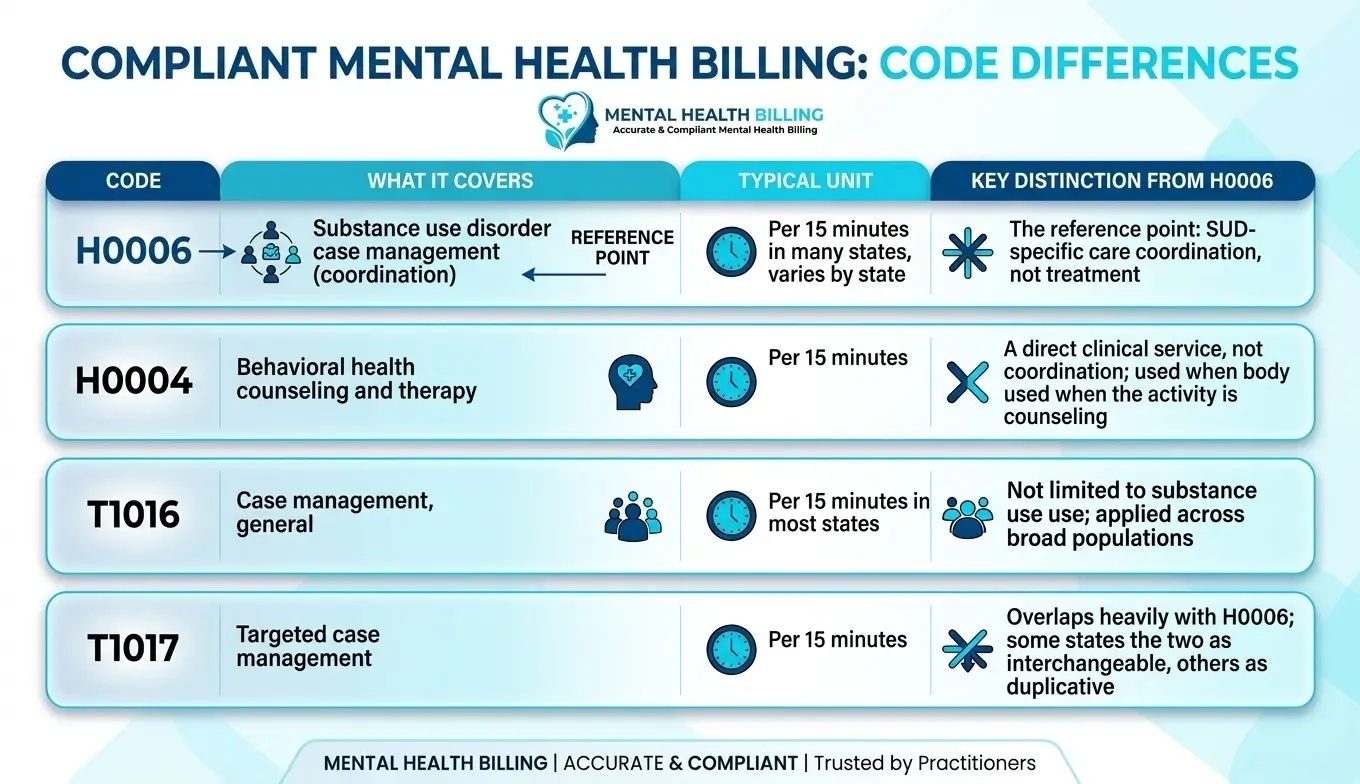
The takeaway for code selection is procedural. Some state Medicaid programs use H0006 for substance use case management, some use T1017 and some use both for different service categories. Rather than assuming, pull your state’s behavioral health billing manual and confirm which code applies to your program and whether the two may be billed together.
Staying compliant
Because H0006 is billed to government payers, several federal rules sit in the background of every claim. HIPAA governs how the underlying protected health information is handled. The False Claims Act creates liability for submitting claims that are not supported by documentation. The Anti-Kickback Statute and Stark Law restrict improper referral arrangements. None of these are unique to H0006, but the code’s reliance on documentation and referral activity puts it squarely in their path.
A practical safeguard is a routine internal audit. Reviewing a random sample of H0006 claims against the matching progress notes and comparing H0006 usage against counseling codes such as H0004 and H0005, catches the upcoding and documentation gaps that external auditors look for. Programs that run these checks quarterly tend to find problems while they are still small.
Key points for billing H0006 accurately
H0006 pays for substance use case management, the coordination that keeps patients connected to care between clinical visits. It is a HCPCS Level II code maintained by CMS, not a CPT code and it is a Medicaid code at heart. Medicare does not cover it and commercial acceptance is spotty. Everything operational about the code, its units, rates, modifiers, provider requirements and whether it can be billed alongside T1017, is decided at the state level, so the H0006 code cannot be billed from national assumptions alone. The habit that protects reimbursement most reliably is also the simplest: write a case management note that clearly documents the coordination performed, keep it distinct from any therapy note and check your state Medicaid fee schedule and billing manual before the claim goes out.
Sources referenced
- Centers for Medicare & Medicaid Services (CMS), HCPCS Level II code set, 2026 (code descriptor and maintenance authority for H0006).
- Colorado Department of Health Care Policy & Financing, State Behavioral Health Services Billing Manual, January 2024 (minimum-time and unit rules for H0006 and T1017; state fee schedule reference).
- AAPC, HCPCS code reference and coder discussion for H0006 (payer acceptance and code-selection issues).