


Case management CPT codes: documentation, modifiers and reimbursement
Search for “case management CPT codes” and you land on two different parts of the CPT manual that are easy to confuse. One is a small subsection the American Medical Association literally labels Case Management Services. The other is the larger group of monthly care coordination services (chronic care management, transitional care management and principal care management) that most billers actually mean when they say case management. Knowing which set a payer is asking about often decides whether a claim gets paid or denied.
This guide separates the two, lists the current codes in each and works through the documentation, modifier and reimbursement rules that trip up new coders and cost practices money.
How case management CPT codes are grouped
The CPT code set, maintained by the American Medical Association, places a subsection titled Case Management Services inside the Evaluation and Management (E/M) chapter. It contains the medical team conference codes (99366, 99367, 99368) and, until recently, anticoagulant management codes (99363 and 99364, which the AMA deleted effective 2019). Care plan oversight codes (99374 through 99380) sit next to it and are usually discussed alongside case management because they describe similar coordination work.
In everyday billing, though, “case management” usually points to the care management services that Medicare pays for on a monthly basis: chronic care management (CCM), transitional care management (TCM), principal care management (PCM) and behavioral health integration. These are the codes tied to real reimbursement, so they deserve most of the attention. The distinction is not academic. A payer that asks for a case management code may want a team conference code, or it may want CCM and billing the wrong family produces a clean denial.
Medical team conference and care plan oversight codes
The team conference codes apply when at least three qualified health care professionals from different specialties or disciplines, each of whom has provided direct care to the patient, meet to coordinate that patient’s care. The three codes divide by who reports and whether the patient is there:
- 99366: patient or family present, 30 minutes or more, reported by a nonphysician qualified health care professional
- 99367: patient or family not present, 30 minutes or more, reported by a physician
- 99368: patient or family not present, 30 minutes or more, reported by a nonphysician qualified health care professional
Conferences shorter than 30 minutes are not reported separately and each reporting participant must have evaluated or treated the patient within the previous 60 days. A physician whose patient or family attends the conference reports an E/M service instead of a conference code.
Here is the practical catch. Medicare generally does not pay 99366, 99367, or 99368 separately, treating the work as bundled into other services and many commercial plans follow that policy. Confirm coverage before you bill, because the time is real but the payment often is not.
Care plan oversight (CPO) covers the physician work of supervising a patient’s care plan across a calendar month. CPT defines six codes across three settings: home health (99374 and 99375), hospice (99377 and 99378) and nursing facility (99379 and 99380). In each pair, the first code covers 15 to 29 minutes of oversight in a month and the second covers 30 minutes or more.
Medicare handles CPO on its own terms. According to Family Practice Management, published by the American Academy of Family Physicians, Medicare pays for care plan oversight using two HCPCS codes, G0181 for home health patients and G0182 for hospice patients and only when the physician spends at least 30 minutes in a calendar month. Medicare does not pay for nursing-facility CPO and it does not recognize the 15-to-29-minute codes. So even though CPT lists six codes, only G0181 and G0182 are billable to Medicare.
Chronic care management codes
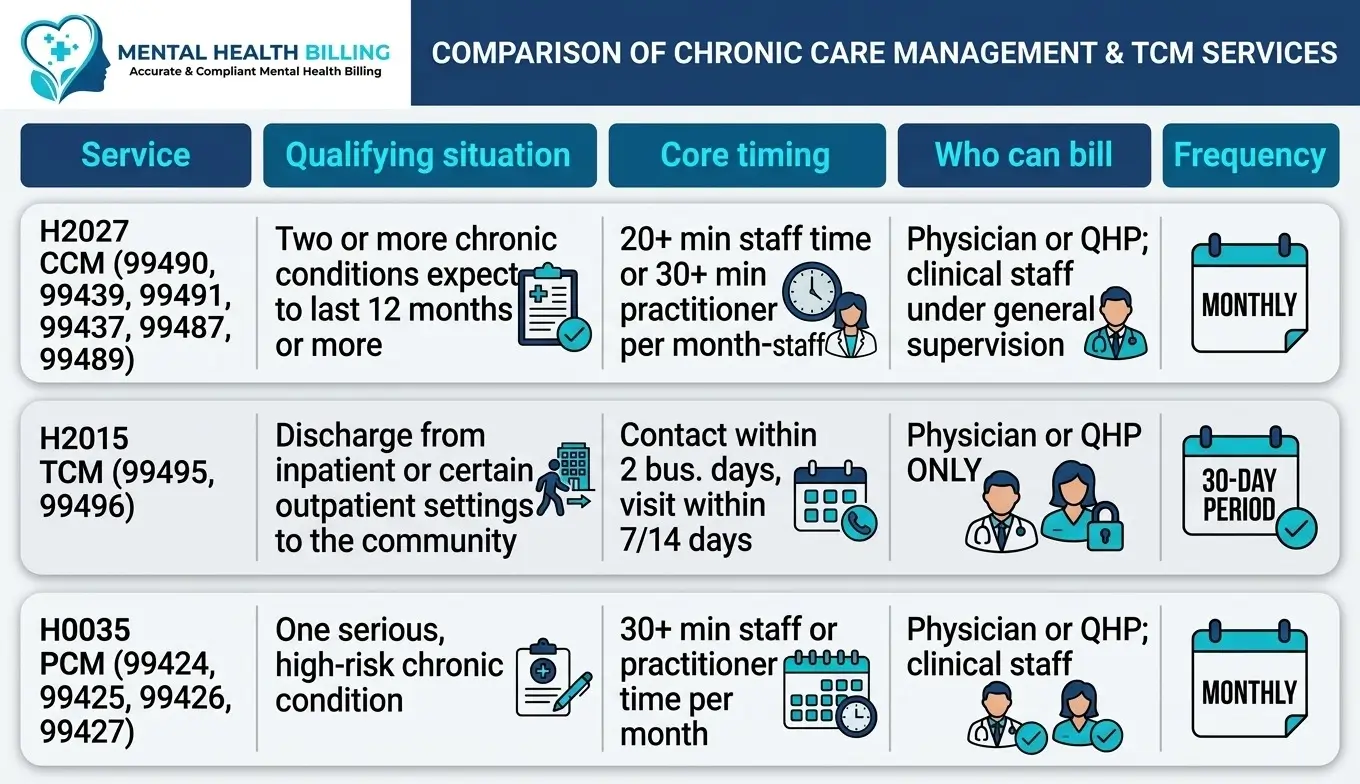
CCM is the most commonly billed case management service. To qualify, a patient must have two or more chronic conditions expected to last at least 12 months (or until the patient’s death) that place the patient at significant risk of decline. The practice needs the patient’s consent, a written and patient-specific care plan and around-the-clock access to care.
The codes split by who does the work and how complex it is:
- 99490: first 20 minutes of clinical staff time, non-complex, per month
- 99439: each additional 20 minutes of clinical staff time (add-on to 99490, reported up to twice)
- 99491: first 30 minutes provided personally by the physician or qualified health care professional
- 99437: each additional 30 minutes provided personally by the physician or qualified health care professional (add-on to 99491)
- 99487: complex CCM, first 60 minutes of clinical staff time, involving moderate-to-high complexity decision-making and a substantial care plan revision
- 99489: each additional 30 minutes of complex CCM (add-on to 99487)
HCPCS code G0506 is a one-time add-on for the initial care-planning work when CCM begins.
The mutual-exclusivity rules matter more than the code list. According to the Centers for Medicare & Medicaid Services in its Chronic Care Management Services booklet (MLN909188, June 2025), you cannot report the physician-time codes (99491 and 99437) in the same calendar month as 99490, 99439, 99487, or 99489 and you cannot bill complex and non-complex CCM together in the same month. That same booklet corrects a widespread misconception: CCM can be reported during the 30-day transitional care management period, provided the same minutes are not counted toward both services.
One more detail decides which code fits. Only clinical staff time directed by the billing practitioner counts toward 99490, 99439, 99487 and 99489, although the practitioner’s own time can count if it is not being used to bill 99491. For 99491 and 99437, only the practitioner’s personal time counts. Coders who miss that split tend to bill the staff-time code for physician work, or the reverse.
Transitional care management (99495 and 99496)
CMS introduced TCM codes in 2013 to pay for the handoff after a patient leaves an inpatient or certain outpatient settings for home or a community setting. Two codes apply:
- 99495: at least moderate-complexity medical decision-making, with a face-to-face visit within 14 days of discharge
- 99496: high-complexity medical decision-making, with a face-to-face visit within 7 days of discharge
Both require interactive contact (by phone, electronically, or in person) with the patient or caregiver within two business days of discharge, along with medication reconciliation. TCM covers a 30-day period and is reported once per patient in that window. Only physicians and qualified health care providers can bill it. Nurses and medical assistants can perform parts of the service, but they cannot report the code.
Principal care management (99424 through 99427)
PCM applies when a patient has a single serious chronic condition, rather than the two or more that CCM requires. It fits specialists managing one high-risk problem, such as a cardiologist coordinating care for advanced heart failure.
- 99424: first 30 minutes provided by the physician or qualified health care professional, per month
- 99425: each additional 30 minutes provided by the physician or qualified health care professional
- 99426: first 30 minutes of clinical staff time
- 99427: each additional 30 minutes of clinical staff time
Like CCM, PCM is a monthly service built around a care plan and ongoing coordination, not a single visit.
How CCM, TCM and PCM compare
A 2025 addition: advanced primary care management
CMS finalized the Advanced Primary Care Management (APCM) codes in the calendar year 2025 Physician Fee Schedule, effective January 1, 2025. Rather than counting minutes, APCM pays a monthly bundled amount based on patient complexity:
- G0556: patients with one chronic condition or fewer
- G0557: patients with two or more chronic conditions
- G0558: patients with two or more chronic conditions who are also Qualified Medicare Beneficiaries, a marker of higher social and financial risk
APCM folds together elements of CCM, TCM and PCM into a single monthly service. The American Academy of Family Physicians notes that services such as remote patient monitoring and behavioral health integration may still be billed alongside APCM. A practice cannot bill APCM and the standard monthly CCM or PCM codes for the same patient in the same month, since that would pay twice for overlapping work.
Documentation that supports these codes
Time-based coordination codes are won or lost on documentation. What the record needs varies by service, but several elements recur:
- Patient consent for CCM, PCM and APCM, noted in the record, including that only one practitioner can bill the service per month.
- A written, patient-specific care plan for CCM, PCM and APCM, listing the problems, goals and interventions.
- A time log showing who performed the work, what they did and how many minutes it took. Cumulative monthly minutes determine code selection for CCM and PCM.
- For TCM: the discharge date, the date and method of the two-business-day contact, the date of the face-to-face visit, medication reconciliation and the complexity of medical decision-making.
- For team conferences: each reporting participant’s discipline, contribution and treatment recommendations, plus confirmation that at least three disciplines took part and that the conference lasted 30 minutes.
A recurring audit failure is billing a monthly code without a minute-by-minute time record. If the total time cannot be reconstructed from the note, the level billed cannot be defended.
Modifiers and billing rules
Care management codes use far fewer modifiers than procedural codes, which surprises coders coming from surgery or radiology. These monthly services are not split into professional and technical parts, so modifiers 26 and TC do not apply. A few situations are worth knowing:
- Modifier 25 goes on a separately identifiable E/M service performed the same day, for example an annual wellness visit reported with a TCM service, when the documentation supports both.
- Overlapping monthly codes cannot be stacked. Reporting CCM and PCM together, or complex and non-complex CCM, for the same patient in the same month will trigger a denial.
- Supervision rules apply. Clinical staff time for CCM and PCM is billed under the general supervision of the practitioner, which does not require the physician to be physically present in the room.
- Rural health clinics and federally qualified health centers have separate care management billing rules (historically HCPCS code G0511) and CMS revised those rules for 2025. Check current CMS guidance rather than assuming the physician fee schedule codes apply.
The wider point is a compliance one. Adding a modifier to push a care management claim past an edit is not appropriate. When two services genuinely overlap in time, only one of them is billable.
Reimbursement and patient cost-sharing
Medicare pays for CCM, TCM, PCM and APCM under the Physician Fee Schedule, which CMS updates every year. Payment for the time-based codes rises with the documented minutes and complexity. In 2025, the national average Medicare payment for 99490 was roughly $60, with the exact amount adjusted by geographic locality and revised annually in the fee schedule final rule. Complex CCM and the physician-time codes pay more and add-on codes raise the monthly total when the time supports them.
Two reimbursement facts catch practices off guard. First, most of these services carry standard Medicare Part B cost-sharing, so the patient owes a coinsurance amount unless a secondary policy covers it, which is one reason the consent conversation matters. Second, the CPT case management codes many coders reach for first, the team conference codes (99366 through 99368) and the nursing-facility care plan oversight codes, are frequently not separately payable, so time spent on them may never turn into revenue.
Why these claims get denied
The avoidable denials in this area follow a short list:
- Missing or undocumented patient consent for CCM, PCM, or APCM.
- No time log, or a documented total that does not reach the code’s threshold.
- Two overlapping monthly codes billed for the same patient and month.
- A TCM claim without the two-business-day contact, or without a qualifying face-to-face visit inside the required window.
- Billing team conference or nursing-facility CPO codes to Medicare, which does not pay them.
- Using the CPT care plan oversight codes for Medicare instead of G0181 or G0182.
Case management CPT codes reward precise reading of two things: which CPT family the payer means and what the record actually documents. The team conference and care plan oversight codes describe coordination work but are narrowly paid, with Medicare routing care plan oversight through G0181 and G0182. The monthly care management codes, chronic care management, transitional care management, principal care management and the newer advanced primary care management bundle, carry most of the reimbursement and each has its own condition, timing and consent requirements. Get the documentation and the calendar-month rules right, confirm coverage before billing and most of these denials stop happening.