


H0002 CPT code description: complete guide to behavioral health billing
Providers who bill behavioral health services run into H0002 early, usually on the first claim they submit for a new client. The code sits at the front door of treatment, attached to the screening that decides whether someone qualifies for a program at all. Get it wrong and payment stalls. In some states, a rejected screening blocks the rest of the episode from being billed.
There is one point worth settling before anything else. Most people search for the “H0002 CPT code,” but H0002 is not a CPT code in the strict sense. It belongs to a different code set with its own rules, its own maintenance schedule and its own payer treatment. That single fact shapes almost everything about how the code is reimbursed, which is where this guide starts.
What the H0002 CPT code actually is
H0002 is a HCPCS Level II code, maintained by the Centers for Medicare & Medicaid Services (CMS). Its official descriptor reads: “Behavioral health screening to determine eligibility for admission to treatment program.” The code falls within the H0001 through H0030 range, the block CMS reserves for drug, alcohol and behavioral health services.
The confusion with CPT is understandable. HCPCS has two levels. Level I is the Current Procedural Terminology (CPT) system, owned and updated by the American Medical Association. Level II is the alphanumeric set CMS created for products, supplies and services that CPT does not describe, including most behavioral health and substance use program services. H codes, S codes and T codes all live in Level II. Because clinicians tend to call every billing code a “CPT code” in conversation, H0002 inherited the label even though the AMA has nothing to do with it.
This is not a pedantic distinction. CMS updates HCPCS Level II codes on a quarterly cycle, separate from the annual CPT release each January. Payers that recognize CPT do not automatically recognize H codes. A commercial plan built around CPT and evaluation and management (E/M) codes may reject H0002 outright, while a state Medicaid program may require it. Knowing which set a code belongs to tells you which rulebook applies.
What the screening covers clinically
H0002 pays for a brief, structured screening, not a full diagnostic workup. The purpose is triage: determine whether a person is eligible for admission to a behavioral health or substance use treatment program and if so, point them toward the right level of care.
According to Arizona’s AHCCCS behavioral health services guidance, the screening uses a standardized tool or set of criteria and includes making preliminary recommendations for treatment, or documenting that no behavioral health need exists. The same guidance states the tool must be normed for the age, literacy and language of the person being screened and must be available for review on request. Screeners gather enough information to route the client, which can include preliminary data toward a supported employment assessment.
In addiction settings, the screening often maps to the American Society of Addiction Medicine (ASAM) criteria, which sort patients into levels of care based on severity and risk. New Mexico’s behavioral health fee schedule lists H0002 explicitly as an ASAM assessment. The screener is usually a licensed or qualified professional working under a program’s clinical supervision, though the specific credential requirement varies by state and payer.
What H0002 does not cover is the in-depth evaluation that produces a diagnosis and a treatment plan. That work belongs to other codes.
How H0002 differs from related assessment codes
Behavioral health intake involves a small family of codes that look similar and get mixed up constantly. The difference comes down to depth and discipline.
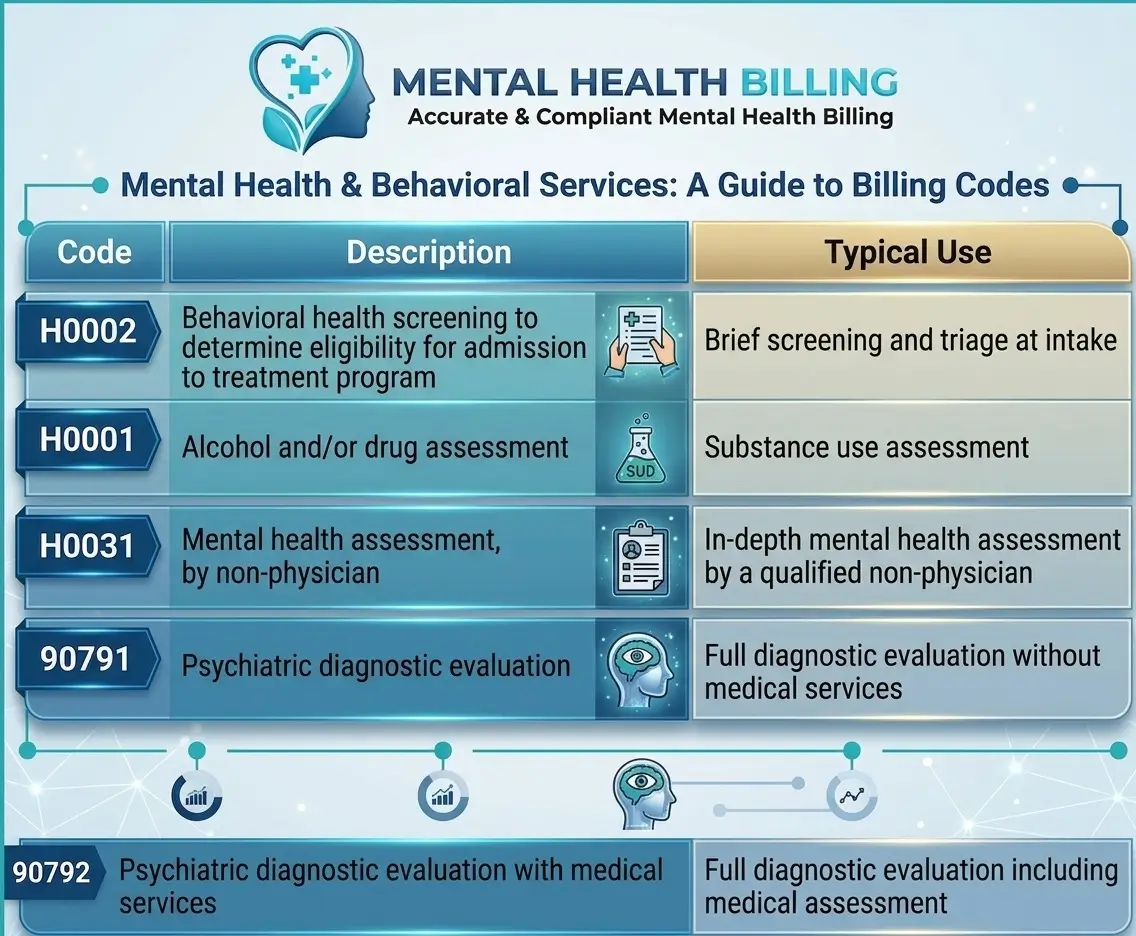
H0002 is the shallowest of the group. H0031 and the two CPT codes 90791 and 90792 are the deeper evaluations that establish a diagnosis. Because a screening is a subset of a full assessment, many payers treat them as mutually exclusive on the same day.
Nevada Medicaid states the rule plainly in its Provider Type 14 billing guide: when H0031 or 90791 are performed, H0002 may not be billed separately. Aetna Better Health of Kentucky takes a similar line, instructing that multiple assessment codes should not be billed for the same member on the same day by the same provider. The AAPC coding community reports the same pattern from commercial payers. An insurer will usually pay for only one assessment when the same provider performs both a screening and a full evaluation, though separate providers sometimes each get paid.
A related code, 96127 (brief emotional/behavioral assessment, with scoring and documentation), gets confused with H0002 but does a different job. Guidance from Aetna Better Health of Kentucky, citing the state’s Department for Medicaid Services, describes 96127 as the code for standardized instruments administered repeatedly to measure progress toward treatment goals, not for the one-time admission screening H0002 covers. Using 96127 for an intake screen, or H0002 for ongoing symptom monitoring, invites denials.
How the code’s scope has changed
H0002 has not always meant what it means now. A North Carolina DHHS special bulletin documents that the descriptor language for H0002 (and the counseling code H0004) was broadened from substance abuse only to behavioral health, widening the code for general behavioral health use rather than limiting it to addiction screening. North Carolina noted that several of these H codes were cross-walked from older codes over a period of years.
A second shift is visible in how states measure the service. Nevada’s 2016 guidance treated H0002 as a timed unit of at least 30 minutes. South Carolina moved it the other direction, converting H0002 from a 15-minute timed unit to a single untimed encounter effective December 1, 2025. The drift toward encounter-based billing for screening reduces the incentive to stretch a session for extra units and it changes how a biller calculates the claim. Neither approach is universal, which is exactly why the code’s history matters. Rules that were current three years ago may not describe today’s claim.
Units, time and frequency limits
Here the guidance stops being national. H0002 units and frequency caps are set state by state and payer by payer and they do not agree. A few verified examples show the spread:
- Nevada Medicaid defines H0002 as one unit per assessment of at least 30 minutes, limited to one screen per 90 days, with no prior authorization unless that limit is exceeded (2016 Nevada Medicaid provider announcement).
- North Carolina Medicaid has billed H0002 in 15-minute units with prior approval required (North Carolina DHHS special bulletin).
- Arizona AHCCCS caps the screening at 24 per year for members age 11 and older.
- Michigan allows one H0002 per day and uses it for screening into non-inpatient programs, while a separate code (T1023) covers screening for inpatient programs.
- South Carolina Medicaid treats H0002 as one untimed encounter per day per patient, effective December 1, 2025 (South Carolina Department of Health and Human Services).
New Mexico adds a wrinkle for long sessions. Its fee schedule allows one additional unit for every 30 minutes when the screening runs past the standard length, up to a stated maximum. The pattern across all of these is the same lesson. The code is national, but the unit definition, the time increment and the annual cap are local. A biller who assumes Nevada’s 90-day limit applies in Arizona will submit claims that fail.
Modifiers and place of service
Modifiers change what H0002 means to a payer and several states require them. The common ones in behavioral health:
- HF flags a substance use service.
- HH flags a co-occurring mental health and substance use situation.
- HT indicates a multidisciplinary team.
- 95 identifies a service delivered by telehealth, usually paired with the appropriate place-of-service code.
Michigan’s mental health code chart, for one, directs providers to append modifier 95 with place of service 02 when the screening happens over telemedicine. States phased these telehealth instructions in heavily during the COVID-19 period and several have kept them. Because modifier requirements are payer-specific, the safe practice is to pull the exact billing guide for the plan and provider type before submitting, rather than carrying a modifier set from one state into another.
Medicare, Medicaid and commercial coverage
H0002 is built for Medicaid and Medicaid managed care and that is where it appears most. Its treatment under Medicare is different. CMS assigns H0002 a Part B pricing indicator of “00,” meaning the service is not separately priced by Part B. In practice, traditional Medicare does not reimburse H0002 as a standalone service.
Commercial coverage is mixed. Some private plans process H codes for behavioral health. Others recognize only CPT and E/M codes and will deny H0002. A billing reference from coding.health describes H0002 as designated for behavioral health assessment in non-Medicare contexts, which matches what providers see in the field. Before delivering the service, confirm three things with the payer: whether H0002 is covered at all, which provider types may bill it and whether prior authorization or a specific modifier is required.
This split explains a frequent frustration in mental health billing. A group that switches a client from Medicaid to a commercial plan, or bills the same screening across a mixed caseload, can see identical services paid under one payer and denied under another. The service did not change. The code set the payer honors did.
Documentation and common denial reasons
Clean H0002 claims rest on documentation that proves a screening happened and qualified for reimbursement. At minimum, the record should show the standardized tool or criteria used, the time spent when the payer bills in timed units, the eligibility determination or referral recommendation and the credential of the person who performed the screening.
The denials that show up most often trace back to a handful of causes:
- Frequency limits exceeded. Billing a second H0002 inside a payer’s look-back window (90 days in Nevada, once per day in Michigan and South Carolina) triggers a denial.
- Bundling conflicts. Submitting H0002 on the same day as H0031, 90791, or 90792 by the same provider, where the payer treats them as mutually exclusive.
- Missing or wrong modifier. Leaving off HF, HH, or a telehealth modifier a state requires.
- Provider type mismatch. Billing under a credential the payer does not accept for this code.
- Wrong code set for the payer. Sending H0002 to a commercial plan that adjudicates only CPT.
Most of these are avoidable by reading the specific payer manual before the claim goes out. The forums that medical billers rely on, including AAPC’s HCPCS discussions, are full of the same recurring question about pairing H0002 with a full assessment, which tells you how easy the bundling mistake is to make.
Summary
H0002 covers a single, defined service: the behavioral health screening that determines whether a person qualifies for admission to a treatment program. It is a HCPCS Level II code maintained by CMS, not a CPT code, even though the “H0002 CPT code” label is how most people search for it. Traditional Medicare does not pay it separately. Medicaid programs use it heavily but define its units, time increments and frequency caps differently from one state to the next and several revised those rules as recently as December 2025. For anyone billing behavioral health, the reliable move is the same every time: confirm the code against the specific payer’s current manual, match the modifier and provider-type requirements and keep H0002 off the claim when a fuller assessment covers the same visit. Accuracy on this one code protects payment for everything that follows it.