



Best medical billing software features for behavioral health practices
Behavioral health billing does not behave like the rest of medical billing. Therapy is billed by the minute, mental health benefits are frequently administered by a different insurer than the rest of a patient’s plan, and payers examine medical necessity far more aggressively than they do for most physical care. Software designed for a general medical office tends to miss these details, and the gap shows up in the numbers. Denial benchmarks published across 2026 place behavioral health initial denial rates well above the medical and surgical average, commonly in the 12 to 20 percent range against roughly 5 to 10 percent for physical care.
Choosing the right medical billing software features for behavioral health practices begins with understanding where those denials come from, then matching each feature to a specific failure point. This guide walks through the features that carry the most weight for a mental health, psychiatric, or substance use practice, and explains the billing rules behind each one so the reason for the feature is clear, not just the feature itself.
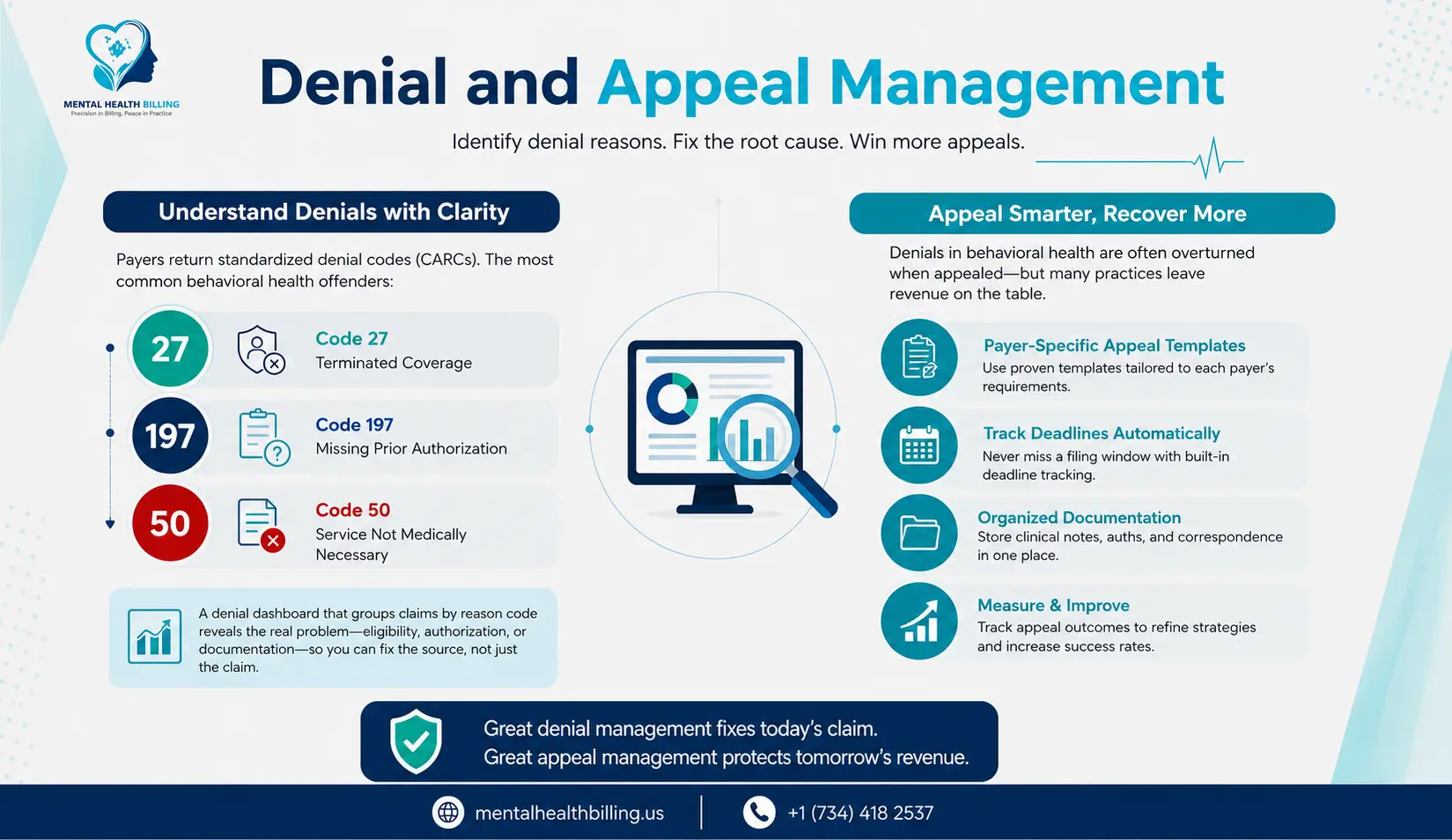
Why general medical billing tools fall short for behavioral health
Three structural facts separate behavioral health billing from the rest of medicine. The first is time. Most physical procedures map to a fixed code. A therapy session does not. The three individual psychotherapy codes (90832, 90834, and 90837) describe the same service at different session lengths: 16 to 37 minutes, 38 to 52 minutes, and 53 minutes or longer. Bill the wrong one and a payer can down-code the claim automatically, paying the lower rate and leaving the difference uncollected on every affected visit. The second is the carve-out. A behavioral health carve-out means a patient’s mental health and substance use benefits are managed by a company separate from the one handling the rest of their medical plan. No other specialty routinely works this way. Send the claim to the medical carrier instead of the behavioral carve-out and it is denied outright. By the time the mistake surfaces, the timely filing window for the correct payer may already have closed, turning a fixable error into a permanent write-off. The third is authorization. Managed behavioral health organizations such as Magellan and Carelon often require prior authorization after a set number of sessions, and higher levels of care like intensive outpatient and partial hospitalization run on step-up and step-down authorization cycles that must be renewed during treatment. Miss a reauthorization window and clinically appropriate care goes unpaid. Every feature that follows exists to blunt one of these three problems.Time-based code validation and session time capture
Because psychotherapy codes are time-based, the single most valuable billing feature for a therapy practice is validation that ties the code to documented face-to-face time. Look for software that records session start and stop times inside the note, then checks the selected code against that duration before the claim leaves the building. The value is concrete. A note that reads 45 minutes cannot support 90837, which requires 53 minutes or more. If a biller submits 90837 anyway, many payers now down-code it to 90834 and reimburse the lower amount, and the practice absorbs the difference every session, every week, for the life of the error. Software that catches the mismatch at the point of documentation stops the leak before it starts. The same feature guards against the opposite risk. Upcoding, meaning billing a longer code than the session supports, draws audit attention when a practice bills 90837 far more often than its peers. A system that matches code to documented minutes keeps utilization patterns defensible.Eligibility and benefits verification with carve-out detection
Eligibility problems drive a large share of denials across all of medicine, and they hit behavioral health harder because of carve-outs and provider-type exclusions. A useful platform runs real-time eligibility checks (the electronic 270 inquiry and 271 response) rather than relying on a single phone call at intake. Two capabilities separate a genuine eligibility feature from a checkbox version. First, it should surface whether behavioral health benefits are carved out to a different payer, so the claim reaches the right place on the first attempt. Second, it should make re-verification quick between sessions, because coverage lapses, deductibles reset, and plans change mid-year. A verification done once in January is stale by spring, and a claim denied for terminated coverage is easier to prevent than to appeal.Authorization tracking built for managed behavioral care
Authorization denials are almost entirely preventable, which makes authorization tracking one of the higher-return features a behavioral health practice can pay for. The feature should count units authorized against units used, show how many sessions remain, and alert staff before an authorization expires rather than after. For practices running intensive outpatient programs, partial hospitalization, or residential care, the requirement is heavier. These levels of care are subject to concurrent review, meaning a payer can shorten or cut an authorization partway through a stay. Software that manages step-up and step-down cycles, and that flags reauthorization deadlines a week or two ahead, keeps necessary treatment from becoming unpaid treatment. Substance use codes and residential stays face this scrutiny most often, so a practice treating addiction should treat authorization tracking as a requirement, not an extra.An integrated clearinghouse and automatic remittance posting
A clearinghouse is the intermediary that scrubs and routes claims to payers, then returns their responses. Some behavioral health platforms include one; others require a separate subscription and a separate login. TherapyNotes, for example, includes clearinghouse access through Waystar at no additional charge, while SimplePractice connects through Waystar and Availity. A standalone clearinghouse subscription typically runs 30 to 60 dollars a month, so a built-in option removes both a recurring cost and a workflow break. Two capabilities here affect cash flow directly. Claim scrubbing checks each claim against payer rules before submission, which raises the first-pass acceptance rate. A healthy target for behavioral health is a clean claim rate in the low-to-mid 90s, and rates below 90 percent usually point to a problem upstream in verification, authorization, or coding. Automatic posting of the electronic remittance advice (the ERA, or 835 file) matches payments to claims without manual re-entry, which compresses the time between service and deposited payment.Telehealth billing that stays current on modifiers and place of service
Behavioral health rests on firmer telehealth ground than most of medicine. The Consolidated Appropriations Act, 2021 permanently removed the geographic and originating-site restrictions for Medicare behavioral health telehealth, so a patient can be seen at home anywhere in the country, and it authorized audio-only sessions when a patient cannot or will not use video. The in-person visit requirement that would otherwise attach to Medicare behavioral telehealth has been deferred repeatedly, most recently to January 1, 2028 under the Consolidated Appropriations Act, 2026, which President Trump signed on February 3, 2026. Billing those visits correctly depends on small details that software should handle without manual bookkeeping. Synchronous video sessions generally carry modifier 95, and Medicare audio-only behavioral health sessions use modifier 93. Place-of-service code 10 indicates the patient was at home, while 02 indicates another location. Commercial payer telehealth policies still shift from year to year, so the feature worth paying for is a platform whose telehealth codes and modifiers are maintained by the vendor rather than updated by hand every January.
Compliance features for parity and substance use records
Two regulatory currents shape what a behavioral health billing system needs to record. The first is federal mental health parity. The Paul Wellstone and Pete Domenici Mental Health Parity and Addiction Equity Act of 2008 requires health plans to treat mental health and substance use benefits no less favorably than medical and surgical benefits. A final rule issued by the Departments of Labor, Health and Human Services, and the Treasury on September 9, 2024 amended the earlier regulations and phased in new obligations for plan years beginning January 1, 2025 and January 1, 2026, including detailed comparative analyses of the limits payers place on behavioral care. Parity compliance sits mostly with insurers, but the practice-side consequence is direct: clean documentation of medical necessity, the exact area payers challenge, is what protects reimbursement. The second applies specifically to substance use treatment. Updated regulations under 42 CFR Part 2, which govern the confidentiality of substance use disorder patient records, reached their compliance date on February 16, 2026, with enforcement carried out by the HHS Office for Civil Rights. The revised rule lets a patient give a single consent covering future treatment, payment, and healthcare operations, and it no longer requires programs to physically segregate Part 2 records from the rest of the chart. For any practice that treats addiction, billing and records software should manage that consent, log who viewed a record, and control redisclosure. General therapy platforms often skip this entirely. TherapyNotes and SimplePractice, for instance, are not built for substance use disorder treatment, a limitation that matters the moment a practice starts billing for it.Choosing medical billing software features for a behavioral health practice
Before committing to a platform, a practice can confirm a short list of specifics that separate a therapy-ready system from a repurposed medical one:- Does it validate time-based codes against documented session length, or does it accept whatever the biller enters?
- Does eligibility verification flag behavioral health carve-outs, and can it be rerun quickly between sessions?
- Does it include a clearinghouse (if so, which one), and does electronic remittance post automatically?
- Are telehealth modifiers and place-of-service codes maintained by the vendor?
- For prescribers, does it support electronic prescribing of controlled substances (EPCS), which psychiatric practices need for stimulants and other scheduled medications?
- For addiction treatment, does it handle 42 CFR Part 2 consent and substance use levels of care at all?