


H2014 CPT code billing: documentation, modifiers and common errors
Search for H2014 and you will find it labeled a “CPT code” almost everywhere, including on billing forms and payer portals. That label is technically wrong and the mistake matters for how the service gets paid. H2014 is a HCPCS Level II code, not a CPT code. CPT is a code set owned and maintained by the American Medical Association. HCPCS Level II codes, including every code that starts with a letter, are maintained by the Centers for Medicare and Medicaid Services (CMS). Getting H2014 CPT code billing right starts with knowing which rulebook applies, because the coding conventions, the payers and the audit exposure all follow from that distinction.
This guide covers what H2014 pays for, who reimburses it, how the 15-minute unit works, the modifiers that change a claim, the documentation a payer expects and the errors that get claims denied or clawed back.
 None of that is knowable from the code alone. It lives in the state Medicaid provider manual and the managed care plan’s policy and it changes. Verify before the first claim rather than after the first denial.
 Two points about modifiers matter more than the list. First, credential modifiers often change the reimbursement rate, because many Medicaid programs pay doctoral-level providers more than master’s-level and master’s more than bachelor’s. Putting the wrong credential modifier on a claim can under-pay or over-pay the service and over-payment is the version that gets recovered later. Second, telehealth modifier requirements vary by payer. Some states want modifier 95 with a specific place-of-service code; others use different combinations. The provider manual settles it.
What H2014 actually covers
The CMS long descriptor for H2014 is short and specific: “Skills training and development, per 15 minutes.” The abbreviated descriptor reads “Skills train and dev, 15 min.” The code was added to the HCPCS set on April 1, 2003 and it carries the maintenance action code N, meaning the descriptor has not changed since it took effect. The service itself is behavioral health rehabilitation. Providers use H2014 to report teaching and reinforcing functional life skills and adaptive skills for people living with a mental health disorder or a substance use disorder. The point is practical capability, not talk therapy. Sessions target things a person needs to live and function in their community, such as medication adherence, personal hygiene, time management, symptom self-management, interpersonal communication and daily routines. AAPC classifies H2014 under “Other Mental Health and Community Support Services.” It is often delivered by qualified mental health professionals, rehabilitation specialists, or trained paraprofessionals working under clinical supervision and it can be provided one-on-one or in small groups depending on the program and the payer. One clinical distinction drives most of the payment risk. H2014 is structured, goal-directed skill building tied to a treatment plan. It is not recreation, companionship, or unstructured socialization. Sessions that look like supervised leisure without documented therapeutic goals get denied and that line comes up repeatedly in audits.Who pays for H2014
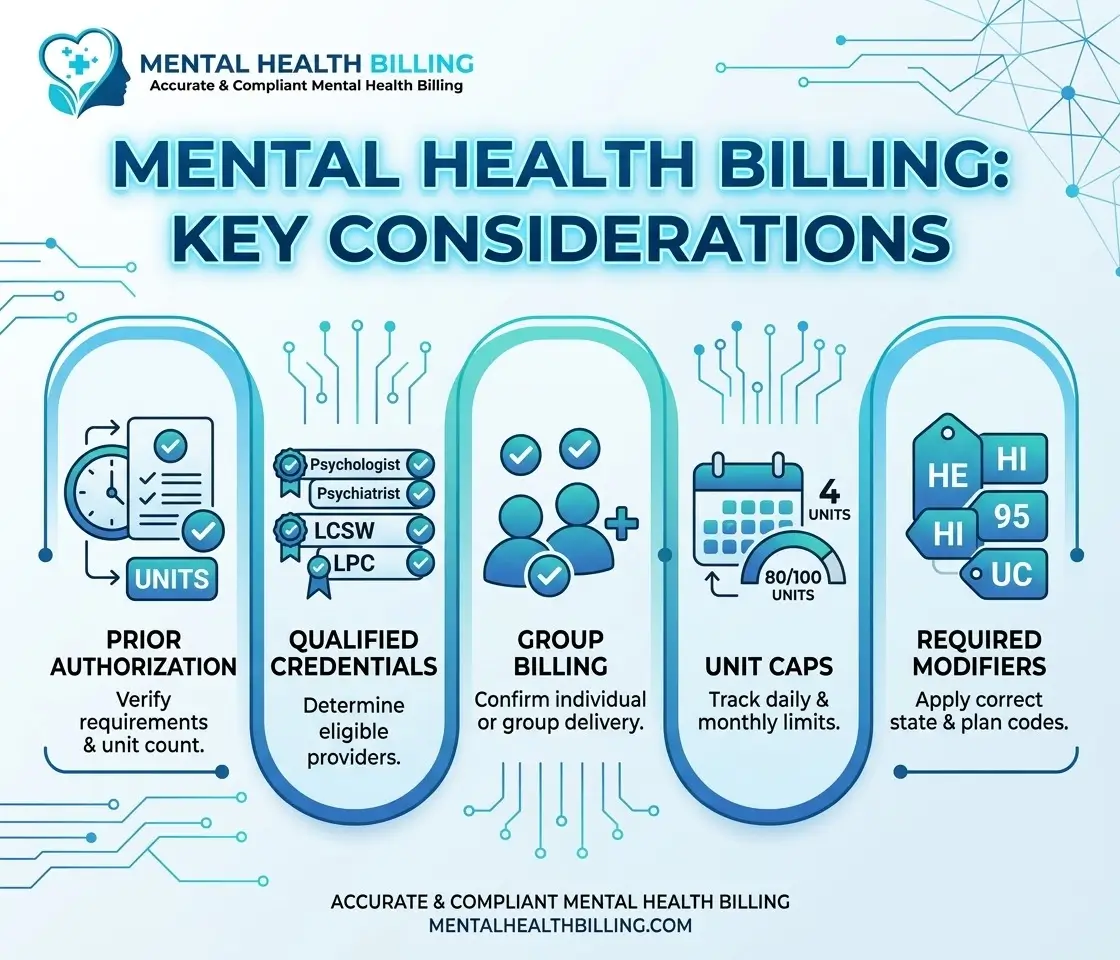
H2014 is a Medicaid code. Coverage runs primarily through state Medicaid programs and Medicaid managed care organizations and the specifics vary from one state to the next. Medicare generally does not reimburse H2014. That single fact prevents a lot of wasted work. Sending H2014 to traditional Medicare is a predictable denial. Some Medicare Advantage plans include behavioral health community support services, but coverage differs by plan, so the plan document is the only reliable answer. Because H2014 is state-administered, several rules that feel like coding questions are actually policy questions:
None of that is knowable from the code alone. It lives in the state Medicaid provider manual and the managed care plan’s policy and it changes. Verify before the first claim rather than after the first denial.
How the 15-minute unit works
H2014 is a time-based code. One unit equals 15 minutes of service, so a 45-minute session is three units and a 60-minute session is four. Rounding is where practices trip. There is no single national rule for H2014 because payment is set at the state level. Many state Medicaid programs apply midpoint (8-minute) rounding, the same logic CMS uses for Medicare outpatient therapy: 1 to 7 minutes rounds to 0 units, 8 to 22 minutes is 1 unit, 23 to 37 minutes is 2 units and so on. Other states require a full 15 minutes for each unit and do not allow partial rounding. Read the state policy, then build the rounding rule into the workflow so coders are not guessing. Two habits keep unit billing defensible. Record actual start and stop times for each session, not an estimate. And bill only time actually spent delivering the service to the client. A two-minute phone contact or a voicemail is not a billable 15-minute unit and billing it as one is a documented reason claims get reviewed.Documentation that supports an H2014 claim
Documentation is what separates a paid H2014 claim from a recouped one. The session note is the evidence and payers read it against the treatment plan and the time billed. A defensible H2014 record generally includes:- An individualized treatment plan that names the specific skill areas being addressed and the goals the training supports
- An assessment of the person’s current skill levels and the gaps the service targets
- Start and stop times and total session time that matches the units billed
- The specific skill worked on and the techniques used during the session
- The client’s response and progress toward the plan goal
- Provider credentials and supervision documentation when a paraprofessional or non-licensed staff member delivered the service
- A medical necessity link to a valid mental health or substance use disorder diagnosis (ICD-10-CM)
- The rendering provider’s signature and date
Modifiers used with H2014
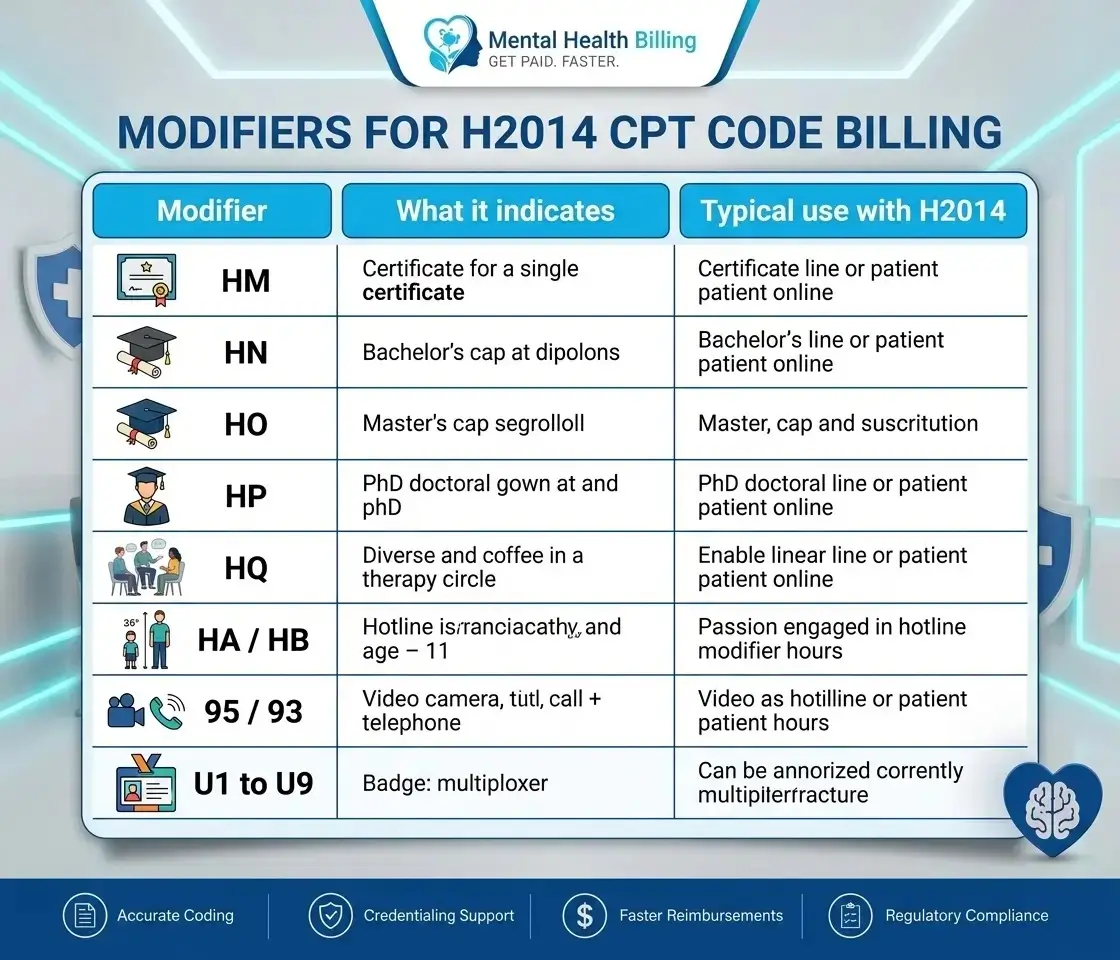
Modifiers on an H2014 claim usually communicate who delivered the service and how. Most fall into three groups: provider credential level, service setting and delivery method. The exact requirements are payer-specific and state-specific, so treat the table below as the common pattern rather than a universal rule.
Two points about modifiers matter more than the list. First, credential modifiers often change the reimbursement rate, because many Medicaid programs pay doctoral-level providers more than master’s-level and master’s more than bachelor’s. Putting the wrong credential modifier on a claim can under-pay or over-pay the service and over-payment is the version that gets recovered later. Second, telehealth modifier requirements vary by payer. Some states want modifier 95 with a specific place-of-service code; others use different combinations. The provider manual settles it.