



Understanding CPT Code 99202 for New Patient Office Visits
CPT code 99202 is one of the first codes a new biller learns, and one of the easiest to bill incorrectly. It sits at the entry level of the new patient office visit series. Yet it carries specific rules about patient status, medical decision making, and time that catch out students and seasoned coders alike.
This guide explains what 99202 covers, how the 2021 rewrite of the evaluation and management (E/M) rules changed it, who counts as a new patient, and what Medicare pays for the code in 2026. The details are worth getting right. A single misjudged element, such as counting a returning patient as new, can turn a clean claim into a denial.
What CPT code 99202 describes
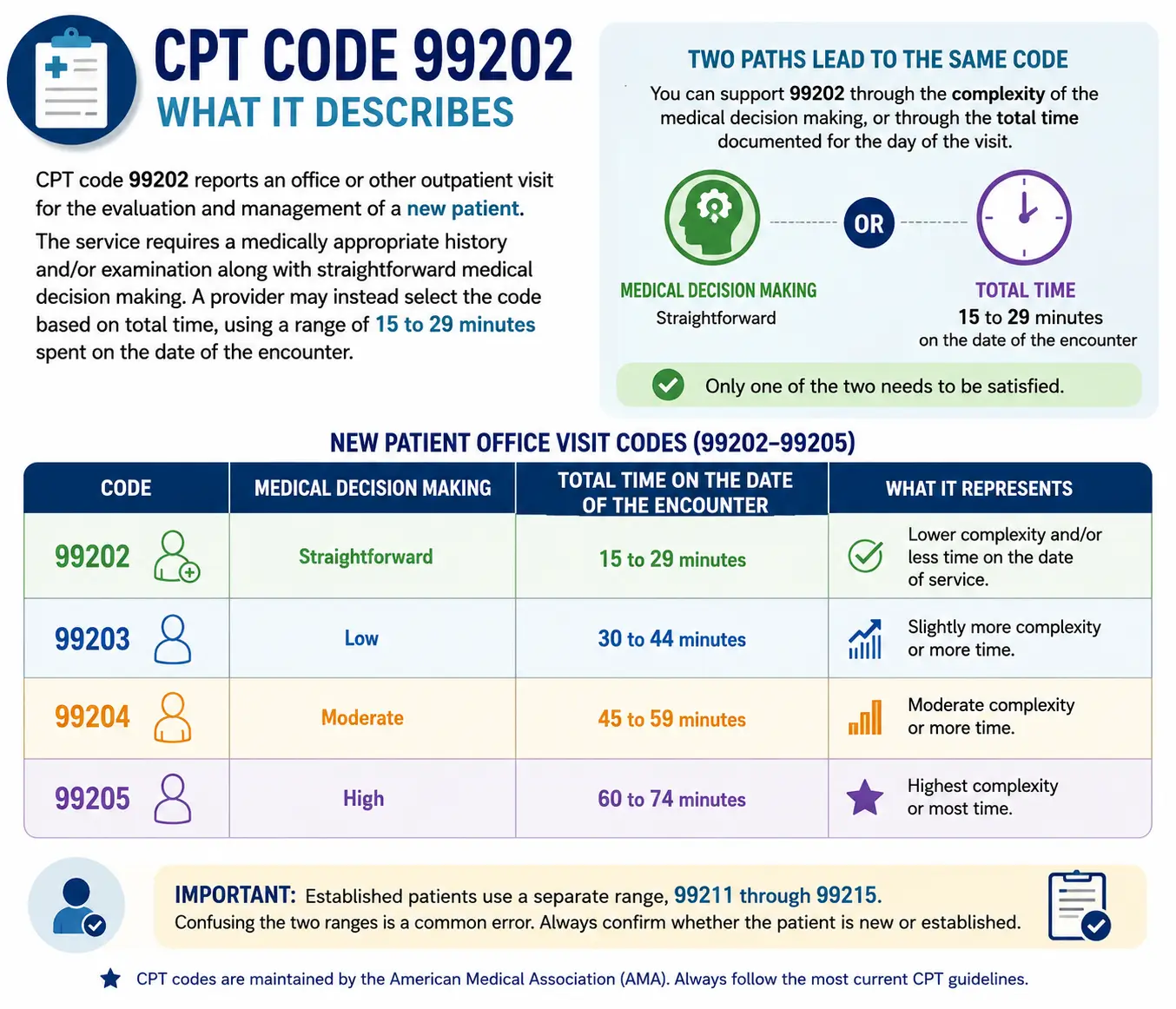
CPT code 99202 reports an office or other outpatient visit for the evaluation and management of a new patient. The American Medical Association (AMA), which owns and maintains the CPT code set, defines the service as one requiring a medically appropriate history and/or examination along with straightforward medical decision making. A provider may instead select the code based on total time, using a range of 15 to 29 minutes spent on the date of the encounter.
Two paths lead to the same code. You can support 99202 through the complexity of the medical decision making, or through the total time documented for the day of the visit. Only one of the two needs to be satisfied.
The code belongs to a family of four new patient office visit codes, 99202 through 99205. Each step up the ladder reflects greater decision-making complexity or more time on the date of service.
|
Code |
Medical decision making |
Total time on the date of the encounter |
|
99202 |
Straightforward |
15 to 29 minutes |
|
99203 |
Low |
30 to 44 minutes |
|
99204 |
Moderate |
45 to 59 minutes |
|
99205 |
High |
60 to 74 minutes |
Established patients use a separate range, 99211 through 99215. Confusing the two ranges is a common error, and the sections below explain how to avoid it.
How the 2021 overhaul reshaped the code
To read 99202 correctly today, it helps to know what changed a few years ago.
The AMA first developed and published CPT in 1966. That first edition used a four-digit system and covered mostly surgical procedures. Five-digit codes arrived with the second edition in 1970. In 1983, the Centers for Medicare and Medicaid Services (CMS) adopted CPT into the Healthcare Common Procedure Coding System and required it for billing under Medicare Part B, which cemented the code set as the standard for reporting physician services.
For most of the following decades, coders chose an E/M level by documenting three key components: history, examination, and medical decision making. Those choices were governed by the 1995 and 1997 Documentation Guidelines for Evaluation and Management Services. The system rewarded lengthy notes, and it created audit risk when the documented exam did not match the complexity of the actual visit.
That framework changed for office and outpatient visits on January 1, 2021. The AMA revised the guidelines so that history and examination, while still performed as medically appropriate, no longer determine the code level. Selection now rests on either medical decision making or total time.
The same 2021 revision deleted code 99201. Because 99201 and 99202 both described straightforward medical decision making, the lower code was redundant. Since that date, the new patient office visit series starts at 99202. Any reference guide or template that still lists 99201 as an active new patient code is out of date.
Who counts as a new patient
The word “new” has a precise meaning in E/M coding, and it is stricter than most people assume.
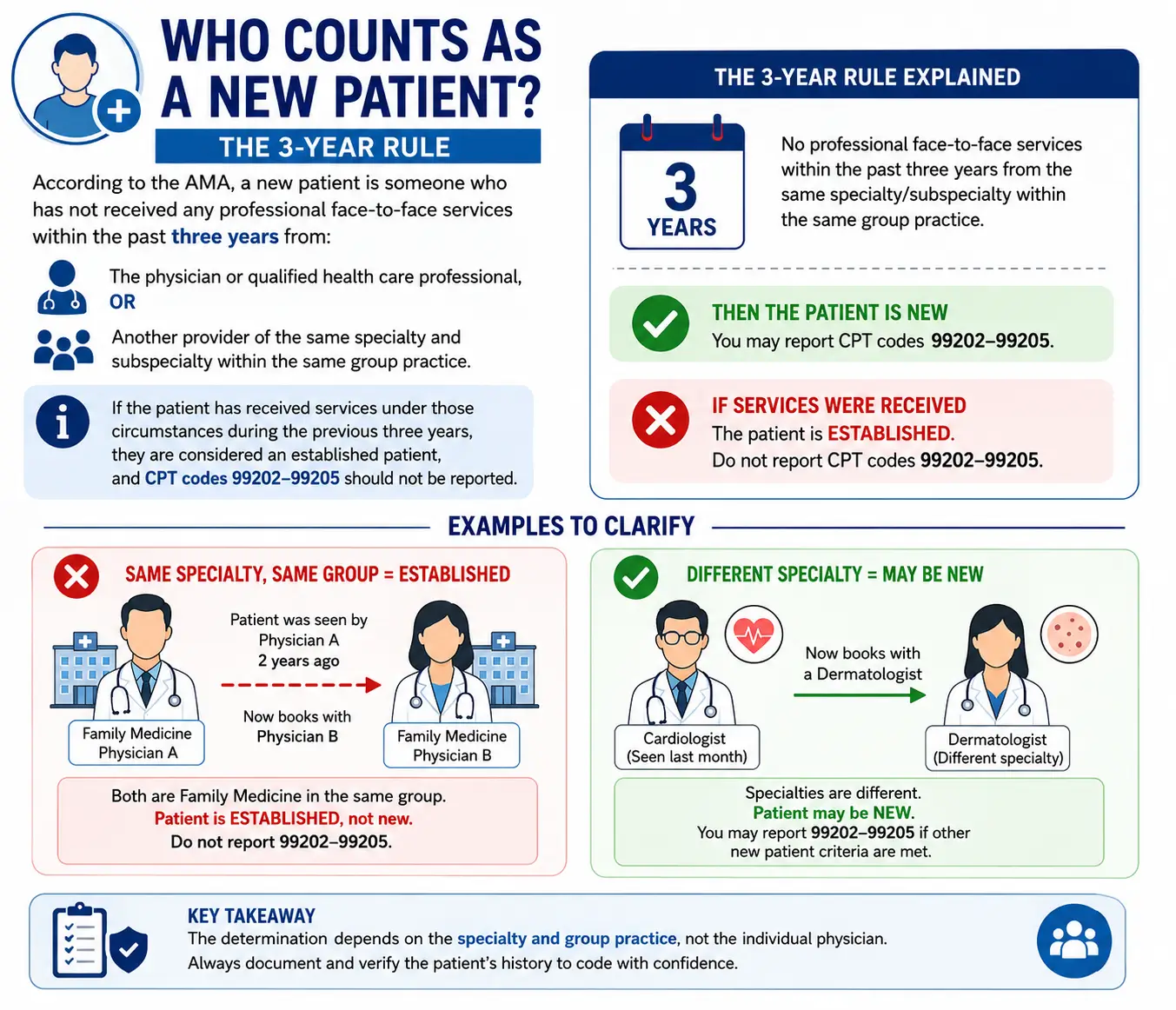
According to the AMA, a new patient is someone who has not received any professional face-to-face services within the past three years from the physician or qualified health care professional, or from another provider of the same specialty and subspecialty within the same group practice. If the patient has received services under those circumstances during the previous three years, they are considered an established patient, and CPT codes 99202–99205 should not be reported.
The three-year rule produces results that surprise providers. Consider a patient who saw a family medicine physician in a practice two years ago and now books with a different family medicine physician in the same group. That patient is established, not new, because the two physicians share the same specialty and the same group. Billing 99202 in that situation invites a denial.
The determination depends on the specialty and group practice, not the individual physician. For example, a patient who saw a cardiologist last month may still qualify as a new patient when visiting a dermatologist in the same building because the specialties are different.
Selecting 99202 by medical decision making
Medical decision making (MDM) is scored on three elements:
- The number and complexity of problems addressed at the encounter.
- The amount and complexity of data to be reviewed and analyzed, counting each unique test, order, or outside source.
- The risk of complications, morbidity, or mortality from the patient management chosen.
The level of MDM is set by meeting or exceeding two of these three elements. For 99202, all three point toward the lowest tier. Straightforward MDM generally means one self-limited or minor problem, little or no data to review, and minimal risk from the plan of care.
A concrete example helps. A healthy new patient arrives with a minor rash. The provider takes a brief history, examines the skin, orders no tests, and recommends an over-the-counter cream. That visit is straightforward, and 99202 fits on the decision-making path. Add a second active problem, a prescription medication, or a set of labs to interpret, and the encounter likely moves up to 99203 or higher.
Selecting 99202 by total time
Time offers a second, independent way to reach 99202. The rule changed in a way that many coders still miss.
Under the current guidelines, total time means all of the qualifying time the provider personally spends on the date of the encounter, both face-to-face and non-face-to-face. That includes reviewing records and results before the patient walks in, taking the history, performing the exam, counseling, ordering tests or medications, documenting in the chart, and coordinating care, as long as it all happens on that calendar day.
Some activities do not count. Time spent by clinical staff does not count toward the provider’s total. Neither does work performed on a different date. Review of medical records on another day, for instance, cannot be added to the encounter time.
For 99202, the documented total must fall between 15 and 29 minutes. Under 15 minutes, the visit does not reach 99202 on the time path, and code selection has to rest on medical decision making instead. At 30 minutes, the correct time-based choice becomes 99203. Because the ranges are narrow, the note should state the total time clearly and tie it to the date of service.
The two paths also work as a safety net for each other. If the decision making is borderline but the provider clearly spent 16 minutes on the date of service, the time path supports 99202 on its own. The reverse holds when a short visit involves straightforward decision making. Coders should check both, then bill on whichever the documentation supports.
What Medicare pays for 99202 in 2026
Medicare pays for physician services through the Physician Fee Schedule. Each code carries three relative value units (RVUs), for physician work, practice expense, and malpractice. Each RVU is adjusted by a geographic index and then multiplied by a national conversion factor to produce a dollar amount.
The CY 2026 Medicare Physician Fee Schedule final rule sets the national non-facility payment for 99202 at approximately $72 and the facility payment at approximately $46. The difference comes from practice expense. In an office, the provider absorbs overhead such as rent, staff, and equipment, so the practice expense RVUs are higher. In a hospital outpatient department, the facility carries that cost, and the provider’s payment drops.
Among the new patient codes, 99202 carries the lowest physician work RVU, at 0.93. For comparison, the AAPC-published work RVU for 99205 is 3.17, more than three times as high, which shows how much revenue is lost when a complex visit is undercoded to this level.
Two changes for 2026 are worth flagging for anyone forecasting revenue:
- For the first time, CMS established two conversion factors. Physicians who are qualifying Advanced APM participants use $33.5675, while all other physicians use $33.4009. The gap traces to statutory updates, including a 2.5 percent one-time increase for 2026 provided by the One Big Beautiful Bill Act. Practices need to confirm which factor applies to their billing entity before projecting collections.
- CMS applied a 2.5 percent efficiency adjustment that reduced work RVUs for many services in 2026. Time-based E/M codes, including 99202, were exempt from that reduction. A separate methodology change raised indirect practice expense RVUs for non-facility settings by roughly 4 percent and lowered facility settings by about 7 percent, so office-based billing of this code saw a small increase while hospital-based billing saw a decrease.
Published amounts are national averages. Actual payment varies by locality, running roughly $63 to $88 for the non-facility rate across Medicare Administrative Contractor regions. Commercial payers usually reimburse above Medicare, while Medicaid rates for the code range from about $35 to $75 depending on the state.
Documentation that supports the code
A 99202 note should let an auditor reconstruct the visit without guessing. At a minimum, include:
- The reason for the visit and the presenting problem.
- A medically appropriate history and examination.
- The straightforward decision making, including any diagnosis reached and any test or treatment ordered.
- If the code is chosen on time, the total time and a statement that it reflects work on the date of service.
- Confirmation that the patient meets the new patient definition.
The last item is easy to skip and expensive to omit. A short line noting that the patient has not been seen by the practice or specialty in three years can save an appeal later.
Common reasons 99202 claims get denied
A handful of mistakes account for most rejected 99202 claims:
- New patient misclassification. The patient was seen by the same specialty and group within three years, making the visit established.
- Time billed without minutes. The provider selected the code on time but did not record the total, so the payer cannot verify the 15 to 29 minute range.
- MDM and code mismatch. The documented complexity supports a different level than the one billed, in either direction.
- Missing modifier 25. A separately identifiable E/M service was performed on the same day as a minor procedure, but the modifier that signals it was left off.
Each of these is preventable with a quick check before the claim goes out.
Applying the code correctly
CPT code 99202 reports a new patient office or outpatient visit that involves straightforward medical decision making, or 15 to 29 minutes of total time on the date of the encounter. It has anchored the bottom of the new patient series since 99201 was deleted on January 1, 2021, and it can be selected on either the decision-making path or the time path. The new patient definition rests on a three-year lookback tied to specialty and group, which is the element most likely to cause a denial. In 2026, Medicare pays roughly $72 for the code in a non-facility setting and about $46 in a facility, with the exact figure shaped by geography and by which of the year’s two conversion factors applies. Get the patient status, the decision making, and the time right, and 99202 is one of the most straightforward codes to bill accurately.