


96127 CPT Code for Depression Screening: Rules, Guidelines, and Best Practices
A completed depression questionnaire does not automatically support a separate claim. The instrument, documented score, reason for the assessment, and patient’s insurance all affect billing.
The 96127 CPT code describes a brief emotional or behavioral assessment using a standardized instrument, with scoring and documentation. Depression screening is one application, but the code also covers assessments of other emotional and behavioral concerns. Medicare’s annual preventive depression screening generally follows a different billing pathway, using G0444.
For healthcare providers and medical billing students, the key is to distinguish three essential questions: What service was actually performed? Does the record support it? Will the payer reimburse it separately?
What does the 96127 CPT code cover?
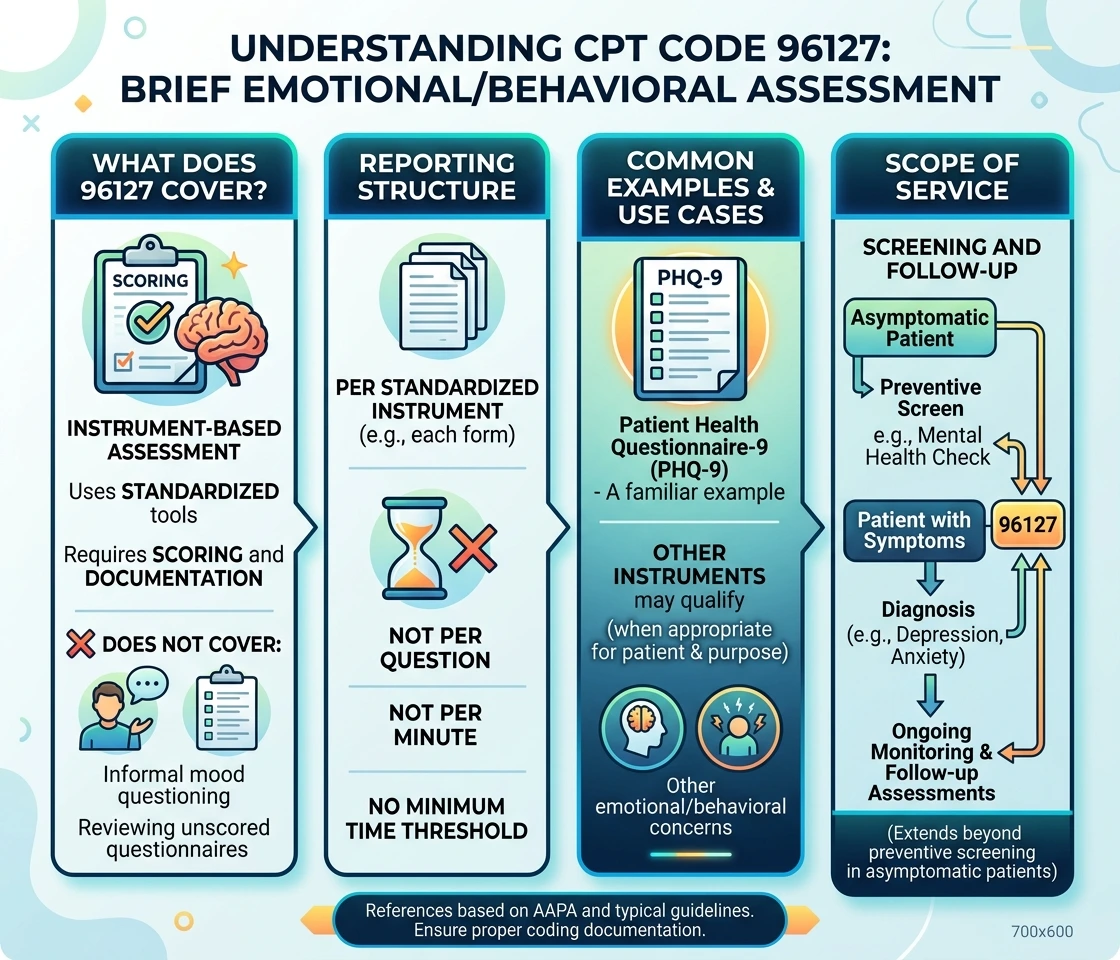
CPT 96127 applies to an instrument-based assessment. Asking a patient informally about mood, recording “depression screen completed,” or reviewing an unscored questionnaire does not establish the same service.
The code’s reporting structure is per standardized instrument, rather than per question or per minute. Its descriptor does not establish a minimum time threshold. The standardized assessment, scoring, and documentation define the service.
A familiar example is the Patient Health Questionnaire-9, or PHQ-9. Other emotional and behavioral instruments may qualify when appropriate for the patient and purpose.
In “Getting Paid for Screening and Assessment Services,” published by the American Academy of Family Physicians in FPM in November/December 2017, Cindy Hughes, CPC, CFPC, explains that 96127 can describe both screening and follow-up assessment of emotional or behavioral conditions. Its scope therefore extends beyond preventive screening in patients without symptoms.
That distinction affects diagnosis selection and coverage. A questionnaire used to monitor established depression serves a different purpose from one administered during an asymptomatic patient’s preventive visit.
Clinical screening recommendations and billing frequency
The U.S. Preventive Services Task Force’s June 20, 2023 recommendation, “Depression and Suicide Risk in Adults: Screening,” recommends depression screening for adults, including pregnant, postpartum, and older adults. It assigns a Grade B recommendation.
The recommendation applies to people without a diagnosed mental health disorder or recognized symptoms of depression. Patients with positive results need further evaluation and, when appropriate, treatment or referral. A questionnaire score by itself is insufficient to confirm a diagnosis.
The task force found insufficient evidence to specify an optimal screening interval. Repeat screening decisions should consider clinical circumstances, risk factors, and life events.
A clinical recommendation does not establish a payer’s frequency allowance. Build separate checks into the workflow for clinical need and insurance eligibility instead of assuming every recommended assessment will generate a separate payment.
96127 versus G0444 for depression screening
These codes overlap in subject matter but have different reporting frameworks.
|
Feature |
CPT 96127 |
HCPCS G0444 |
|
Service |
Brief standardized emotional or behavioral assessment |
Annual depression screening |
|
Reporting structure |
Per instrument |
Annual preventive screening service |
|
Time description |
No specified minimum in the descriptor |
Current descriptor specifies 5 to 15 minutes |
|
Scope |
May include screening or follow-up assessment |
Medicare preventive depression screening benefit |
|
Coverage considerations |
Payer-specific benefits and edits |
Medicare setting, frequency, and support requirements |
CMS lists G0444’s 5-to-15-minute descriptor in its April 29, 2025 Transmittal 13199.
Under CMS National Coverage Determination 210.9, effective October 14, 2011, Medicare covers annual depression screening in primary care settings with staff-assisted depression care supports. Those supports include staff who can communicate results and coordinate referrals. The benefit does not include depression treatment, and the Part B deductible and coinsurance are waived for the covered screening.
Do not report both codes for the same screening work.
There is also a documentation nuance. In its February 21, 2025 guidance, “Is time documentation required for Medicare depression screenings?”,The American Medical Association notes that neither the applicable CMS manual nor the national coverage determination requires documentation of the exact time spent performing G0444. Avoid automatically converting the descriptor into a universal stopwatch-documentation requirement.
Documentation that supports the assessment
A useful assessment record should identify:
- The instrument used and assessment date.
- The patient and, when applicable, the person supplying responses.
- The completed score.
- The person administering the instrument.
- Clinician review and discussion of the findings.
Hughes’ 2017 FPM article describes these documentation elements and notes that some payers require a separate report.
For internal quality control, also document why the assessment occurred and the resulting plan. This helps a reviewer distinguish routine screening from symptom evaluation or treatment monitoring.
Consider this illustrative entry:
PHQ-9 completed and scored today. Total score: 12. Clinician reviewed responses and discussed symptoms and functional concerns. Further diagnostic evaluation and follow-up arranged.
This example shows the structure of a useful entry, not a complete clinical note. Actual documentation should reflect the patient’s responses, clinical findings, and actions taken. Never populate a follow-up plan automatically when no such plan was discussed.
Choosing the correct diagnosis code
Z13.31 identifies an encounter for depression screening. It fits preventive screening when the patient does not have symptoms prompting the assessment.
An assessment ordered because of depressive symptoms requires diagnosis coding that reflects the documented circumstances. Likewise, monitoring an established disorder should not automatically be labeled preventive screening.
The AAFP’s May/June 2020 FPM “Coding & Documentation” guidance distinguishes asymptomatic screening from assessments prompted by symptoms and identifies Z13.31 for depression screening.
A positive questionnaire should trigger clinical review, not an automatic major depressive disorder code. The USPSTF’s 2023 recommendation expressly calls for further diagnostic evaluation after a positive screen.
A practical safeguard is to keep questionnaire scoring separate from diagnosis assignment in the EHR. Allow the clinician’s assessment to determine the diagnosis rather than mapping every positive score to the same condition.
Units and multiple instruments
The AAFP’s 2020 guidance describes reporting one unit of 96127 for each completed instrument, using PHQ-9 and GAD-7 assessments as an example. Each instrument needs its own score and documentation.
For example, a patient may complete a depression instrument and a separate anxiety instrument during one encounter. Two units may be supportable, subject to the payer’s rules.
Do not translate that example into a universal daily allowance. Check the payer’s current unit limits, medical necessity requirements, and claim-line instructions. CMS explains in its Medicare NCCI FAQ Library that medically unlikely edits address units of service and operate separately from procedure-to-procedure edits.
For a PHQ-2 followed by a PHQ-9, avoid automatically generating two charges. Review how the payer treats that sequential screening workflow before configuring billing automation.
Modifier 25 and modifier 59
Modifier selection should follow the services documented and the applicable edit.
Modifier 25 belongs on the E/M service
When a significant, separately identifiable evaluation and management service accompanies a procedure or assessment, modifier 25 may be appropriate on the E/M code.
The American Academy of Pediatrics’ 2025 clinical report, “Promoting Optimal Development: Screening for Mental Health, Emotional, and Behavioral Problems,” discusses reporting standardized assessments with E/M services and using modifier 25.
Do not attach modifier 25 to 96127. Also, a questionnaire alone does not establish the level of a separately reported office visit.
Modifier 59 is not an automatic addition
CMS’s “Proper Use of Modifiers 59, XE, XP, XS, and XU” guidance explains that modifier 59 identifies qualifying distinct services that ordinarily are not reported together.
Its use requires an applicable circumstance and supporting documentation. Adding it routinely to every 96127 claim, or simply because two instruments were administered, is not a defensible default. Check the actual code pair and whether the edit permits a modifier.
Avoid double-counting E/M time
Cindy Hughes addresses this issue in the November/December 2021 FPM “Coding & Documentation” column.
When reporting 96127 separately, time spent administering the instrument, calculating its score, and documenting that score should not also count toward a time-based E/M service. The clinician’s work reviewing and interpreting the result in the context of the patient’s presentation may count toward E/M time.
For example, distinguish questionnaire administration from subsequent clinical discussion about symptoms, treatment response, or management options. An EHR template should make those activities identifiable without copying the same minutes into both services.
Reimbursement checks and denial prevention
A code definition does not guarantee separate reimbursement. Before placing 96127 into an automated charge workflow, create a payer reference containing:
- Covered assessment purposes and eligible provider types.
- Frequency and unit limits.
- Accepted diagnosis and modifier combinations.
- Same-day service restrictions.
- Contracted payment and documentation requirements.
Date each entry and identify the policy used. This makes future updates easier to trace.
For denied claims, review the explanation of benefits before changing anything. A units denial requires a different investigation from a bundled-service denial or a missing-documentation request. Preserve the original clinical facts; do not substitute a screening diagnosis merely to obtain payment.
During periodic audits, compare the claim with the actual instrument and score. A checked EHR box should prompt verification, especially if the underlying questionnaire cannot be found.
A practical standard for accurate billing
Use the 96127 CPT code when the record supports a standardized emotional or behavioral assessment with scoring and documentation. Match the diagnosis to its purpose, verify payer limits, and keep separately reported work distinct.
For Medicare annual depression screening, evaluate G0444 under its preventive benefit rules. Across both pathways, the record should explain what was completed and what the clinician did with the result.